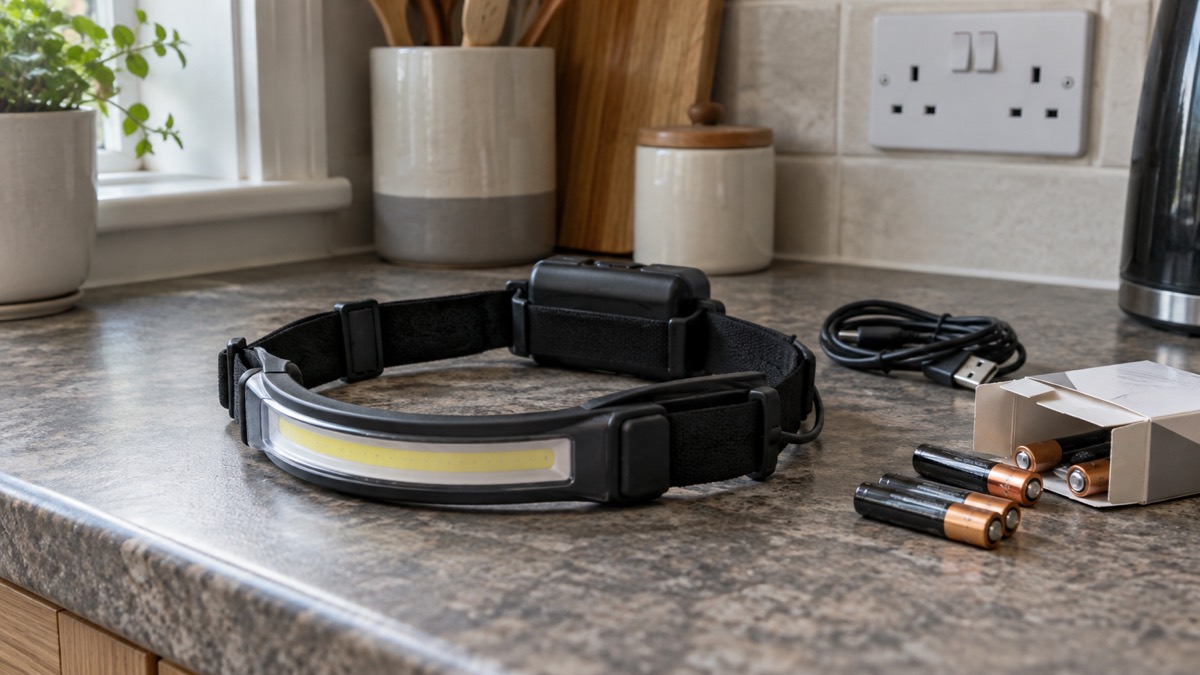
The NEBO Curvbeam 600 Flex is a rechargeable head torch that puts a narrow spot beam and a wide 180 degree flood beam on your head, so both hands stay free. It reaches a maximum of 600 lumens with the spot and flood running together, weighs 124g and carries an IPX4 rating, which the maker describes as water and impact resistant1. For a household, that combination suits two jobs: lighting a room or a stairwell during a power cut, and lighting the work in front of you, such as a fuse box, a meter cupboard or a path in the dark.
The feature that matters most in an emergency is how it is powered. The Curvbeam 600 Flex runs on the included rechargeable battery, or on three AAA size alkaline batteries if the battery is flat and there is no power to charge it2. That gives you a fallback that most rechargeable head torches do not have. Run times range from 1.5 hours on Spot High to 10 hours on Spot Low, so the mode you choose decides whether the light lasts an evening or most of a night1.
This page sets out the specifications, what each of the six modes does and how long it runs, how to charge the battery and read the charge lights, and how to use and store the lamp safely. It is a page about one product, not a comparison, and it gives no prices.
What the Curvbeam 600 Flex is and who it suits
The maker describes the Curvbeam 600 Flex as a headlamp that combines a powerful spot light with an ultra-wide 180 degree flood beam in a comfortable design2. Those are two different kinds of light in one unit. The spot throws a narrow beam a long way, up to 96 metres on Spot High, which is what you want for checking a garden, a driveway or a route ahead1. The flood spreads light across a wide arc close to you, which is what you want for reading, cooking, changing a fuse or moving around a room without a torch in your hand.
The lamp is built from aluminium, TPR and ABS polymer, and the maker positions the battery at the back of the head rather than the front, which it calls BackBalance Fit and says gives better weight displacement for a more secure fit2. At 124g it is light enough to wear for a long evening2. The maker also fits Smart Power Control, which it says automatically adjusts light output based on remaining battery charge, and Direct-to-Low, which lets you start on the lowest setting rather than cycling through brighter ones2.
Who it suits: a household that wants one head torch that can light a room during a power cut and also be worn for practical jobs in the dark, and that values being able to fall back on ordinary AAA batteries. If you are choosing between a head torch and a hand torch, our page on torch or head torch for a power cut sets out the trade-offs, and the wider head torches guide covers the type as a whole.
Specifications
The figures below are the maker's own, from its product pages1. Where a retailer lists the same product, its listing describes an adjustable elastic headband, which matches the maker's description of an adjustable head strap4.
| Specification | Figure |
|---|---|
| Maximum output | 600 lumens (180 degree flood plus spot)1 |
| Light modes | 62 |
| Weight | 124g2 |
| Dimensions | 250mm long x 45mm wide x 50mm high2 |
| Water and impact rating | IPX42 |
| Battery | 1x 1,100mAh lithium-ion 802938, 3.7v, included2 |
| Alternative power | Three AAA size alkaline batteries2 |
| Construction | Aluminium, TPR and ABS polymer2 |
| Charging cable | USB-A to USB-C, included2 |
| Head strap | Adjustable, one size fits all2 |
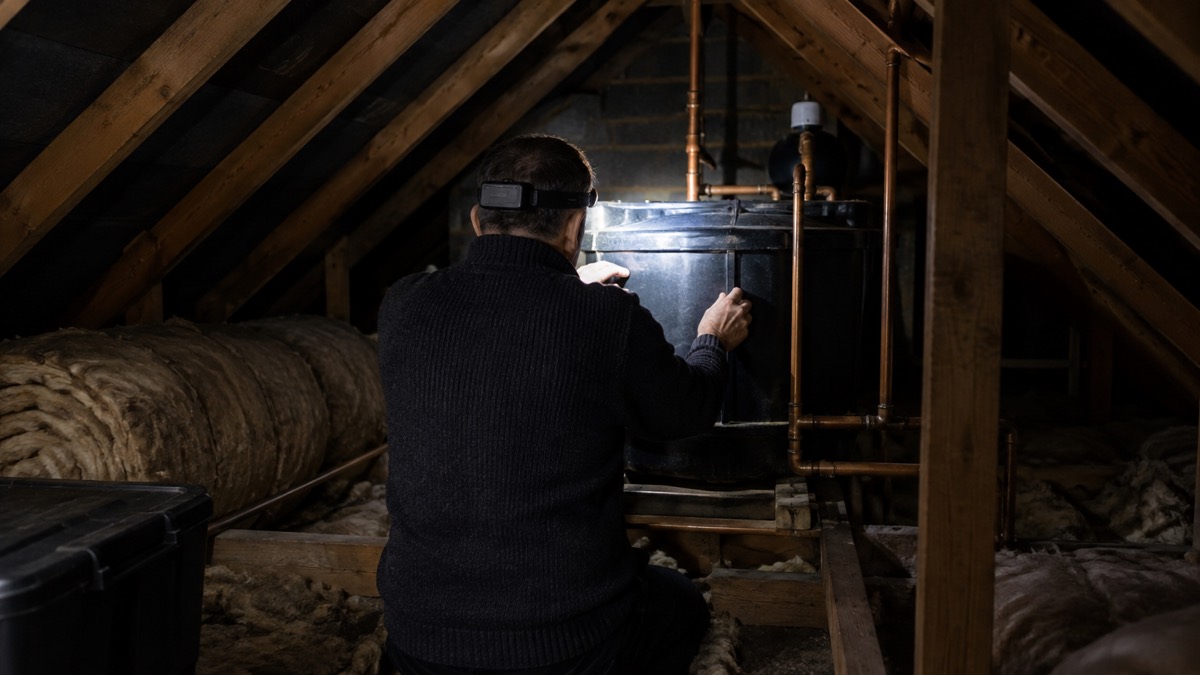
The IPX4 rating is worth understanding before you rely on it. The maker states that while the lamp is not fully waterproof, IPX4 devices can withstand everyday moisture exposure, with protection against water splashes from any direction1. That covers rain and splashes. It does not mean you can submerge the lamp. Our page on what IPX ratings mean explains the scale.
Six light modes and how to switch between them
The Curvbeam 600 Flex has six light modes: Spot High, Spot Medium, Spot Low, 180 degree High, 180 degree Low, and 180 degree plus Spot2. There are two rear-positioned buttons, one for the spot light and one for the flood light, and the maker says to press the Flood Light or Spot Light button repeatedly to cycle through the modes2.
The order is fixed. On the spot side the sequence runs High, then Medium, then Low, then Off. On the flood side it runs High, then Low, then Off2. Because the two sides have separate buttons, you can run the flood and spot together, which is how you reach the full 600 lumens2.
| Mode | Output | Run time | Beam distance |
|---|---|---|---|
| Spot High | 500 lumens | 1.5 hours | 96 metres1 |
| Spot Medium | 150 lumens | 5.5 hours | 53 metres1 |
| Spot Low | 30 lumens | 10 hours | 23 metres1 |
| 180 degree High | 300 lumens | 2 hours | 18 metres1 |
| 180 degree Low | 100 lumens | 4 hours | 11 metres1 |
| 180 degree plus Spot | 600 lumens | 1.5 hours | 92 metres2 |
A practical way to use the modes in a power cut is to start on a low flood setting for moving around the house, switch to the spot only when you need to see something at a distance, and save the combined 600 lumen mode for short bursts. The maker's Direct-to-Low feature supports this, letting you go straight to the lowest setting rather than stepping through brighter ones2. If you want to understand what lumens and beam distance actually mean for a household, our explainer on lumens, beam distance and run time covers it.
Run time: from 1.5 hours on Spot High to 10 hours on Spot Low
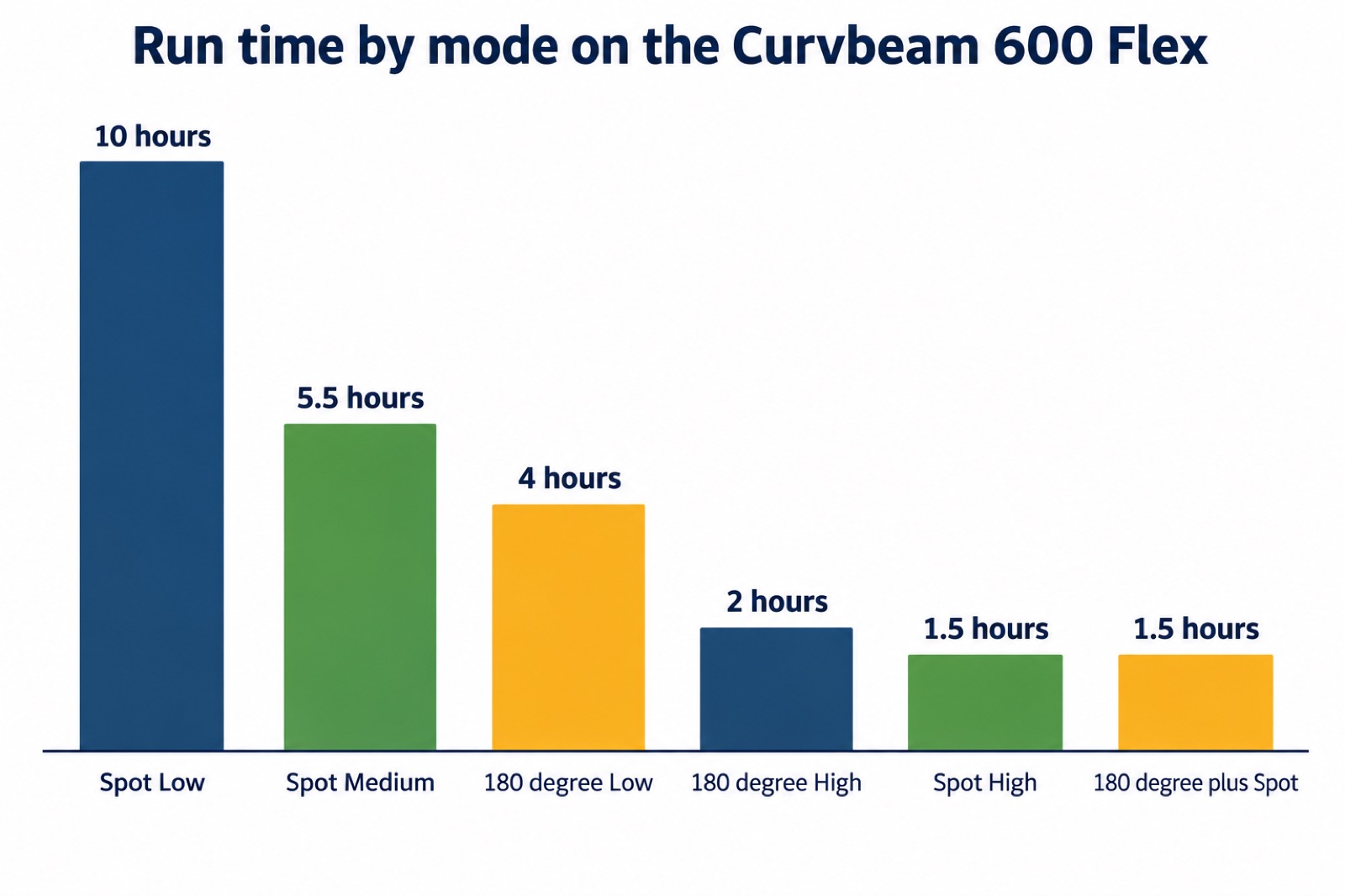
Run time is the figure that decides whether a head torch is useful in a long power cut, and on this lamp it varies by a factor of more than six depending on the mode. The maker gives 1.5 hours on Spot High at 500 lumens and 10 hours on Spot Low at 30 lumens1. In between, Spot Medium at 150 lumens runs for 5.5 hours, the 180 degree flood runs for 2 hours on High at 300 lumens and 4 hours on Low at 100 lumens, and the combined 600 lumen mode runs for 1.5 hours1.
The pattern is simple: the brighter the setting, the shorter the run. That is true of any torch, and our page on how long a torch battery lasts on low explains why. For a household, the practical consequence is that the low settings are the ones to plan around. Ten hours on Spot Low is enough to cover an evening and into the night on a single charge, while 1.5 hours on the brightest setting is a short burst for checking something outside or signalling.
Two things affect these figures in practice. The first is temperature and battery condition: a cold battery holds less charge, so a lamp left in a cold shed may not deliver its full run time. The second is Smart Power Control, which the maker says automatically adjusts light output based on remaining battery charge3. That means the beam may step down as the battery empties rather than cutting out without warning, which is helpful in an emergency but means the quoted output is not held flat for the whole run.
Flex power: the rechargeable battery or three AAA batteries
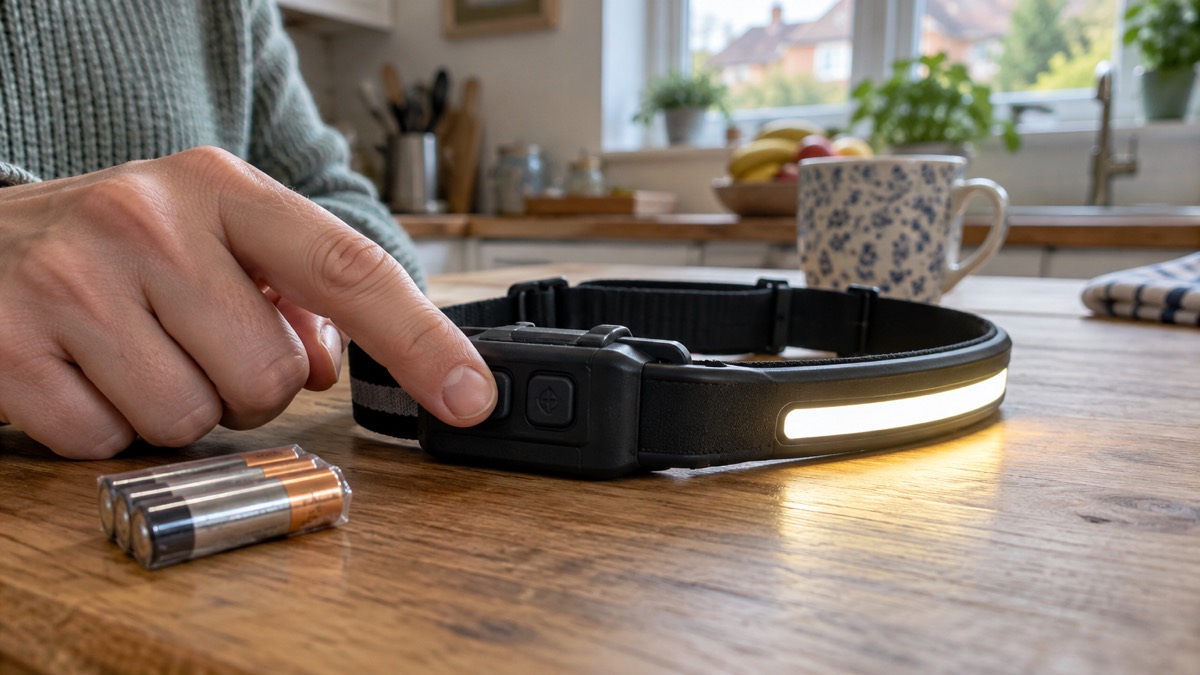
The Flex in the name refers to the power source. The maker states that the headlamp operates with the included rechargeable battery, or with three AAA size alkaline batteries2. To fit the AAA cells, you unclip the back of the power pack, insert the three AAA alkaline batteries and replace the back2. The maker's general guidance for its Flex Power lights is to use either rechargeable batteries or standard alkaline cells5.
That flexibility matters for a household preparing for a power cut. A rechargeable battery is the better everyday option: it costs nothing to run and recharges from a USB port. But if the power is out for long enough that you cannot recharge, three AAA cells are widely available and easy to store. Our page on torch batteries explains the different types, and the spare batteries checklist helps you decide what to keep at home.
The rechargeable battery is a single 1,100mAh lithium-ion 802938 cell rated at 3.7 volts2. That is a modest capacity, which is why the brightest modes run for a relatively short time. Keeping a spare set of three AAA alkaline batteries in the house gives you a second full run of the lamp without needing mains power.
Charging the battery and reading the charge lights
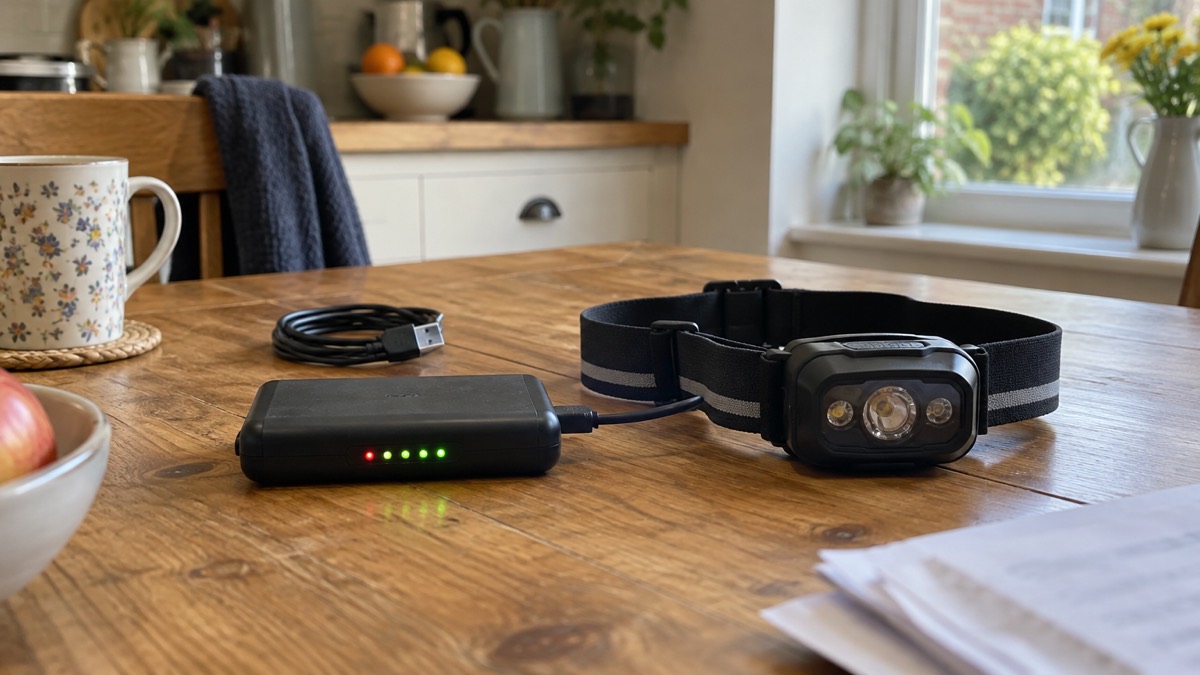
Charging is done through the battery itself. The maker's instruction is to insert the USB-C cable into the battery port and connect it to a power source, using the included USB-A to USB-C charging cable2. In other words, you remove the battery from the power pack, plug the cable into the port on the battery, and connect the USB-A end to a charger, a computer or a power bank.
The charge indicator tells you what is happening. The maker states that a solid red light means charging, a solid green light means 100% charged, and once charged, each red light indicates the level of charge remaining1. So the same lights serve two purposes: during charging they show progress, and afterwards they show how much charge you have left before you head out.
A few practical points follow from this. Charge the battery fully before you store the lamp, and check the indicator lights periodically so you know the state of charge without having to switch the lamp on. If you are charging from a power bank during a power cut, our page on charging and storing rechargeable torches safely covers the general principles, and can the wrong USB charger damage a torch battery answers a common question about chargers.
Using it safely and keeping it ready
The Curvbeam 600 Flex is a light, not a toy, and the maker's safety instructions are worth reading before you hand it to a child. The main risks are eye exposure at close range and heat. The maker says not to shine the light directly in someone's eyes, to look away immediately if it happens, not to use magnifying instruments that could concentrate the beam, and to keep the lamp away from heat, hot surfaces, sparks and open flames, not to incinerate it, and to use it only for its intended purpose2. Our page on whether it is safe to look into a bright torch explains why a 600 lumen beam deserves care, and torches, candles and children covers keeping younger members of the household safe.
For a household preparing for a power cut, the sensible routine is to keep the lamp charged, keep a set of three AAA alkaline batteries with it, and store it somewhere you can find in the dark. Our power cut checklist and where to keep torches so you can find them in the dark help with that. If you are lighting a room rather than working, a lantern may suit better, and our comparison of lantern or torch explains which lights a room better.
If your home is at risk of flooding, the official advice for contact with flood water is to wear rubber boots and gloves6. A head torch is useful here because it leaves both hands free while you do that. Our page on what to do in a flood and the wider emergency lighting section cover the household side.
Support, spares and the rest of the NEBO range
The Curvbeam 600 Flex is made by NEBO, whose range includes head torches, hand torches and lanterns. If you are comparing this lamp with others in the range, the NEBO Galileo Tempest 350 is a lantern rather than a head torch, and the NEBO Torchy 600 Flex is a hand torch that shares the Flex power idea. Neither is a substitute for the Curvbeam if you want your hands free, but they show how the range fits together.
On support, the maker's product pages carry the specifications and instructions reproduced here1. Keep the charging cable with the lamp, since it is a USB-A to USB-C cable and a different cable may not fit the battery port. If you need to replace the battery, the maker's specification is a 1,100mAh lithium-ion 802938 at 3.7 volts2, and it is worth matching that exactly rather than substituting a different cell.
Sources (6)
- Curvbeam 600 Flex, NEBO Tools, 2026-10-25
- Curvbeam 600 Flex product page, NEBO Tools, 2026-10-26
- Galileo Tempest 350, NEBO Tools, 2026-10-25
- Torches, Screwfix, 2026-10-25
- Lighting technology, NEBO Tools, 2026-10-25
- What to do in a flood, Wiltshire and Swindon Prepared, 2026-10-25

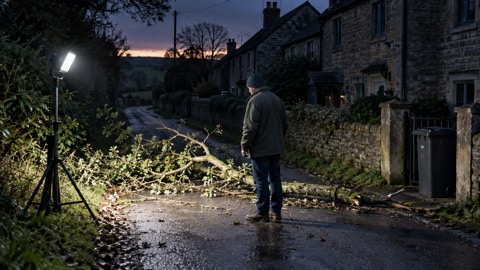 NEBO 8K Flood Light
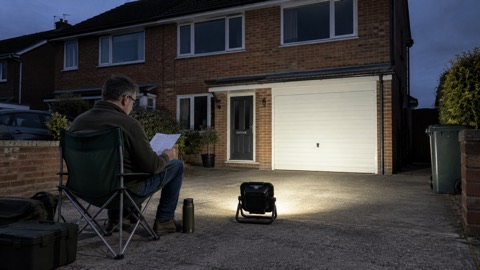 NEBO 5K Floodlight