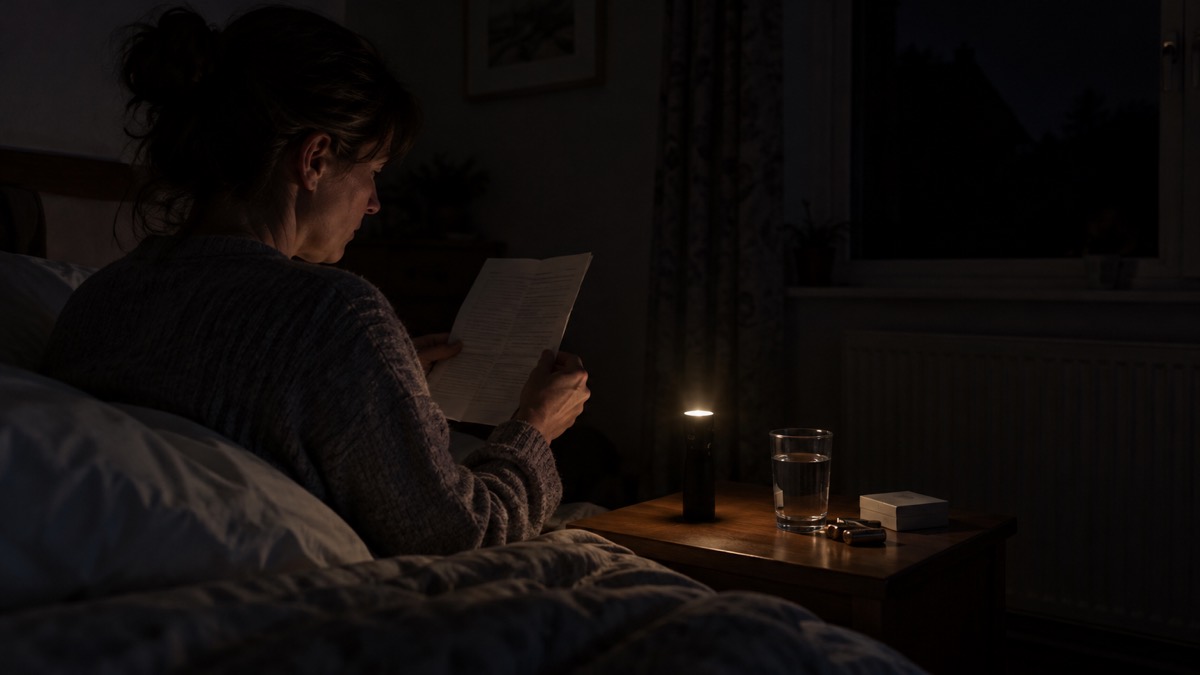
A torch on its low setting can run for days rather than hours. The maker Ledlenser states that its P6R rechargeable torch gives up to 65 hours of runtime at low power, which is 25 lumens with a 45m beam, against 20 hours on the smaller P5R1. A head torch from GP Batteries is listed by its maker with a maximum runtime of up to 69 hours2. So the honest answer to how long a torch lasts on low is: long enough to see you through almost any power cut, provided the batteries are charged and you can find the torch in the dark.
That last point is the one that catches people out. Official guidance is consistent that you should keep a battery or wind-up torch and spare batteries at home, and that torches are safer than candles. The practical work is not buying an expensive torch; it is deciding where it lives, checking it before winter, and having a second way to make light that does not depend on a battery at all.
This page covers how long torches actually run, why a battery torch and a wind-up torch together are the safest combination, why candles are the thing to avoid, and how to charge and store rechargeable torches without creating a fire risk.
Keep a torch and spare batteries where you can reach them in the dark
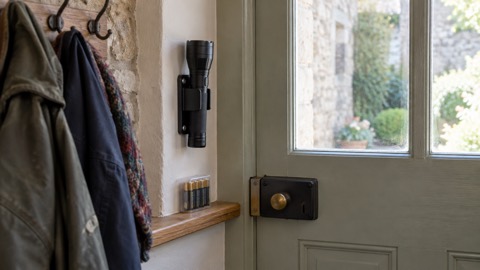
The first decision is not which torch to buy but where it lives. Official guidance says to keep a torch with spare batteries in an accessible location4. Anglesey council's winter advice is more specific: store a battery or wind-up torch somewhere you can access easily, so you can use it to check on the fuse box and make your way around the house safely3. A torch in a cupboard under the stairs, behind the Christmas decorations, is not accessible in a power cut.
The second decision is who knows about it. Guidance for households says everyone in the home should know where the torches are kept, so the nearest person can retrieve them and then safely help others6. That matters most at night, when a power cut wakes the house and people are moving around in the dark.
A few practical points follow from this:
- Keep one by the bed and one downstairs. The bedside torch is for getting up safely; the downstairs torch is for checking the fuse box and finding the rest of the kit.
- Keep the spares with the torch, in an accessible place. Keep a torch with spare batteries in an accessible location, and if the torch is battery operated, make sure you have spare batteries7.
- Do not rely on your phone. Most of us have a torch on our mobiles, but official guidance warns this drains the battery heavily, so use it only in emergencies and for short periods7. Your phone is your link to help and information; you do not want to flatten it lighting a corridor.
- Tell children where it is and how to switch it on, without letting them play with it as a toy.
If you want to go further on placement, there is a dedicated guide to where to keep torches so you can find them in the dark.
Battery or wind-up torch: why both are the safest light in a power cut
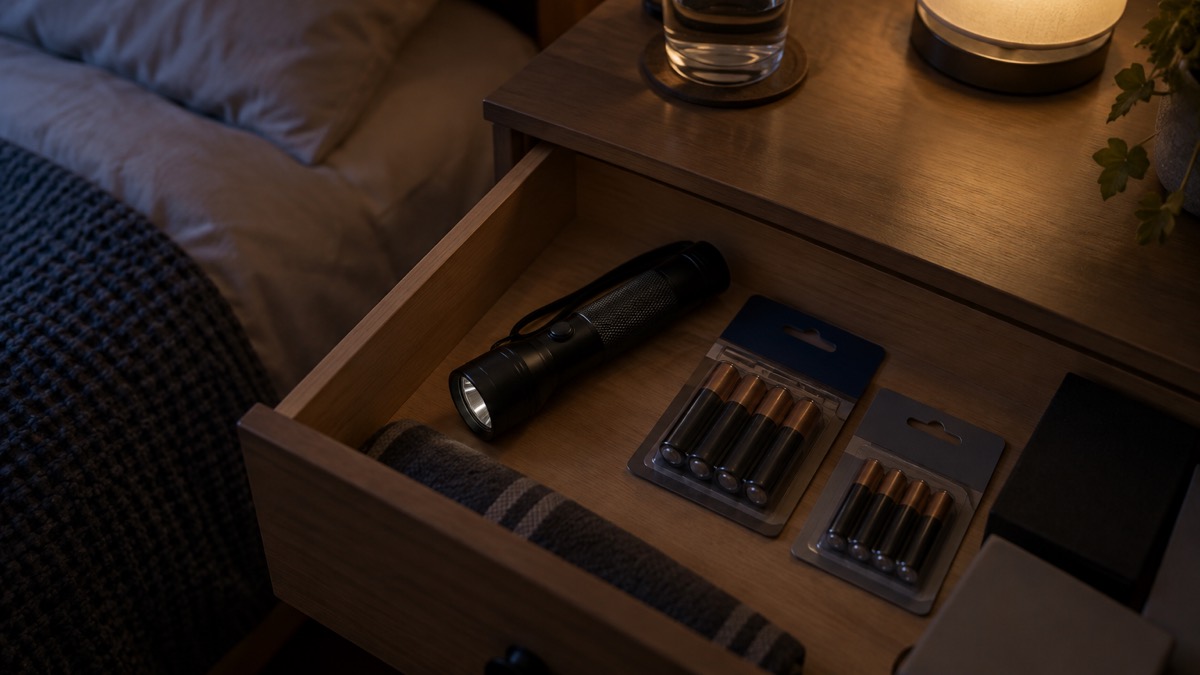
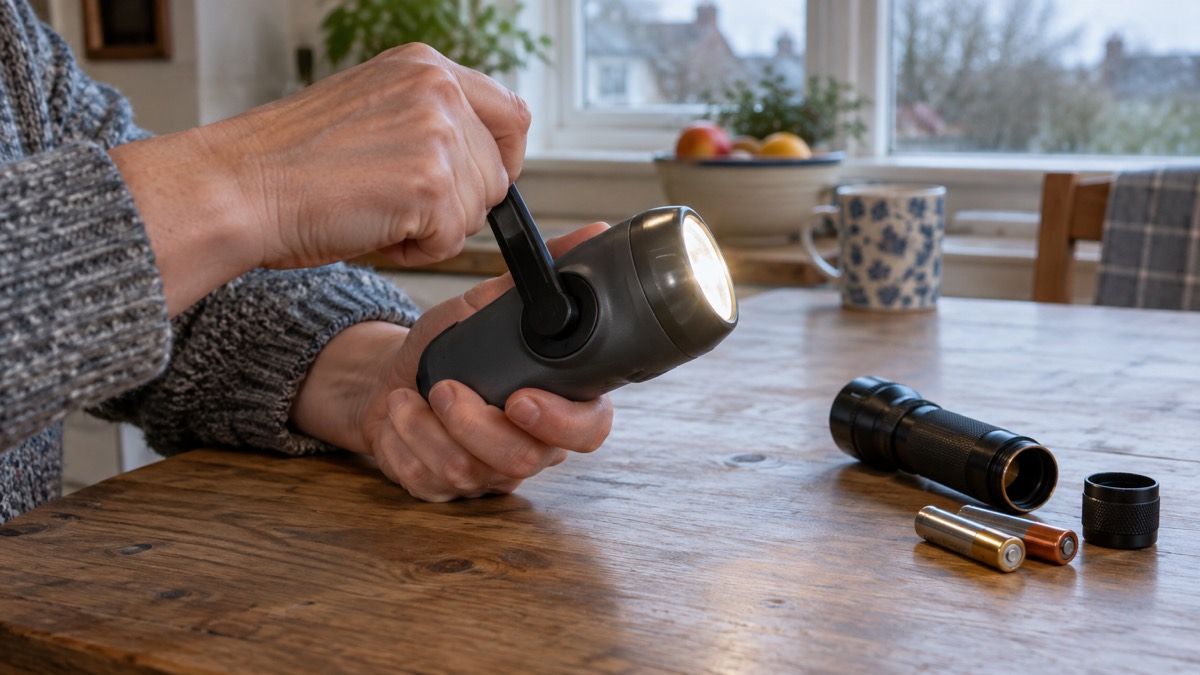
Official guidance does not ask you to choose between a battery torch and a wind-up torch. It asks you to have either, plus spare batteries. The reason to have both is that they fail in different ways. A battery torch is bright and convenient but goes dark when the cells run out. A wind-up torch needs no batteries at all, so it keeps working as long as you can keep winding it.
The case for the wind-up torch is strongest when an outage drags on. Wiltshire and Swindon's guidance calls a handheld wind-up torch inexpensive and says it gives you confidence to move around your home during a dark winter night. The Met Office winter car kit advice makes the same point for vehicles: a large torch with spare batteries or a wind-up torch which doesn't require battery power is essential8.
The case for the battery torch is brightness and ease. A rechargeable torch on low will run for days, and on high it will light a room properly for the minutes you need to find something. A wind-up torch is typically dimmer and needs regular winding, so it suits moving around and checking things rather than sustained work.
| What you need it for | Battery torch | Wind-up torch |
|---|---|---|
| Finding your way around the house | Good, bright | Good, no batteries needed |
| Checking the fuse box | Good | Good3 |
| A long outage with no spare cells | Runs out | Keeps working as you wind |
| Lighting a room for a task | Good on high | Dimmer, needs winding |
| Stored for months unused | Check batteries before winter | Ready when needed |
A third option worth knowing about is a battery-powered light that plugs into a power socket and comes on automatically during a power cut9. These are not a substitute for a handheld torch, but they mean you are not fumbling in the dark at the moment the lights go out. There is more on these in the guide to power failure lights and rechargeable emergency bulbs.
Why a torch is safer than candles: 850 house fires in England in a year
The single strongest reason to reach for a torch rather than a candle is the fire record. North Yorkshire Fire and Rescue Service puts the national figure at over 800 fires in UK homes every year10. In Devon and Somerset, the fire service attends over 20 fires every year caused by candles11.
Against that, the fire services are blunt. Official guidance says to keep a battery or wind-up torch and spare batteries at home, and that torches are safer than candles. Devon and Somerset Fire and Rescue Service advises using a standing electric torch or battery-powered lights in a power cut, because candles are a fire risk12. Northern Powergrid says to avoid using candles as they can pose a fire risk4. The British Red Cross says the same: avoid using candles where possible as they increase the risk of fire13.
The wider fire picture explains why the fire services are so firm about this. In England alone there have been 254,030 accidental dwelling fires over the last ten years, with 1,804 deaths and 44,806 casualties14. Half of accidental domestic fires in the UK every year are caused by electricity15. A candle adds an open flame to a house that may already have lost its usual lighting, often late at night, often with people tired or distracted.
If you have no torch at all and a power cut strikes, the safest immediate light is your phone torch for short bursts7, not a candle. Then get a torch and batteries into the house as soon as you reasonably can.
Charging rechargeable torch batteries safely
A rechargeable torch is the most convenient option for most households, and its runtime on low is measured in days rather than hours. The Ledlenser P6R, for example, gives 65 hours at 25 lumens on low power, against 20 hours on the smaller P5R1. That is more than enough for a typical outage, so the question is not runtime but charging and storage.
The fire risk with rechargeable batteries is real and rising. The advice that follows is straightforward:
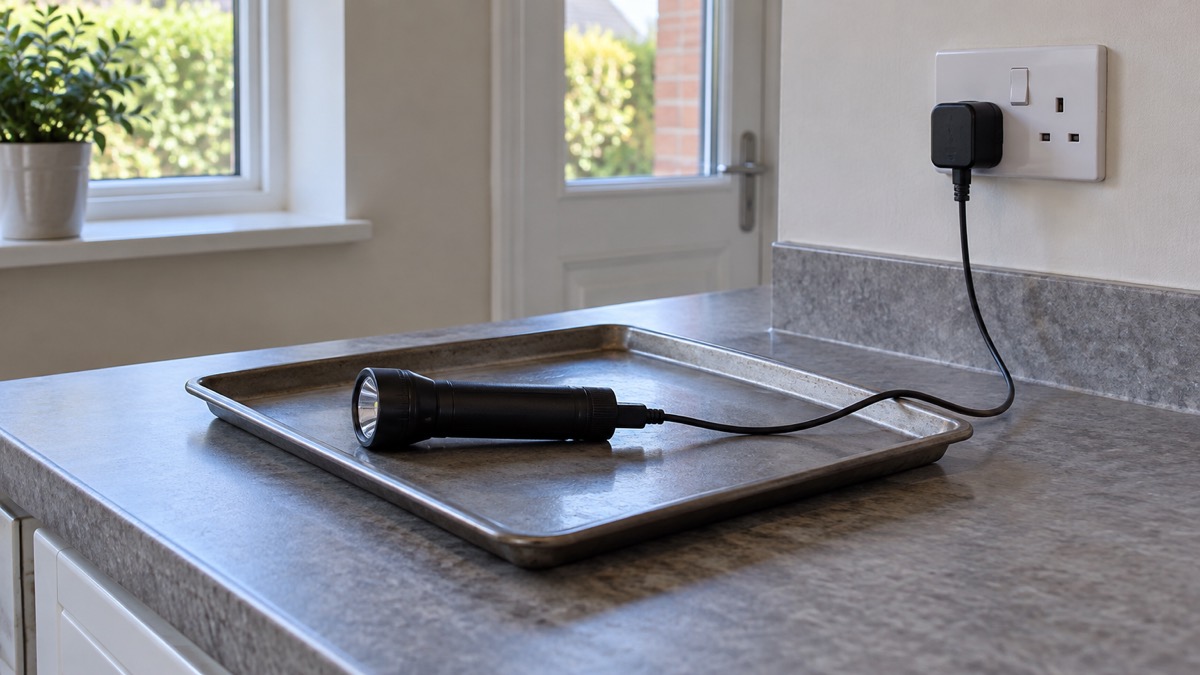
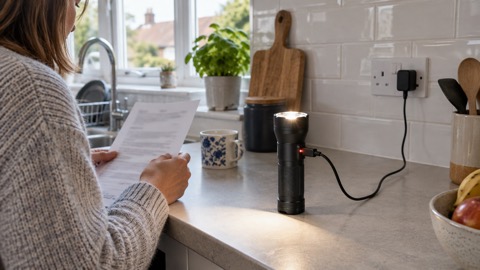
- Charge while you are awake and at home. Do not leave a torch charging overnight or while you are out.
- Use the charger and cable that came with the torch, or one the maker specifies. A mismatched charger is a common cause of battery problems.
- Keep the torch out of direct sunlight and away from anything that could catch fire while charging.
- Check the torch and charger for damage before each charge, and stop using anything with a damaged cable or a swollen battery.
- Store the torch charged, so it is ready when the power goes, and top it up before winter.
There is more detail in the guide to charging and storing rechargeable torches safely, and on which battery types suit which torch in torch batteries: AA, AAA, 18650 and built-in packs.
How long will my torch actually last?
Runtime depends on the setting, the battery and the torch. The figures makers publish are for the lowest setting, which is the one you should use for moving around in a power cut. On low, a modern rechargeable torch will typically outlast the outage by a wide margin.
| Torch | Runtime on low | Source |
|---|---|---|
| Ledlenser P6R | Up to 65 hours at 25 lumens, 45m beam | Maker1 |
| Ledlenser P5R | 20 hours at low power | Maker1 |
| GP Batteries Discovery head torch CH45 | Up to 69 hours maximum runtime | Maker2 |
Two things shorten that runtime in practice. The first is using a higher setting: high modes are much brighter but drain the battery far faster, so save them for short bursts. The second is cold: batteries lose performance in low temperatures, which is why the Met Office winter checklist includes a torch and spare batteries5 and why a torch kept in a cold car should be checked before you rely on it.
If you want to understand how lumens, beam distance and runtime relate, there is a full explanation in lumens, beam distance and run time explained. For a lantern rather than a torch, the same question is answered in how long does a camping lantern run in a power cut.
Spare batteries: how many and which ones
There is no official number of spare batteries to keep, but the advice is consistent that you should have some. Which? recommends spares so you can keep your torch or radio running, or replace the batteries in a piece of medical equipment16. Its storm kit lists a torch and spare batteries, or a wind-up torch instead17. The Met Office winter checklist lists a torch and spare batteries5. Northern Ireland's flood advice says to include a torch with spare batteries in your flood kit18.
A practical approach for an ordinary household:
- A full spare set for each battery torch, kept with the torch rather than in a drawer.
- A few extras of the size you use most, in case a torch is left on or a battery leaks.
- A wind-up torch as the backstop, so you are never entirely dependent on cells.
- A check before winter, replacing anything flat, leaking or past its date.
The guide to spare batteries to keep for your lights sets this out as a checklist. If you are choosing between rechargeable and battery torches for emergencies, rechargeable or battery torches for emergencies compares them directly.
A torch for every person, and one for the car
One torch per household is the minimum, not the target. Official guidance says everyone in the home should know where the torches are kept, so the nearest person can retrieve them and safely help others6. That works best when there is more than one torch and more than one person who can use it.
A head torch is worth considering for anyone who needs both hands: checking the fuse box, helping a child, or moving around outside. The GP Batteries CH45 head torch is listed by its maker with a maximum runtime of up to 69 hours2, and there is a full guide to head torches for power cuts and jobs in the dark.
For the car, the Met Office winter car kit advice is to include a torch and spare batteries8. A torch left in a car should be checked before winter, because cold and disuse are hard on batteries.
For older or disabled people, a torch that is easy to switch on and hold matters more than brightness. There is dedicated advice in lights for older and disabled people in a power cut.
Lighting during a flood
Flooding brings its own lighting problem: the power may go off, and you may need to move around a dark house or leave it. Northern Ireland's official flood advice says to include a torch with spare batteries in your emergency flood kit18. Keep it where you can reach it if the power fails, and take it with you if you are told to leave.
Do not use candles during a flood. The fire risk is the same as in any power cut, and a flood adds water, stress and movement around the house. If you are preparing a flood kit more broadly, the power cut checklist covers the lighting side, and the emergency lighting section covers the full range of options.
Sources (18)
- Ledlenser P6R rechargeable torch, Ledlenser, 2026-10-26
- GP Discovery Everyday multi-purpose head torch CH45, GP Batteries, 2026-10-25
- Winter ready, Isle of Anglesey County Council, 2026-10-25
- Be prepared, Northern Powergrid, 2026-10-26
- WeatherReady winter checklist, Met Office, 2026
- 12 tips to prepare for a power cut, Horsted Keynes Parish Council, 2026
- How to prepare for the loss of electricity, Wiltshire and Swindon Prepared, 2026-10-25
- Simple steps to stay safe this summer, Northern Ireland Fire and Rescue Service, 2025-06-23
- Being prepared for a power cut, SP Energy Networks, 2026-10-26
- Candle safety, North Yorkshire Fire and Rescue Service, 2026-03-09
- Smoking, Devon and Somerset Fire and Rescue Service, 2026
- Safety in severe weather conditions, Devon and Somerset Fire and Rescue Service, 2026
- Power cut, British Red Cross, 2026-10-25
- Home safety position statement, National Fire Chiefs Council, 2025-12
- 10 Ways To Avoid Electrical Fires In Your Home, Electrical Safety First
- Emergency kit packing list, Which?, 2026-09-30
- Storm damage: how to protect your home, Which?, 2026-10-21
- Preparing for a flood, nidirect, 2025-09-11
 Spare Batteries for Lights
 Candle Safety Checklist
 Lighting Checks Before Winter
 Can Jar Candles Shatter
 Battery Tea Lights in a Pumpkin
 Keeping Pets Away from Candles
 Finding Torches in the Dark
 Red Light Mode on a Head Torch
 SOS and Strobe Modes
 IPX Ratings for Torches
 Camping Lantern Run Time
 Using a Torch While Charging
 Looking Into a Bright Torch
 Storing Spare Coin Cells
 Flat Button Battery Dangers