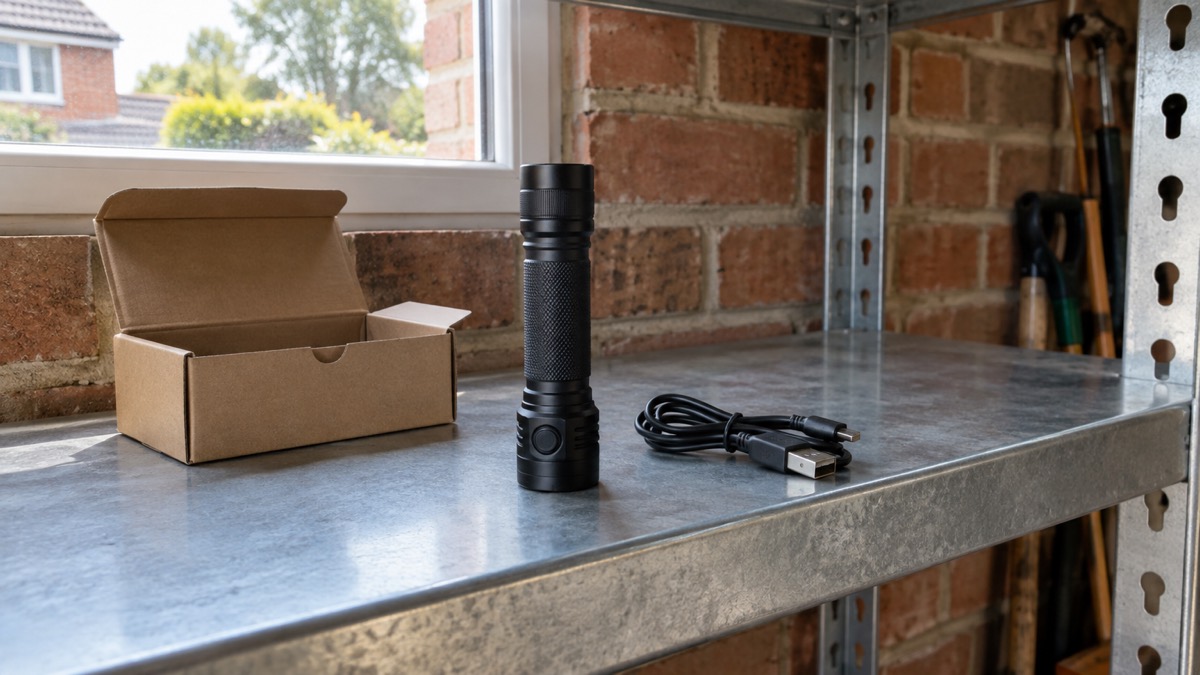
The Ledlenser P5R is a small rechargeable torch that Ledlenser describes as fitting the role of a light for home emergencies, combining a dependable runtime with practical charging support1. It runs on a single rechargeable cell, reaches 750 lumens on its boost setting, and will run for 20 hours on its lowest setting at 25 lumens2. For a household preparing for power cuts, that combination matters more than peak brightness: a long, dim run time is what gets you through an evening without mains power.
If you are thinking about one for your own home, the practical points are these. Charge it fully before winter and check it each season. Keep it somewhere you can reach in the dark, not in a cupboard you would have to search for. Know that it takes a replaceable 14500 cell and can also run on an AA battery, so a flat cell is not the end of the torch2. And read the maker's charging instructions before you plug it in, because the P5R does not come with a charging cable2.
This page sets out what the P5R does, what its specifications mean for a household in a power cut, how to charge and store it safely, and where to get support. It covers the P5R Core and the P5R Work where their figures differ, because owners often have one of those models and search for the P5R name.
What the P5R is and what it suits
The P5R is a rechargeable LED torch with a focusing beam and four light modes: boost, power, mid power and low power2. It is built around a metal housing, 75% of which is recycled aluminium, and it comes with the rechargeable battery and an adjustable lanyard2. Ledlenser's own guidance on preparing for blackouts names a model such as the P5R as fitting the role well, citing dependable runtime and practical charging support as the reasons1.
For an emergency-preparedness household, the useful question is not how bright it is at its maximum but what it does across a whole evening and across several days. A power cut that lasts a few hours is a different problem from one that runs into a second night, and the P5R is specified for both: a short burst of high output for checking outside or finding the fuse box, and a long low setting for sitting in a room with the family.
It is a torch rather than a room light. If you want to light a whole room for several people, a battery or rechargeable lantern does that better, and if you want both hands free while you work, a head torch is the more practical choice. The P5R suits being carried, kept by a bed or in a hallway, and used to move around the house, check on neighbours or look at a meter. Our guide to torches and how to choose one for home sets the different types side by side.
Brightness: 750 lumens on the P5R
The P5R reaches 750 lumens on its boost setting, with a maximum beam distance of 280 metres2. The other modes step down from there, and the table below sets out what each one gives you.
| Mode | Brightness | Beam distance | Run time |
|---|---|---|---|
| Boost | 750 lumens | 280 metres | Not stated |
| Power | 350 lumens | 180 metres | 1 hour |
| Mid power | 100 lumens | 100 metres | 4 hours |
| Low power | 25 lumens | 50 metres | 20 hours |
Source: Ledlenser product page2
The pattern is the one that matters in an emergency: the brightest setting is the shortest, and the dimmest setting is the one that lasts. Twenty hours on low power at 25 lumens is enough to cover a long winter evening and the following morning without recharging, and 25 lumens is ample for moving around a dark house once your eyes have adjusted. The one hour on power at 350 lumens is the setting for a specific job: checking a path, reading a meter, looking at damage outside.
Boost is best treated as a brief burst rather than a mode to leave running. Ledlenser describes boost on the P5R Work as a short burst of maximum power for when you need it most3, and the same logic applies here. If you are working out how much light you actually need for a task, our explanation of lumens, beam distance and run time goes through what the numbers mean in practice.
Battery: one 920mAh 14500 Li-ion cell
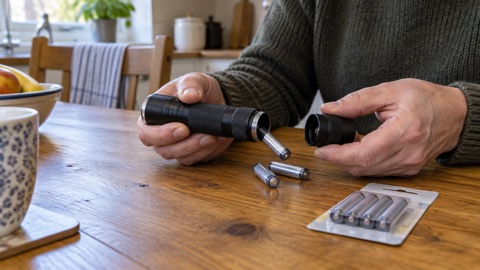
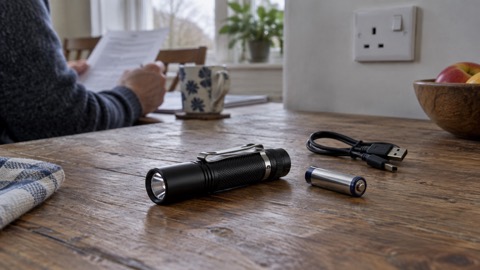
The P5R runs on a single 14500 lithium-ion cell, 920mAh at 3.7V, which is included and replaceable2. It is also compatible with an AA alkaline battery at 1.5V or an AA NiMH at 1.2V2. That compatibility is the single most useful fact on this page for a household preparing for an emergency, because it means a flat rechargeable cell does not leave you without a torch: a standard AA from a drawer will run it.
The P5R Core and the P5R Work each take one 14500 Li-ion rechargeable battery at 3.7V, with a stated capacity of 750mAh4. Note that the P5R's own cell is listed at 920mAh while the Core and Work are listed at 750mAh; these are different models with different supplied cells, so do not assume a cell bought for one is specified for another.
A replaceable cell is a real advantage over a torch with a sealed built-in pack. When the cell eventually stops holding charge, you replace it rather than the whole torch. Keep one spare 14500 cell if you rely on the torch heavily, and store it safely: our guide to torch batteries, including AA, AAA, 18650 and built-in packs, explains what to keep and how to look after lithium cells. If you are weighing up whether to standardise on rechargeable or battery torches across the house, rechargeable or battery torches for emergencies sets out the trade-offs.
Run time: 3.5 hours on the P5R Core
The P5R Core is listed at 130 lumens on mid power, with a 110 metre beam and a 3.5 hour runtime4. Ledlenser's own page for the same model also gives other figures for the same mode, so treat the mid-power output as reported rather than settled. What is not in doubt is that the Core is a different torch from the P5R, and that it is no longer in production: the maker's page states that the item is no longer in production and is kept for information only4. If you own one, it is a torch to look after rather than replace.
The P5R Core takes 120 minutes to reach a full charge4, and the P5R Work is listed with the same 120 minute charge time3. Two hours is a useful figure to plan around: it means a torch charged in the early evening is ready before bed, and that a torch run flat during a long outage can be back in service the same day if you have a power source.
The P5R Work's modes give a clearer picture of how a torch behaves over a long outage. Its low power setting gives 15 lumens at 30 metres for 25 hours, and its mid power setting gives 120 lumens at 100 metres for 3 hours3. The Work also has an optional backup mode: it monitors its charge continuously and, once it drops below 25%, falls to low power to give you about one hour of remaining light3. That is the kind of behaviour that matters when you cannot see the battery gauge in the dark.
P5R Core light modes: low to boost, with dimming
The P5R Core offers low power, mid power, standard power and boost mode, and it is dimmable, with seamless adjustment of the luminosity4. Dimming is genuinely useful in a power cut: you can turn the light down to exactly what a room needs rather than choosing between too bright and too dim, which stretches the battery without leaving you in the dark. The Core also has a temperature control system that keeps the light from overheating so it can run brighter and longer4.
The P5R itself has four modes, boost, power, mid power and low power, without the dimming function listed for the Core2. The P5R Work adds a boost mode of 480 lumens at 240 metres, described as a short burst of maximum power3.
| Model | Modes | Dimming | Notable feature |
|---|---|---|---|
| P5R | Boost, power, mid power, low power2 | Not listed | AA battery compatible2 |
| P5R Core | Low, mid, standard, boost4 | Yes, seamless adjustment4 | Drops to low-power mode when charge is low, giving about 1 hour of remaining light4 |
| P5R Work | Boost mode gives 480 lumens for 240 meters, a short burst of maximum power3 | Not listed | Not listed |
If you are choosing between a torch with a few fixed settings and one you can dim, think about how you will actually use it. Fixed modes are simpler to operate by feel in the dark, which matters if you are half asleep or helping someone else. Dimming gives finer control but asks more of the person holding it. Neither is wrong; they suit different households.
Water and dust protection: IP68 on the P5R Work
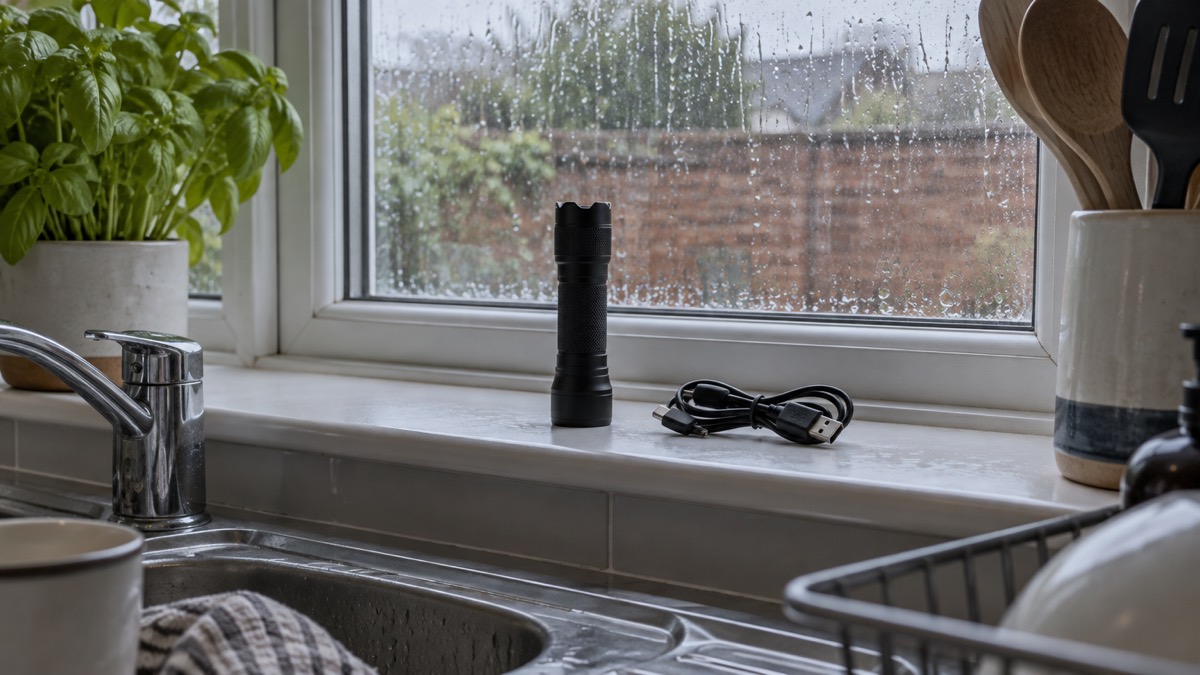
The P5R Work carries an IP68 rating, and Ledlenser describes its Flex Sealing Technology as providing superior protection against dust and water3. The P5R is also rated IP68, which the maker specifies as full submersion protection2, and the P5R Core is rated IP68 as well4.
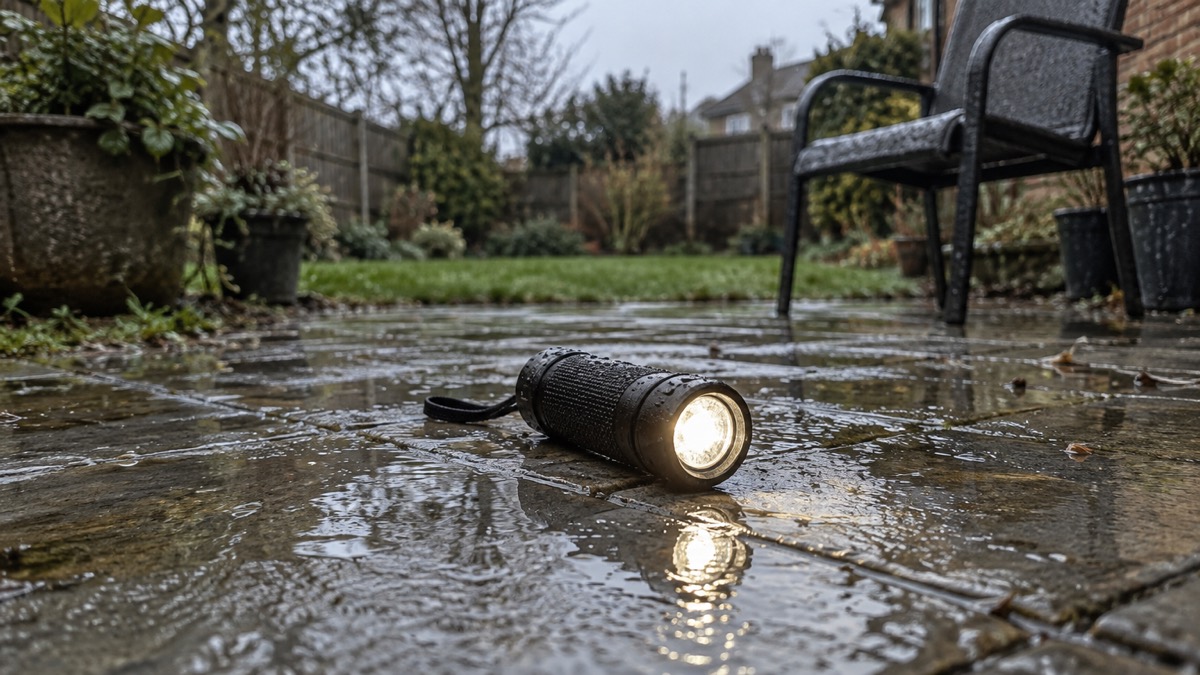
In household terms, IP68 means the torch is sealed against dust and against being dropped in water. That matters in the emergencies a UK household is most likely to face: a storm that takes the power out and brings water through a doorway, a flood where you are moving around in the wet, or simply a torch dropped in a puddle in the garden while you check a fence. It does not mean you should store it underwater, and it does not remove the need to dry the charging contacts before you plug it in. Our explanation of what IPX ratings mean for torches and lanterns covers the scale and what each number promises.
Keeping one ready for a power cut
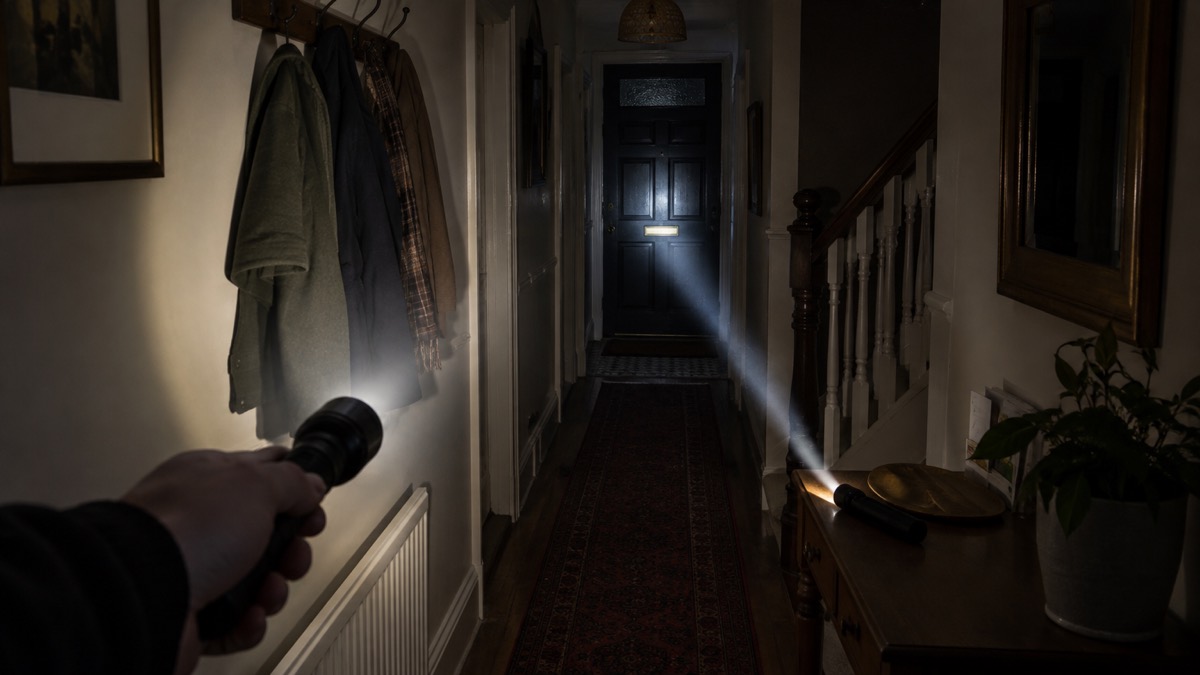
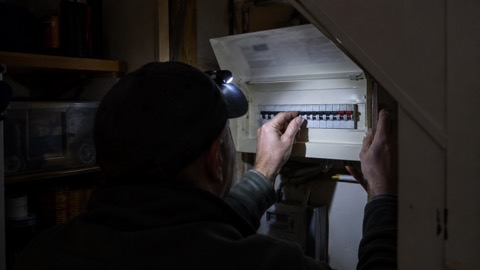
A torch you cannot find is no better than no torch. Official advice for households facing power cuts is to keep a torch handy5, and it is worth building that into how you keep the P5R.
A simple routine for the household:
- Charge it fully before winter. A full charge is an evening's job, not an overnight one, so put it on well before the cold weather arrives.
- Check it each season. Switch it on, run through the modes and confirm the beam focuses. Our lighting checks before winter checklist covers the rest of the house.
- Keep it where you would reach in the dark. A bedside drawer or a hallway shelf beats a cupboard under the stairs. Our guide to where to keep torches so you can find them in the dark has more on placing them.
- Keep a spare AA battery. The P5R accepts an AA alkaline at 1.5V or an AA NiMH at 1.2V2, so a flat 14500 cell does not leave you without light.
The wider power cut checklist for torches, lanterns and candles sets this routine alongside the rest of a household's lighting plan, and our guide to lighting your home safely when the power goes off covers what to do once the lights are already out.
Charging, using and storing it safely
The P5R's cell is a lithium-ion battery, and the maker's instructions for its own product are the ones to follow. Charge it with a suitable USB-C cable, which is not included2, and use a charger you trust. Our guide to charging and storing rechargeable torches safely covers the general principles, and can the wrong USB charger damage a torch battery answers the question people ask most often.
Store the torch somewhere dry and at room temperature, with the cell in place, and check it each season. Do not leave it charging unattended for long periods, and do not charge it somewhere you would not want a fire to start. If you are using it during an outage, remember that a torch is not a room light: pointing a bright beam at a wall gives a harsh pool of light and drains the battery, where a lower setting or a lantern lights the room more evenly.
If you are using candles as well as torches during an outage, treat them as a separate risk. A torch is the safer light for moving around, and our candle fire safety at home guide sets out the rules. For a household with older or disabled people, our guide to lights for older and disabled people in a power cut covers what to keep within reach.
Support, spares and warranty
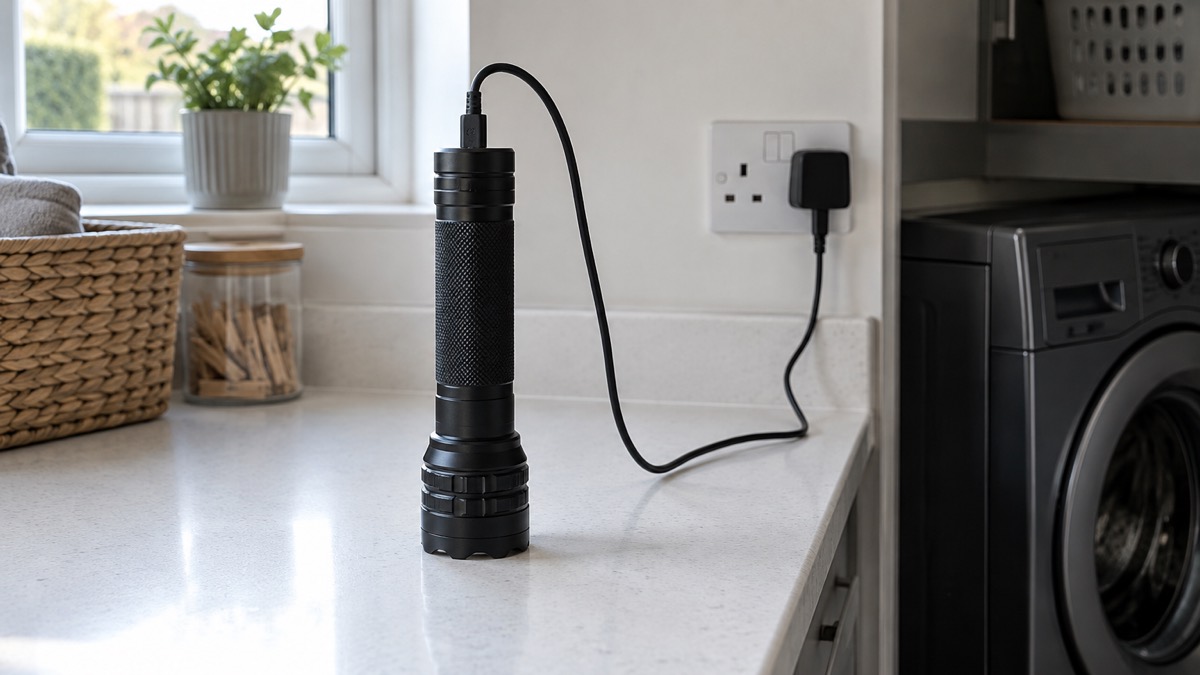
The P5R carries the product number 5031092, which is the reference to quote if you contact Ledlenser about a spare part, a replacement cell or support. The torch comes with the 14500 Li-ion rechargeable battery and an adjustable lanyard2; the charging cable is not included2. The P5R Work comes with a fuller set: the 14500 battery, a magnetic charging cable, a charging dock, a USB adaptor plug, a wrist strap, a rotating belt clip and a storage pouch3.
If your torch stops working, work through the simple checks first: confirm the cell is charged, check the contacts are clean and dry, and try a known-good AA battery if you have one, since the P5R accepts AA alkaline at 1.5V or AA NiMH at 1.2V2. If it still fails, contact the maker with the product number to hand.
Before you rely on any torch, check it has not been recalled. Our guide to recalled and unsafe torches and chargers explains how to check and how to report a problem. And if you would like a free assessment of fire risks in your home, including where you charge and store electrical items, your fire and rescue service offers free home fire safety visits.
For the wider picture of how a torch fits a household's lighting plan, start with our emergency lighting at home section, and for the maker's other models see the Ledlenser page. If you are building a kit from scratch, our emergency kit guide and our power cuts guide set lighting alongside water, heat and information.
Sources (5)
- Torch for power cuts: what to keep at home, Ledlenser, 2026-05
- Ledlenser P5R Rechargeable Torch 750 Lumens, Ledlenser, 2026-10-26
- Ledlenser P5R Work, Ledlenser, 2026-10-25
- Ledlenser P5R Core, Ledlenser, 2026-10-25
- Adverse weather events, power outages and emergency contact numbers, Llangattock Community Council, 2023-10-12

 NEBO Galileo Tempest 350
 NEBO Newton 500 Torch
 NEBO Davinci 800L
 NEBO Luxtreme SL25R
 NEBO Master Series SL25
 NEBO 8K Flood Light
 NEBO 5K Floodlight
 NEBO Torchy 2K Torch
 NEBO Torchy 600 Flex
 NEBO Tac Slyde Torch
 NEBO Slyde King 4K
 NEBO Mycro 900+ Headlamp