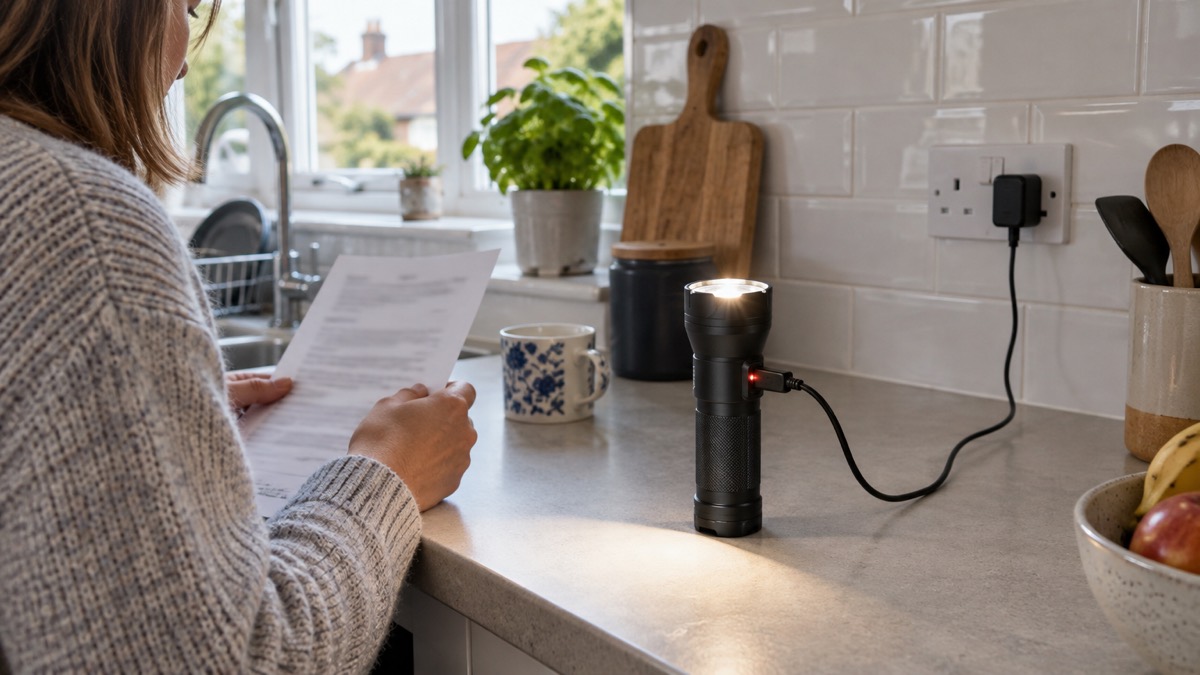
If your torch is designed to charge over USB, you can generally keep using it while it is plugged in, but the safer habit in a power cut is to have a second light ready so you are not relying on a charging torch at all. The government's power cut advice is to keep a battery or wind-up torch and spare batteries at home, because torches are safer than candles1. Fire and rescue services say the same: use battery-operated lights or torches as your alternative light source during a power cut2.
The reason to plan around a second torch is simple. A rechargeable torch that is flat and plugged into a power bank is not much use for the next hour, and a phone torch drains the phone's battery heavily, so it is best kept for short emergencies3. A battery torch with a spare set of cells, or a wind-up torch that needs no mains at all, always works.
Charging itself carries a small but real fire risk if it is done carelessly. Fire services advise using only the charger that came with the device and charging on a hard, non-flammable surface4, and never covering the charger, battery or device while charging, because that can cause overheating or even a fire5. Keep those two rules and a charging torch is an ordinary household appliance.
Using a rechargeable torch while it charges
A rechargeable torch is convenient in normal life and perfectly usable in a power cut, provided you thought about charging before the power went off. The question of whether you can use it while it charges has a practical answer: yes, if the maker's instructions allow it and you follow the charging safety rules below. The bigger issue is timing. A torch on charge is tethered to a cable and a power source, which is awkward when you need to check the fuse box or move around the house.
Some makers design for exactly this. Ledlenser states that its P7R 25th Anniversary Edition has universal cable compatibility and can charge from any USB-C power source including power banks, laptops and vehicle adaptors8. Olight states that its Javelot Turbo 2 has USB-C and magnetic charging capabilities, for what the maker calls maximum charging convenience and flexibility9. Those are the makers' own descriptions of their own products; check your own torch's instructions before assuming the same.
What you should not do is treat a charging torch as your main light. If the power returns briefly, charge first and use a battery torch meanwhile. If you are running from a power bank, remember the power bank is also finite, and a torch that is charging and lit at the same time will draw down both. The practical arrangement is one torch in use and one on charge, not one torch doing both jobs.
A battery-powered or wind-up torch is the safest option
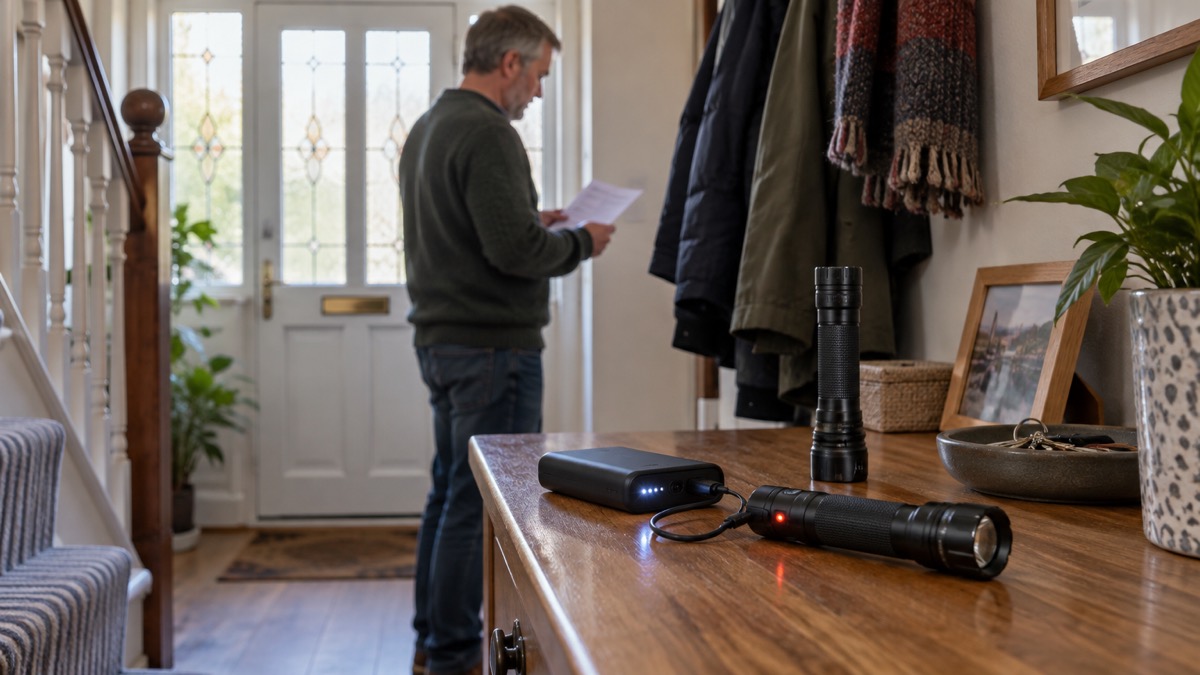
Every official list of power cut kit says the same thing. Keep a battery or wind-up torch and spare batteries at home, and torches are safer than candles1. Northern Powergrid puts it plainly: "a battery-powered or wind-up torch is the safest option"11. The Scottish Government's emergency kit list includes a battery-operated torch and spare batteries, or a wind-up torch2. Northern Powergrid's own power cut plan lists a torch and radio that can run on battery, solar or wind-up12.
The reason is fire. Fire and rescue services across the UK advise using battery-operated lights or torches rather than candles, because candles are a fire risk13. Wiltshire and Swindon's preparedness guidance is blunt: candles can be used but they present a fire hazard, so it is best to stick with torches3. The British Red Cross says to avoid candles where possible as they increase the risk of fire9.
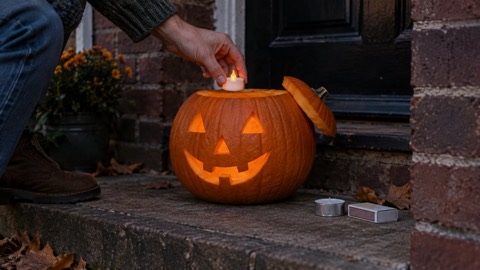
If you want the warmth of candlelight, there is a safer substitute. Devon and Somerset Fire and Rescue Service states that the safest way to use candles is to buy battery-powered versions, which have almost no fire risk, last longer and can be reused because you can replace, recycle or recharge the battery15.
| Light source | Works without mains | Fire risk | Best use |
|---|---|---|---|
| Battery torch | Yes, with spare cells | Low | Main light in a power cut1 |
| Wind-up torch | Yes, no batteries needed | Low | Always-available backup2 |
| Rechargeable torch | Only while charged | Low if charged safely | Everyday use, charge ahead of storms8 |
| Phone torch | Only while phone has charge | Low | Short emergencies only3 |
| Candles | Yes | Fire risk | Avoid; use battery candles instead15 |
Keep a torch and spare batteries where you can reach them
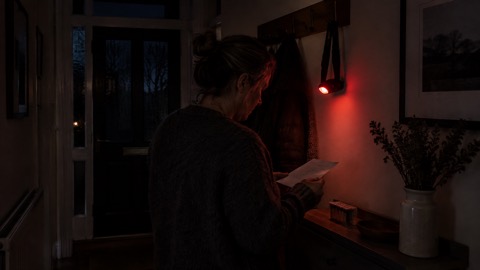
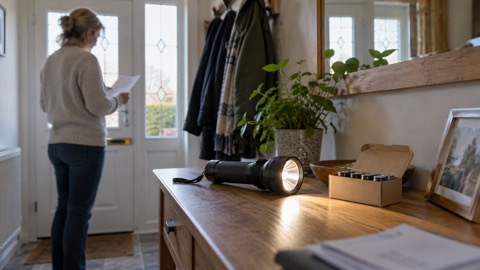
A torch you cannot find in the dark is no torch at all. Northern Powergrid advises keeping a torch with spare batteries in an accessible location6. Anglesey Council's winter guidance adds the reason: store a battery or wind-up torch somewhere you can access easily, so you can use it to check the fuse box and make your way around the house safely16. Mersey Care NHS Foundation Trust tells households to keep a battery-operated or wind-up torch somewhere easy to find17.
The Met Office winter checklist pairs a torch with spare batteries as standard household kit18, and its WeatherReady advice says that if you are using the torch on your phone, always make sure your phone is fully charged before you go out19. That is a useful reminder that the phone torch is a fallback, not a plan.
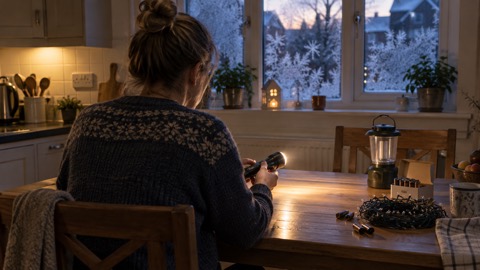
Where to keep it matters as much as what you keep. A hall drawer, a bedside table or a shelf by the fuse box all work, as long as everyone in the household knows. Keep spare batteries with the torch rather than in a separate drawer, and check them at the start of winter. Kidney Care UK recounts a home dialysis patient who once had to do a manual washback in the pitch black because she hadn't changed the batteries in her emergency torch20, which is exactly the failure a two-minute check prevents.
- A battery torch with spare cells, kept where you can reach it6
- A wind-up torch as a no-battery backup2
- Spare batteries stored with the torch, not elsewhere3
- A phone kept charged as a last resort19
- A second torch, because one is easy to mislay21
Safe charging: use the charger made for the device
Charging a torch is charging a lithium-ion battery, and the fire services treat it that way. Devon and Somerset Fire and Rescue Service advises: "When using chargers only use the charger that came with your device. Charge on a hard, non-flammable surface."4 The Scottish Fire and Rescue Service is equally direct: "Do not cover the charger, battery, or device while charging. This can cause overheating or even a fire."5 Merseyside Fire and Rescue Service explains why covering is dangerous: it traps heat and increases fire risk22.
Cables matter too. Devon and Somerset Fire and Rescue Service warns that if your charging cable is cracked, severely twisted or has exposed wires, you should not use it, because it could cause a fire23. London Fire Brigade advises avoiding storing, using or charging batteries at very high or low temperatures24, which rules out a windowsill in direct sun or a cold shed.
When a charger or power bank is recalled
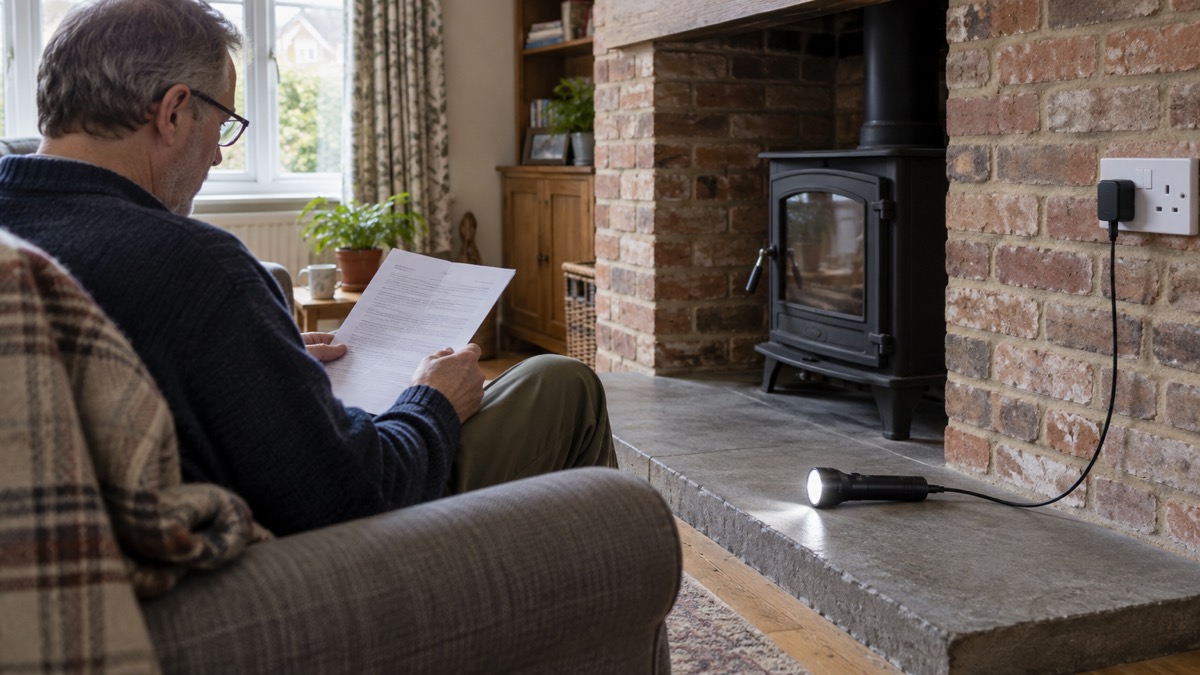
A power bank is only as safe as its battery. In December 2025 the Office for Product Safety and Standards recalled the Belkin BoostCharge BPB002 and Playa PB0003 power banks because their lithium-ion batteries could overheat in use, causing smoking, melting or fire27. If you own either model, stop using it and follow the recall instructions rather than charging your torch from it.
Checking is straightforward. Look up the model number on the Office for Product Safety and Standards recall listings, and read any safety notice that came with the product. Electrical Safety First's guidance for USB chargers is a good habit to build: if a charger shows odd smells, sparking, smoke, swelling, cracks or damage, unplug it immediately and contact the retailer and/or manufacturer25. The same test applies to a power bank that has been dropped or has a swollen case.
Torches with a battery you cannot replace
Some rechargeable torches have a sealed battery you cannot swap. That is fine while the battery holds charge, but it means the torch's working life depends on that one cell, and in a long power cut you cannot simply fit fresh batteries. Ledlenser states that its P2R has a replaceable battery, with both the rechargeable cell and AAA alternatives able to be swapped, so the torch is never permanently out of action28. That is the maker's description of its own product; check whether yours is the same before you rely on it.
If your torch has a sealed battery, treat it as a convenience light rather than your emergency light. Keep a battery torch alongside it, and charge the sealed one whenever a storm is forecast. The Met Office advises charging mobile phone devices ahead of thunderstorms29, and the same logic applies to any rechargeable torch: charge before the weather arrives, not during it.
Keeping children safe around torch batteries
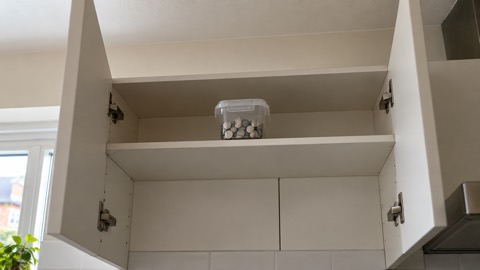
Button and coin cells are the hidden danger in household lighting kit. An NHS trust leaflet warns: "If your child swallows a button battery, it can get stuck in their food pipe. It can burn through to the main artery and badly harm or even kill them. This can happen very quickly."7 The same leaflet notes that button batteries can also cause burns if they are lodged in a child's nose or ear30.
They turn up in more places than parents expect, including toys where the battery compartment isn't secured, string lights and nightlights, small remote controls, car key fobs, musical cards and books, light-up toys and novelty items, and digital scales and thermometers7. Keep spare cells locked away, check that torch battery compartments are screwed shut, and store used cells out of reach too.
Where to get help
If a power cut lasts, your network operator is the first call. Northern Powergrid, SP Energy Networks and Electricity North West all publish power cut advice and preparation tips for their areas11. In Scotland, the Scottish Fire and Rescue Service and Ready Scotland publish power cut and emergency kit guidance2. In Wales, local authority winter guidance covers torches and power cuts16. In Northern Ireland, the Northern Ireland Fire and Rescue Service publishes home fire safety advice32.
For anyone who depends on electrical equipment at home, tell the network operator in advance. Kidney Care UK's guidance for home dialysis patients covers power cuts and water supply failure20, and Mersey Care NHS Foundation Trust's community equipment service explains what to do in a power cut for people using its equipment17. If you need help finding a torch or checking a battery, a free home fire safety visit from your local fire service is a practical route; fire and rescue services offer them and will look at lighting and battery safety in the home4.
For more on choosing and looking after lights, see Emergency Lighting at Home: Torches, Lanterns and Candles, Charging and Storing Rechargeable Torches Safely, Torch Batteries: AA, AAA, 18650 and Built-In Packs, Recalled and Unsafe Torches and Chargers: Checking and Reporting, and Torches, Candles and Children: Keeping Them Safe.
Sources (32)
- Power cuts, GOV.UK, 2026-10-21
- Power cuts, Scottish Fire and Rescue Service, 2026-10-25
- What to do if your child has an accident, NHS, 2025-12-18
- Fire safety checklist, Devon and Somerset Fire and Rescue Service, 2026
- Lithium-ion batteries, Scottish Fire and Rescue Service, 2025-11-27
- Be prepared, Northern Powergrid, 2026-10-26
- Home fire safety, Northern Ireland Fire and Rescue Service, 2026-10-25
- P7R 25th Anniversary Edition Rechargeable Torch, Ledlenser, 2026-10-26
- Javelot Turbo 2, Olight UK, 2026-10-26
- Power cuts, GOV.UK, 2026-10-21
- What to do in a power cut, Northern Powergrid, 2026-10-25
- Power cut plan, Northern Powergrid, 2026-10-26
- Safety in severe weather conditions, Devon and Somerset Fire and Rescue Service, 2026
- Tips to prepare for a power cut, Electricity North West, 2026-10-26
- How to prepare for the loss of electricity, Wiltshire and Swindon Prepared, 2026-10-25
- Winter ready, Isle of Anglesey County Council, 2026-10-25
- Equipment services: what to do in a power cut, Mersey Care NHS Foundation Trust, 2026-10-25
- Stay warm safely in winter, Devon and Somerset Fire and Rescue Service, 2026
- Weather hacks, Met Office, 2026-10-26
- Power cut, British Red Cross, 2026-10-25
- WeatherReady winter poster, Met Office, 2026
- Lithium battery fire safety, Merseyside Fire and Rescue Service, 2026-10-26
- Student safety, Devon and Somerset Fire and Rescue Service, 2026
- Batteries and chargers, London Fire Brigade, 2026-10-25
- USB chargers, Electrical Safety First, 2026-10-25
- Mobile phones and tablets, Electrical Safety First, 2026-10-25
- Recall: Belkin BoostCharge BPB002 and Playa PB0003 power banks, London Borough of Bromley, 2025-12-08
- P2R Rechargeable Torch, Ledlenser, 2025
- What to do in a power cut, Met Office, 2026-10-25
- Button battery safety leaflet, WWL Teaching Hospitals NHS Foundation Trust, 2026-10-25
- Being prepared for a power cut, SP Energy Networks, 2026-10-26
- Home dialysis tips: power cuts and water supply failure, Kidney Care UK, 2024-01-23
 Spare Batteries for Lights
 Candle Safety Checklist
 Lighting Checks Before Winter
 Can Jar Candles Shatter
 Battery Tea Lights in a Pumpkin
 Keeping Pets Away from Candles
 Finding Torches in the Dark
 Red Light Mode on a Head Torch
 SOS and Strobe Modes
 IPX Ratings for Torches
 Torch Battery Runtime
 Camping Lantern Run Time
 Looking Into a Bright Torch
 Storing Spare Coin Cells
 Flat Button Battery Dangers