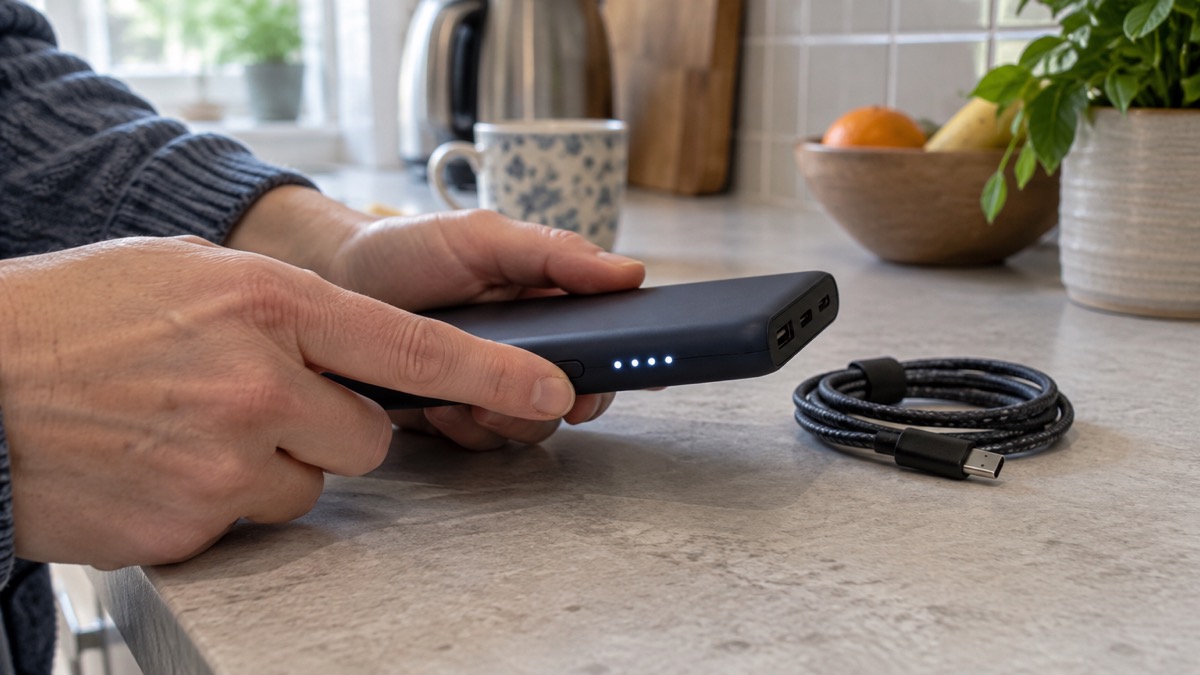
The NEBO 5K Powerbank is a pocket-sized battery for keeping a phone alive when the mains goes off. It holds 5,000mAh, or 18.5Wh at 3.7V, weighs 113g and measures 98 x 63 x 13 mm, so it slips into a coat pocket or a kitchen drawer alongside a torch1. It has two USB-A output ports and a USB-C bi-direction port, and the maker states you can charge up to two devices at once, even while the power bank itself is being charged1.
For a household preparing for a power cut, that is the point of it. Official advice across the UK is to keep phones and power banks fully charged before bad weather arrives, so you have battery power for a short time at least2. A power bank like the NEBO 5K is charged through either its USB Micro input port or its USB-C bi-direction port, and can charge up to two devices at once3.
Before you rely on it, charge it fully. The maker's first instruction is to fully charge the product before using it for the first time, and the total charge time is 2 to 3 hours1. Then check the power level indicator, which shows four bands from 0% to 24% up to 75% to 100%, and top it up whenever a storm is forecast4.
What the NEBO 5K Powerbank is and who it suits
This is a power bank in the ordinary sense: a battery, some circuitry and one or more charging ports, usually USB or USB-C5. The maker's specification puts it at 5,000mAh and 18.5Wh, with a Li-ion battery, dual USB-A output ports, a USB-C bi-direction port and a USB-Micro charging input1. The body is aluminium, with a side-positioned on/off button and a power level indicator4.
What it suits is the household that wants a phone kept alive through an evening without power, or a top-up on a long journey. Independent guidance describes portable power banks as able to hold enough power to charge a mobile several times, and well worth having to hand to stay connected in a blackout6. It is not a substitute for a portable power station: if you want to know where the line falls, the comparison of a power bank or portable power station sets out what each can run.
| Specification | Maker's figure |
|---|---|
| Battery capacity | 5,000mAh / 18.5Wh, 3.7V1 |
| Battery chemistry | Li-ion4 |
| Ports | Dual USB-A output, USB-C bi-direction port, USB-Micro charging input1 |
| USB-C output | 5V 2.1A1 |
| USB-Micro input | 5V 2A1 |
| Maximum output | 10.5W1 |
| Dimensions | 98 x 63 x 13 mm1 |
| Weight | 113g1 |
| Operating temperature | 0 to 45°C1 |
| In the box | USB-A to USB-C cable, USB-C to USB-C cable, USB-C to USB-A adapter4 |
The maker also makes torches and lanterns that double as power sources for phones and other USB-chargeable gadgets, so if you are buying for a power cut it is worth looking at the whole NEBO range rather than the battery alone7.
Charging it fully before you need it
The single most useful habit with this power bank is keeping it full. The maker's manual is direct: "IMPORTANT: Before using your product for the first time, fully charge it."1 The same instruction appears on the product page4. From empty, the maker gives a total charge time of 2 to 3 hours1.
That matters because the official advice is to charge before the event, not during it. The Northern Ireland Executive's weather warning guidance tells households to keep mobile phones, laptops, tablets and power banks fully charged so they have battery power for a short time at least2. Scotland's ready campaign gives the same instruction ahead of storms and high winds: charge mobile phones and power banks in case there is a power cut8. Network operators repeat it before planned outages, asking customers to charge phones and devices before the power is due to go off9.
A practical routine for an ordinary household:
- Charge the power bank before you need it: the maker's instruction is to fully charge the product before using it for the first time8.
- Keep the cables with the power bank, so you can charge it from either its USB Micro input port or its USB-C bi-direction port4.
- Unplug it once it is full. The National Energy Action guidance is to unplug or switch devices off at the wall and only charge phones for as long as necessary10.
- Store key numbers, including the 105 power cut helpline, on the phone itself, and consider a separate battery charger as a backup3.
Keeping phones going in a power cut
When the power goes, the phone becomes the household's link to the outside world. Independent guidance from Northern Powergrid is to ensure your mobile phone is fully charged and keep a power bank as a backup11. Energy Networks Association puts it the same way: keep a mobile phone fully charged so you can go online for updates or call if you have a power cut12.
The NEBO 5K does two things here. It can charge up to two devices simultaneously, so a phone and a second phone, or a phone and a set of earbuds, can be topped up at once1. And because it can be charged and discharged at the same time, it can sit on a USB charger while passing power through to a phone1. The maker's own description of its power bank range is a reliable power source for smartphones, tablets and other USB-chargeable gadgets7.
What it cannot do is keep a phone going indefinitely. The maker gives no number of phone charges, only the capacity and the 10.5W maximum output1. Independent guidance notes that power banks hold enough to charge a mobile several times, but the number depends on the phone6. Treat it as a buffer that buys hours, not days, and plan around that:
- Put the phone on low power mode and limit use of electrical devices, as UK Power Networks advises9.
- Use the power bank for calls and messages rather than video, and charge in short bursts.
- Keep a written note of important phone numbers in case the phone dies9.
- Remember that many cordless and digital home phones will not work without power, so keep an analogue phone or a charged mobile to hand13.
What it can and cannot power
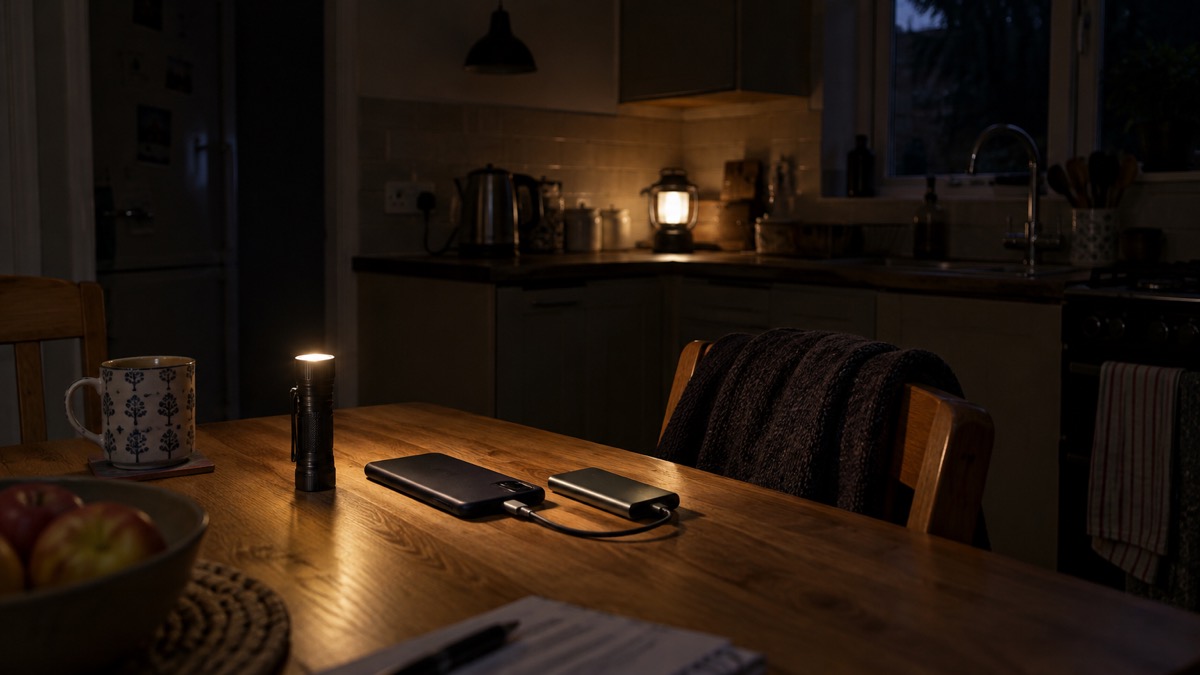
The 10.5W maximum output sets the limit. This is a device for phones, tablets and other USB-chargeable gadgets, not for anything that plugs into a mains socket1. If you want to run a fridge, a boiler or a router through an outage, that is the job of a portable power station, and the backup power section explains the options. For the arithmetic behind capacity and output, see watts, watt-hours and surge explained.
| What you might want to keep going | Does the NEBO 5K suit? |
|---|---|
| A mobile phone | Yes, it has a USB-C output at 5V 2.1A1 |
| A tablet or earbuds | Yes, it can charge up to two devices simultaneously1 |
| A hearing aid charger that takes USB | Yes, if it charges from a USB port14 |
| A router, fridge or boiler | No, it has no mains output1 |
Independent guidance makes the same distinction when it comes to generators: if you just want to charge your smartphone on the move, you would be better off with a portable power bank15. That is not a criticism of generators, which do a different job; it is a reminder that the smallest tool is often the right one for the phone.
Safe use and storage: temperature limits and fire risk
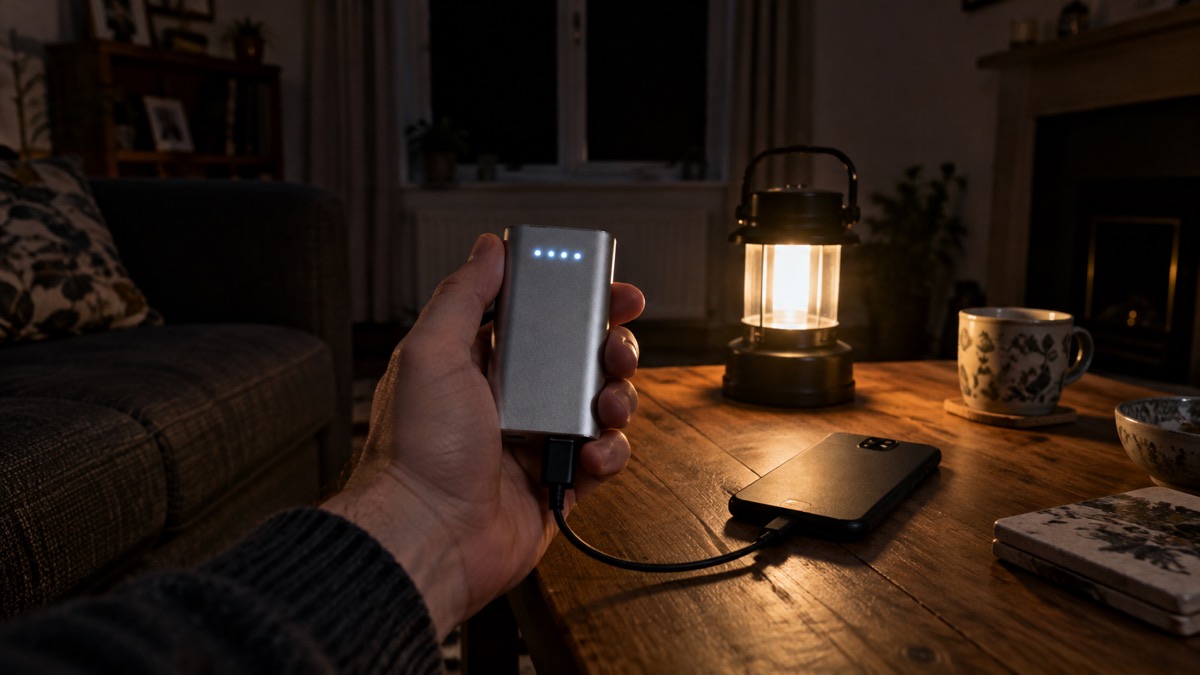
Power banks contain lithium-ion batteries, which can hold a sizeable amount of energy in a very small space and can pose a serious fire risk if they become damaged or are manufactured to a substandard level16. The maker's manual carries its own warning: "Failure to follow these instructions may result in electrical shock, explosion, fire which may result in serious injuries, death or property damage."1
The maker's specific limits are these. Do not expose the power bank to heat above 176°F (80°C) or incinerate it1. The operating temperature is 0 to 45°C1. Electrical Safety First adds that you should not expose a power bank to extreme temperatures, for example leaving it in a parked car where it could get very cold in winter or very hot in summer17. The Health and Safety Executive notes that in particularly harsh conditions it is worth selecting lower voltage equipment powered by a battery18, which is one reason a small battery device is a sensible choice for a cold porch or a shed.
For more on the warning signs, see warning signs a lithium battery is dangerous and what to do if a battery starts swelling. The London Fire Brigade advises against keeping all your items containing lithium-ion batteries together when you travel, especially on a plane, and to check with your flight carrier for additional advice19.
Taking it on a plane
The NEBO 5K is small enough to travel with, but the rules are about chemistry, not size. Rechargeable lithium batteries such as power banks can bring a fire risk that could be uncontrollable if packed in checked baggage, so they belong in the cabin17. Electrical Safety First notes that major airlines have been clamping down on the use of power banks on planes following a spate of incidents20.
Before you fly:
- Pack the power bank in your cabin bag, not your hold luggage17.
- Do not keep all your lithium battery items together, especially on a plane19.
- Check with your airline for its own rules on power bank use in flight19.
- If you notice any damage or deformation, do not bring the device with you; dispose of it safely at a local recycling centre as soon as possible16.
Using it in cold weather
The maker's operating range of 0 to 45°C is the figure to work from1. A cold car boot or a hot windowsill sits outside the comfortable middle of that range, and Electrical Safety First specifically warns against leaving a power bank in a parked car where it could get very cold in winter or very hot in summer17. North Yorkshire Fire and Rescue Service's winter safety advice is a useful reminder of how quickly vehicles and outbuildings change temperature21.
If the power bank has been out in the cold, bring it indoors and let it return to room temperature before charging or using it. For the wider question of charging batteries in low temperatures, see can you charge lithium batteries below freezing, and for storage temperatures generally, what temperature should batteries be stored at.
Where it fits in a household power cut plan
A power bank is one line in a longer list. Official and independent guidance for households consistently includes a charged phone, a charged power bank, a torch, and a way to get information22. The NEBO 5K covers the phone and the small devices, charging up to two at once through its USB ports1; the rest of the kit is set out in the power cut backup power checklist and the wider power cuts guide.
| Job in a power cut | What does it |
|---|---|
| Keep the phone alive for calls and updates | NEBO 5K Powerbank1 |
| Light a room | A torch or lantern, not a candle22 |
| Hear warnings and news | A battery or wind-up radio22 |
| Run a fridge or boiler | A portable power station or generator, not a power bank1 |
For the wider picture of keeping phones charged, the power banks guide covers the category, and USB-C charging, power delivery and cables explained explains why the cable matters as much as the battery.
Sources (24)
- NEBO 5K Power Bank manual, NEBO, 2026-10-25
- Strong winds weather warning: information and advice, nidirect, 2026-10-24
- 10 things you should do now to prepare for winter, Met Office, 2026-10-25
- 5K Powerbank product page, NEBO, 2026-10-25
- Power banks, Electrical Safety First, 2026-10-26
- What to do in a power cut, Which?, 2026-06-04
- Lighting technology, NEBO, 2026-10-25
- Storms and high winds, Ready Scotland, 2026-03-24
- Tips to prepare for a power cut, Electricity North West, 2026-10-26
- Preparing for winter, National Energy Action, 2025-10-14
- What to do in a power cut, Northern Powergrid, 2026-10-25
- Power cut, Energy Networks Association, 2026-10-25
- national-grid-homeowner-preparing-for-a-power-cut.pdf, National Grid Electricity Distribution
- Emergency kit packing list, Which?, 2026-10-26
- How to buy the best generator, Which?, 2026-01-20
- Major airline bans the use of power banks this week, Electrical Safety First, 2024-10
- Is your power bank a flight risk?, Electrical Safety First, 2026-10-25
- Electricity safety FAQs, Health and Safety Executive, 2026
- Batteries and chargers, London Fire Brigade, 2026-10-25
- Power banks safety advice, Electrical Safety First, 2026-10-25
- Staying safe in the snow, North Yorkshire Fire and Rescue Service, 2023-03-09
- 12 tips to prepare for a power cut, Horsted Keynes Parish Council, 2026
- Yourself: personal resilience, Wiltshire and Swindon Prepared, 2026-10-25
- Be summer ready, Electricity North West, 2026-10-25