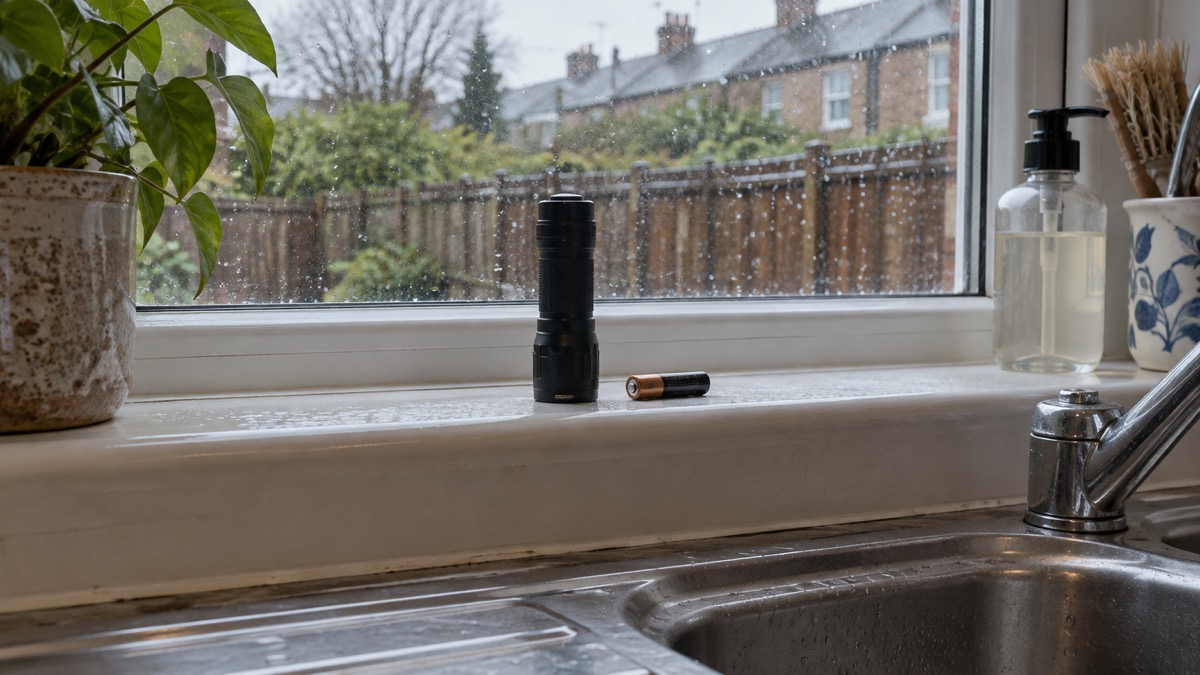
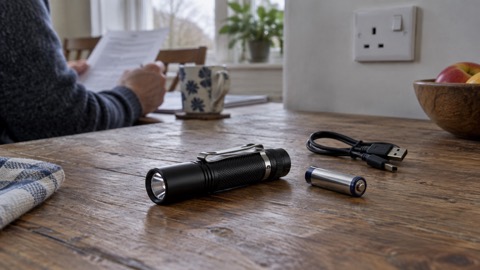
The Ledlenser P3 Core is a small battery operated torch that runs on a single AAA cell, measures 96mm long and weighs 42g, and gives three brightness levels of 15, 50 and 90 lumens1. For a household getting ready for a power cut, that combination is the point: it is light enough and small enough to live in a jacket pocket or a bedside drawer, so it is with you when the lights go out rather than in a cupboard downstairs.
What it does in an emergency is simple and worth knowing before you need it. On its lowest setting it runs for 6 hours at 15 lumens and throws light 40 metres; on Mid Power it gives 50 lumens for 4 hours at 70 metres; on Standard Power it gives 90 lumens for 3 hours at 110 metres2. A single AAA alkaline battery is included in the box, along with a pocket clip3, so it works straight away.
It is not a room light and it is not rechargeable. It is a personal torch: one for a pocket, one for a handbag, one for the drawer beside the bed. This page sets out what it can and cannot do, how to keep it ready between emergencies, and how to use it safely.
What the P3 Core is, and what it suits
Ledlenser describes the P3 Core as a mini torch that "surprises with its strong performance and ability to fit into any pant or shirt pocket"1. It is a battery operated torch, listed by the maker as a 2021 model rated at 90 lumens4. It has a single LED1 and a fast-access switch in the end cap, so it comes on with a press of the thumb rather than a hunt for a side button1.
For emergency planning, the useful question is not how it compares with other torches but what job it does in a household. It suits three jobs particularly well:
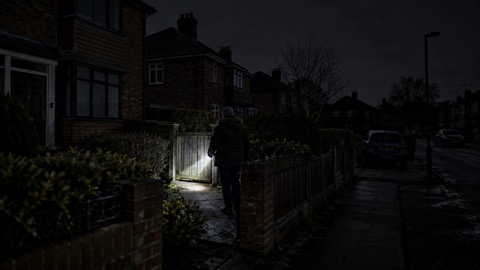
- Kept on the person. At 42g and 96mm it disappears into a pocket, so it is there when the power fails at night2.
- Kept in several places. Because it costs little to run on one AAA cell, having one in the kitchen drawer, one by the bed and one in the car is a practical way to make sure a light is always within reach.
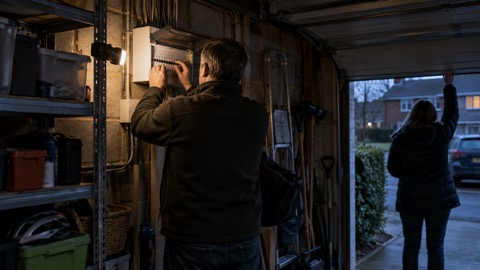
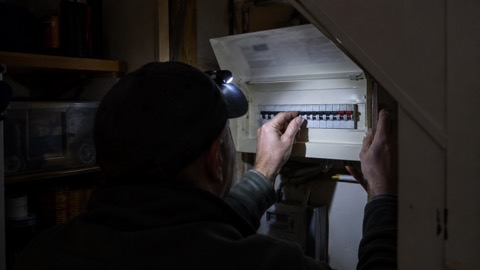
- Short, directed tasks. Checking a fuse box, finding shoes, reading a meter, getting to the stairs: jobs where a beam you can point beats a lamp that lights a whole room.
It does not suit lighting a room for an evening, and it is not the torch to hand a child to play with unsupervised. For those jobs, a lantern or a head torch does the work better, and the wider guide to torches for the home sets out the types side by side.
Light modes: 15, 50 and 90 lumens
The torch has three brightness levels, and the maker's figures for each are set out below. Ledlenser's product pages give the same three levels but list the run times and beam distances in a way that pairs each figure with a different mode in different places, so the table gives the maker's figures as published and notes where they sit together2.
| Mode | Output | Run time | Beam distance |
|---|---|---|---|
| Low Power | 15 lumens | 6 hours | 40 metres |
| Mid Power | 50 lumens | 4 hours | 70 metres |
| Standard Power | 90 lumens | 3 hours | 110 metres |
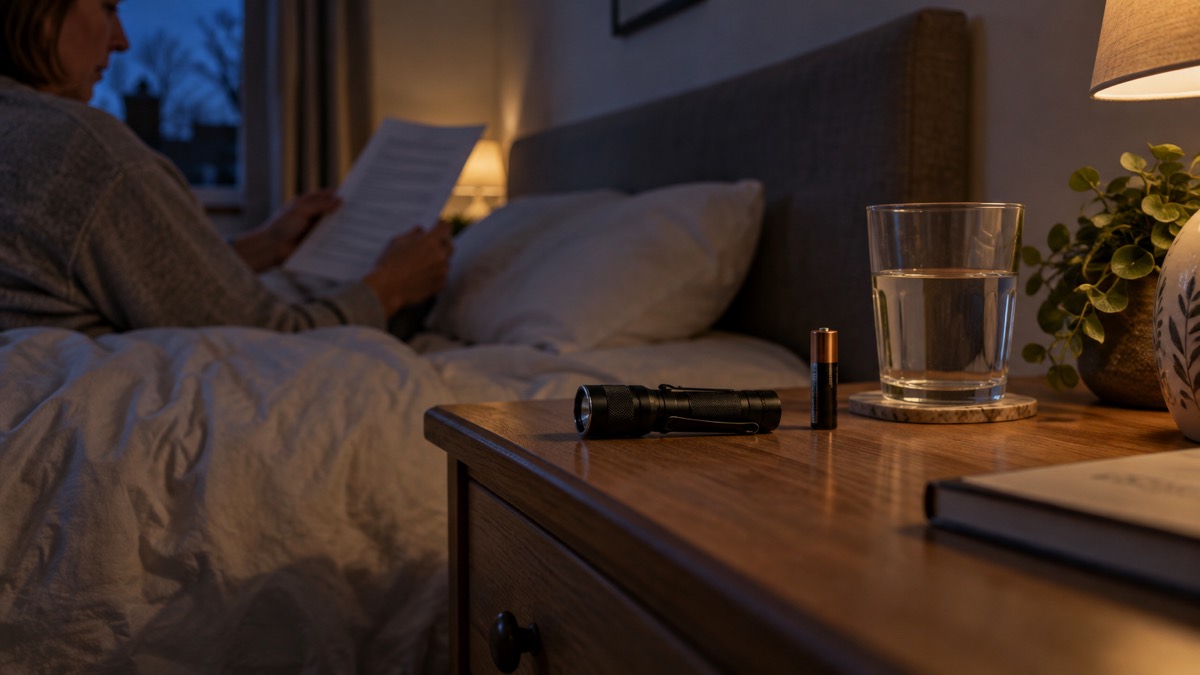
These are the maker's figures for the P3 Core2. The pattern is the one you would expect: the brighter the setting, the shorter the run and the further the beam carries. What that means in practice is that the lowest setting is the one to reach for indoors in a power cut. At 15 lumens for 6 hours it will get you through an evening and still have light left, and it is gentler on the eyes than 90 lumens bouncing off a nearby wall.
The higher settings have their place. Standard Power at 90 lumens and 110 metres is for looking down a garden, checking a path from a doorway or signalling. Mid Power sits between the two. If you want to understand what lumens and beam distance actually measure, the guide to lumens, beam distance and run time explains it, and how long a torch battery lasts on low goes into the run time question in more detail.
Batteries: one AAA, alkaline or NiMH
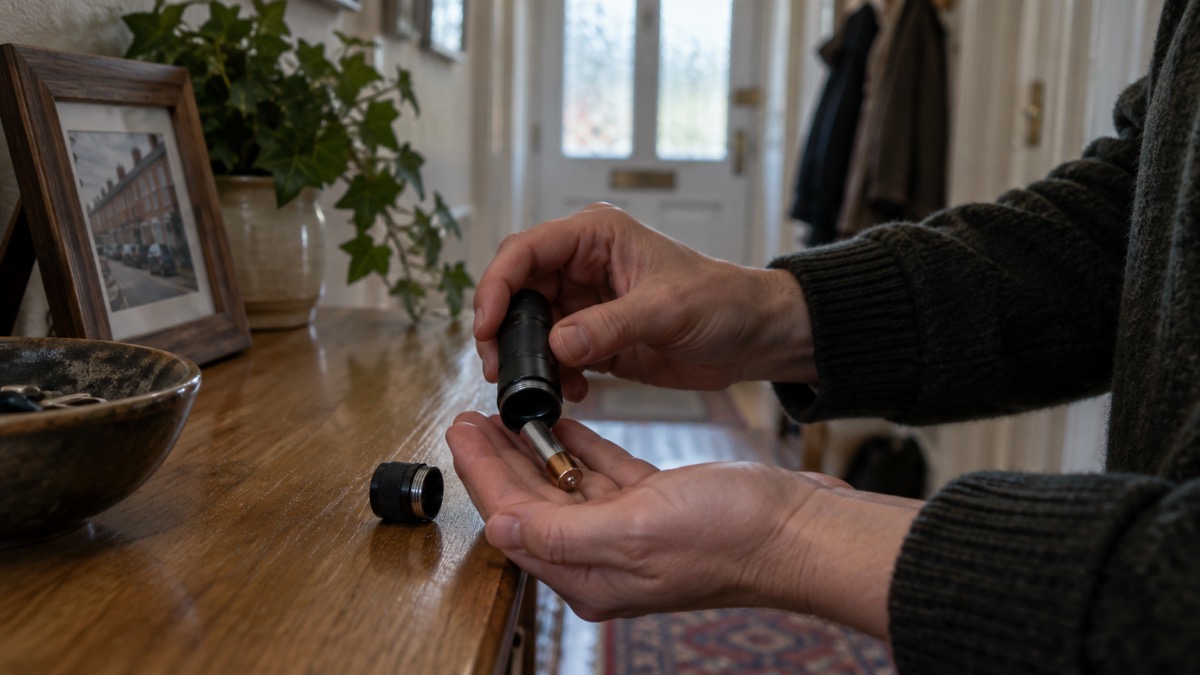
The P3 Core takes a single AAA battery. Ledlenser supplies an alkaline cell in the box and states that the torch is also compatible with standard NiMH rechargeable AAA batteries, which are not supplied1. The maker's instruction on those rechargeable cells is specific: they must be charged outside of the torch2. There is no charging port and no cable, so the torch itself is never plugged in.
That has practical consequences for a household plan:
- Keep spares. A pack of AAA alkaline cells in the same drawer as the torch means a flat battery is a 30-second fix, not a trip to the shops in a storm.
- Store cells properly. Keep spare batteries in their packaging, away from metal objects that could bridge the ends, and away from children. The guide to spare batteries to keep for your lights sets out what to hold.
- Rechargeable cells need a charger. If you use NiMH AAA cells, you need a separate charger and a way to run it, which in a power cut means a backup power arrangement. The comparison of rechargeable or battery torches for emergencies weighs the two approaches.
The advantage of the AAA format for emergency use is that it is the most widely sold household battery size, so replacements are easy to find and easy to store. The guide to torch batteries covers AA, AAA, 18650 and built-in packs side by side if you are deciding what to standardise on across your kit.
Rain, dust and drops: IP54 and a 2 metre rating
The maker rates the P3 Core IP54, described as "dust and splash water protected for outdoor and work use", and says it is drop tested to 2 metres with a housing of aircraft-grade aluminium2. In plain terms, that means it will take rain falling on it, a splash at the sink and a knock off a table onto a hard floor, which is the sort of treatment a torch gets in a real power cut.
It does not mean the torch is waterproof in the sense of surviving being submerged. IP54 covers splashes, not immersion, so it should not go into flood water, a full sink or a pond. If you are working in the wet, dry your hands and the torch before you open it to change the battery, and dry it again afterwards. The guide to what IPX ratings mean for torches and lanterns explains the scale.
The aluminium housing matters for a different reason: it is a metal body, so it will feel cold in a winter power cut and it should not be left where a child might put it in their mouth. The guide to torches, candles and children covers keeping lights safe around young children.
Using the Advanced Focus System and pocket clip
The P3 Core has Ledlenser's Advanced Focus System, which the maker describes as "smooth spot-to-flood beam transition"2. In use, you push or pull the head of the torch to change the beam: one end of the travel gives a wide flood of light for close work, the other a tight spot for looking into the distance, and anywhere in between is available1. The torch measures 96mm with the beam defocused and 100mm with it focused, so the change in length is the change in beam1.
For a household in a power cut, the flood setting is usually the more useful. A wide beam lights the stairs, a hallway or a fuse box without the harsh hotspot a tight spot throws. The spot setting is for looking down a garden path, checking a gate or seeing what caused a noise outside.
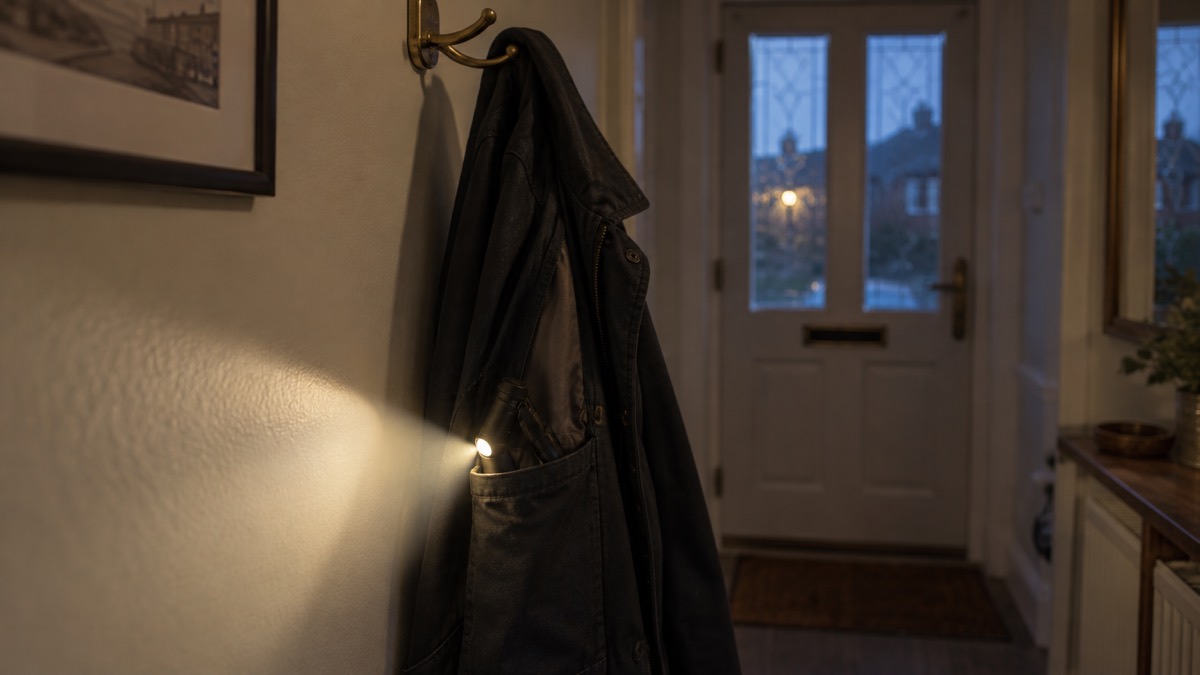
The pocket clip is described by the maker as a "secure attachment to jacket pockets, trouser" pockets and straps2, and the torch also has a fast-access end cap switch1. Between them they make the torch easy to keep on you and easy to switch on one-handed. A few habits are worth building:
- Clip it where you will pat for it. A jacket pocket or a bag strap, so you can find it without turning on a light.
- Store it defocused. That way the first press gives a wide, useful beam rather than a narrow spot.
- Check it monthly. Press the switch, confirm it comes on, and change the battery if the light looks dim.
- Keep it out of reach of small children when it is not in use, and teach older children how to use it rather than leaving them to work it out in the dark.
Keeping it ready between emergencies
A torch that is flat when you need it is worse than no torch, because you have stopped looking for alternatives. The P3 Core is easy to keep ready because it needs so little: one AAA cell, a dry place and a monthly press of the switch.
A simple routine for a household:
- Before winter, check every torch in the house, replace any cell that looks tired, and note where each torch lives. The lighting checks before winter checklist covers the whole house.
- Keep a spare cell with each torch, not in a central drawer you would have to find in the dark.
- Store it dry and at room temperature. A car glovebox in winter is cold, and a cold cell gives less.
- Keep it where you would reach in the dark, which is the point of the guide to where to keep torches so you can find them in the dark.
- Add it to your power cut plan. The power cut checklist lists the lights a household should have ready, and the power cuts guide covers the wider arrangements.
The P3 Core also appears in two Ledlenser bundles, one with the H8R rechargeable head torch2 and one with the P7R Core3. If you are building a household lighting kit, a small pocket torch plus a head torch plus a room lantern covers the three jobs: on the person, hands free, and lighting a room. The emergency lighting section sets out the whole picture, and the emergency kit guide shows where lighting sits among the other things a household should keep.
Support, spares and where to get help
The P3 Core is a current product on the maker's own site, listed with its specifications and box contents1. Ledlenser's UK pages are the place to confirm the model details, the battery type and the accessories before you buy, and the Ledlenser brand page gathers the models covered here. The torch is also sold in the bundles noted above, which is worth knowing if you are buying for a household rather than for one person2.
If a torch or a charger in your home is subject to a safety recall, stop using it and follow the recall notice. The guide to recalled and unsafe torches and chargers explains how to check and how to report a problem.
For households where someone is older, disabled or dependent on powered equipment, lighting is part of a wider plan. The guide to lights for older and disabled people in a power cut and the extra help guide cover the Priority Services Register and the support available. A free home fire safety visit from your local fire and rescue service is also worth arranging if anyone in the household would struggle to get out in the dark.
Sources (4)
- P3 Core Battery Operated Torch, Ledlenser, 2026
- H8R Rechargeable Head Torch and P3 Core Torch Bundle, Ledlenser, 2026
- P7R Core and P3 Core Combo Set, Ledlenser, 2026
- 2020 Core Series, Ledlenser, 2026

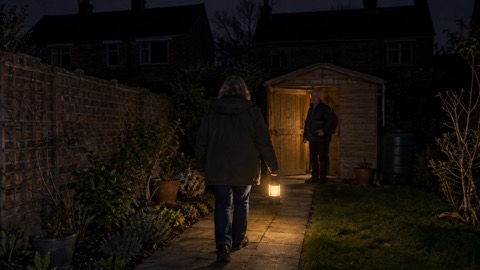 NEBO Galileo Tempest 350
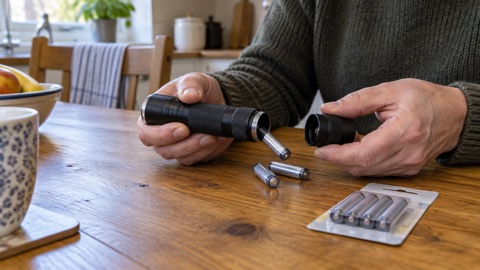 NEBO Newton 500 Torch
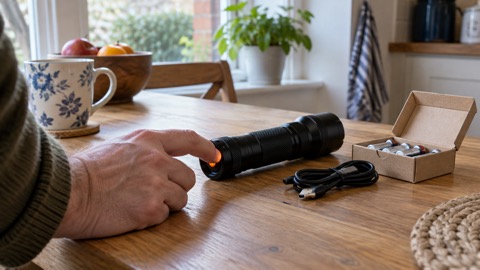 NEBO Davinci 800L
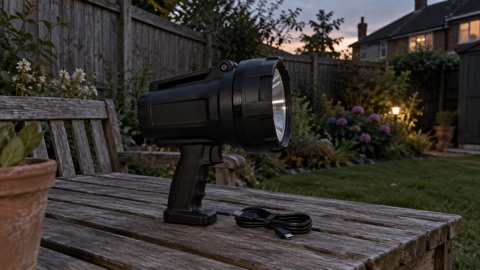 NEBO Luxtreme SL25R
 NEBO Master Series SL25
 NEBO 8K Flood Light
 NEBO 5K Floodlight
 NEBO Torchy 2K Torch
 NEBO Torchy 600 Flex
 NEBO Tac Slyde Torch
 NEBO Slyde King 4K
 NEBO Mycro 900+ Headlamp