

Black Diamond is an outdoor equipment maker whose lighting range, head torches in particular, is the part of its catalogue that matters most to a UK household preparing for a power cut. Its lights are built for climbing and camping, but the qualities that suit a hillside, a bright beam, simple buttons and a long run time, are the same ones that suit a dark landing at 2am. The Spot and the Spot 400-R are the two models described here, and both carry a three year warranty on all Black Diamond lighting products1.
If you are buying one now, the choice comes down to batteries. The Spot runs on three AAA cells or a BD 1500 rechargeable battery sold separately, and has a USB-C charge-in port for that pack1. The Spot 400-R has an integrated 1500 mAh lithium-ion battery charged by micro-USB2. A household that can charge from a power bank or a car may prefer the 400-R; a household that wants to swap in fresh cells in the dark, with no mains power at all, is better served by the Spot and a stock of AAA batteries.
Whichever you choose, treat it as part of a wider lighting plan rather than the whole of it. Official advice is to keep a torch and batteries in an easily accessible place, and the fire and rescue service is blunt that you should never use lighted candles in a tent or campsite3. The sections below set out what each light does, how to keep it ready, and how to use and store it without creating a fire risk.
What Black Diamond makes for UK households
Black Diamond's lighting range is aimed at people who need light where there is no switch: head torches for hands-free work, and the small lights and lanterns that go with a camping or climbing kit. For a household, the useful framing is not the mountain but the mains failure. A head torch leaves both hands free to hold a torch, read a meter, carry a child or find the fuse box, and it points where you look rather than where you hold it.
The case for keeping one is straightforward. Official household emergency checklists put a torch and batteries among the items to keep easily accessible, alongside candles and matches, a battery radio and a list of useful telephone numbers3. A head torch does the job of the torch in that list and does it better in the specific moment a power cut creates, when you are moving around a dark house and need both hands.
The two models covered here differ in more than price. The Spot is a 450 lumen lamp with one flood lens, one spot lens and one red-green-blue spot lens, a headband built from recycled materials, and a size range of one size1. The Spot 400-R gives 400 lumens on high, 200 on medium and 6 on low, with settings that include full strength in proximity and distance modes, dimming, strobe, red night-vision and a digital lock mode2. Both have a PowerTap function that drops instantly from any setting to full power with a tap of a finger, which is the feature you will be glad of when something goes bump in the dark1.
For the wider question of how to light a home through an outage, from room lighting to candles and their risks, see Emergency Lighting at Home: Torches, Lanterns and Candles. For the outage itself, Power Cuts: A Household Guide covers what to do and in what order.
Head torches for hands-free light in a power cut
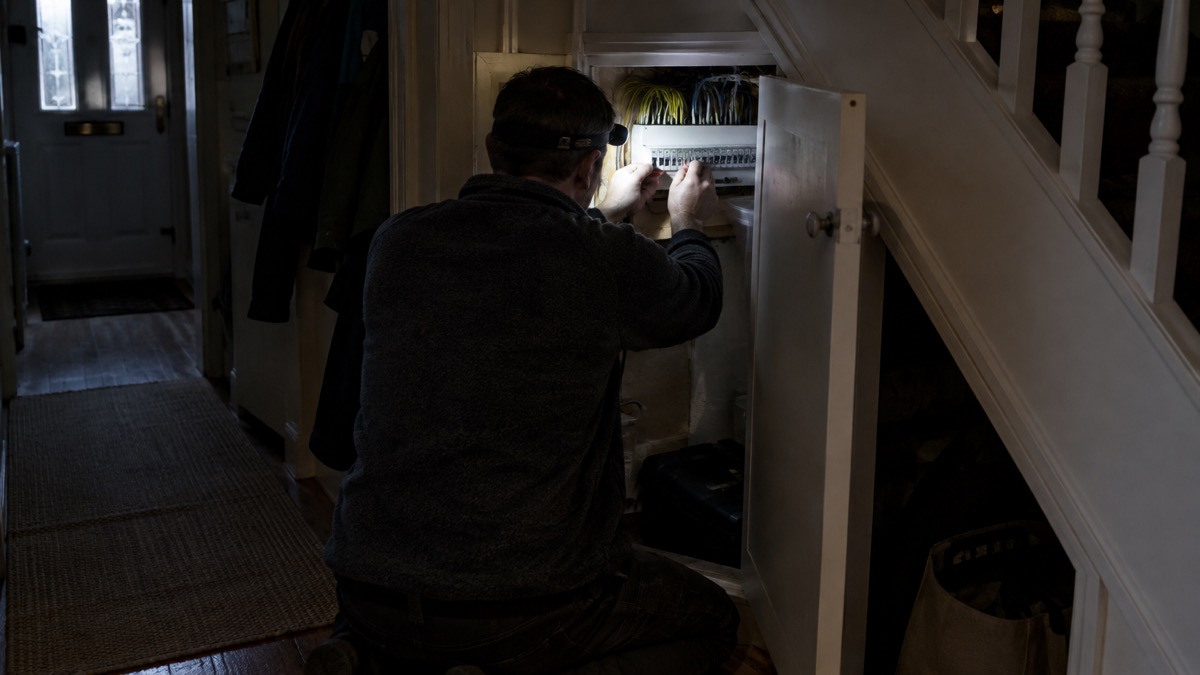
A head torch earns its place in a power cut because it solves the problem that stops people moving: you cannot carry a torch and a candle, or a torch and a child, at the same time. Strapped on, the light follows your gaze. The Spot's three lenses let you switch between a wide flood for lighting a room or a staircase and a tighter spot for looking at something specific, with a red-green-blue lens for preserving night vision1. The Spot 400-R offers proximity and distance modes, dimming, strobe and red night-vision, so you can run it low to conserve battery and turn it up when you need to see2.
The controls are deliberately simple, which matters when you are half awake. PowerTap takes you from any setting to full output with a tap of a finger on both models1. The Spot 400-R adds a multifaceted optical efficiency lens, which is the maker's description of how it shapes the beam2.
On the Spot, the maker's page carries a customer rating of 2.6 out of 5 from 5 reviews, and one reviewer's complaint is worth knowing about before you rely on the battery indicator: "when I had 3 fresh batteries in, the power meter only read one light, instead of three"1. Treat the meter as a rough guide and keep spare cells rather than trusting it to tell you the torch is full. The same page quotes a review from NYT Wirecutter describing the Spot as having "a bright beam, simple buttons, and great battery life", and noting its reliability and versatility among similarly priced peers1.
Lanterns for lighting a room
Black Diamond's lighting range is built around head torches, and the facts here describe the Spot and Spot 400-R rather than a separate lantern model. That matters for how you plan: if you want a light that stands on a table and fills a room, a head torch is not that, and you should think about how you will light a room before you buy.
There are two practical ways to get room light from a head torch. The first is to run it on a low or dimmed setting and hang or stand it so the beam falls on a ceiling or wall, which spreads the light around rather than throwing it in one direction. The Spot 400-R's dimming and its low setting of 6 lumens suit this: a low, wide wash of light is what you want for eating, dressing or moving about, and it draws far less from the battery than full output2. The second is to use the flood lens on the Spot, which is designed to light a broad area rather than a point1.
Set against that, the official checklists are clear that a torch is one item among several, not a substitute for the rest. Guidance for households preparing for a power cut lists an easily accessible supply of candles, matches, a torch and batteries, a battery operated radio tuned to the local radio station, a stockpile of food and water, a list of useful telephone numbers, and a portable camping gas cooker if you rely solely on electricity3. The fire and rescue service adds the warning that goes with the candles: always keep a torch handy for emergencies and never use lighted candles4.
For the full comparison of torches, lanterns and candles, and how to place lights so a room is usable rather than just visible, see Emergency Lighting at Home: Torches, Lanterns and Candles.
Batteries and charging: what to check
The battery is the part of a torch that decides whether it works when you need it, and it is also the part that carries a fire risk if it is damaged. The Spot takes three AAA batteries or the BD 1500 rechargeable battery, which is sold separately, and has a USB-C charge-in port for that pack1. The Spot 400-R has an integrated 1500 mAh lithium-ion battery with a micro-USB charge port2. Both are lithium-based when run on the rechargeable pack, and lithium-ion batteries are the type found in phones, e-bikes, e-scooters, mobility scooters, laptops, vapes and power tools, which is why the fire services give them so much attention6.
Check the battery regularly for damage or wear and tear8. The warning signs the fire service lists are specific: producing smoke, feeling extremely hot to touch, looking swollen or having any type of lump or leak, making a hissing or cracking sound, smelling unusual, or taking longer to charge or not fully charging9. If you see any of these, stop using and charging the device, and recycle the battery rather than using or charging it9.
| Check | What good looks like | What to do if it fails |
|---|---|---|
| Casing | Smooth, no swelling or lumps | Stop use, recycle the battery9 |
| Heat | Cool or mildly warm in use | Stop use if extremely hot to touch9 |
| Charging | Charges fully in the usual time | Stop use if it takes longer or will not fully charge9 |
| Smell and sound | Nothing unusual | Stop use if hissing, cracking or smelling odd9 |
| Wear | No damage or wear and tear | Check regularly and replace8 |
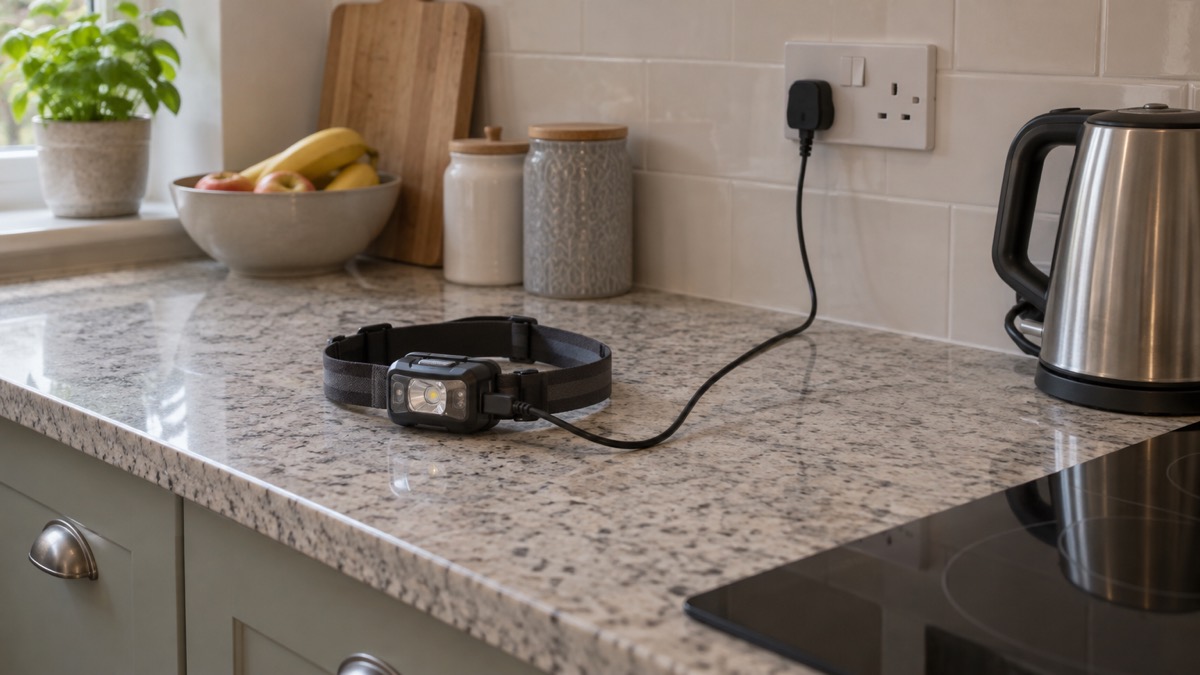
Charging practice matters as much as inspection. Charge on a hard, flat, heat-resistant surface, away from extreme heat, cold, direct sunlight and flammable materials6. Unplug when fully charged7. Store the product and its batteries in a cool place, avoiding extreme heat or cold9. For a household, the practical version is a kitchen worktop rather than a sofa cushion, and unplugging the cable once the light on the charger says it is done.
Water resistance and what the ratings mean
Both lights carry an IP rating, and the two ratings are not the same. The Spot is IPX7, described by the maker as waterproof and tested to operate up to 1 meter underwater for 30 minutes1. The Spot 400-R is IP67, tested to operate at least 1.0 meters underwater for 30 minutes2. The X in IPX7 means the rating says nothing about protection from dust or grit; the 6 in IP67 means it is dust-tight as well as water-resistant.
There is a discrepancy on the Spot 400-R's own page, which also describes the lamp as having an IPX8 waterproof housing2. The stated IP rating for the model is IP67, and the two figures do not agree. Treat the IP67 rating as the specification and the IPX8 line as a claim on the page that conflicts with it.
What the ratings mean in practice is that a dropped torch in a puddle, or a light used in the rain while you check a stopcock or a fence, is not the end of it. They do not mean the torch is dive equipment, and they say nothing about how it behaves if water gets past the seal after a knock. Dry the light and open it to let any moisture out before storing it, and do not charge a light that is wet.
Keeping Black Diamond lights ready in an emergency kit
The single most useful habit is where the light lives. Keep useful items in one easy-to-find place, ideally somewhere accessible if the lights are not working10. That last clause is the one people get wrong: a torch in the loft, or in a drawer you cannot see into, is no use in a blackout. Choose a spot you could reach in the dark, at the bottom of the stairs or by the front door, and keep the torch, its spare batteries and a small radio together there.
The rest of the kit is a matter of what your household needs. Official checklists suggest spare glasses or contact lenses kept at home11, a phone or alert device kept nearby in case you need help12, and, for anyone dependent on powered medical equipment, a battery back-up so the equipment keeps working when the power is out13. For a car, the winter kit advice includes a torch among the snow shovel, grit or cat litter, ice scraper, spare warm clothing, a blanket and a fully charged mobile phone14. For pets, an emergency kit should include an extra collar or harness15.
- Light: a head torch, plus a second torch for a family member
- Power: spare AAA cells for the Spot, or a charged power bank for the 400-R
- Information: a battery radio tuned to your local station3
- Contact: a written list of useful telephone numbers3
- Health: spare glasses or contact lenses11, and a battery back-up for essential medical equipment13
- Pets: an extra collar or harness15
Keep the whole kit in the one place, and check it on a fixed date each year, the way you would check a smoke alarm. Swap the batteries, run each torch for a minute, and put the kit back where you can find it in the dark.
Using and storing lights and batteries safely
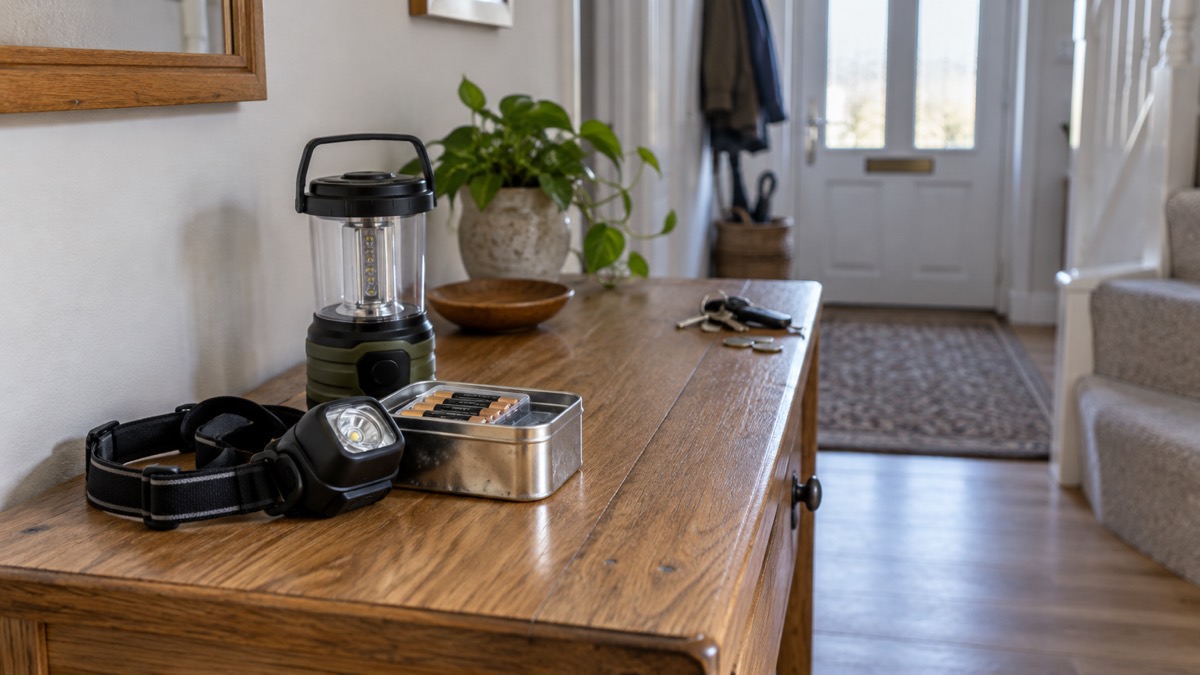
The fire and rescue service treats batteries as a fire risk in the home, and the advice is consistent across services. Keep batteries in a cool, dry place and away from metal objects like keys or coins5. Always store single-use batteries in their original packaging and away from metal objects, because contact with metal can cause overheating and a fire6. Store the product and its batteries in a cool place, avoiding extreme heat or cold9, and keep batteries away from flammable materials and direct sunlight16.
The maker builds in a safeguard for storage. Both the Spot and the Spot 400-R have a patented digital lock, which prevents the light switching on by accident when it is in a pack or a pocket1. Use it. A torch that has been knocked on in a drawer is a flat battery when you need it, and a hot one in a bag of metal objects is worse than that.
If you remove cells for long storage, keep them in their packaging and out of the way of keys and coins. If you leave them in, store the torch cool and dry, locked, and away from anything that could press the switch. Store matches, lighters and chemicals safely as well, and keep them out of reach of children17.
Safety notices and recalls
There is no Black Diamond recall in the material behind this page, and no safety notice naming a Black Diamond light. The advice that applies is the general product safety advice, and it is worth following for any electrical item in the home, torch included. Register your electrical items with the manufacturer so you are informed of any safety recalls18. Check for recalls or safety notices on the Electrical Safety First website20, and check periodically for recalls or notices relating to your specific models21. The Office for Product Safety and Standards issues recalls and alert notices on its website22.
Recalls do happen, and they are specific. A product recall was issued for Bull and Cygnus Fire Alarm Detection Systems23. A.Vogel Ltd recalled a batch of its Rapunzel Biosnacky seeds because of contamination, with point of sale notices displayed in stores selling the product24. Neither concerns a torch, but both show the pattern: a named product, a named fault, and a route to check whether yours is affected.
For a Black Diamond light, the check is simple. Compare the model name on the lamp with the maker's own page for that model, and if a recall is ever announced, it will name the model and the batch. Keep your proof of purchase with the torch's paperwork so a claim is straightforward if one is needed.
Support and warranty in the UK
All Black Diamond lighting products are covered by a three year warranty policy1. That is the headline for a UK buyer: a fault in the lamp within three years is a warranty question, and the first thing you will be asked for is proof of purchase. One buyer on the Spot 400-R page reports a lamp that "has failed to charge straight out of the box", having tried different cords and outlets, and says they were offered a 30% coupon code rather than a warranty repair because they did not have the original receipt2. Keep the receipt.
For a UK household, the practical steps are these. Buy from a recognised outdoor retailer rather than an unknown marketplace seller, and keep the receipt and the packaging. Register the product if the retailer or maker offers it, in line with the general advice to register electrical items so you hear about recalls18. If something goes wrong, contact the retailer first, then the maker, with the model name, the date of purchase and a description of the fault.
On counterfeit goods, the official advice for electrical products is to avoid counterfeit or cheaply made items and to verify that they meet safety requirements and carry CE or UKCA marking25. The maker's pages give the country of origin as Vietnam for the Spot and China for the Spot 400-R1, which is a detail to compare if a listing looks doubtful. If the price is far below the going rate, or the packaging and printing look poor, treat it as a warning sign and query it before you rely on the light.
For the wider question of what a household should hold and how to plan, start with Getting Started: Preparing Your Household for an Emergency and Emergency Kit: What a UK Household Should Keep Ready.
Sources (25)
- Spot Headlamp, Black Diamond Equipment, 2026-10-26
- Spot 400-R Rechargeable Headlamp, Black Diamond Equipment, 2026-10-25
- Be Prepared, Lancaster City Council, 2026-10-26
- Caravans and camping, North Yorkshire Fire and Rescue Service, 2026-05-13
- Battery safety, West Yorkshire Fire and Rescue Service, 2026-10-29
- Battery safety, Greater Manchester Fire and Rescue Service, 2026-10-29
- Battery safety, Tower Hamlets Council, 2026-10-29
- Lithium batteries, Surrey County Council, 2026-10-28
- Lithium-ion batteries, Scottish Fire and Rescue Service, 2025-11-27
- Be prepared for emergencies, North Devon Council, 2026-10-29
- Emergency kit checklist, Neath Port Talbot Council, 2026-10-29
- Falls prevention, Staffordshire County Council, 2026
- 12 tips to prepare for a power cut, Horsted Keynes Parish Council, 2026
- Road safety and fire rescue, Warwickshire County Council, 2026-10-29
- Your pets, Wiltshire and Swindon Prepared, 2026-10-25
- Recycle your batteries to prevent fires, Devon and Somerset Fire and Rescue Service, 2024-03-15
- Home Fire Safety - Northern Ireland Fire & Rescue Service, Northern Ireland Fire & Rescue Service
- Electrical, Greater Manchester Fire and Rescue Service, 2026-10-29
- Electrical fire safety leaflet, Greater Manchester Fire and Rescue Service, 2026
- White goods, Cheshire Fire and Rescue Service, 2026-05-20
- Electrical fire safety, Warwickshire County Council, 2026-10-29
- Electrical items, London Fire Brigade, 2026-10-25
- Product Recall for Bull and Cygnus Fire Alarm Detection System (FADS), Office for Product Safety and Standards, 2026-08-12
- A.Vogel Ltd recalls Rapunzel Biosnacky Das Original Red Clover Seeds, Food Standards Scotland, 2026-08-07
- Fire safety tips: smoking, vaping and using e-cigarettes, Warwickshire County Council, 2026-10-29