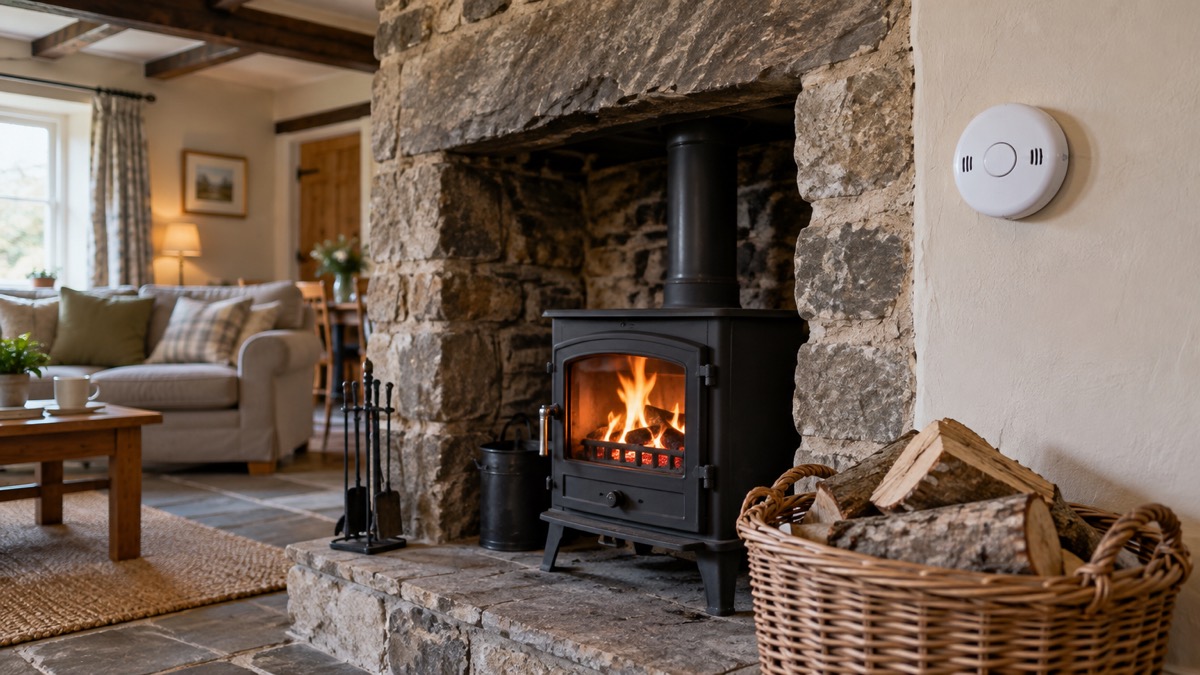
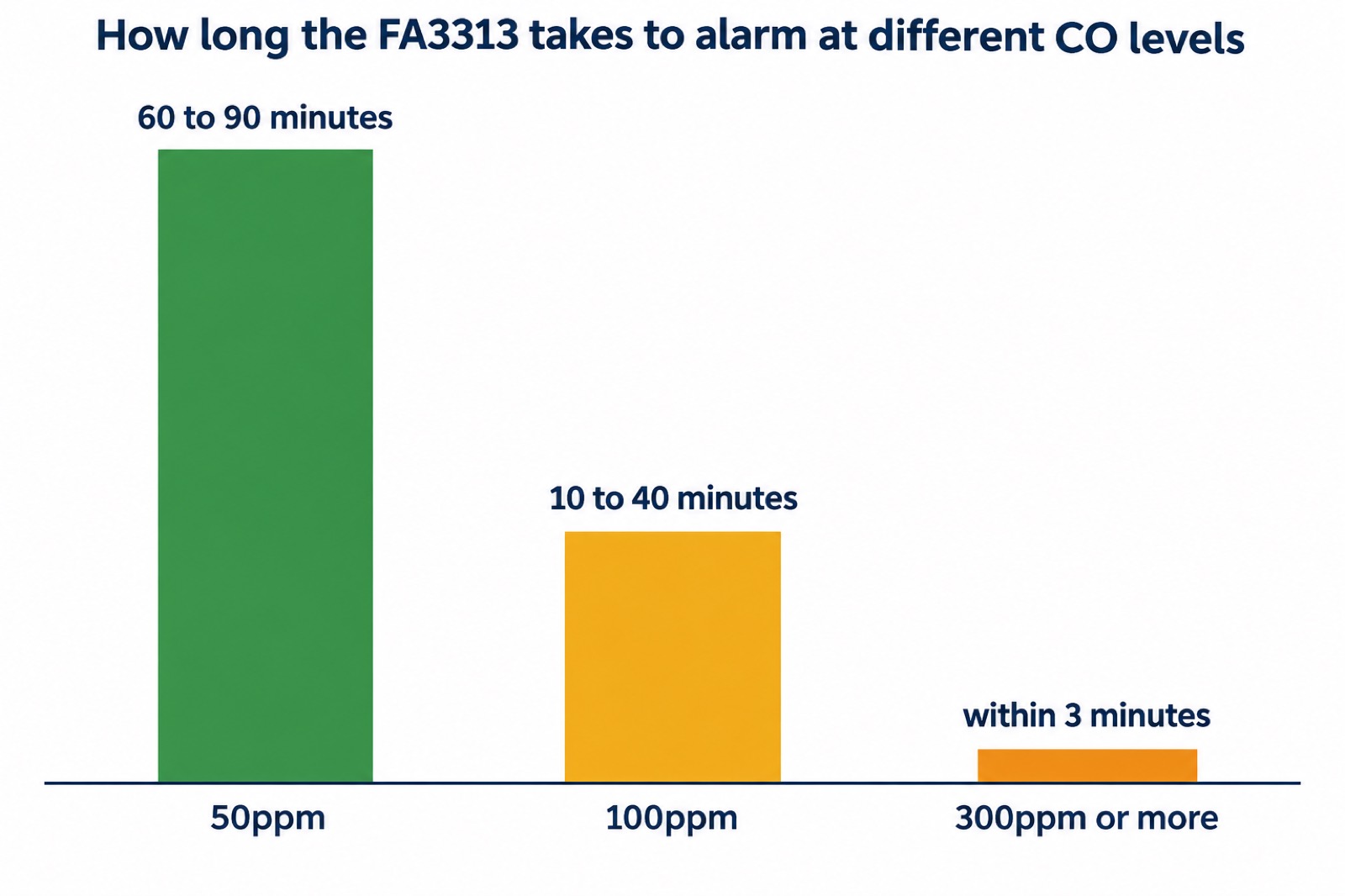
The FireAngel FA3313 is a battery-powered carbon monoxide alarm for the home, with a sensor the maker says lasts 10 years and two replaceable AA batteries that should be changed about once a year. It sounds at 85dB at 3 metres, and how quickly it goes off depends on how much carbon monoxide is present: within 3 minutes at 300ppm, between 10 and 40 minutes at 100ppm, and between 60 and 90 minutes at 50ppm1.
If it sounds, do not wait to work out why. The maker's instruction is to evacuate the property immediately, and the fire and rescue service advice is to get out and call the Gas Emergency Helpline on 0800 111 9991. A loud alarm is a warning that potentially lethal levels of carbon monoxide are present, and the maker's manual says never to ignore it1.
This page sets out what the FA3313 is, what its specifications mean in practice, where to fit it, how to silence it without taking a risk, and how to look after it so it is still working in ten years' time. It is a carbon monoxide alarm only: the maker states it is not a substitute for a smoke alarm or a combustible gas detector1.
If the FA3313 sounds: get out, ventilate and call the gas emergency line
A carbon monoxide alarm going off is not a nuisance to be silenced and forgotten. The maker's manual is blunt: "A loud alarm is a warning that potentially lethal levels of carbon monoxide are present. NEVER IGNORE THIS ALARM, FURTHER EXPOSURE CAN BE FATAL."1
The action is the same whichever official source you read. The maker says to evacuate the property immediately1. The fire and rescue service says: "If the alarm sounds, get out and call the Gas Emergency Helpline on 0800 111 999."2 The gas emergency helpline number is 0800 111 9994.
- Get everyone out of the property. Do not stop to open windows first if that delays you.
- Once out, call the Gas Emergency Helpline on 0800 111 9992.
- Do not re-enter until you are told it is safe. The maker warns that, depending on the level of carbon monoxide detected, it can take up to 10 minutes to clear the sensor and for the alarm to stop, and says not to re-enter the property until the alarm has stopped1.
- Do not smoke or use naked flames until you are sure there is no leaking gas5.
If you can smell gas as well, the advice is slightly different in emphasis: open a window if you can, leave the property immediately, call the National Grid on 0800 111 999, and do not smoke or use naked flames until you are sure there is no leaking gas5. Northern Ireland's advice is to contact the Gas Emergency Service immediately6.
What the FA3313 is: a battery CO alarm with a 10-year sensor
The FA3313 is a standalone carbon monoxide alarm that runs on disposable batteries, which Which? lists as its power source7. The maker describes it as a CO alarm with a 1 year battery, with a 10 year sensor life3. It uses an advanced electrochemical sensor, calibrated and tested in CO gas, with an intelligent sensing algorithm that increases the sensing rate when it detects low level carbon monoxide3.
That sensing detail matters more than it sounds. The sensor samples every 55 seconds in normal conditions, but on detection of carbon monoxide the algorithm increases the sensor rate to 12 seconds1. In plain terms, once it has caught a trace, it starts checking far more often.
It also has a memory function that indicates a previous alarm activation, and data logging support via cable3. The memory function is the one most households will use: it tells you whether the alarm went off while you were out.
The unit is 119mm wide, 62mm high and 38mm deep, weighs 128g, and is made of fire retardant ABS3. It is independently tested by BSI under certificate number KM 551504, and certified to BS EN 50291-1: 2018 and BS EN 50291-2: 20193. The second of those standards is the one that covers caravans and boats, which is why the maker can list it for those settings.
If you are moving from an older unit, the fitting advice below is worth reading again rather than assuming the old position still applies.
Specifications: 85dB at 3m, AA batteries, -10°C to +40°C
The headline figures are the ones that decide whether it suits your home and where it can go.
| Specification | Figure |
|---|---|
| Alarm sound level | 85dB at 3m (minimum)3 |
| Sensor type | Advanced electrochemical3 |
| Sensor life | 10 years, replace unit after 10 years of operation1 |
| Batteries | 2 x replaceable AA alkaline, over 1 year in normal use1 |
| Supply voltage | 3V DC3 |
| Operating temperature | -10°C to +40°C1 |
| Operating humidity | 30 to 90% RH1 |
| Dimensions | 119mm x 62mm x 38mm3 |
| Weight | 128g3 |
| Installation | Wall or free-standing, integrated mounting bracket3 |
| Standards | BS EN 50291-1: 2018, BS EN 50291-2: 20193 |
| Warranty | 5 years3 |
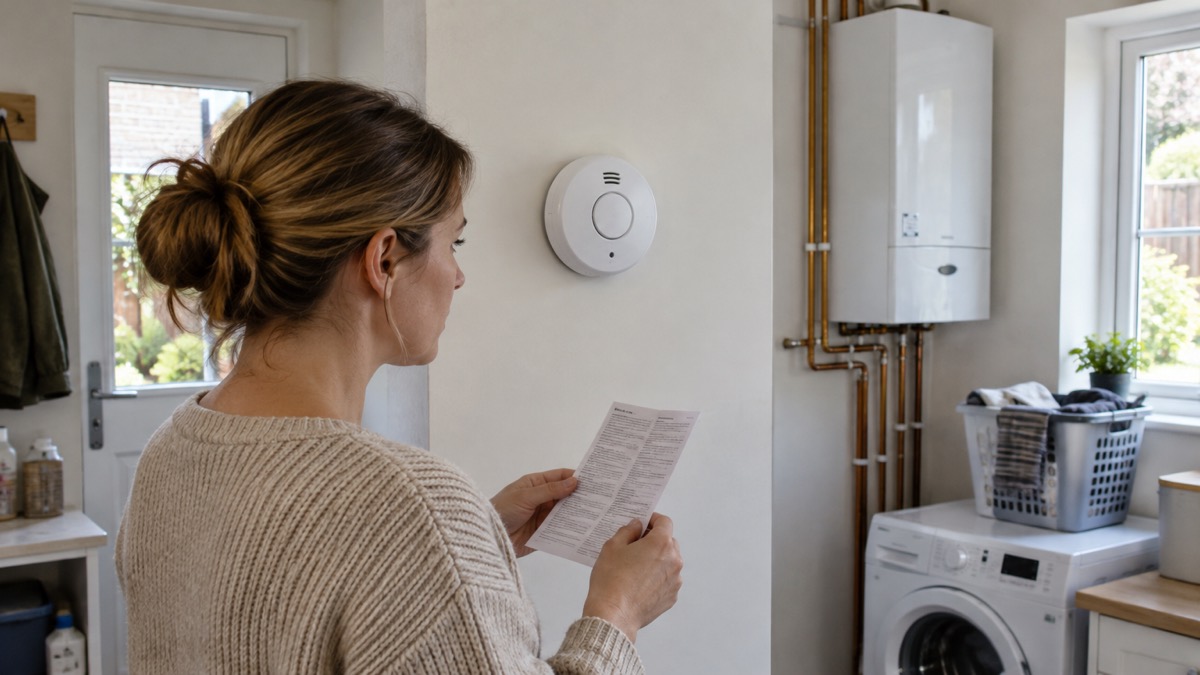
The temperature range is wider than most people expect, and the maker recommends fitting it in a room where the temperature stays between -10°C and 40°C for the earliest warning, warning that use outside those temperatures will reduce product life1. A garage or an unheated outbuilding that swings below freezing in winter is therefore a compromise, not a first choice.
The maker also warns that prolonged exposure to extreme high or low temperatures may reduce the life of the batteries1. If your alarm lives somewhere cold, expect to change the batteries more often than once a year.
Which? notes that the FA3313 can be wall-mounted or freestanding and has a large test and hush button8. The freestanding option is useful if you want to move it between a living room and a bedroom, but a wall fixing is more reliable for a permanent position.
How quickly it alarms at 50, 100 and 300ppm
Carbon monoxide alarms are deliberately not instant. They are designed to avoid false alarms from tiny traces while still giving enough warning to act, and the FA3313's response times are set out in the maker's manual1.
| Carbon monoxide level | Time to alarm |
|---|---|
| 50ppm | Between 60 and 90 minutes1 |
| 100ppm | Between 10 and 40 minutes1 |
| 300ppm or more | Within 3 minutes1 |
Read that table as a warning about slow leaks. At 50ppm, a level the maker's own exposure table links to symptoms, the alarm may take an hour and a half to sound1. A faulty appliance giving off a steady low level overnight could have been producing carbon monoxide for most of the night before the alarm wakes you. That is why the alarm belongs in or near the room where you sleep as well as near the appliance.
At the other end of the scale, 300ppm or more brings the alarm within 3 minutes1. The maker's exposure table gives a sense of why: 200ppm can bring slight headache, fatigue, dizziness and nausea after 2 to 3 hours, and 400ppm brings frontal headaches within 1 to 2 hours and is life threatening after 3 hours1.
The FA3313 gives you the alarm, the memory function and the indicator lights, not a running ppm readout1. The maker's intelligent sensing algorithm increases the sensing rate on detection of low level CO, so the alarm responds sooner once carbon monoxide is present1.
Where to fit it: 1 to 3 metres from the appliance
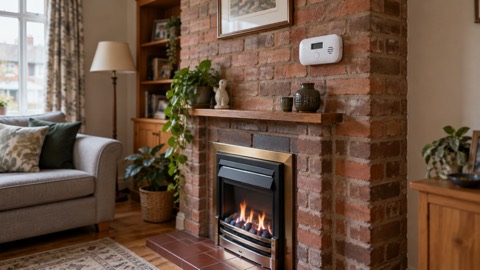
Position decides whether the alarm works. The maker's rule for a room with a fuel-burning appliance is a horizontal distance of between 1m and 3m from the potential source, on the same side of a partition wall as the source, and at the high side of the room if the ceiling slopes1.
- Wall mounting: close to the ceiling, higher than any door or window, and at least 150mm from the ceiling1.
- Ceiling mounting: at least 300mm from any wall and from any ceiling obstruction such as light fittings1.
- Avoid: placing it directly above a source of heat or steam1.
- Additional alarms: the maker suggests more alarms in remote rooms where people spend considerable time awake and might not hear an alarm elsewhere, and in every sleeping room1.
The maker says the alarm must be installed by a competent person, able to install according to the instructions1. For most households that means a qualified fitter or a competent DIYer working carefully through the manual, not a rushed job on a stepladder.
The FA3313 is listed for domestic premises including static and mobile homes, caravans, motor caravans and boats, and the maker points to EN 50292 for more on positioning and mounting in those settings1. In a caravan or boat, fit a detector in the same room as any combustion appliance9.
Silencing the alarm and when it will not stop
The FA3313 has a silence function, but it is deliberately limited. Pressing the button stops the sounder and puts it into silence mode for 5 minutes; after 5 minutes, if the carbon monoxide level is still high, the device will sound again9.
There is a hard limit. The maker states: "The alarm will not silence if more than 150ppm has been detected."1 Silence mode can also only be activated once, until carbon monoxide returns to negligible levels9. If you press the button and nothing happens, that is the alarm telling you the level is too high to be quietened, and the answer is to get out and call 0800 111 9992.
There is a separate function for a low battery chirp at night. The alarm will silence for 8 hours and the amber LED will continue to flash1. You can use this a maximum of 10 times1. During that mode the unit still detects carbon monoxide and will alert you to any new faults10. Use it to get through the night, then change the batteries in the morning.
Changing the AA batteries and the monthly test
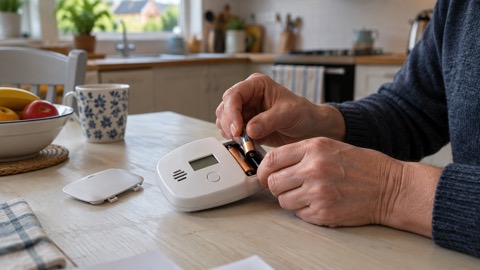
The FA3313 takes 2 x AA alkaline batteries, supplied with the unit3. The maker says battery life exceeds 1 year under normal operating conditions, and the batteries are replaceable1. The maker's recommended batteries are Size AA Alkaline: Gold Peak GN15A, Energizer EN91, Panasonic LR6XWA and Duracell MN15001.
When the batteries run down, the alarm gives 1 beep per minute and 1 amber flash per minute, and for the FA3313 the instruction is simply to replace the batteries1. That is different from some other FireAngel models, where a low battery means replacing the whole alarm within 30 days1. Check which model you have before you act.
To change them, twist the unit off its mounting bracket, take out the old batteries, fit the new ones the right way round, and refit. The maker adds a specific note for this model: "For FA3313, ensure batteries do not dislodge when removing unit from the wall."1 Check the batteries are still seated before you put it back.
The routine is short:
- Every month: test the alarm by pressing the Test button1.
- Every 3 months: vacuum the alarm1.
- Never: paint the alarm or use cleaners or solvents on it1.
If the alarm has been sitting in its packaging, note that after activation you should wait 1 minute for the device to be operational, and it will not sound before that minute has passed9.
Replace the whole alarm after 10 years
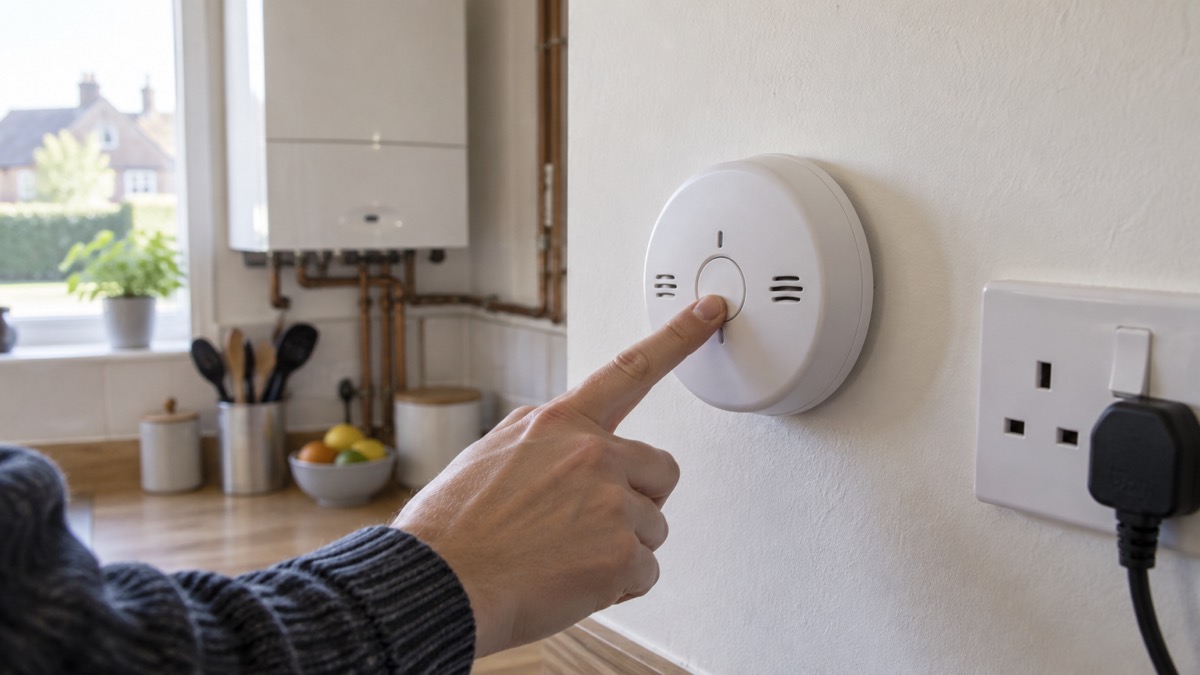
The sensor has a working life, and no amount of fresh batteries extends it. The maker's instruction is to replace the alarm every 10 years, and the sensor life is given as 10 years with the unit replaced after 10 years of operation1. The replacement date is next to the REPLACE BY marking on the unit9.
That is the date to put in your diary or calendar now, while you still have the packaging. A CO alarm that is well past its replacement date and still beeping when tested is not protecting anyone: the sensor has drifted and the reading can no longer be trusted.
The warranty is 5 years3, which is shorter than the sensor life. Keep the receipt or order confirmation somewhere you can find it, because a claim inside five years will normally need proof of purchase.
The FA3313 is one of a range. If you want a display, a different battery arrangement or a combined unit, the maker's other models include the FA3322 and the FA3820, and there are combined smoke and CO units such as the SP530 and SP540. Our guide to carbon monoxide alarms sets out the wider choice, and sealed or replaceable battery alarms explains the trade-off the FA3313 sits on the replaceable side of.
Support, warranty and getting help
FireAngel's customer support specialists are based in the UK and can help with product advice, installation queries and troubleshooting by phone, email or live chat10. For the FA3313 the contact details are:
- Phone: 0330 094 58301
- Email: technicalsupport@fireangeltech.com1
- Online: www.fireangeltech.com/support1
- Fire and rescue service customers: 0800 141 25611
- Support hours: 9am to 5pm Monday to Friday11
The maker states that the user manual is also available in large text and other formats, and asks you to email or call to find out more1. If someone in the household is deaf or hard of hearing, a large print manual is only part of the answer: FireAngel says it makes carbon monoxide alarms with visual alerts as well as sound so people are alerted regardless of hearing level, and our guide to alarms for deaf and hard of hearing people covers what to look for.
If you are not sure whether you need a CO alarm at all, our page on whether you need a carbon monoxide alarm sets out the situations that call for one, and where to put a carbon monoxide alarm goes further into positioning. If your alarm is beeping rather than sounding a full alarm, why is my carbon monoxide alarm beeping explains the difference between a low battery chirp, a fault and a real alert.
For the wider picture, the Home Emergencies section covers fire, gas leaks and burst pipes, and what to do if your CO alarm sounds or you suspect carbon monoxide walks through the response step by step. FireAngel's own safety pages are at FireAngel.
Sources (12)
- FA3313, FA3322, FA3328 and FA3820 EU manual, FireAngel, 2024-09
- Carbon monoxide safety, Devon and Somerset Fire and Rescue Service, 2026
- FA3313 data sheet, FireAngel, 2024-09
- Pesach fire safety, Greater Manchester Fire and Rescue Service, 2026-10-29
- Prepare yourself, Greater Manchester Combined Authority, 2026-10-29
- Energy, power supply and utilities | nidirect, nidirect (Northern Ireland government)
- Carbon monoxide symptoms, Which?, 2026-07-14
- Best carbon monoxide detectors - Which?, Which?
- FA3820 EU manual, FireAngel, 2026-07
- Carbon monoxide safety at home, FireAngel, 2026-07-31
- Spec+ combined manual, FireAngel, 2026
- Our solutions, FireAngel, 2026-07-27
 FireAngel FA3322 CO Alarm
 FireAngel FA3820 CO Alarm
 FireAngel FA6812 CO Alarm
 FireAngel FA6813 CO Alarm
 FireAngel FA6829S CO Alarm
 FireAngel CW1-PF CO Alarm
 FireAngel W2-CO-10X CO Alarm
 FireAngel FP1820W2-R CO Alarm
 Kidde K7DCO CO Alarm
 Kidde K5DCO CO Alarm
 Kidde K10LLDCO CO Alarm
 Kidde K10LLCO CO Alarm