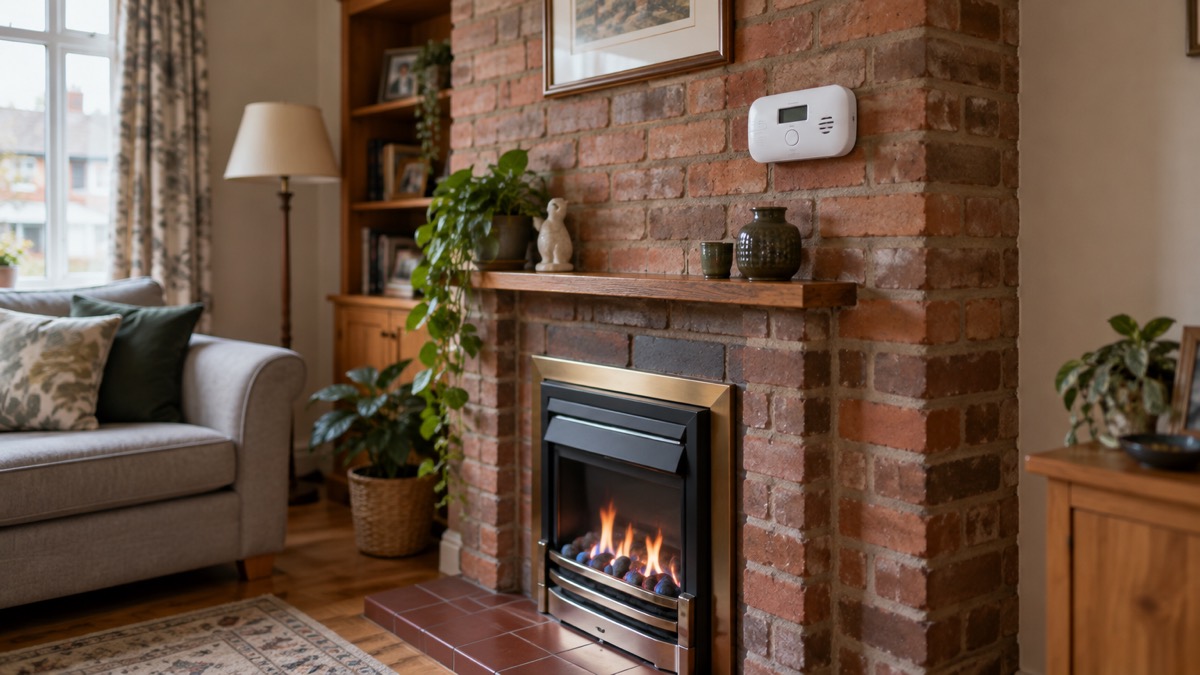
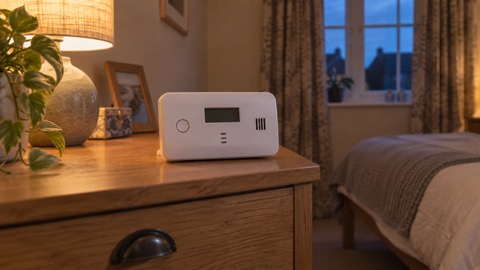
The FireAngel FA6829S is an ultra-slim carbon monoxide alarm with a sealed battery that lasts ten years and a small digital display showing carbon monoxide levels in parts per million. It detects carbon monoxide only, not smoke or fire, and it is designed to sit in the same room as a boiler, gas fire, wood burner or other fuel-burning appliance, between 1m and 3m horizontally from the source1.
If it sounds, it emits four loud beeps followed by a pause, repeated continuously, at 85dB. That is a warning that potentially lethal levels of carbon monoxide may be present. The maker's instruction is blunt: "NEVER IGNORE THIS ALARM, FURTHER EXPOSURE CAN BE FATAL"2. Open doors and windows, stop using and turn off fuel-burning appliances if you can, get everyone out, ring your fuel supplier's emergency number, and get medical help for anyone with symptoms such as headache or nausea, saying carbon monoxide poisoning is suspected2.
This page sets out what the alarm is, where to fit it, how it responds at different gas levels, how to silence it safely, what its beeps and chirps mean, and how to look after it until the whole unit is replaced at the end of its life. For the wider picture, see Carbon Monoxide Alarms: What They Do and How to Choose and What to Do If Your CO Alarm Sounds or You Suspect Carbon Monoxide.
What the FA6829S is and what it can and cannot do
The FA6829S is a battery-powered carbon monoxide alarm made by FireAngel, a UK brand established since 1998 with customer support specialists based in the UK3. Its defining features are a 10-year sealed battery, a 10-year sensor life and a compact digital display that shows carbon monoxide levels in ppm and gives clear visual instructions1. The maker backs it with a 5-year manufacturer's warranty1.
The display matters in a real event. When the alarm triggers, the screen shows a clear "ALARM" message alongside the current carbon monoxide level in parts per million, so you and any engineer can see what was detected5. The alarm also records previous events: after an activation, the red memory indicator flashes to show the alarm was triggered, even if you were not present at the time5.
What it cannot do is just as important. The maker states plainly that "this carbon monoxide (CO) alarm detects carbon monoxide only. It will not alert you to smoke or fire"1. The manual adds that a carbon monoxide alarm is not a substitute for a smoke alarm or a combustible gas detector2. If you need smoke cover, see Smoke Alarms: Types and How to Choose One; if you smell gas, see What to Do If You Smell Gas.
| Feature | FA6829S specification |
|---|---|
| Power | Tamperproof 10-year sealed battery1 |
| Sensor | Electrochemical CO sensor, 10-year sensor life1 |
| Display | Digital, shows CO level in ppm and an "ALARM" message1 |
| Sound level | 85dB at 3m1 |
| Alarm pattern | 4 loud beeps, pause, repeated1 |
| Profile | 25mm deep1 |
| Splash protection | IP441 |
| Mounting | Wall, free-standing or portable1 |
| Operating temperature | -10°C to 40°C2 |
| Operating humidity | 25% to 95% RH2 |
| Warranty | 5-year manufacturer's warranty1 |
Where to fit it: 1m to 3m from a fuel-burning appliance
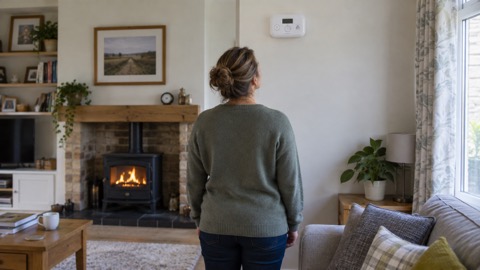
Fit the alarm in the same room as the appliance, at a horizontal distance of between 1m and 3m from the potential source2. The maker's product guidance says the same: place it between 1m and 3m horizontally from the source1. That distance gives the sensor a realistic sample of the air around the appliance without sitting directly in the draught or heat of it.
On a wall, position it close to the ceiling, at least 150mm from the ceiling and higher than any door or window. On a ceiling, keep it at least 300mm from any wall or light fitting1. The manual recommends fitting it in a room where the temperature stays between -10°C and 40°C for the earliest warning2. Avoid areas that are excessively dusty, greasy or exposed to solvent fumes1, and do not expose the alarm to fumes from petrol, diesel, solvents, greases, alcohols or organic cleaning fluids2.
Which rooms? The maker advises every room containing a fuel-burning appliance such as a boiler, gas fire or wood burner. For additional protection, fit one in every bedroom and in rooms where occupants may not hear an alarm elsewhere1. The manual adds that detectors for bedrooms, and for parts of the home far from fuel-burning appliances, should sit relatively near occupants' breathing zone2. For more on placement, see Where to Put a Carbon Monoxide Alarm.
Wall mounting needs two holes 82mm apart, drilled at Ø 5.0mm2. If you would rather not drill, the alarm can stand free-standing or be carried as a portable unit1.
What happens when it sounds: four beeps and a pause
The FA6829S alarm pattern is four loud beeps followed by a pause, repeated continuously1. It is deliberately different from a smoke alarm, which pulses rapidly, and from the low-battery warning, which is a single chirp every 40 to 60 seconds5. Knowing the difference tells you instantly whether you are dealing with carbon monoxide or a battery issue.
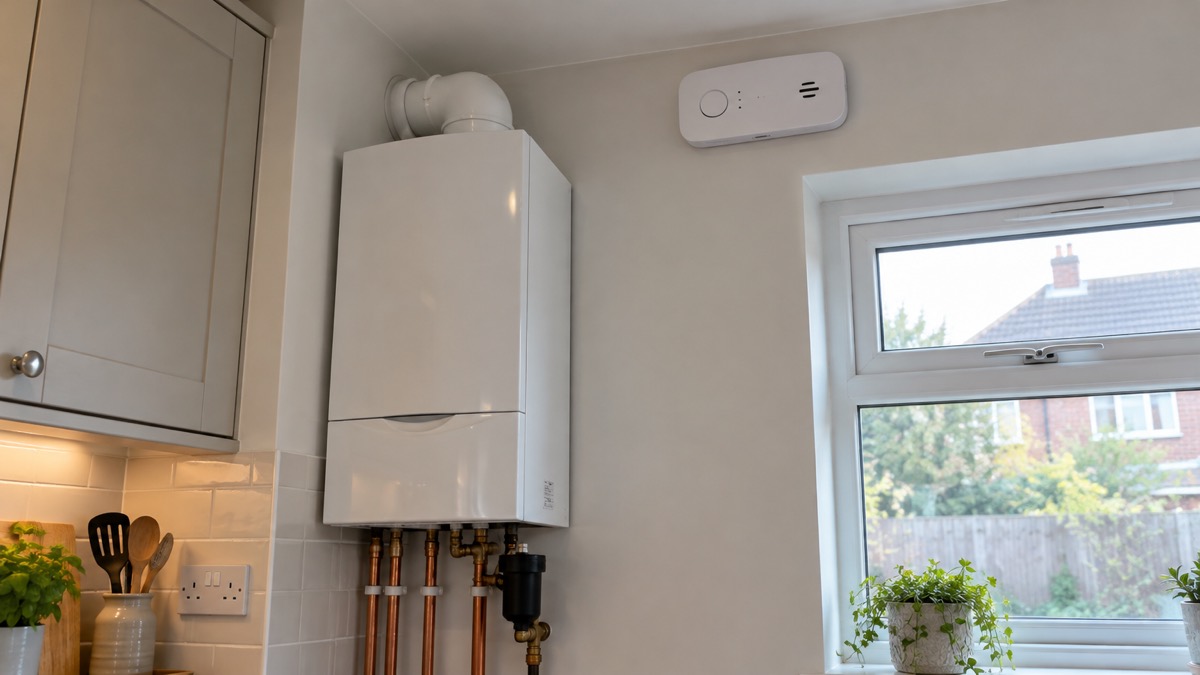
The maker's manual sets out the response in order: keep calm; open doors and windows to ventilate the property; stop using all fuel-burning appliances and, if possible, turn them off; evacuate the property immediately; ring your fuel supplier on their emergency number; do not use appliances again until they have been checked by an expert; and get medical help immediately for anyone suffering the effects of carbon monoxide poisoning, such as headache or nausea, advising that carbon monoxide poisoning is suspected2.
The alarm may keep sounding after the air clears. Depending on the level of carbon monoxide detected, it can take up to 10 minutes to clear the sensor and for the alarm to stop2. That is not a reason to stay inside; it is a reason to wait outside.
If you come home to a flashing red memory indicator, the alarm was triggered while you were out5. Treat it as a real event: ventilate, stop using fuel-burning appliances and have them checked by an expert before use2.
Response times at different carbon monoxide levels
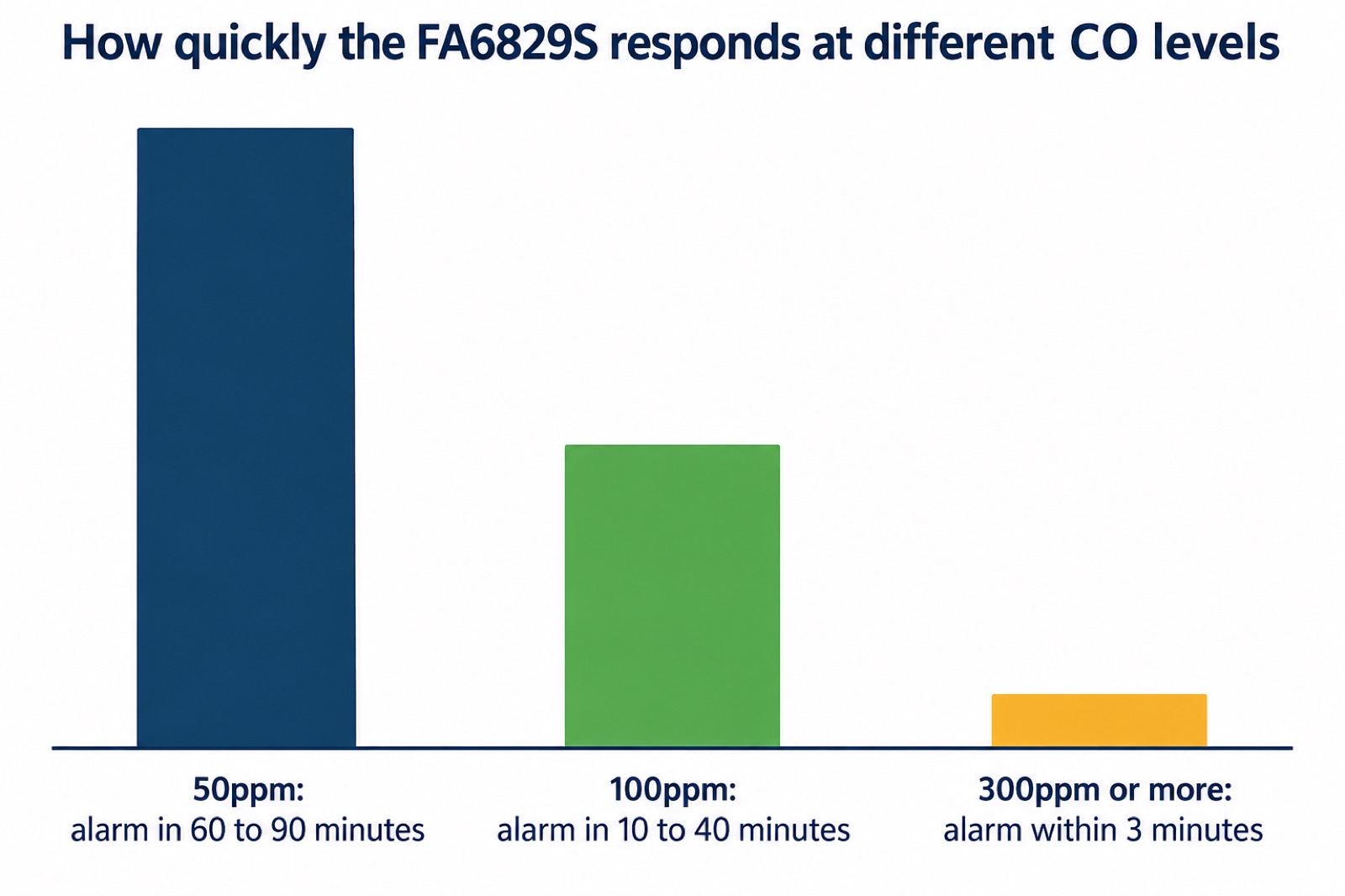
The FA6829S does not wait for a fixed threshold before sounding. Its response time shortens as the concentration rises, so a serious leak triggers it quickly while a slow build-up still gets caught.
| Carbon monoxide level | Alarm response time |
|---|---|
| 50ppm | Between 60 and 90 minutes2 |
| 100ppm | Between 10 and 40 minutes2 |
| 300ppm or more | Within 3 minutes2 |
The manual also sets out what those concentrations do to people, which explains why the response times matter. At 200ppm, slight headache, fatigue, dizziness and nausea can follow after 2 to 3 hours. At 400ppm, frontal headaches within 1 to 2 hours, life threatening after 3 hours. At 800ppm, dizziness, nausea and convulsions within 45 minutes, unconsciousness within 2 hours, and death within 2 to 3 hours2.
The manual groups the effects of exposure into mild, medium and extreme. Mild exposure brings a slight headache, vomiting and fatigue, often described as flu-like symptoms. Medium exposure brings a severe throbbing headache, drowsiness, confusion and a fast heart rate. Extreme exposure brings unconsciousness, convulsions, cardiorespiratory failure and death2. Official NHS guidance lists a similar range: headache, dizziness, feeling sick or being sick, feeling weak, tiredness and confusion, chest and muscle pain, shortness of breath, flushing and loss of vision6. Fire and rescue services add that the symptoms can easily be mistaken for flu, food poisoning, a viral infection or tiredness7. For a fuller symptom guide, see Carbon Monoxide Poisoning Symptoms.
Silencing the alarm, and when it will not silence
The FA6829S has a silence function, but it is deliberately limited. When you press to silence, the sounder stops and the alarm enters silence mode for 10 minutes2. After that it will sound again if carbon monoxide is still present.
There is a hard limit. The maker's manual states: "The alarm will not silence if more than 200ppm has been detected"2. At high concentrations, the alarm keeps sounding whatever you press, because the risk is too great to allow a pause.
The alarm also has a quiet self-test. A double press of the test button performs a self test at full alarm volume, 85dB at 3m1. Separately, the maker offers a quiet test at least 10dB below the full volume of the alarm1. The manual advises testing the alarm every month by briefly pressing the central test area2. For more on routines, see How Often to Test Smoke and CO Alarms.
The FA6829S also has Night-time Sensing, which dims the LED for restful sleep1. The power icon LED has an automatic brightness adjustment2, so a bedroom unit should not keep you awake with a bright light.
Low battery chirps and Sleep Easy
The FA6829S has a sealed battery designed to last the life of the alarm, so you do not change it. The low-battery warning is a single chirp every 40 to 60 seconds1. If you hear that pattern, the battery is nearing its end and the alarm is approaching replacement.
Sleep Easy is the maker's name for silencing low-battery chirps. On the FA6829S it silences the chirp for up to 9 hours and can be used up to 10 times1. It is a night-time convenience, not a repair: it does not restore the battery, and once the uses are gone the chirp returns.
If the chirp persists and the alarm is near the end of its life, plan the replacement rather than relying on repeated silencing. For the general picture, see Why Is My Carbon Monoxide Alarm Beeping? and When to Replace a Smoke, Heat or CO Alarm.
End of life: three rapid beeps every 60 seconds means replace the whole unit
The FA6829S is not repairable. When the sensor reaches the end of its life, it will emit 3 rapid beeps every 60 seconds alongside 3 rapid yellow LED flashes1. The maker's instruction is to replace the entire unit immediately, because the electrochemical sensor deteriorates over time and cannot be serviced or recalibrated1.
The replacement date is printed on the alarm. You can find it next to the "REPLACE BY" marking2. Note it when you fit the alarm so you know when to expect the end-of-life signal.
Maintenance between replacements is simple. The manual advises vacuuming the alarm every 3 months, not using cleaners or solvents, not painting the alarm, and replacing the alarm every 10 years2. The maker also states a 10-year sensor life and a 5-year manufacturer's warranty1.
Caravans, motorhomes, boats and Scottish rules
The FA6829S is certified for more than the home. The maker states it is certified to BS EN 50291-1:2018 for domestic use and BS EN 50291-2:2019 for use in caravans, motorhomes and boats1. Its 25mm profile, IP44 splash protection and tamperproof 10-year sealed battery make it suited to caravans, campervans and similar spaces, and it can be wall mounted, free-standing or portable1. A separate maker support article describes the BS EN 50291-2:2019 certification as covering leisure accommodation vehicles including caravans, campervans, motorhomes and boats5; the two maker documents word the scope slightly differently but agree on the standard.
In Scotland, the maker states that regulations introduced in 2022 require sealed, tamper-proof batteries for the full lifespan of the alarm, and that the FA6829S meets that requirement5. Alarm rules differ across the UK; for the wider picture see Alarm Standards: BS 5839-6, BS EN 50291 and System Grades and Wales and Northern Ireland: Alarm Rules and Fire Services.
Support, warranty and the manual in other formats
FireAngel's customer support specialists are based in the UK and can help with product advice, installation queries and troubleshooting by phone, email or live chat3. The maker's manual states that the user manual is also available in large text and other formats; to ask, email technicalsupport@fireangeltech.com or call 0330 094 58308. FireAngel can be contacted on 02476 323232 or at sales@fireangel.co.uk, and its alarms are sold at leading retailers such as B&Q, Tesco, Robert Dyas, Mothercare and Boots3.
The FA6829S carries a 5-year manufacturer's warranty and a 10-year sensor life1. Independent guidance on FireAngel alarms notes that some models carry a 7-year life guarantee9, so check the paperwork for your own unit rather than assuming.
Sources (9)
- FA6829S Ultra Slim CO Alarm, FireAngel, 2026-10-28
- FA6829S EU Manual, FireAngel, 2026
- Carbon Monoxide Safety, FireAngel, 2026-07-31
- Carbon Monoxide Poisoning, Carmarthenshire County Council, 2023-12-11
- FireAngel Product FAQs, FireAngel, 2026-10-29
- Carbon Monoxide Poisoning, NHS, 2025-12-16
- Diogelwch Carbon Monocsid, Mid and West Wales Fire and Rescue Service, 2026-10-29
- FA8080BW-R-Wifi-3-Gateway-Manual.pdf, FireAngel Safety Technology Limited
- About CO Alarms, CO-Gas Safety, 2024-02-18
 FireAngel FA3313 CO Alarm
 FireAngel FA3322 CO Alarm
 FireAngel FA3820 CO Alarm
 FireAngel FA6812 CO Alarm
 FireAngel FA6813 CO Alarm
 FireAngel CW1-PF CO Alarm
 FireAngel W2-CO-10X CO Alarm
 FireAngel FP1820W2-R CO Alarm
 Kidde K7DCO CO Alarm
 Kidde K5DCO CO Alarm
 Kidde K10LLDCO CO Alarm
 Kidde K10LLCO CO Alarm