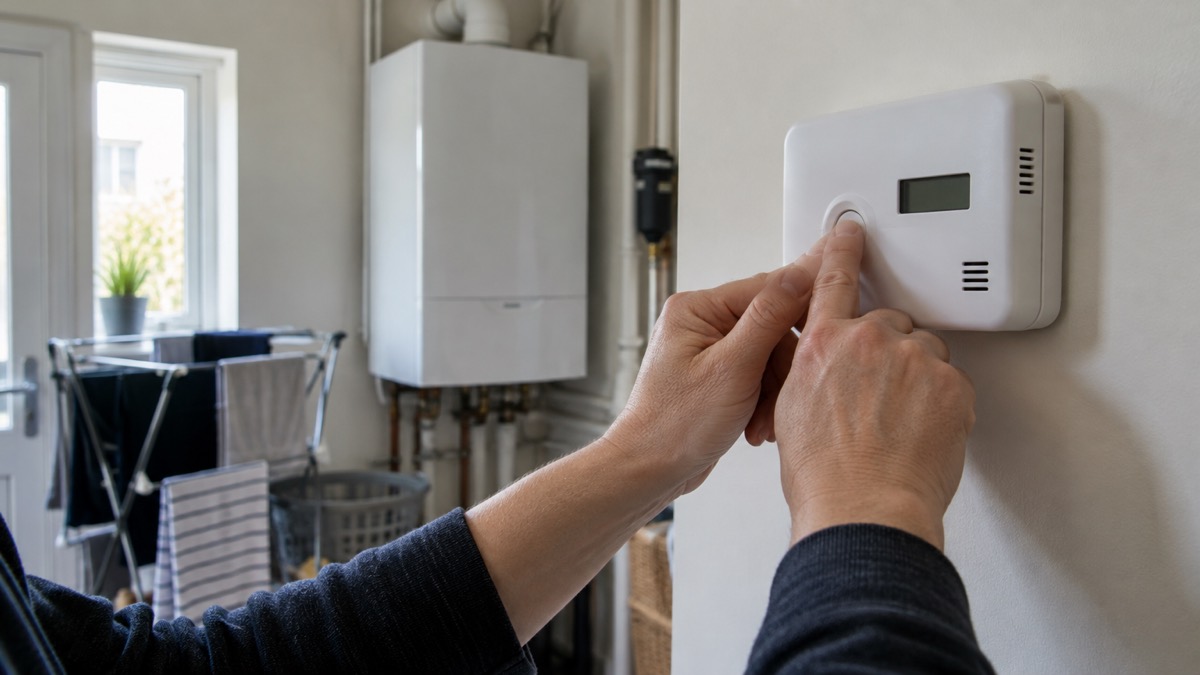
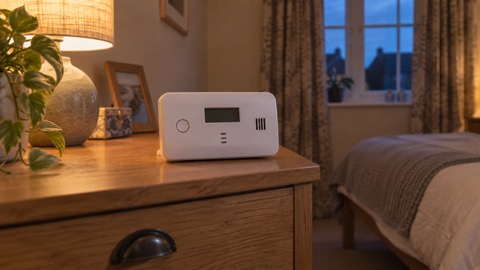
The Kidde K5DCO is a battery-powered carbon monoxide alarm for the home, with a digital screen that shows CO levels as they rise. It runs on two AA batteries, sounds at 85dB, and the distributor lists a product life of 10 years1. Carbon monoxide is odourless and invisible, which is why a detector is the only way to know it is there before you feel unwell2.
If you are thinking of fitting one, the practical points are these. It mounts at head height, either on the wall with the fixings supplied or freestanding on a shelf1. It is Kitemarked to BS EN 50291-1: 2018 and carries CE and UKCA marks1. It is a standalone alarm, so it does not link to other alarms in the house1. And it will chirp and show a message on the screen when the batteries run low1.
This page sets out what the alarm does, the specifications that decide where it suits, where to put it, how to look after the batteries and the test button, and what to do at the end of its life. It does not cover what to do if the alarm actually sounds: that is a separate decision, and it is covered on our page on what to do if your CO alarm sounds.
What the Kidde K5DCO does, and what the screen adds
A carbon monoxide alarm is a device built to detect an odourless, invisible gas2. The K5DCO does that with an electrochemical sensor, and it adds a digital display of CO readings1. That display is the feature that separates it from a plain alarm with no screen.
The screen matters because it shows you the level before the alarm triggers. FireAngel, a maker of CO alarms, describes the principle: a built-in screen shows real-time CO levels, letting you spot rising concentrations before the alarm triggers4. On the K5DCO the display starts reading from 30ppm, while the alarm itself sounds from 50ppm1. So there is a band between the two figures where the screen is telling you something the sounder has not yet acted on.
That is useful in two situations. If you have a fuel-burning appliance that you suspect is not burning cleanly, a rising reading gives you a warning to act on before anyone feels ill. And if the alarm has sounded and then stopped, the screen can tell you whether the level has fallen or is still climbing.
What it cannot do is replace the alarm. The sounder is the part that wakes you at night, and at 85dB it is loud enough for that purpose in an ordinary bedroom1. The display is a supplement, not a substitute.
It is also worth being clear about what the alarm detects. It responds to carbon monoxide, not to natural gas or to smoke. If you smell gas, that is a different emergency with a different response, covered on our page on what to do if you smell gas. If you want one device that covers both smoke and carbon monoxide, that is a different product choice, set out in our comparison of combined or separate alarms.
Specifications
The figures below come from the distributor's product page for the K5DCO1. Where a specification decides whether the alarm suits your home, the note explains why.
| Specification | Kidde K5DCO |
|---|---|
| Sensor type | Electrochemical1 |
| Alarm level | From 50ppm1 |
| Display range | CO levels from 30ppm1 |
| Sound level | 85dB1 |
| Power | Battery powered, two AA batteries1 |
| Battery chemistry | Lithium1 |
| Connection | Standalone1 |
| Installation | Wall mounted (fixings included) or freestanding1 |
| Mounting height | Head height1 |
| Dimensions | 73mm high, 127mm wide, 39mm deep1 |
| Weight | 168g1 |
| Material | Plastic1 |
| Operating temperature | -10°C to +40°C1 |
| Relative humidity | 10% to 95%1 |
| Environmental suitability | Home1 |
| Product life | 10 years1 |
| Certifications | Kitemarked to BS EN 50291-1: 2018; CE and UKCA marked1 |
| Local legislation | Welsh Legislation (2022)1 |
| End of life | Warning signal when the alarm needs replacing1 |
Two of these deserve a word. The operating range of -10°C to +40°C and humidity of 10% to 95% covers ordinary UK homes, including cold hallways, but a garage or shed that drops below -10°C is outside what the maker states1. And the "home" suitability rating is a reminder that this is an indoor domestic alarm, not a device for a caravan, boat or workplace1.
The distributor also lists a customer rating of 4.7 out of 5 stars from 48 reviews1. That is one retailer's snapshot of buyer opinion, not a safety measure, and it should not sway a decision that should rest on the standard and the specification.
Where to put it: head height, wall or shelf
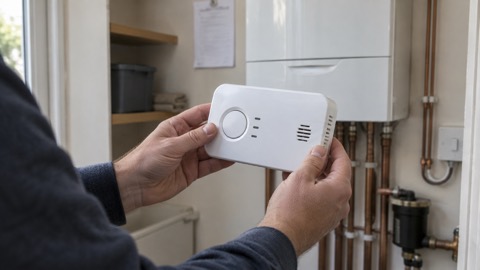
The K5DCO is designed to be mounted at head height, and it can be wall mounted with the fixings supplied or stood freestanding1. Those two options cover most homes: a wall fixing in a hallway or beside a bedroom door, or a freestanding position on a shelf or windowsill where you can see the screen.
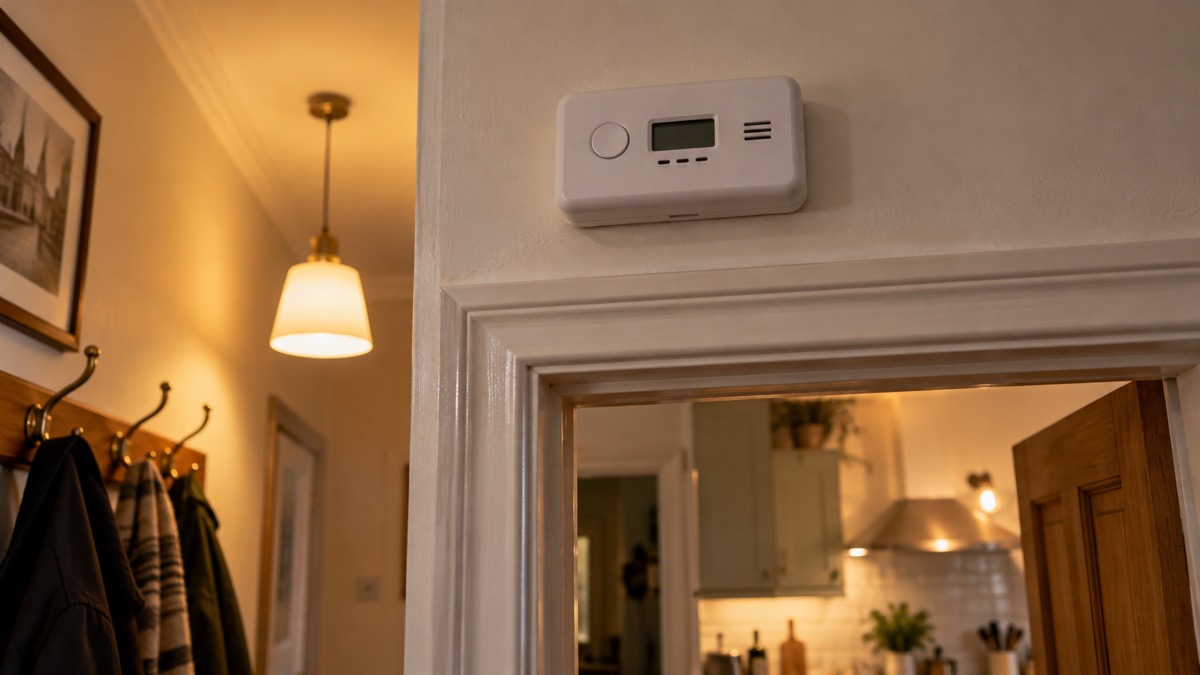
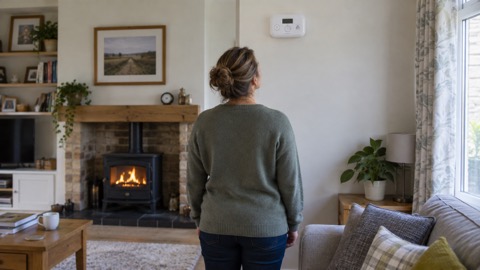
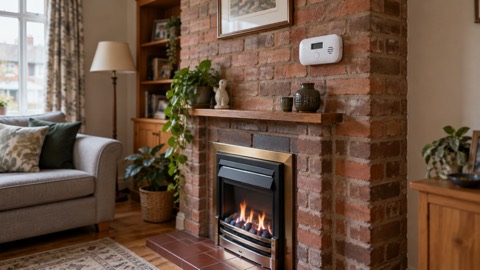
Where exactly to place it is a question with official guidance behind it. Government guidance for CO detectors says they should be either ceiling mounted and positioned at least 300mm from any wall, or wall mounted and positioned at least 150mm below the ceiling and higher than any door or window in the room, unless the manufacturer indicates otherwise5. FireBlitz, a maker of CO alarms, gives a similar instruction for its own products: place it high in the room, above the tops of windows and doors, but no closer than 150mm from the ceiling6.
For a wall-mounted K5DCO, that means fitting it high on the wall, above the height of any door or window in the room, and at least 150mm down from the ceiling5. The head-height instruction from the distributor and the "high in the room" guidance from the standard point the same way: the alarm wants to be up where the air and the gas collect, not down at skirting level.
Which room matters as much as which height. CO comes from fuel-burning appliances, so the rooms that matter are the ones with a boiler, gas fire, cooker or solid fuel stove. Our page on where to put a carbon monoxide alarm sets out room-by-room placement, and our guide to carbon monoxide alarms explains how many a household needs.
Batteries, the low-battery chirp and the test button
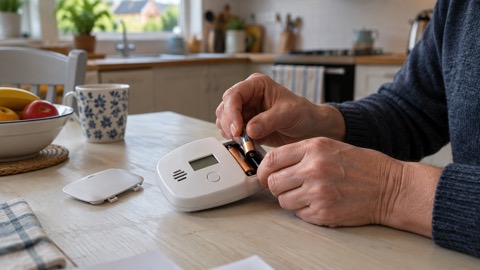
The K5DCO runs on two AA batteries1. When they run low, the alarm gives a warning chirp and a message on the digital display1. That combination is helpful: the chirp gets your attention and the screen tells you what it means.
A chirp or beep every minute is the standard low-battery signal on detectors with replaceable batteries, and it is your cue to replace them8. It often starts at night, because a drop in temperature reduces battery power, which is why a chirping alarm at 2am is such a common experience13.
The general advice from fire and rescue services is to replace the batteries in your CO alarms at least once a year, or as the manufacturer recommends, even if the alarm is wired to the electrical system2. For a battery-only alarm like the K5DCO, the annual change is the routine that keeps it working between chirps.
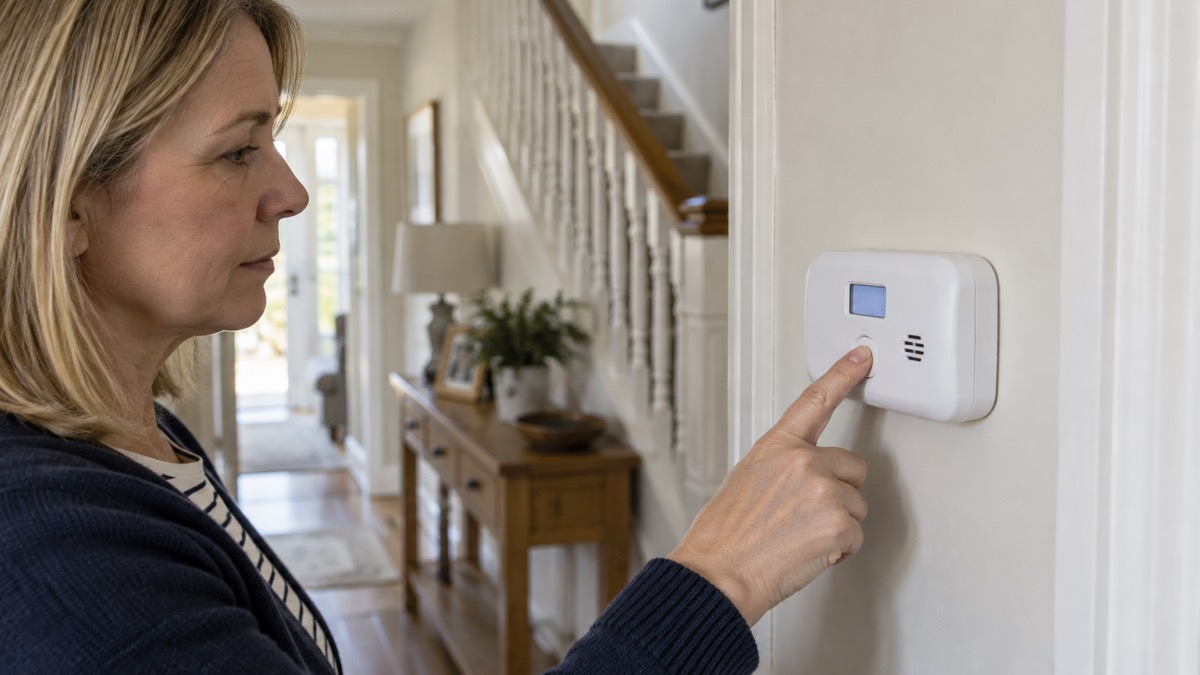
The test button is the other half of the routine. Most CO alarms come with a test button for simple verification of their operation2, and Surrey County Council's fire and rescue service advises installing a CO alarm and testing it weekly14. The K5DCO has a large hush/test button, and the same button silences a false alarm as well as running the test3.
Certified CO alarms also run regular self-tests of their battery, circuitry and sensor, and are designed to let you know when there is a problem15. So the weekly button press is a check on top of what the alarm does by itself, not the only thing keeping it honest.
If your alarm is beeping and you are not sure whether it is the low-battery chirp or a real alarm, our page on why your carbon monoxide alarm is beeping walks through the difference. And if you want a routine for testing every alarm in the house, see how often to test smoke and CO alarms.
Certification: what the marks on the box mean
The K5DCO is Kitemarked to BS EN 50291-1: 2018 and carries CE and UKCA marks1. Those marks are not decoration. They tell you the alarm has been tested to a recognised standard for domestic carbon monoxide alarms.
The Kitemark and the BS EN 50291 standard number are the two things to look for on any CO alarm, according to Age UK's home safety guidance16. Government guidance for CO detectors says they must comply with BS EN 50291-1:2010+A1:20125. The K5DCO's stated standard, BS EN 50291-1: 2018, is the same family of standard in a later edition1.
The CE and UKCA marks are the product safety marks for the UK market. For a carbon monoxide alarm, check the box for the European Standard number BS EN 50291, the standard the maker states its alarms are certified to17.
A CO alarm that carries none of these marks is not a substitute for one that does. The Gas Safe Register's advice is to make sure the alarm bears the Kitemark and the European Standard number BS EN 5029118. If you are buying a K5DCO, check the box and the back of the unit for the marks before you fit it.
Look for the European Standard number BS EN 50291 on the box. Kidde states that its whole home range is fully certified by BSI to EN50291-Part 1 and guaranteed for 10 years19.
Warranty, support and recycling an old alarm
The K5DCO has a seven-year warranty and a 10-year product life1. Those two figures are not in conflict: the life is how long the alarm is designed to work, and the warranty is the period the maker backs it for. Keep the receipt and note the date you fitted it, so you know where you are in both periods.
At the end of its life the alarm tells you. The K5DCO has an end-of-life warning signal that alerts you when the alarm needs replacing1. When that signal comes, replace the unit rather than trying to keep it going: a CO alarm past its design life is not a safety device you can rely on.
Recycling is possible but not universal. Some but not all types of alarm can be recycled at recycling centres, and the advice is to look on the alarm for information or check with the manufacturer20. The K5DCO's product page lists take-back through Valpak's WEEE Distributor Take-back Scheme1, so the retailer you bought it from may be able to take it back.
For support, Kidde says its CO alarms can be found online and in leading independent stores, as well as national retailers including Argos, Homebase, Asda, Amazon and Costco, and you can reach the company through its UK website or on 01753 76639219. That is the route for warranty questions and for advice on a specific unit.
If you are replacing an alarm, our page on when to replace a smoke, heat or CO alarm covers the timing, and our guide to sealed or replaceable battery alarms explains the trade-off if you are choosing a replacement.
The Kidde valve recall: what it was and what it was not
The facts available here do not cover the Kidde valve recall: its date, the batches affected and what was done about them are not recorded in the material behind this page, so no account of it is given.
What can be said is that the K5DCO is a carbon monoxide alarm, certified by BSI to EN50291-Part 1 and guaranteed for 10 years19, and that its display shows CO levels from 30ppm17. Whether any recall affects it is not something these facts establish, so check the maker's own safety notices for your model rather than relying on this page.
It is worth knowing about because the two products share a maker's name, and a household searching for "Kidde recall" could easily worry that their alarm is affected. It is not. Our page on how to check if an electrical product has been recalled explains how to check a product against a recall notice.
Where the K5DCO fits in a household's alarm plan
A single CO alarm is one part of a household's protection, not the whole of it. The K5DCO suits a home that wants a battery-powered alarm with a visible CO reading, fitted at head height in a room with a fuel-burning appliance, and maintained with an annual battery change and a weekly test1.
It does not suit every situation. If you want linked alarms that all sound together, you need a different installation, fitted by a qualified electrician7. If someone in the house is deaf or hard of hearing, a standard sounder may not be enough, and our page on smoke and CO alarms for deaf and hard of hearing people covers the alternatives. If you rent in Wales, the alarm's listing of Welsh Legislation (2022) is a prompt to check what your landlord is required to fit1.
For the wider picture, our guide to carbon monoxide alarms explains what they do and how to choose one, and our page on alarm standards sets out what BS EN 50291 and the other standards mean. If you are fitting alarms across a whole house, our fire safety checklist puts the CO alarm alongside the smoke alarms and the other checks.
Sources (20)
- Kidde 10 Year Digital Display Carbon Monoxide Alarm K5DCO, Safelincs, 2026-10-29
- Smoke alarms and CO detectors, Warwickshire County Council, 2026-10-29
- Carbon monoxide symptoms, Which?, 2026-07-14
- Carbon monoxide safety, FireAngel, 2026-07-31
- Carbon monoxide detectors: governmental guidance, Scottish Borders Council, 2015-06-25
- Where to install CO alarms, FireBlitz, 2025-03-19
- Fire safety for people with hearing difficulties, Devon and Somerset Fire and Rescue Service, 2026
- How to install and test carbon monoxide detectors, Which?, 2026-07-14
- What to do when a carbon monoxide detector goes off, Which?, 2026-07-14
- Five ways to avoid a carbon monoxide build-up, Which?, 2026-07-14
- How we test carbon monoxide detectors, Which?, 2026-07-14
- Unbranded carbon monoxide alarm, Which?, 2026-07-14
- Smoke and carbon monoxide alarms, Northamptonshire Fire and Rescue Service, 2026
- Fire safety at home, Surrey County Council, 2026-10-15
- Top 5 carbon monoxide alarm tips for winter, Which?, 2020-12-18
- Fire prevention, gas safety and electric safety, Age UK, 2026-03-23
- Battery fires, Devon and Somerset Fire and Rescue Service, 2026
- Carbon monoxide alarms, Gas Safe Register, 2026-10-29
- About CO alarms, CO-Gas Safety, 2024-02-18
- Installation of alarms, Scottish Government, 2024-08-14
 FireAngel FA3313 CO Alarm
 FireAngel FA3322 CO Alarm
 FireAngel FA3820 CO Alarm
 FireAngel FA6812 CO Alarm
 FireAngel FA6813 CO Alarm
 FireAngel FA6829S CO Alarm
 FireAngel CW1-PF CO Alarm
 FireAngel W2-CO-10X CO Alarm
 FireAngel FP1820W2-R CO Alarm
 Kidde K7DCO CO Alarm
 Kidde K10LLDCO CO Alarm
 Kidde K10LLCO CO Alarm