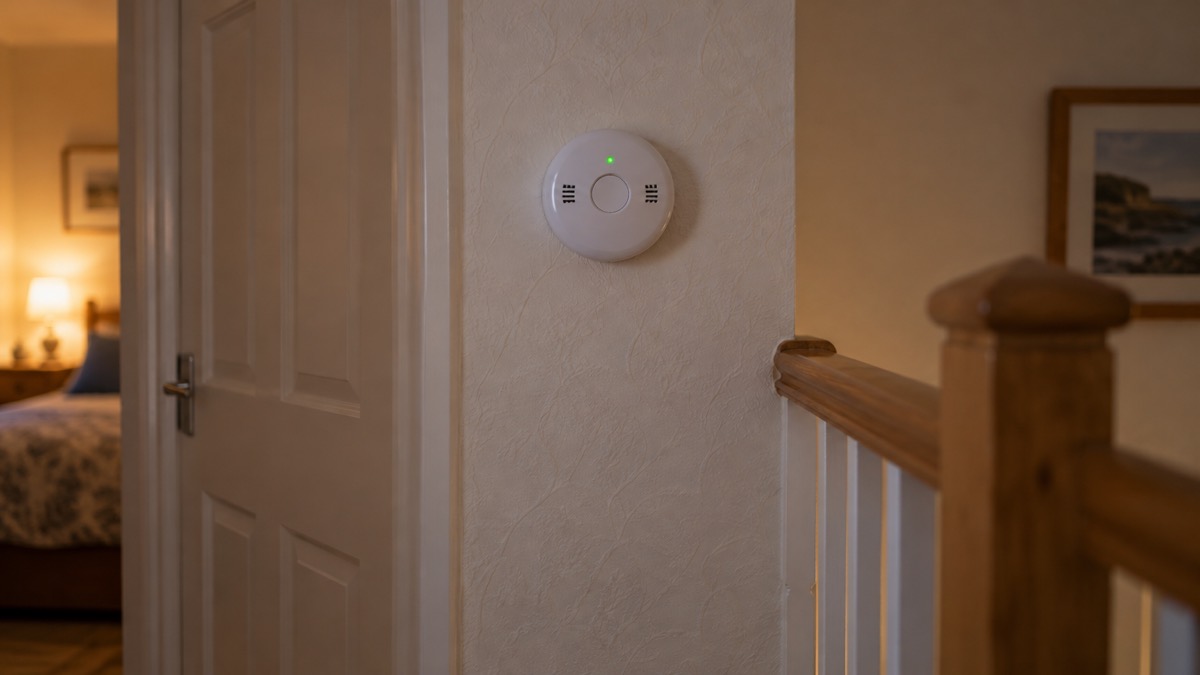
A beeping carbon monoxide alarm is telling you one of three things, and the pattern of the sound tells you which. Four loud beeps with a break, repeating, is the gas alarm: get everyone out of the building and call 9991. A single chirp about once a minute is usually a low battery on a model with replaceable batteries3. A chirp every 30 seconds means the alarm has reached the end of its working life and needs replacing3.
The first of those is the one that matters most. Fire and rescue services are blunt about it: carbon monoxide alarms rarely beep as a false alarm, so if the detector is sounding you should act fast and get out of the property4. The purpose of an alarm is to alert you to the presence of carbon monoxide and give you time to exit the building safely6. Treat the full alarm as real every time.
The other two signals are maintenance reminders, not emergencies, but they still need dealing with promptly. An alarm that is chirping for a flat battery may not have the power to sound properly if carbon monoxide does appear. This page sets out how to tell the signals apart, what to do for each, and how to choose and look after an alarm so the beeping you hear is never the one you cannot afford to ignore.
Four loud beeps and a pause means carbon monoxide: get out now
The full alarm on a carbon monoxide unit is deliberately hard to ignore. FireAngel's own product instructions for its FA6813 alarm describe it plainly: it will emit an alarm sound consisting of 4 loud beeps and a break repeated until the sensor is clear of Carbon Monoxide gas1. The pattern repeats for as long as the sensor is detecting gas, so it will not stop just because you have opened a window.
What to do is not complicated, and every fire and rescue service gives the same core instruction. Leave your home, call 999, and seek medical attention2. Do not re-enter until professionals have declared the property safe8. If anyone in the household has symptoms such as headaches, dizziness or nausea, say so when you call, because those are the signs of carbon monoxide poisoning and they change the urgency of the response8.
A few practical points help once you are outside:
- Take everyone with you, including pets, and do not go back in for belongings.
- Call 999 from outside the building, not from inside it.
- Tell the operator that your carbon monoxide alarm is sounding and whether anyone feels unwell6.
- Do not re-enter until the alarm has stopped7.
If you suspect carbon monoxide but the alarm has not sounded, the same caution applies. Leave the building, call the emergency services if anyone feels unwell, and do not re-enter until it has been declared safe6. The symptoms page explains what to look for, and the guide to what to do if your CO alarm sounds walks through the full response step by step.
What to do when the alarm sounds continuously
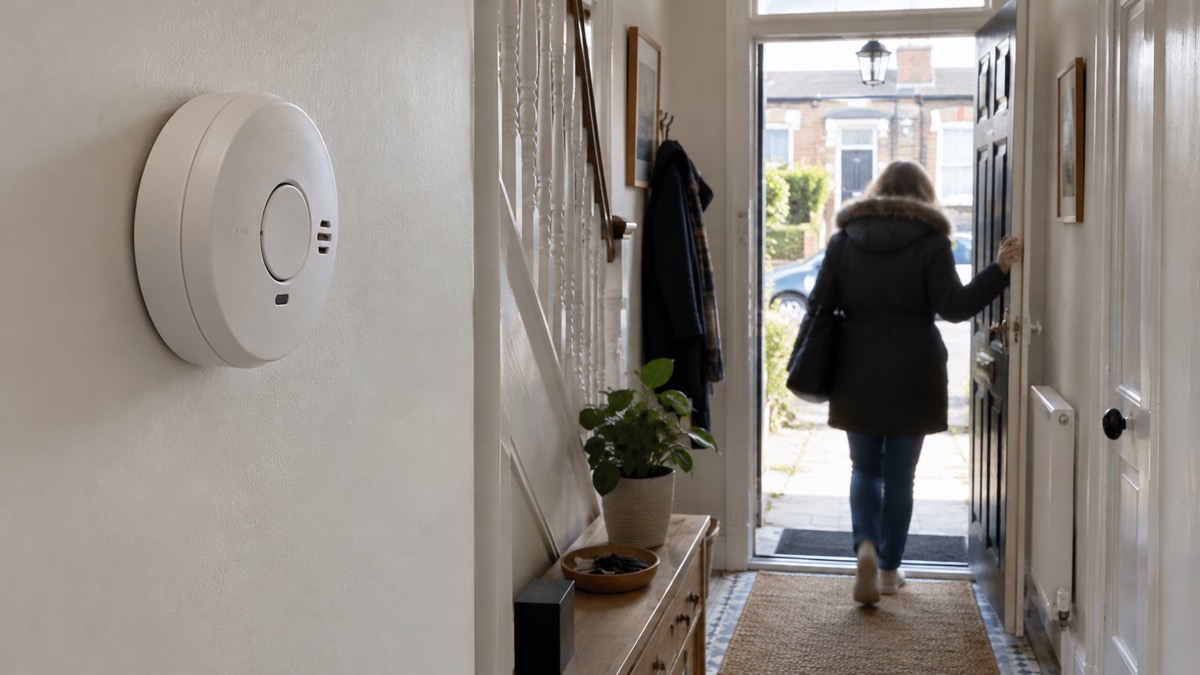
A continuous alarm is the same emergency as the four-beep pattern, and the response is the same. Some households hesitate because they cannot smell anything or see a problem. Carbon monoxide is colourless and has no smell, which is exactly why the alarm exists.
Surrey Fire and Rescue Service sets out a fuller sequence for a sounding alarm: open all doors and windows, stop using and turn off all fuel burning appliances, evacuate leaving doors and windows open, do not re-enter until the alarm has stopped, and contact your gas or fuel supplier on their emergency number9. Opening windows helps clear the gas, but it does not make the building safe to stay in, so ventilate on your way out rather than settling down to wait.
Once outside, the sequence is:
- Call 999 if anyone feels unwell, and seek medical attention2.
- Call your gas or fuel supplier on their emergency number9.
- Wait for the property to be checked and declared safe before going back in8.
- Have the appliance and flue serviced by a qualified engineer before using them again.
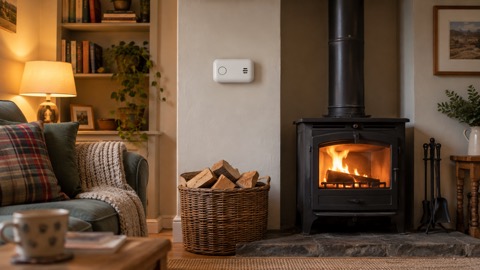
If you rent, tell your landlord as well as your supplier. If you have a solid fuel appliance such as a log burner, the same rules apply: stop using and turn off all fuel burning appliances, and contact your gas or fuel supplier on their emergency number7.
A chirp every minute usually means a low battery
A single chirp at roughly one-minute intervals is the standard low battery warning on an alarm that takes replaceable batteries. Which? puts it directly: if your detector uses replaceable batteries, a chirp or beep every minute is your cue to replace the batteries3. Several fire and rescue services give the same advice for alarms generally: if it beeps every minute or so this could be a low battery warning, and you should replace the battery as soon as possible10.
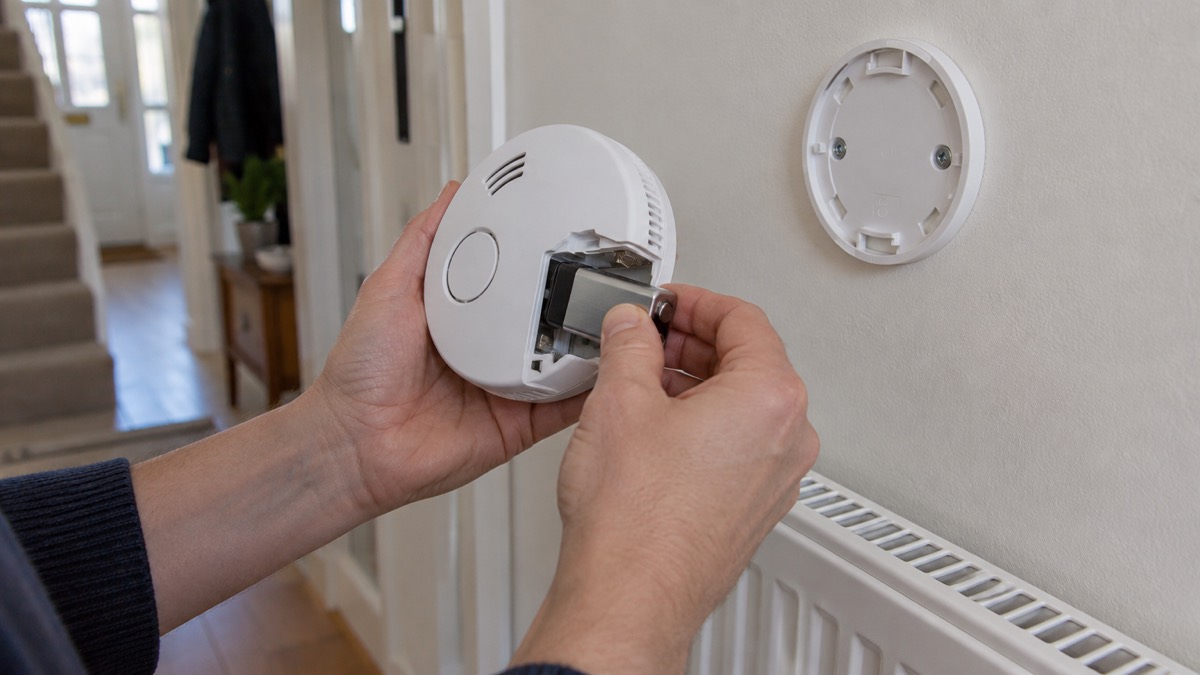
These warnings often start at night. Beeping or chirping is normally due to low battery power in the alarm, and this beeping most commonly starts at night due to the drop in temperature causing a decrease in battery power11. That is worth knowing so you are not alarmed by a 3am chirp, but it is also a reason not to put off changing the battery in the morning.
Hard-wired alarms are not exempt. Mains-powered alarms usually have a battery backup for power cuts, and that backup can produce the same low battery chirp12. If your alarm is wired into the ceiling and starts chirping, check the backup battery rather than assuming the unit has failed.
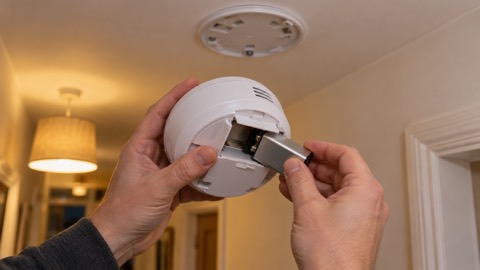
When you change the battery:
- Replace it straight away rather than waiting for a convenient moment10.
- Use the battery type the manufacturer specifies, and fit long-lasting, tamper-proof batteries where the alarm allows8.
- Test the alarm after fitting the new battery13.
- Replace the batteries at least once a year even if the alarm has not chirped, and even if it is wired to the electrical system8.
If a fresh battery does not stop the chirping, the alarm may be signalling something else, most likely that it has reached the end of its life.
Chirping every 30 seconds: the alarm has reached end of life
A chirp every 30 seconds is a different message from the once-a-minute battery warning, and it means the unit itself is finished. Which? states it clearly: chirping every 30 seconds is the sign that your alarm is ready to be replaced3. The reason is that carbon monoxide detectors have a set lifetime, after which the sensors start to fail, and the alarm chirps to warn you that replacement is due13.
How long that lifetime is varies. Bedfordshire Fire and Rescue Service advises that most alarms will last between five and seven years, with some lasting for as long as 10 years7. The Gas Safe Register gives a typical lifetime of between 5 and 10 years14. The Health and Safety Executive for Northern Ireland notes that unit life span can range from one to six years depending on the manufacturer and the expected life span of the batteries, and that some units have replaceable batteries while others are sealed for the life of the unit15. The figure that applies to your alarm is the one in its instructions, so keep the manual or note the date you fitted it.
| Signal | What it usually means | What to do |
|---|---|---|
| Four loud beeps and a break, repeating | Carbon monoxide detected1 | Leave the building, call 9992 |
| A chirp about once a minute | Low battery on a replaceable-battery alarm3 | Replace the batteries10 |
| A chirp every 30 seconds | End of life, sensors failing3 | Replace the whole alarm3 |
Do not try to silence an end-of-life alarm and keep using it. A unit whose sensor has failed cannot be relied on to detect carbon monoxide, which defeats the point of having it. Replace it with one that meets the current standard, and make a note of the fitting date so you know when the next replacement is due.
Sealed-for-life or replaceable battery: how each one warns you
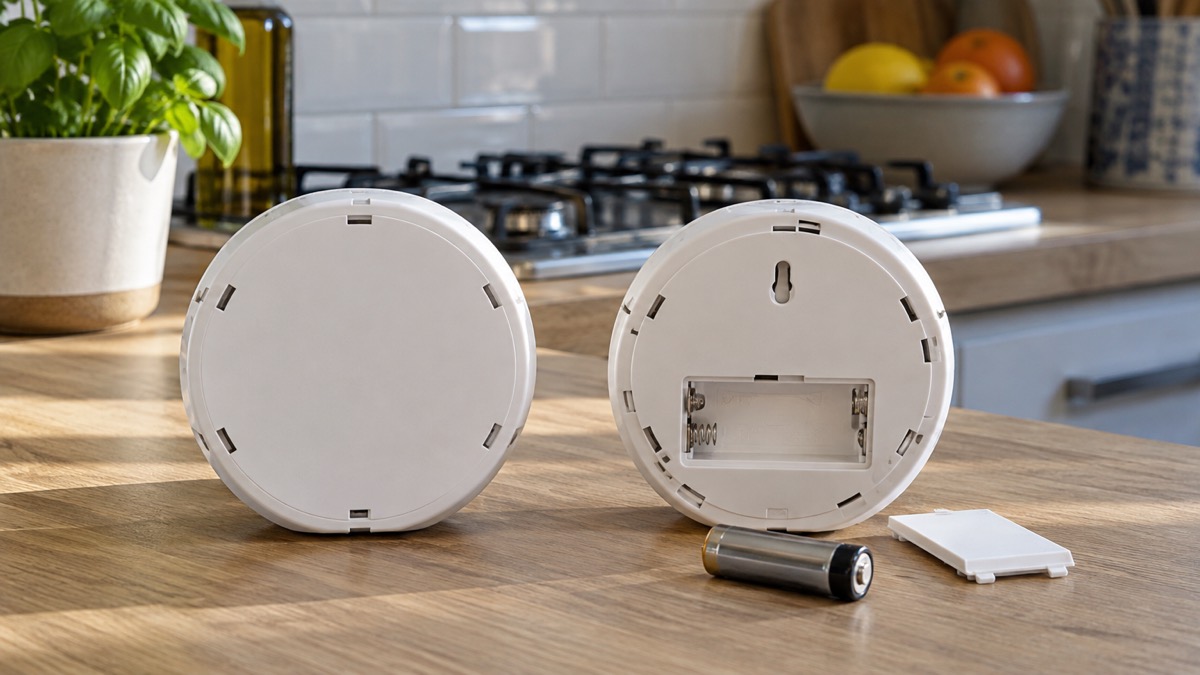
Carbon monoxide alarms come in two battery arrangements, and the one you have changes what its beeps mean and what you have to do about them.
Replaceable battery alarms take standard batteries that you change yourself. They chirp once a minute when the battery runs low3, and you replace the battery to keep the alarm working. They suit households who are happy to keep a spare battery and a reminder in the diary.
Sealed-for-life alarms have a battery built in to last the life of the unit. Which? suggests that if you do not want the hassle of changing batteries, you should go for an alarm with a sealed battery designed to last the lifetime of the detector13. In Scotland, the guidance for battery-operated carbon monoxide alarms is that they must have a sealed battery for the duration of their lifespan16. Sealed units still reach end of life, and they signal it with the 30-second chirp rather than a battery warning you can fix.
Sealed alarms are sold with different rated lives. The Gas Safety charity's guidance lists Firehawk sealed-for-life carbon monoxide alarms offering 5 years, 7 years and 10 years, plus a digital display version17. The rated life is the period the maker expects the unit to work, so a 10-year alarm should not need replacing as often as a 5-year one.
Whichever type you have, the maintenance routine is similar:
- Test the alarm at least once a month using its test button2.
- Replace the batteries at least once a year on replaceable models, even if there has been no chirp8.
- Note the date of fitting and the rated life so you know when replacement is due.
- Replace the whole unit at end of life, not just the battery3.
If you are choosing between the two, our comparison of sealed 10-year and replaceable battery alarms sets out the trade-offs, and the guide to carbon monoxide alarms covers what they do and how to choose one.
Support and guarantees from FireAngel and Kidde
If your alarm is still under guarantee or you cannot work out which signal it is giving, the manufacturer's support line is the place to start. FireAngel states that its customer support specialists are based in the UK and can help with product advice, installation queries and troubleshooting by phone, email or live chat18. Have the model name and the date of purchase to hand before you call.
FireAngel's FA6813 is a carbon monoxide alarm with electrochemical sensing technology, a clear loud alarm and replaceable batteries18. Its product instructions describe the four-beep alarm pattern and the conditions under which it repeats1. If you are replacing a FireAngel unit, the FA6813 product page covers the model in more detail.
Kidde alarms are covered on our product pages for the Kidde K7DCO, K5DCO, K10LLDCO and K10LLCO. Before relying on any alarm, check whether it has been recalled. The Office for Product Safety and Standards published a safety notice for a Carbon Monoxide Alarm with the identifier 2112-0591, manufactured in China, in March 202219. Our guide to product recalls explains how to check a model against recall notices.
Choosing an alarm that will not cry wolf
The best defence against a confusing beep is an alarm that is correctly specified, correctly sited and properly maintained. Fire and rescue services and safety bodies are consistent on what to look for.
Certification. Before buying, ensure the alarm complies with British Standard EN 50291 and carries a British or European approval mark such as a CE or Kitemark15. Fire and rescue services add that you should buy from a reputable source with the British Standard mark on the packaging8. For caravans and motorhomes, look for an alarm tested to BS EN50291-2 and kitemarked20. Our guide to alarm standards explains what these marks mean.
Placement. Fit an alarm in any room with a fuel-burning appliance. The Northern Ireland Fire and Rescue Service advises having a working carbon monoxide alarm installed in rooms with fuel burning appliances21, and Cumberland Council gives the same advice for solid fuel appliances such as log burners22. Our guide to where to put a carbon monoxide alarm covers siting in detail.
Response time. Alarms do not sound the instant any carbon monoxide is present. Which? reports that at 50ppm, alarms should sound between 60 and 90 minutes23. That delay is built in to avoid nuisance alarms, and it is another reason not to ignore the full alarm pattern when it comes.
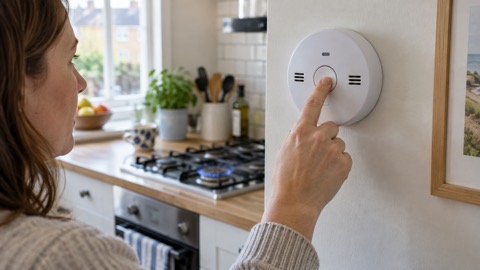
Testing. Test alarms at least once a month2, and replace batteries as needed13. A monthly test is the simplest way to catch a failing unit before it matters.
Monitored alarms. For some households, a monitored alarm adds a layer of protection. Anglesey Council's telecare service describes a carbon monoxide detector that raises an audible alarm within the home and provides additional protection by raising an instant alarm call to the monitoring centre when carbon monoxide levels are increased, for example from a blocked flue or faulty appliance24. This can suit someone who lives alone, is hard of hearing, or would not be woken by an alarm. Ask your council's telecare service what is available locally; arrangements differ across England, Scotland, Wales and Northern Ireland.
Where to get help and advice
If you are unsure whether your alarm is working, your local fire and rescue service is a good first call. Fire and rescue services advise fitting both smoke and carbon monoxide alarms in the home9. Contact your local service to ask what it offers; provision varies by service and by nation.
For gas appliances, the Gas Safe Register is the body to check. It advises that carbon monoxide alarms have a typical lifetime of between 5 and 10 years14, and its register lets you confirm that an engineer is qualified to work on your appliances.
For anyone who needs extra support, the extra help guide covers older, disabled and medically dependent households. If you are deaf or hard of hearing, our guide to alarms for deaf and hard of hearing people covers vibrating and flashing alternatives.
If you are going away, take an alarm with you. On arrival, check that the accommodation's own alarms are working25. Caravan and motorhome users should look for a BS EN50291-2 kitemarked alarm20.
For the wider picture on fire and carbon monoxide safety at home, start with our home emergencies section, and for the alarm rules that differ across the UK, see our guide to Wales and Northern Ireland.
Sources (25)
- FA6813 Carbon Monoxide Alarm, FireAngel, 2026
- Smoke alarms and CO detectors, Warwickshire County Council, 2026
- What to do when a carbon monoxide detector goes off, Which?, 2026
- Carbon monoxide, Devon and Somerset Fire and Rescue Service, 2026
- Carbon monoxide symptoms, Which?, 2026
- Carbon monoxide, North Wales Fire and Rescue Service, 2026
- Carbon monoxide leaflet, Bedfordshire Fire and Rescue Service, 2026
- Safe home heating, Warwickshire County Council, 2026
- Smoke alarms and carbon monoxide detectors, Surrey County Council, 2026
- Smoke alarms, Devon and Somerset Fire and Rescue Service, 2026
- Smoke and carbon monoxide alarms, Northamptonshire Fire and Rescue Service, 2026
- Problems with smoke alarms, Devon and Somerset Fire and Rescue Service, 2026
- How to install and test carbon monoxide detectors, Which?, 2026
- Carbon monoxide alarms, Gas Safe Register, 2026
- Carbon monoxide alarms, Health and Safety Executive for Northern Ireland, 2026
- Where and what to buy, Scottish Government, 2024
- About CO: alarms, CO-Gas Safety, 2024
- Carbon monoxide safety, FireAngel, 2026
- Product safety report: Carbon Monoxide Alarm 2112-0591, Office for Product Safety and Standards, 2022
- Caravan, motor home and campervan safety, Humberside Fire and Rescue Service, 2026
- NIFRS home fire safety appeal, Northern Ireland Fire and Rescue Service, 2025
- How to prevent fire in your home, Cumberland Council, 2026
- How to choose a carbon monoxide detector, Which?, 2026
- What's available from the Telecare service, Isle of Anglesey County Council, 2026
- Carbon monoxide poisoning, CO Awareness, 2025
 Home Fire Safety Checklist
 Bedtime Fire Safety Checks
 Fire Risk Checks for Carers
 Smoke Alarm Keeps Chirping
 Testing Smoke and CO Alarms
 Replacing Smoke and CO Alarms
 Where to Fit Smoke Alarms
 How Many Smoke Alarms
 Where to Put a CO Alarm
 Do I Need a CO Alarm
 Can a CO Alarm Detect a Gas Leak
 Trapped by Fire What to Do
 Putting Out a Chip Pan Fire
 Electrical Fire Safety
 Appliances Left On Overnight