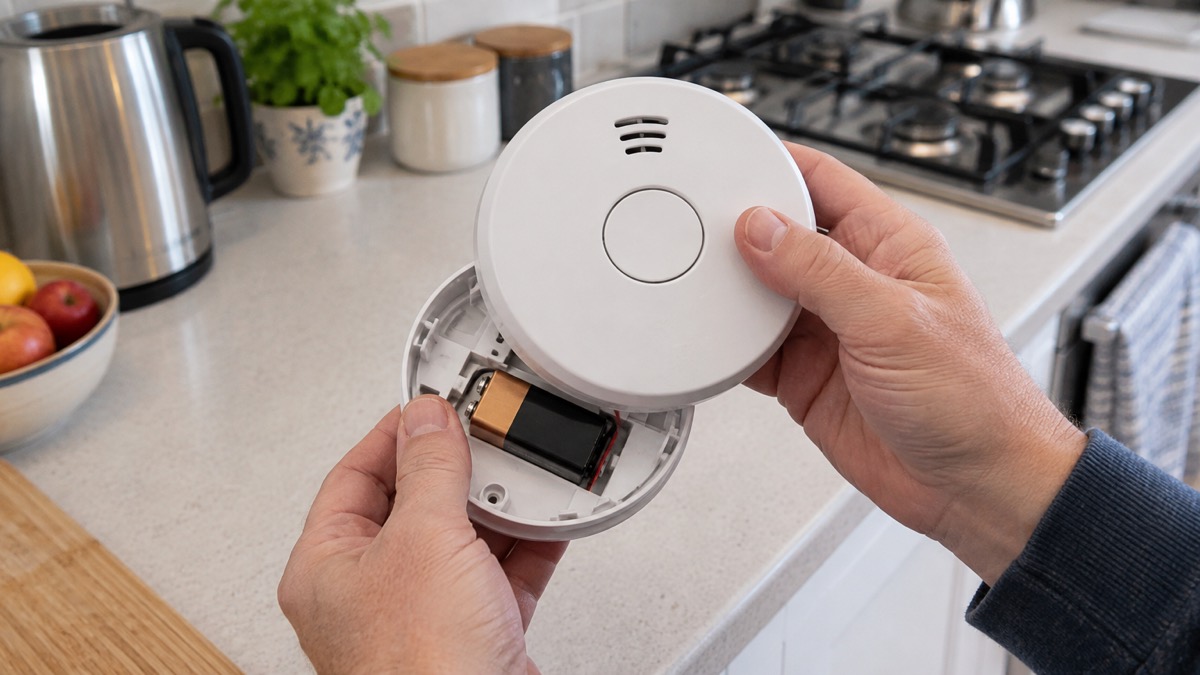
The Kidde Firex KF30 is a 230V hard-wired heat alarm with a battery back-up, designed for the rooms where a smoke alarm would keep going off: kitchens, garages and unoccupied loft spaces1. It sounds at 85dB, is rated for temperatures from 0°C to +40°C, and is built to the Grade D2 pattern, meaning it runs from the mains with a replaceable back-up battery1. If you are fitting one, the practical points are these: it goes on the ceiling, it is wired into the household mains rather than plugged in, and it can be linked by signal cable with up to 24 alarms across the Firex KF series so that one alarm sets off the rest1.
It is not a smoke alarm and it is not a carbon monoxide alarm. A heat alarm responds to a rise in temperature, which is why it suits a kitchen where cooking fumes would otherwise trigger a smoke alarm. If you are deciding what each room needs, the choice between a heat alarm and a smoke alarm is the place to start, and the wider guide to heat alarms explains what they do and where they go.
This page sets out what the KF30 is, where it is designed to be fitted, its specifications, how interlinking works, what changes if you are replacing an older Kidde unit, what happens in a power cut, and the warranty, standards and disposal arrangements. It also covers the one recall in the public record that carries the Kidde name, so that owners can tell whether it affects them.
What the Kidde Firex KF30 is and what it is for
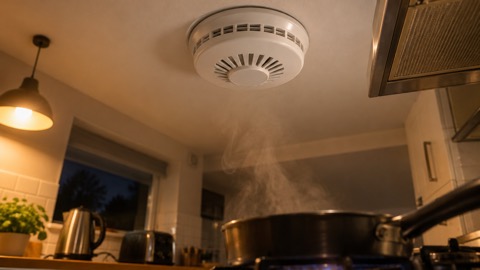
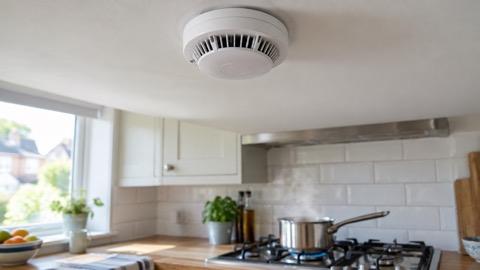
The KF30 is a heat alarm, not a smoke alarm. Its sensor type is listed as heat, its power type as mains powered at 230V, and its grade as Grade D2, which means mains power with a replaceable back-up battery1. The back-up is a 9V alkaline battery, and the retailer lists alkaline as the back-up battery type1. That combination is what makes it a fit for rooms where a smoke alarm would be a nuisance: the alarm waits for heat rather than for smoke, so a pan of frying onions will not set it off in the way it would set off an optical smoke alarm.
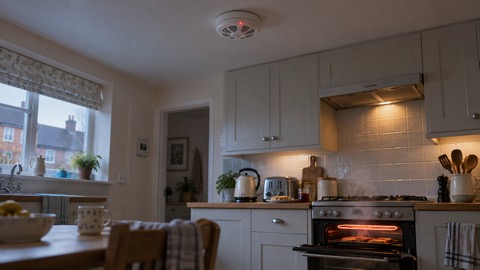
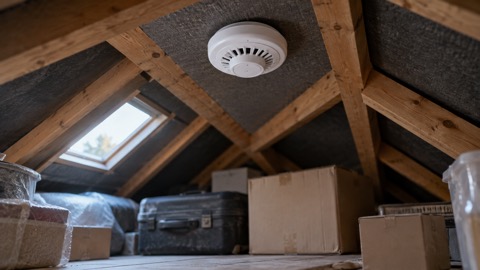
The retailer describes it as suitable for kitchens, garages and unoccupied loft spaces1. Those three rooms have something in common. A kitchen produces smoke and steam as a matter of course. A garage may be cold, dusty and used for parking. A loft is often empty for months at a time, which is exactly where a mains alarm with a back-up battery earns its place, because it keeps working when the circuit is off and does not depend on someone remembering to change a battery every year.
The KF30 sits within the Kidde Firex range, and the same range includes the Kidde Firex KF20 optical smoke alarm, which is the smoke counterpart for hallways and landings2. If you are planning alarms for a whole house, the two are designed to work as a set: heat where smoke would cause false alarms, smoke where an early warning of smouldering matters most.
Where to fit it: kitchens, garages and lofts
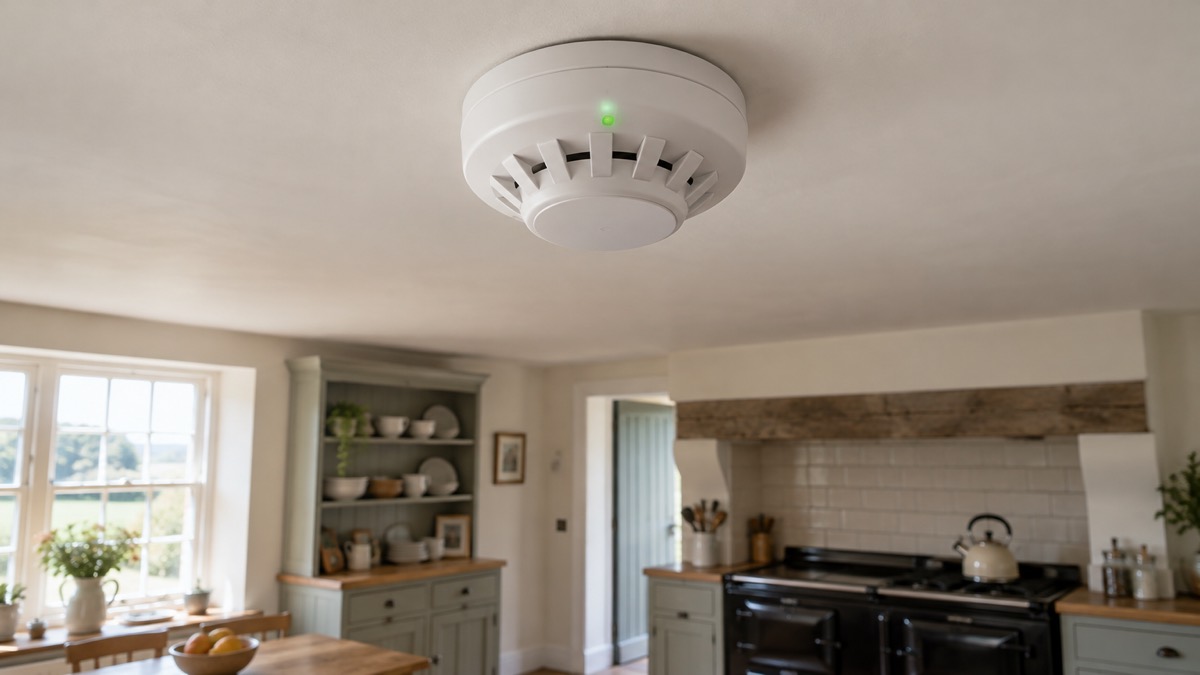
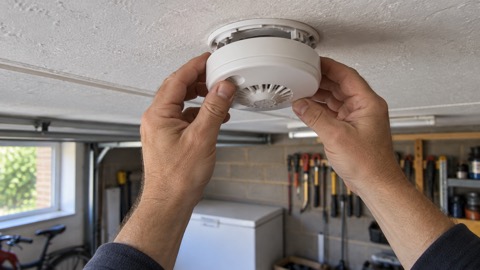
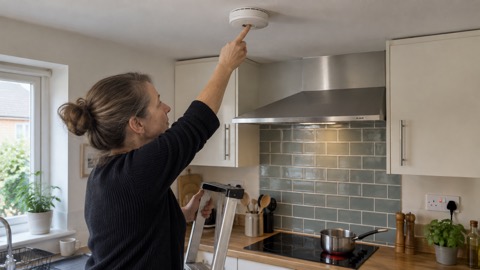
The retailer lists the installation position for the KF30 as ceiling, the connection as wired, and the fixing options as screws, which are included1. So the physical job is straightforward in principle: a ceiling position, a mains feed, and the base plate screwed to the ceiling before the alarm is twisted on. The harder part is choosing the room and the spot within it.
The three rooms the retailer names each have a reason1. In a kitchen, a heat alarm gives you warning of a fire without the false alarms that cooking sets off in a smoke alarm. In a garage, it covers a space where cars, tools and stored fuel sit away from the rest of the house. In an unoccupied loft, it covers a space nobody visits, where a fire could develop unnoticed until it breaks through the ceiling below.
A heat alarm is slower to respond than a smoke alarm, by design. It waits for the temperature to rise enough to indicate a fire, which is why it is not the right choice for a hallway, a landing or a bedroom, where you want the earliest possible warning. The guide to where to fit smoke alarms covers the rooms that need smoke detection, and the fire safety checklist for your home is a useful way to work through a whole property room by room.
The KF30 is listed as suitable for the home, and its operating temperature range of 0°C to +40°C covers an unheated garage in most British winters, though a garage that regularly drops below freezing is at the edge of that range1. If your loft or garage gets very hot in summer, the same range applies at the other end. The maker's instructions in the box are the authority on the exact position, and they should be followed over any general advice.
Specifications: Grade D2, 85dB, 0°C to +40°C
The figures that decide whether the KF30 suits your house are set out below. They come from the retailer's product listing, which is the specification a buyer sees before ordering1.
| Specification | Figure |
|---|---|
| Product type | 230V hard-wired heat alarm1 |
| Sensor | Heat1 |
| Power | Mains powered (230V)1 |
| Grade | Grade D2: mains powered with replaceable back-up1 |
| Back-up battery | 9V alkaline1 |
| Sound level | 85dB1 |
| Operating temperature | 0°C to +40°C1 |
| Relative humidity | Up to 93%1 |
| Dimensions | 39mm high, 133mm diameter1 |
| Weight | 400g1 |
| Display | LED indicators1 |
| Warning type | Audible alarm sounder1 |
| Controls | Combined test and hush button1 |
| Standard | BS 5839-6: 2019, Grade D2 (alkaline)1 |
| Certification | CE marked and Kitemarked to BS 5446-2: 20031 |
| Warranty | 6 years1 |
Two of these figures matter more than the rest. The 85dB sound level is the alarm's loudness at source, and it is the figure to weigh against the size and layout of the room and against who sleeps in the house1. The Grade D2 rating is the one an electrician will look for: it tells them the alarm is designed to run from the mains with a replaceable back-up battery, which is the pattern used in much of the housing stock1. The guide to alarm standards and system grades explains what the grades mean in practice.
The 93% relative humidity figure is worth noting for a kitchen, where steam is routine1. It does not make the alarm waterproof, and it does not mean it belongs in a bathroom. It means the manufacturer has rated it for the damp air of a working kitchen.
Interlinking up to 24 alarms across the Firex KF series
One alarm sounding in a closed kitchen may not wake a household asleep upstairs. Interlinking solves that: when one alarm in the network sounds, the others do too. The KF30 can be linked by signal cable with a maximum of 24 units across the Firex KF series1.
The retailer publishes the list of units that can interlink with the Firex KF series, and it is long. It includes the KF10, KF10R, KF20, KF20R, KF30R, KF1, KF1R, KF2, KF2R, KF3, KF3R, 4MCO, K4MCO, 1239HI, 1239HILL, 2239HI, 2239HILL, 3239HI, 3239HILL, 4870, 4881, 4973, 4985, 4899, 4892, I240C and PADC2401. The same list appears on the KF20 smoke alarm listing, which is a useful cross-check if you are mixing heat and smoke alarms in one system2.
The practical consequence is that a KF30 can sit in a kitchen and be linked to smoke alarms in the hall and landing, so that a fire in any of those rooms raises the alarm throughout the house. The guide to interlinked alarms explains how the wiring works, and the comparison of wired and wireless interlinked alarms helps if you are deciding which route to take.
Replacing an older Kidde 3239HI: the base plate will not fit
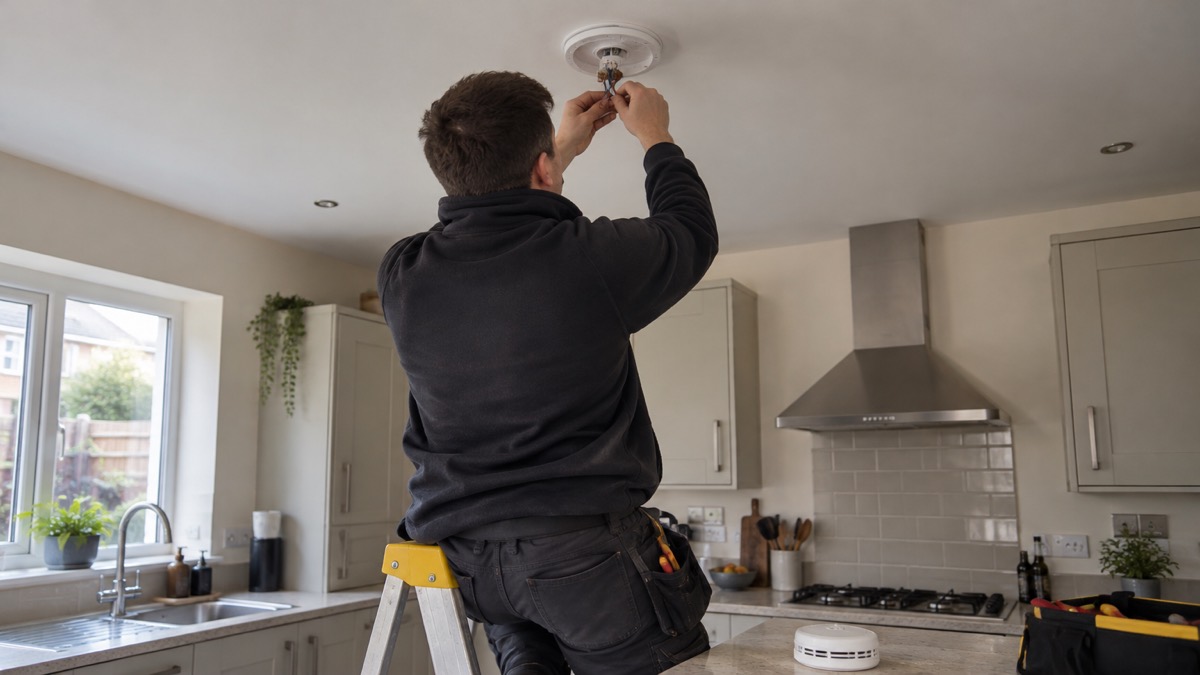
If you are replacing an older Kidde alarm, the single most important fact is this: the KF30 and KF30R are replacements for the Kidde 3239HI and Kidde 3239HILL, but the new models cannot be used on the same base plates and use different connector blocks1. In other words, the alarm is a like-for-like replacement in function, not a drop-in swap. The old base comes off and the new one goes on, and the wiring has to be reconnected to a different connector block.
That changes the job from a five-minute twist-and-click into an electrical task. The NICEIC, the electrical industry's certification body, advises householders to use a registered electrician for fire alarm installation3. That advice carries particular weight here, because the connector block is different from the one already on the ceiling and the person doing the work needs to be confident with mains wiring.
The KF30 has also been sold under earlier names: the retailer lists it as previously the Kidde 4899 and the Kidde KF31. If you are matching an existing alarm or looking up an old manual, those names refer to the same line. The 4899 also appears in the interlink compatibility list, which is consistent with it being an earlier version of the same unit1.
There is a separate point about base plates in the wider market. Fireblitz, a maker of alarm bases, describes its FireHawk range of bases as designed to replace the baseplate supplied with the FHN250 and FHN450 ranges of mains smoke and heat alarms4. That is a different product line and does not apply to the KF30, but it illustrates the general rule: base plates are specific to a range, and a new alarm from a different range will usually need its own base.
During a power cut the 9V back-up battery keeps it working
The KF30's back-up battery allows the alarm to function during a power outage1. That is the whole point of the Grade D2 design: the alarm draws its power from the mains in normal use, and the 9V alkaline battery takes over when the mains fails. A heat alarm that went silent in a power cut would be at its least useful exactly when a household is relying on candles, torches and maybe a portable heater.
North Wales Fire and Rescue Service gives the householder's version of the same advice: if you experience a power cut and you have mains powered smoke alarms, check that the battery back-up is working5. The same check applies to a heat alarm. When the power comes back, the alarm returns to mains operation and the back-up battery is there for the next outage.
The KF30 has a low battery warning chirp, which can be silenced for 8 hours1. That is a useful feature in the middle of the night, but it is a delay, not a fix. The guide to why a smoke alarm keeps chirping explains what the different chirps mean, and the guide to when to replace a smoke, heat or CO alarm covers the end of an alarm's working life.
A power cut is also the moment to check the rest of the household's readiness. The guide to power cuts covers what to do while the supply is off, and the backup power section explains what a power bank or a small battery system can and cannot do. The KF30's own back-up is deliberately modest: it keeps the alarm working, not the house.
Warranty, standards and disposal
The KF30 carries a 6 year warranty1. It is CE marked and Kitemarked to BS 5446-2: 2003, and it is suitable for installations complying with BS 5839-6: 2019 at Grade D1 (lithium) or Grade D2 (alkaline)1. The Kitemark is the certification mark that tells a buyer the alarm has been tested against the standard by an independent body, and BS 5839-6 is the code of practice that sets out how fire detection is designed for domestic premises.
The retailer lists the KF30 as covered by Valpak's WEEE Distributor Take-back Scheme1. That is the arrangement that lets a household dispose of an old electrical alarm properly rather than putting it in the general waste. When you replace an alarm, ask the retailer about take-back, or use your local household waste recycling centre.
The KF30 is a heat alarm, and the Kidde name covers a much wider range of alarms, including carbon monoxide alarms. The Gas Safe Register notes that carbon monoxide alarms are a separate product with their own standard, and the guide to carbon monoxide alarms explains what they do7. A heat alarm will not detect carbon monoxide, and a CO alarm will not detect heat. If your home has a fuel-burning appliance, you need both kinds of protection, and the guide to whether you need a CO alarm sets out the cases.
The Kidde CO2 valve recall, and what it does and does not cover
In February 2024 a product safety report recorded the recall of affected batches of the Kidde CO2 Klem Valve, made between 01/2022 and 05/2023, over the risk of the valve detaching and CO2 discharging8. Affected batches were withdrawn from the market, UK customers were sent a safety notice, and a retrofit safety guard was made available8.
That recall concerns a CO2 valve, not the Firex KF30 heat alarm. If you own a Kidde CO2 Klem Valve from those batches, follow the recall notice and fit the safety guard as instructed8. If you own a KF30, the recall does not apply to it. The guide to how to check if an electrical product has been recalled explains how to check a product against the official recall lists.
Northern Ireland, Scotland and the rest of the UK
Fire alarm rules differ across the UK, and the KF30's listing carries a note about local legislation. The retailer lists "Northern Ireland Legislation (2024)" and "Scottish Legislation (2022)" against the product, without saying which applies to which installation1. The two entries are not reconciled on the listing, so treat them as a prompt to check the rules for your own nation rather than as a statement of what the law requires.
In Northern Ireland, building regulations for new builds require fire alarm systems of at least category LD2 and at least grade D2, including a smoke alarm or alarms in every habitable room and a heat alarm in every kitchen3. That is a direct fit with the KF30's Grade D2 rating and its role as a kitchen heat alarm1. Separately, carbon monoxide alarms have been a mandatory requirement in Northern Ireland homes where a new fossil fuel appliance is installed since 31 October 2012, when a change to The Building Regulations (Northern Ireland) 2012 came into operation9. The Health and Safety Executive for Northern Ireland sets out the same requirement9.
The Northern Ireland Fire & Rescue Service's household advice is consistent across its public messages: ensure you have a working smoke alarm fitted to each floor and test them so you know they work6. It makes the same point about smoke and carbon monoxide alarms for students12, and it describes a working smoke alarm as giving you and your family the vital time needed to escape a fire13. For anyone in Northern Ireland who wants advice by telephone, the service's Prevention and Protection Teams, based in Belfast, Ballymena, Portadown and Derry/Londonderry, can be reached on 0289266422114.
The guide to Wales and Northern Ireland: alarm rules and fire services sets out the devolved arrangements in more detail. If you are in England, Scotland or Wales and are unsure what your home needs, the smoke alarms guide and the battery or mains alarms comparison are the places to start.
Sources (14)
- Kidde Firex KF30 mains heat alarm with back-up battery, Safelincs, 2026-10-29
- Kidde Firex KF20 optical smoke alarm with back-up battery, Safelincs, 2026-10-29
- Fire alarm installation, NICEIC, 2025-09
- Bases for mains smoke and heat alarms, Fireblitz, 2026-10-14
- Winter safety, North Wales Fire and Rescue Service, 2026-10-29
- NIFRS New Year's resolutions: the ones worth keeping, Northern Ireland Fire & Rescue Service, 2026-01-05
- Carbon monoxide alarms, Gas Safe Register, 2012-10-31
- Product safety report: Kidde CO2 Klem Valve, GOV.UK, 2024-02-12
- Carbon monoxide alarms, Health and Safety Executive for Northern Ireland, 2026
- Carbon monoxide, Health and Safety Executive for Northern Ireland, 2012-10-31
- Carbon monoxide alarm regulations: are you ready?, CO-Gas Safety, 2012-10-31
- NIFRS urges students to think fire safe, Northern Ireland Fire & Rescue Service, 2023-09-25
- A safer Christmas starts at home, Northern Ireland Fire & Rescue Service, 2024-12-05
- NIFRS measures to keep firefighters and public safe during coronavirus pandemic, Northern Ireland Fire & Rescue Service, 2020-03-18
 FireAngel FA6720-R Heat Alarm
 FireAngel HW1 Heat Alarm
 FireAngel HW10 Heat Alarm
 FireAngel HM-SN-1 Heat Alarm
 Firehawk FHH10 Heat Alarm
 Aico Ei144e Heat Alarm
 FireAngel FA8720BW Heat Alarm