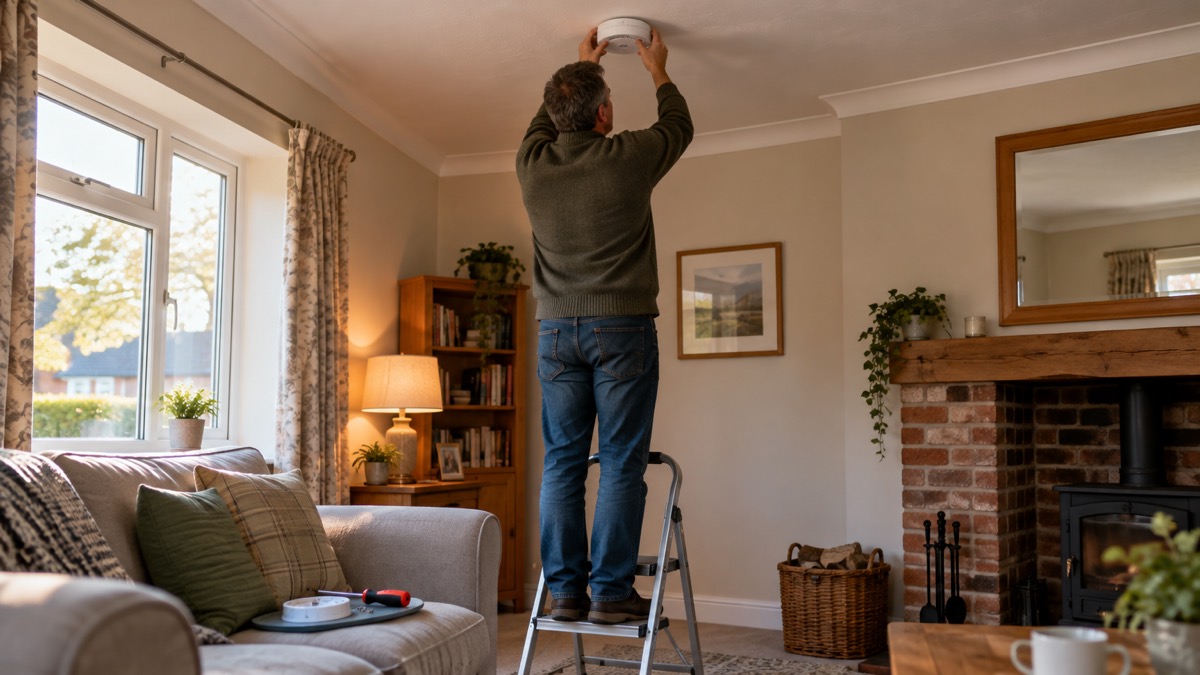
The Kidde Firex KF20 is a mains powered optical smoke alarm with a replaceable 9V alkaline back-up battery. It runs from a 230V supply, sounds at 85dB, and measures 133mm across by 39mm high1. It is the alarm the distributor recommends when an older Kidde KF10 reaches the end of its life, because it fits the existing base plate and connector without an electrician1.
If you are searching for it by name, you are probably doing one of three things: replacing a failed or ageing mains alarm, checking whether a particular model suits your home, or working out why the alarm on the landing keeps chirping. This page answers all three. It sets out what the KF20 does, how it differs from the sealed-battery KF20R, how it links with other alarms, where it should go, and what to do when it beeps or reaches the end of its life.
One thing to be clear about from the start: the KF20 is a smoke alarm, not a carbon monoxide alarm. It detects smoke and raises the alarm; it does not detect carbon monoxide, and it is no substitute for a CO alarm where one is needed. For the wider picture on choosing alarms for a home, our guide to smoke alarms and how to choose one sets the types side by side.
What the KF20 is and what it does
The KF20 is one half of a pair. The distributor describes the KF20 and KF20R as "a pair of mains powered optical smoke alarms", both running from a 230V supply and both using an optical sensor to spot smoke2. The difference between them is the back-up battery, and that difference decides which one suits your wiring and your building's fire strategy.
An optical sensor responds to the smoke that tends to come from smouldering fires, the slow, smoky kind that can fill a hallway while a household sleeps. The alarm sounds at 85dB, which is loud enough to wake most people in an ordinary home, and it carries LED indicators so you can see at a glance that it is receiving power and working2. It is Kitemarked to BS EN 14604: 2005 and CE marked, and the distributor lists it as suitable for installations complying with BS 5839-6: 2019 Grade D21.
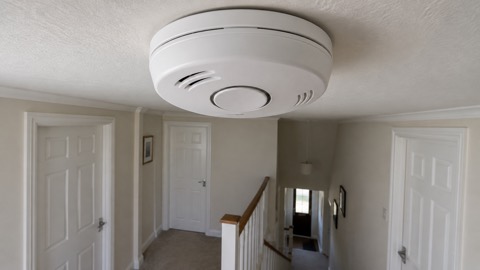
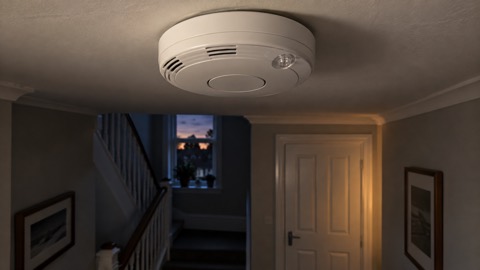
The unit is plastic, ceiling mounted, and supplied with screws and a coloured dust cover for use when decorating1. It has a combined test and hush button, so the same control that checks the alarm can also quieten it after a false alarm1. It weighs 280g, light enough for a standard ceiling fixing1.
What it does not do matters as much. It is a single-point smoke alarm for a home, not a control panel, and it does not call the fire service or send a notification to your phone. Its job is to make a loud noise in the room it protects, and, if it is wired into an interlinked system, in the other rooms too. If you want to understand how that wiring works before you buy, our page on interlinked alarms explains the principle.
Specifications
The figures below come from the distributor's product listings for the KF20 and, where noted, the KF20R. Where the two models share a specification, it is given once.
| Specification | KF20 | KF20R |
|---|---|---|
| Type | Mains powered optical smoke alarm | Mains powered optical smoke alarm with rechargeable lithium cell2 |
| Power | 230V mains2 | 230V mains3 |
| Back-up battery | Replaceable 9V alkaline1 | Sealed rechargeable lithium, designed to last the life of the alarm2 |
| British Standard grade | Grade D2 (mains with replaceable back-up)2 | Grade D1 (mains with 10 year longlife back-up)3 |
| Sound level | 85dB2 | 85dB3 |
| Diameter | 133mm1 | 133mm3 |
| Height | 39mm1 | 39mm3 |
| Weight | 280g1 | 280g3 |
| Operating temperature | 0°C to +40°C2 | 0°C to +40°C3 |
| Relative humidity | Up to 93%2 | Up to 93%3 |
| Installation position | Ceiling2 | Ceiling3 |
| Fixings | Screws included2 | Screws included3 |
| Standards | BS 5839-6; BS EN 14604: 20052 | BS 5839-6; BS EN 14604: 20053 |
| Warranty | 6 years2 | 6 years3 |
The 0°C to +40°C range and the 93% humidity limit tell you where the alarm belongs: inside the heated part of the house, in ordinary room conditions2. A hallway, landing, living room or bedroom meets that easily. A cold conservatory in winter, an unheated loft or a steamy bathroom does not, and the alarm should not be fitted there.
KF20 or KF20R: replaceable alkaline or sealed lithium
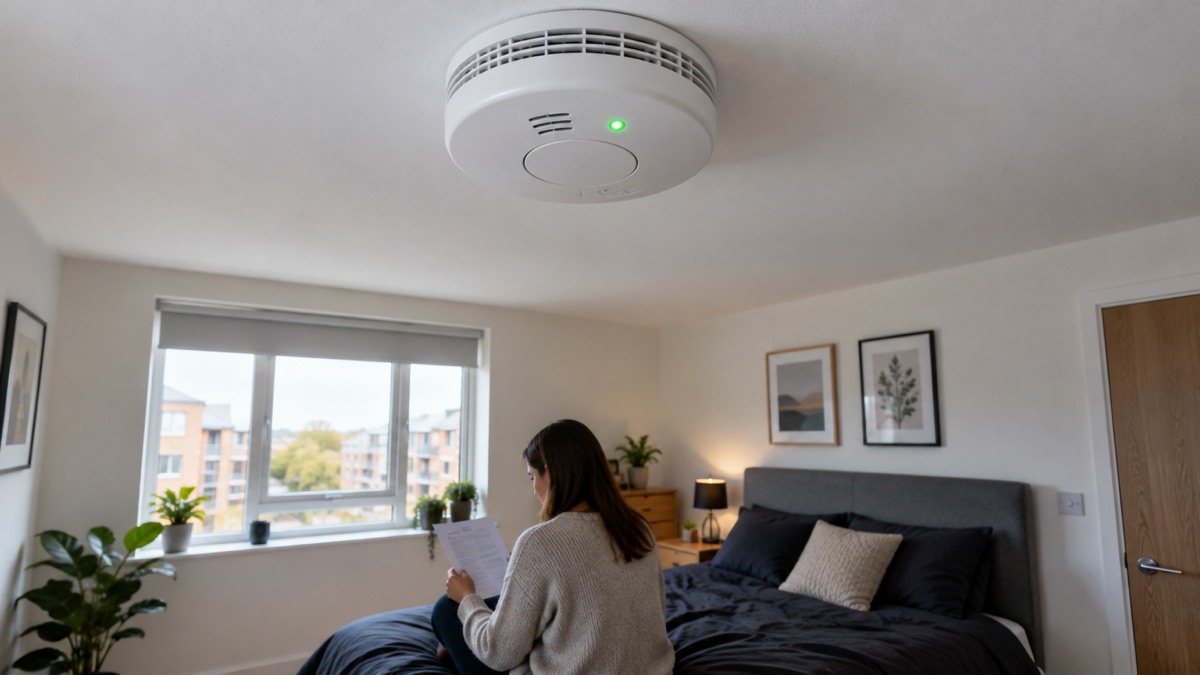
The choice between the two models comes down to the back-up battery and the grade it gives you. The KF20 is fitted with a replaceable alkaline back-up, which the distributor grades as Grade D2: mains powered with a replaceable back-up2. The KF20R is fitted with a rechargeable lithium battery designed to last the life of the alarm, and is graded Grade D1: mains powered with a 10 year longlife back-up2.
In plain terms, the KF20 asks you to buy and fit a 9V alkaline battery when the old one runs down, and the KF20R does not. The KF20R's sealed cell recharges from the mains and is not meant to be changed by the householder. That makes the KF20R the simpler unit to live with over a decade, and the KF20 the one that keeps a familiar routine of battery changes.
Which you need depends on what your building's fire risk assessment or the standard your installation follows calls for. Grade D2 and Grade D1 are different points on the same scale, and the grade required can vary with the property. Our guide to alarm standards and system grades explains what the grades mean and where each is expected. If you are weighing up the two approaches in general, sealed 10 year or replaceable battery alarms sets out the trade-offs.
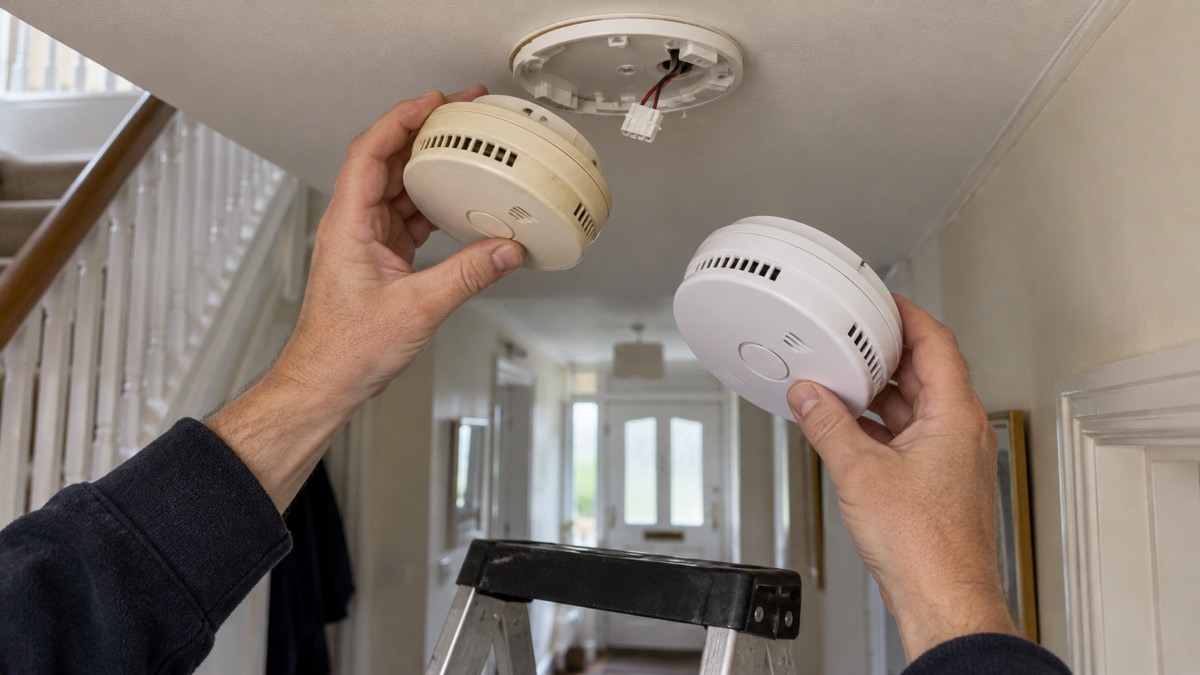
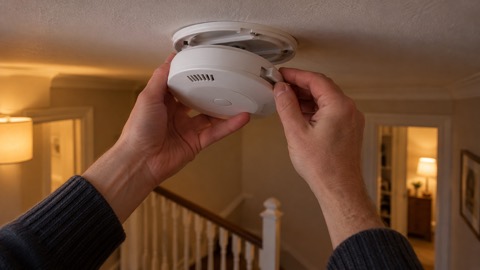
There is a practical catch that decides many replacements. The distributor states that the new models cannot be used on the same base plates and use different connector blocks2. So if you are swapping an old alarm, check which model your existing base was made for before you buy. The KF20 is the direct swap for a KF10; the KF20R is not.
Linking up to 24 alarms on one system
A single alarm protects the room it is in. An interlinked system protects the whole home, because when one alarm sounds, they all do. The KF20 can be hardwire interlinked with up to 24 other compatible units via a signal cable2. That ceiling of 24 applies across the Firex KF Series, and the KF20R carries the same limit3.
The distributor publishes the list of units that can share that signal cable with the KF20. It includes the KF10, KF10R, KF20R, KF30 and KF30R, the KF1, KF2 and KF3 families and their R variants, the 4MCO and K4MCO, a long run of 1239 and 2239 and 3239 models, the 4870, 4881, 4973, 4985, 4899 and 4892, and the I240C and PADC2402. In practice this means a household can mix smoke alarms, heat alarms and carbon monoxide alarms from the same range on one network, so a fire in the kitchen sounds the alarm in the bedroom.
That mixing is the point of linking. A heat alarm in a kitchen, such as the Kidde Firex KF30, avoids the false alarms that cooking smoke can cause, while the KF20 on the landing gives early warning of a smouldering fire elsewhere. Our page on heat alarms and where they go explains the division of labour.
Two cautions. First, interlinking is not universal: alarms from different makers do not share a signal cable, and the limits differ by maker. The Kidde Firex KF20 and KF20R manuals state that a maximum of 24 units can be interlinked via signal cable5, while the FireAngel manual for its own range states that up to 12 FireAngel mains smoke (SW1/SW10), heat (HW1/HW10) or carbon monoxide (CW1) alarms can be interconnected on a single network6. Second, the wiring itself is a fixed installation. If you are adding alarms to an existing system rather than replacing like for like, the work needs an electrician. Our guide to wired or wireless interlinked alarms covers when each approach makes sense.
Which older Kidde alarms the KF20 replaces
The KF20 exists largely to replace alarms that have reached the end of their working life. The distributor recommends it as the replacement for older Kidde smoke alarms when they reach the end of their 10 year lifespan1. That 10 year figure is the working life of the alarm itself, not of its battery, and it is the reason a working-looking alarm on the ceiling may still need changing.
The replacement table the distributor publishes sets out which old model maps to which new one:
- KF10 (ionisation, alkaline back-up): a simple swap, no electrician needed1.
- KF1 (ionisation, alkaline back-up): replaced by the KF201.
- KF1R (ionisation, lithium back-up): replaced by the KF201.
- 1275H (ionisation): replaced by the KF201.
- 1240C and IAR230C (ionisation): replaced by the KF201.
- KF10R (ionisation, lithium back-up): replaced by the KF20, but the connector must be swapped by an electrician1.
The pattern is that the KF20 takes over from the older ionisation models, and from the alkaline KF10 without any tools beyond a screwdriver. The KF10R is the exception: it needs an electrician because its connector differs1. If your old alarm is a KF10R, budget for that visit rather than planning a straight swap.
Where to fit it
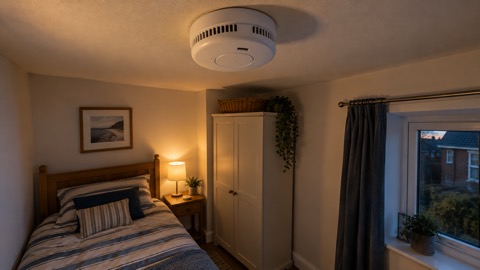
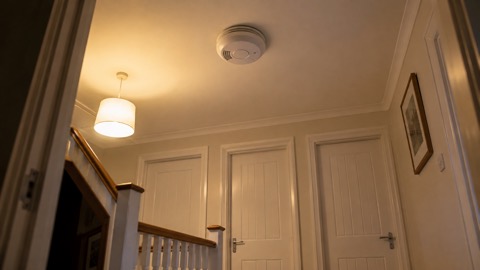
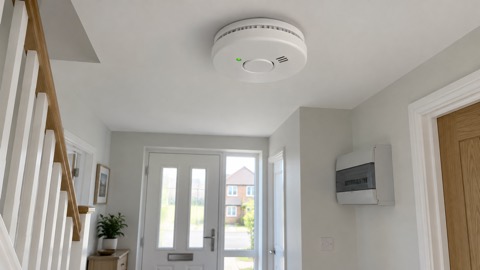
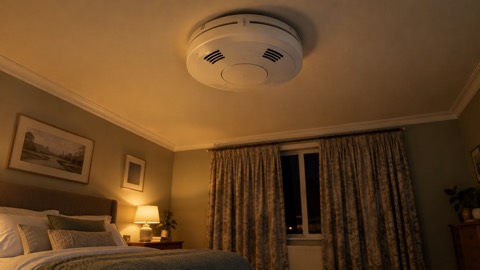
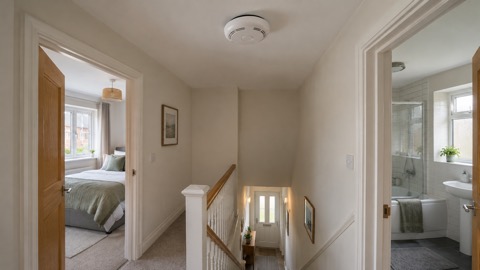
The KF20 is a ceiling-mounted alarm, and the distributor lists bedrooms, hallways and living rooms as its positioning2. It is suitable for hallways, landings, living rooms and bedrooms2. Those are the rooms where people sleep and where fires most often start or spread unnoticed, which is why they come first.
A sensible arrangement in an ordinary house is one alarm in the hallway or landing that serves the bedrooms, one in each bedroom, and one in the main living room. The hallway alarm is the one that wakes the household; the bedroom alarms are the ones that catch a fire that starts in a bedroom, from a charger, a lamp or a cigarette. Our guide to where to fit smoke alarms goes through the detail room by room, and how many smoke alarms a house or flat needs helps you count.
The distributor does not give a clearance figure for the KF20, so follow the general principle for ceiling alarms: keep them away from the immediate corner where wall meets ceiling, where dead air can stop smoke reaching the sensor. For comparison, the maker FireBlitz advises for its carbon monoxide alarms that they go high in the room, above the tops of windows and doors, but no closer than 150mm from the ceiling6. That is CO guidance, not smoke alarm guidance, but it illustrates the kind of clearance that keeps a sensor in moving air.
Keep the alarm out of the kitchen and bathroom. Steam and cooking smoke will set it off, and repeated false alarms lead households to disable alarms, which is the worst outcome of all. A heat alarm is the right choice for a kitchen. If false alarms are already a problem in your home, our page on stopping smoke alarm false alarms has practical fixes.
Testing, the low battery chirp and when to replace it
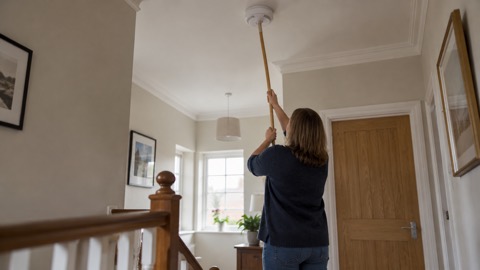
Test the alarm regularly using the combined test and hush button1. The button does two jobs: a press checks that the sensor and sounder work, and a press during a false alarm quietens it. Our guide to how often to test smoke and CO alarms sets out a routine that is easy to keep.
When the KF20 chirps, it is telling you the back-up battery is running down. The fire and rescue services are consistent on what that sound means. North Yorkshire Fire and Rescue Service advises: "Check if the batteries need replacing as the beeping may be the low battery warning sound"7. Devon and Somerset Fire and Rescue Service puts it more precisely: "If it beeps every minute or so this could be a 'low battery' warning", and says to replace the battery as soon as possible8. RoSPA is blunter still: "Replace batteries immediately if the alarm starts to chirp"9.
The KF20 has a feature that makes the night-time chirp less disruptive: the distributor says the low battery warning chirp can be silenced for 8 hours for a peaceful night1. Use that to get through the night, then fit a fresh 9V alkaline battery the next day. Silencing is a delay, not a repair, and an alarm with a flat back-up battery is an alarm that may not work in a power cut.
Replacement, not repair, is the answer when the alarm reaches the end of its life. The distributor's replacement guidance is built around the 10 year lifespan of the alarms the KF20 supersedes1. Our page on when to replace a smoke, heat or CO alarm explains how to date an alarm and what to do when it is due.
Safety, disposal and support
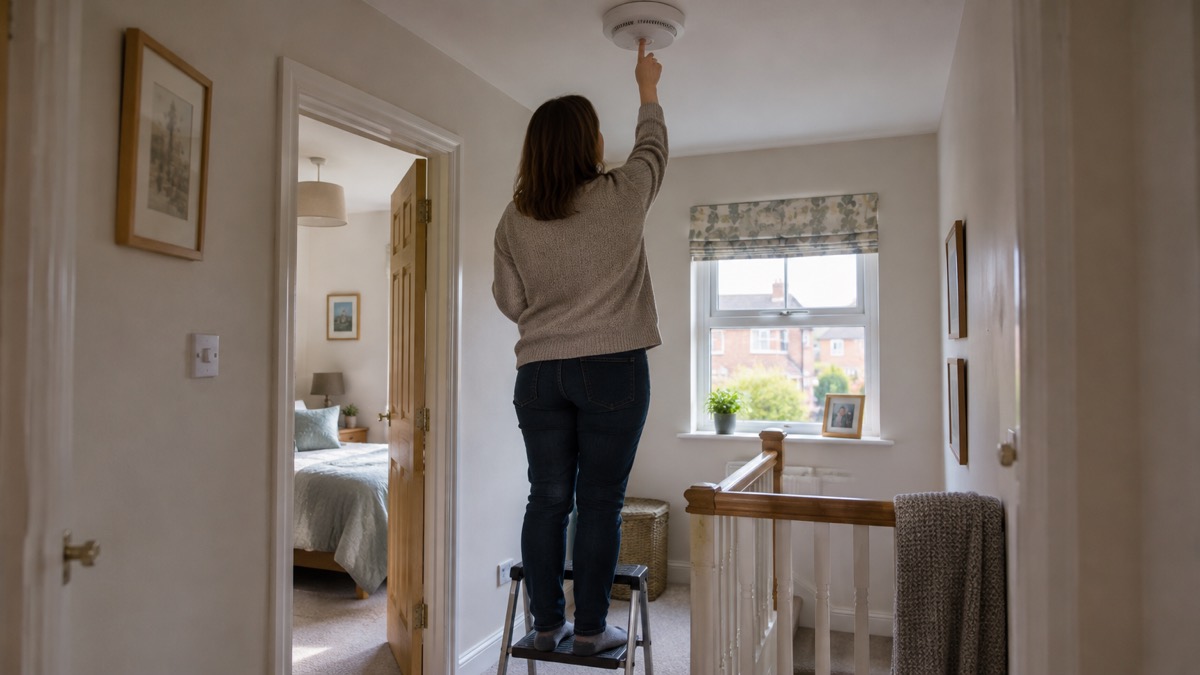
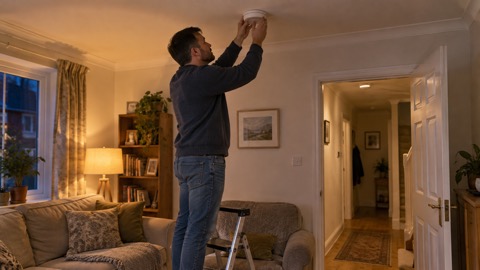
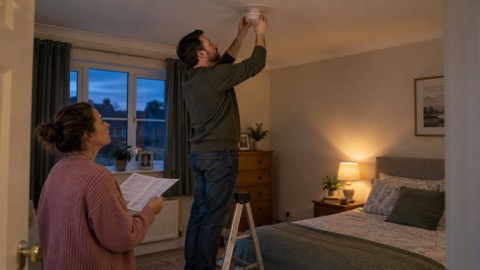
The KF20 is a mains device, and the mains side of it should be treated with respect. Replacing a like-for-like unit on an existing KF10 base is described by the distributor as a simple, electrician-free job1, but anything involving new cable, a new circuit or a connector change is electrical work and belongs with an electrician. If in doubt, isolate the circuit before you touch the base.
When an alarm is finished, dispose of it properly. Aico's guidance for its own alarms is that "Old alarms should be disposed of responsibly, following your local waste and recycling guidance"10. The distributor lists the KF20 under Valpak's WEEE Distributor Take-back Scheme, so the retailer you bought it from may take it back2. Do not put an old alarm in the bin without checking your council's rules, and never burn one.
On support, the distributor lists a 6 year warranty for the KF202. Keep the receipt and note the fitting date, because a claim will need both. Kidde's wider home safety range is sold through national retailers and independent stores, and the company can be contacted through its European site or on 01753 76639211. For the general question of which alarm type suits which room, our section on home emergencies brings the fire, carbon monoxide and utility guides together.
Sources (11)
- Kidde KF10 Replacement Smoke Alarm, Safelincs, 2026-10-29
- Kidde Firex KF20 Mains Powered Optical Smoke Alarm with Back-Up Battery, Safelincs, 2026-10-29
- Kidde Firex KF R Series 1 Heat 2 Smoke Alarm Kit, Safelincs, 2026-10-29
- Kidde Firex KF R Series 1 Heat 3 Smoke Alarm Kit, Safelincs, 2026-10-29
- FireAngel CW1 User Manual, FireAngel, 2019
- Where to Install CO Alarms, FireBlitz, 2025-03-19
- Safe at Home: Frequently Asked Questions, North Yorkshire Fire and Rescue Service, 2026-08-18
- Smoke Alarms, Devon and Somerset Fire and Rescue Service, 2026-02-17
- Child Safety Hub: Fire, RoSPA, 2026-10-26
- How Do I Replace My Alarm?, Aico, 2026-10-28
- Carbon Monoxide Alarms, CO-Gas Safety, 2024-02-18
 FireAngel FP2620W2-R Alarm
 FireAngel ST-632 Smoke Alarm
 FireAngel ST-750 Smoke Alarm
 FireAngel SW1 Smoke Alarm
 FireAngel SW10 Smoke Alarm
 FireAngel SB1 Smoke Alarm
 FireAngel SM-SN-1 Smoke Alarm
 FireAngel FA6611 Smoke Alarm
 FireAngel FA6615 Smoke Alarm
 FireAngel FA8620BW Alarm
 Kidde 2030-DSR Smoke Alarm
 Kidde 2030-DCR CO Alarm