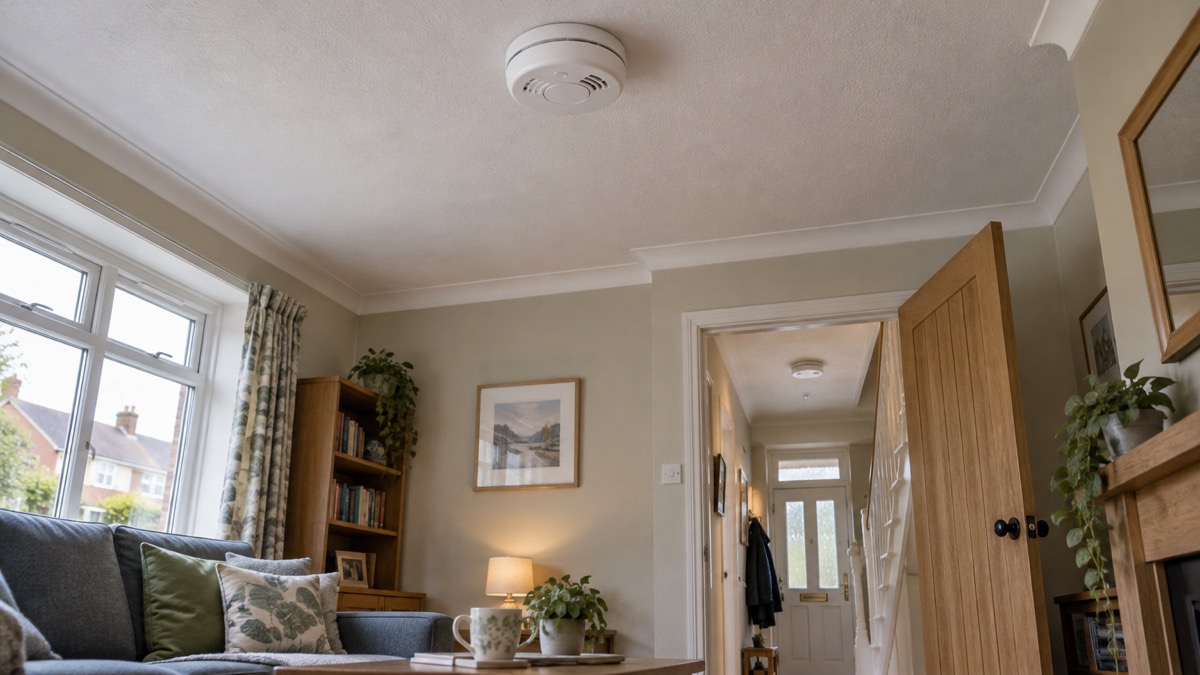
Interlinked alarms are the single most useful upgrade most households can make to their fire safety. The idea is simple: when one alarm senses fire, every alarm in the house sounds. Fire services describe it plainly: "Interlinked alarms means if one goes off, they all go off, so you will always hear an alarm wherever you are in your home"1. That matters most at night, when a fire in a downstairs kitchen can fill a landing with smoke long before a bedroom alarm notices anything.
You have two ways to get there. Hard-wired alarms are connected by cable, usually to the mains, and are the arrangement fire services prefer: "Ideally alarms should be hardwired and interlinked (this is a legislative requirement for rented accommodation)"2. Wireless alarms are linked by radio instead, and "do not need WiFi"1. Both types can be interlinked, and both can be bought as sealed battery units or as mains-wired units1.
Which suits you depends on your home, whether you rent, and where you live. In Scotland every home must have interlinked fire alarms, and all smoke and heat alarms must be ceiling mounted and interlinked1. In England, Wales and Northern Ireland the legal duty falls mainly on landlords, while owner-occupiers are strongly advised to interlink. This page sets out what each system does, what the official advice prefers, and how to keep it working.
Both types make every alarm sound when one is triggered
The point of interlinking is coverage, not gadgetry. A single alarm protects the room it is in and perhaps the landing outside. A linked system protects the household, because the alarm nearest the fire raises the whole house. Fire services recommend linked alarms "so that one alarm detects a fire they all go off together", and note they are useful in a large house or over several levels6. Another service puts it as a system that ensures "smoke alarms are heard in all rooms of the house"7.
This is not only a convenience for big houses. Interlinked alarms are "particularly important where a person has any issues that may prevent or delay their escape"8. If someone needs more time to get up, get dressed or get to a door, an early warning in the room they are in buys that time. Carers are advised to make sure alarms are interlinked "so that when one alarm detects a fire they all go off together, giving the person early warning"9.
The same logic applies to particular building types. In a thatched property with loft space, fire services recommend installing an interlinked smoke alarm10. In homes where someone is deaf or has hearing loss, the linked system extends to strobe lights and vibrating pads, so the warning reaches them wherever they are11.
What interlinking does not do is detect anything earlier. A linked system is only as good as the alarms in it and where they are placed. A heat alarm in a kitchen linked to a smoke alarm upstairs will still take longer to trigger than a smoke alarm would, because that is how heat alarms work. The gain is in how many people hear the warning, and how soon.
Hardwired and interlinked: what the official advice prefers
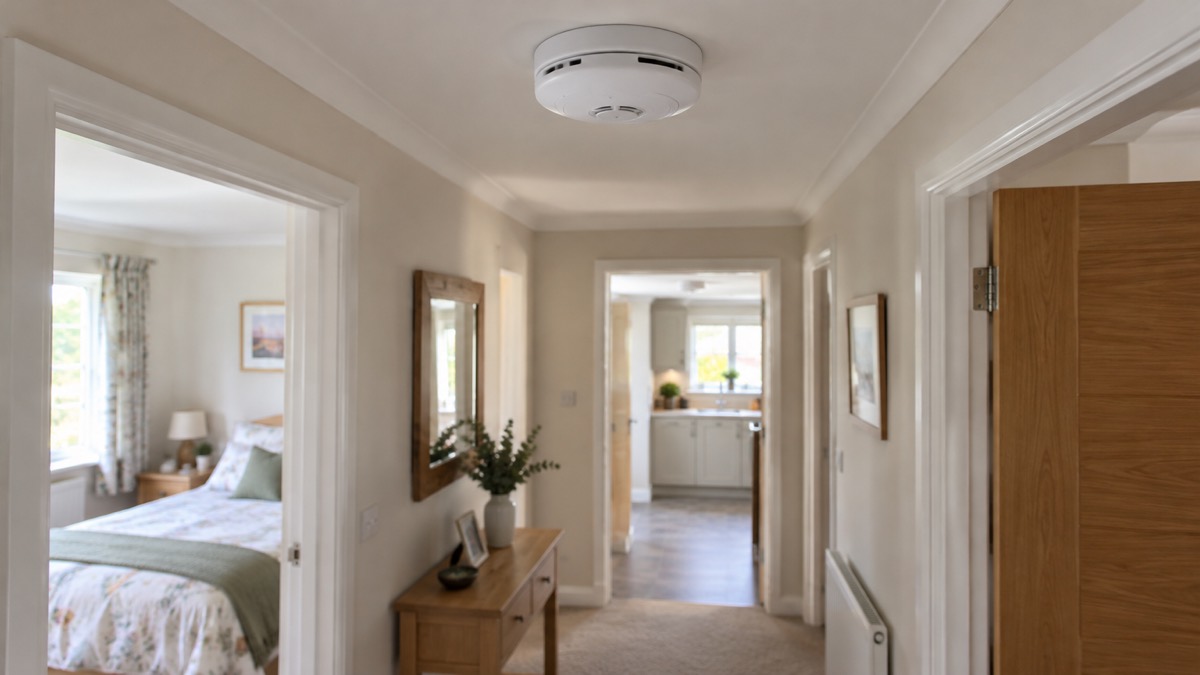
If you are starting from nothing, the official steer is clear. Fire services in England, Wales and Northern Ireland say that "ideally alarms should be hardwired and interlinked", and that this is a legislative requirement for rented accommodation2. The same wording appears in guidance for landlords and tenants, so it is worth knowing whether you are the person responsible for meeting it12.
Hard-wired means the alarm is connected to the home's mains wiring, usually with a backup battery so it keeps working in a power cut. The practical advantages are that you never have to think about batteries day to day, and the system is fixed and permanent. The practical costs are that installation normally needs an electrician, and that the work is disruptive if the house is finished and decorated.
Maintenance is straightforward once fitted. Hard-wired alarms "should be replaced as per the manufacturer's guidelines" and "should also be tested weekly"13. Mains-wired alarms should be replaced every 10 years4. That replacement interval is not a battery issue: mains-wired alarms "use the same technology" as battery-operated detectors "and so have the same shelf life"14. The sensor itself ages, so the whole unit is replaced.
For a heat alarm in a kitchen, London Fire Brigade sets out the choice directly: "Choose between battery-powered models you can install yourself or hard-wired ones that require professional installation by an electrician"15. The hard-wired option can also be linked to a telecare system, which matters if someone in the home uses one.
| Feature | Hard-wired interlinked | Wireless interlinked |
|---|---|---|
| How alarms connect | By cable, usually to the mains16 | By radio frequency, no WiFi needed1 |
| Who installs | An electrician for mains wiring15 | Often self-install for sealed battery units17 |
| Power | Mains with backup battery18 | Sealed battery or mains-wired units1 |
| Official preference | Ideally hardwired and interlinked2 | Accepted; interlinking by radio is recognised16 |
| Replacement | Every 10 years for mains-wired4 | Follow the maker's guidance for the unit |
How wireless interlinking works without WiFi
A common worry is that a wireless alarm depends on the home broadband. It does not. Fire services state that both types of alarm "are interlinked by radio frequency and do not need WiFi"1. The alarms talk to each other directly on their own radio link, so a router failure, a power cut to the broadband or a cancelled broadband contract makes no difference to whether they raise the alarm.
The Scottish tolerable standard guidance describes the two routes in the same way: alarms "can be interlinked via wires (hardwired) or wirelessly (by radio communication)"16. That is the whole mechanism. There is no app, no account and no subscription in the basic arrangement, and nothing to configure beyond pairing the units as the maker instructs.
Wireless linking is what makes interlinking practical for a household that is not rewiring. You can fit sealed battery alarms room by room, link them, and have the whole-house warning without an electrician. It also suits solid-walled or older homes where running cable is awkward, and rented homes where the tenant cannot alter the wiring.
The trade-offs are real but modest. Each unit needs its own power, which for battery models means a sealed battery with a finite life. Radio range within a typical house is not usually the limiting factor, but very large or thick-walled properties may need the maker's advice on how many units and where. And because there is no cable, there is nothing to check visually: the weekly test button is how you confirm the link is working.
Mixing wired and wireless alarms in one system
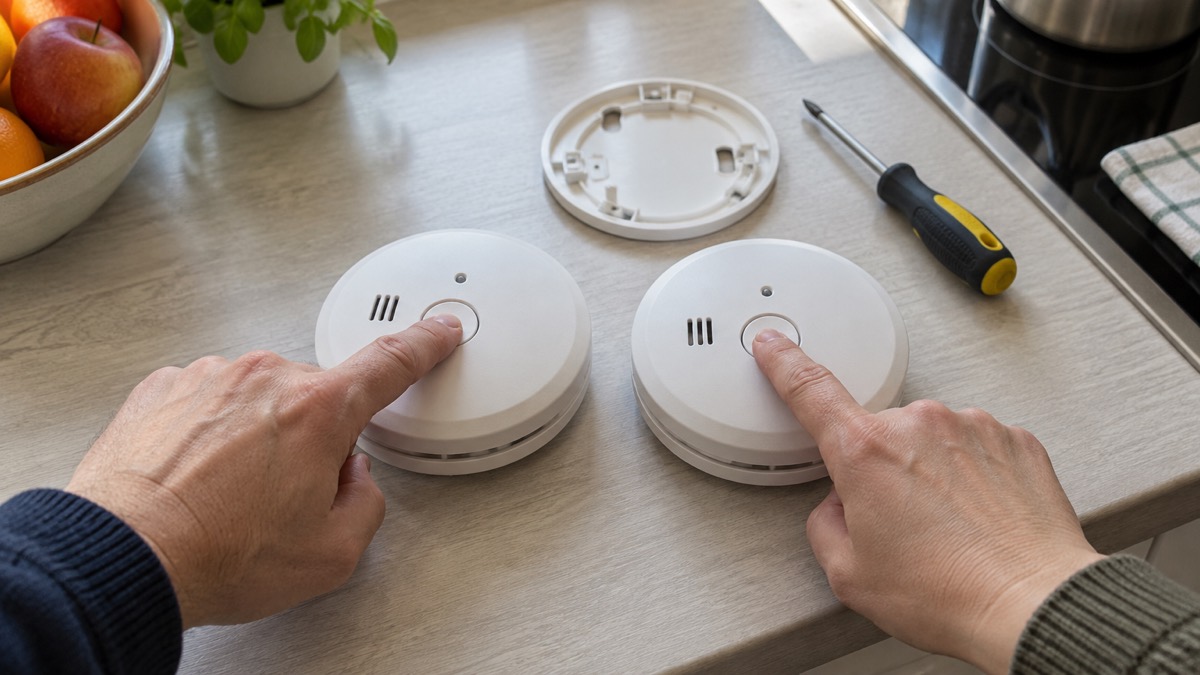
You do not have to choose one system for the whole house forever. Fire services describe linked detectors as "wired or wirelessly interlinked so if one alarm activates, all alarms activate"19, and note that "some battery or mains alarms can be interlinked"8. In practice that means a household can extend an existing system rather than replace it.
The usual pattern is a home with mains-wired alarms on the landing and hallway, adding a wireless alarm in a converted loft, an extension or a kitchen where running cable is impractical. Whether the new unit will join the old system depends on the maker and the radio protocol, so check compatibility before buying. Alarms from different makers generally will not link to each other, and even within a maker's range the linking method can differ between generations.
Where a telecare, carecall or lifeline system is in use, the advice is more specific. Fire services suggest considering "interlinked smoke alarms that connect to the telecare, carecall or lifeline system"20. The Scottish tolerable standard goes further: where telecare is in use, interlinked smoke and heat alarms "should be installed which are compatible with any telecare alarms and connected to the telecare system", ensuring a single system approach16. If that applies to your household, the telecare provider is the right first call, because the alarm has to speak to their equipment.
Sealed for life power: what changes when you go wireless
Going wireless usually means going battery, and the choice of battery type decides how much maintenance you take on. Guidance for rented homes is explicit: where battery powered alarms are selected, alarms with "sealed for life" batteries rather than alarms with replaceable batteries are the better option17. A sealed unit cannot be left with the battery removed because someone wanted to stop a chirp, and it cannot be fitted with the wrong cell.
The fire services that supply alarms follow the same approach. Alarms supplied by Hampshire & Isle of Wight Fire and Rescue Service "are sealed units with a 10-year battery life"21, and the alarms provided by Mid and West Wales Fire and Rescue Service "have a 10-year battery life"22. A decade of cover from one sealed cell is the standard to look for.
What changes in practice is the maintenance routine. With a sealed unit you test weekly using the test button, and you replace the whole alarm when the battery or the sensor reaches the end of its life. You do not buy batteries, and you do not have a spare battery to fit at short notice. That is the trade: less to remember, but no partial fix if a unit fails early.
There is a second consideration for anyone weighing wireless against mains. A mains-wired alarm with a backup battery keeps working through a power cut, and so does a sealed battery alarm. A mains-only alarm without a working backup does not. Fire services list "mains-powered smoke alarms with back-up batteries" among the options for households with special needs1, and it is a sensible specification for any home.
Choosing alarms for each room and system grade
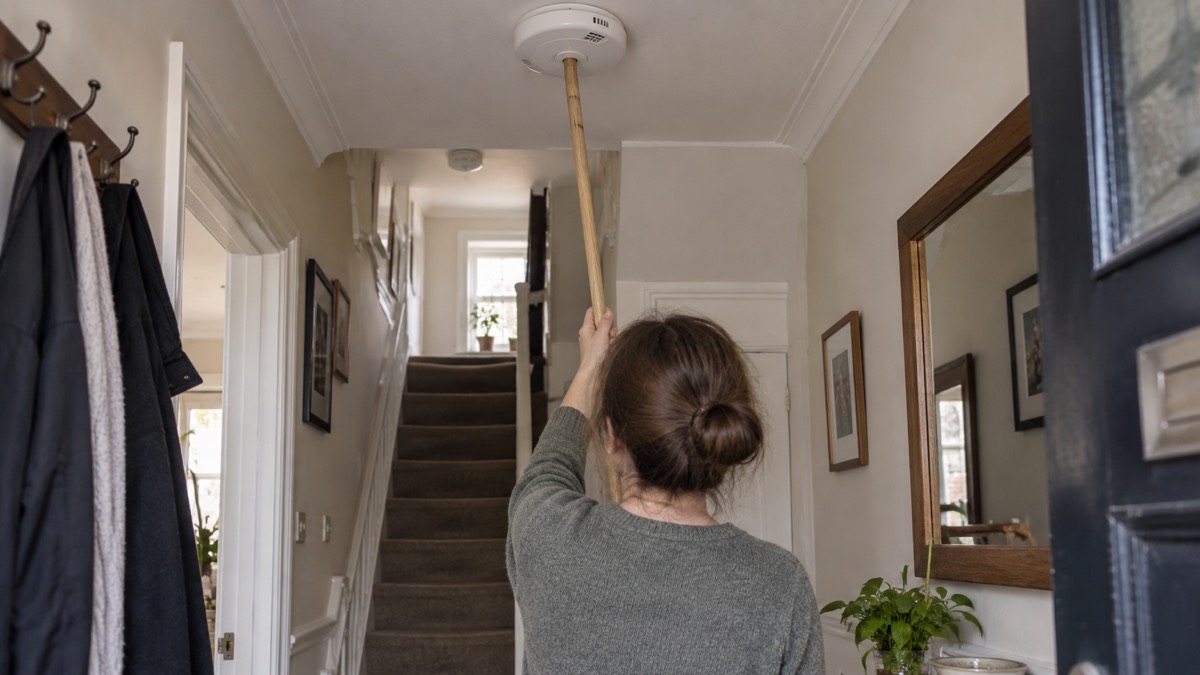
The type of alarm matters as much as the linking. Smoke alarms belong in circulation spaces and bedrooms, heat alarms in kitchens and garages where cooking and steam would set a smoke alarm off repeatedly. All smoke and heat alarms "should be attached to the ceiling and be interlinked"3. Ceiling mounting is not a detail: hot smoke rises, and a wall-mounted alarm sits below the layer that would trigger it first.
In Scotland the standard is set out in terms of grades. The tolerable standard "can be met by the use of Grade A or Grade C alarms which should be installed in compliance with BS 5839-6"23. Grade A covers smoke, heat and multi-sensor detectors; Grade C also includes fire alarm sounders and visual or vibrating alarm devices23. For a householder, the practical reading is that the system should be designed to a recognised standard rather than assembled from whatever was on offer.
Certification is the quick check. "Check your smoke alarm has either a British Standard (BS) kitemark or the Loss Prevention Certification Board (LPCB) symbol"5. For rented homes, landlords should choose alarms "compliant with British Standards BS 5839-6"17. If you are buying for your own home, the same marks tell you the unit has been tested to a published standard.
| Room | Alarm type | Notes |
|---|---|---|
| Hallway and landing | Smoke alarm | The escape route is the priority; link to the rest of the house6 |
| Living room | Smoke alarm | Linked so a fire here raises the bedrooms6 |
| Bedrooms | Smoke alarm | Interlinking gives early warning to anyone who needs time to escape8 |
| Kitchen | Heat alarm | Choose battery or hard-wired; hard-wired can link to telecare15 |
| Loft (thatched property) | Smoke alarm | Interlinked alarm recommended where there is loft space10 |
| Any room with a boiler or wood burner | Carbon monoxide alarm | Required in Scotland where there are fixed combustion appliances18 |
Carbon monoxide is a separate job. "They are not a substitute for one another and both types of alarm should be installed in your house"24. In Scotland a carbon monoxide alarm is required "where there are fixed combustion appliances such as boilers and wood burners"18. If you are linking alarms anyway, linking the CO alarm too means a warning in the kitchen is heard in the bedrooms.
Recall: Aico Ei3014 heat detector labelling
In May 2025 the Office for Product Safety and Standards recalled the Aico Ei3014 Heat Detector. The product is described as "a white, battery-powered heat detector"25, and the recall notice records that "the product has been recalled from end users"26. The reason was labelling: some units were labelled as detecting carbon monoxide when they detect heat only25.
The batches affected are listed in the recall notice as Ei3014-25W08C002-00223, Ei3014-25W08C002-00196 and Ei3014-25W08C002-0015026. If you have an Ei3014, check the batch number on the unit against that list. A heat detector that appears to offer carbon monoxide protection but does not is a serious gap, because the household may believe it is covered when it is not.
The recall is a reminder to check any alarm you buy or inherit against the product recall lists. It also shows why the labelling on the box matters as much as the sensor inside: an alarm that claims a capability it does not have is worse than no claim at all.
Help with siting, installation and faults
Most alarm problems are simple, and the first step is the test button. If a hard-wired alarm develops a fault, fire services advise: "If you have a fault with a hard wired alarm, then please contact an electrician or your landlord if in a rented property"22. Manchester Fire and Rescue Service gives the same steer: "If there is a problem with an alarm that is hard wired to mains electric, contact an electrician. Alternatively, if in rented accommodation contact your landlord for further advice"27.
For alarms supplied by a fire and rescue service and still under guarantee, the maker's support line is often the quickest route. FireAngel can be reached on freephone 0800 141 2561, and FireHawk on freephone 0800 008 6568, or by text to 07885 831239 if you cannot call27. Have the alarm to hand when you ring.
If you are unsure what you need, ask your local fire and rescue service. Many offer home fire safety visits and some supply and fit alarms; the units they provide are typically sealed with a 10-year battery21. For households where someone is deaf or has hearing loss, the service can advise on strobe lights and vibrating pads, which should be fitted alongside the standard alarms rather than instead of them3.
If you rent, the responsibility sits with your landlord. In Scotland, private landlords "must provide interlinked fire and smoke alarms", and council or housing association landlords are responsible for ensuring interlinked fire alarms are in place28. Across the UK, hardwired and interlinked alarms are described as a legislative requirement for rented accommodation2. Report faults in writing and keep a copy.
Sources (28)
- Smoke and heat alarms, Scottish Fire and Rescue Service, 2025
- Home fire safety, Northern Ireland Fire and Rescue Service, 2026
- Fire and smoke alarms in Scottish homes, Scottish Government, 2024
- Where and what to buy, Scottish Government, 2024
- Baby and toddler safety, NHS, 2026
- Fire safety in the home, Suffolk County Council, 2021
- Fire safety carers, Devon and Somerset Fire and Rescue Service, 2026
- Smoke alarms and heat alarms, London Fire Brigade, 2026
- Alarms, London Fire Brigade, 2026
- Thatched properties, Devon and Somerset Fire and Rescue Service, 2026
- Additional Advice for Carers - Greater Manchester Fire Rescue Service, Greater Manchester Fire Rescue Service
- Other safety, Northern Ireland Fire and Rescue Service, 2026
- Smoke alarms, Cheshire Fire and Rescue Service, 2026
- Mains wired smoke detectors, Dorset and Wiltshire Fire and Rescue Service, 2021
- Cooking, London Fire Brigade, 2026
- Tolerable standard guidance, Scottish Government, 2023
- Housing standards, Cherwell District Council, 2026
- Home fire safety, Scottish Government, 2026
- Equipment, Devon and Somerset Fire and Rescue Service, 2026
- Hearing and sight difficulties, Dorset and Wiltshire Fire and Rescue Service, 2025
- Home fire safety visit booklet, Hampshire and Isle of Wight Fire and Rescue Service, 2023
- Smoke alarm maintenance and problems, Mid and West Wales Fire and Rescue Service, 2026
- Tolerable standard guidance, chapter 16, Scottish Government, 2023
- Safe home heating, Warwickshire County Council, 2026
- Product recall: Aico Ei3014 heat detector, London Borough of Bromley, 2025
- Product recall: Aico Ei3014 heat detector, Office for Product Safety and Standards, 2025
- Problem with your smoke or heat alarm, Greater Manchester Fire and Rescue Service, 2026
- What the alarms must have, Scottish Government, 2024
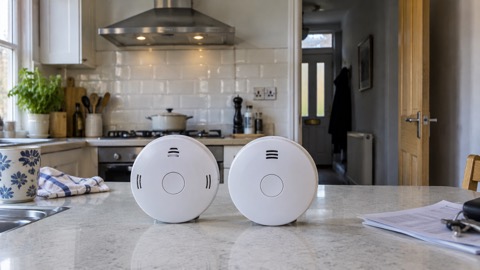 Heat Alarm or Smoke Alarm
 Combined vs Separate Alarms
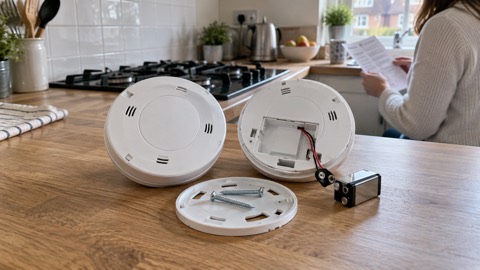 Sealed or Replaceable Alarms
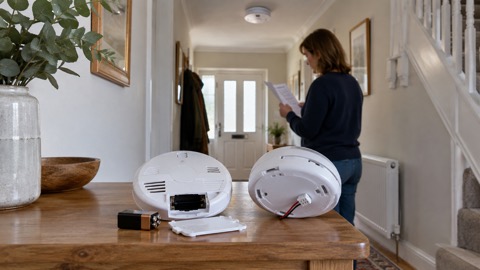 Battery or Mains Smoke Alarms
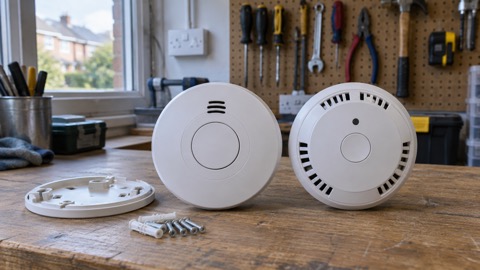 Optical or Ionisation Alarms
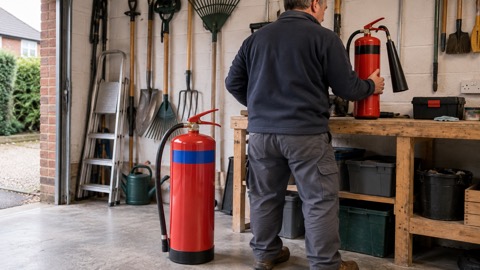 CO2 vs Powder Extinguishers