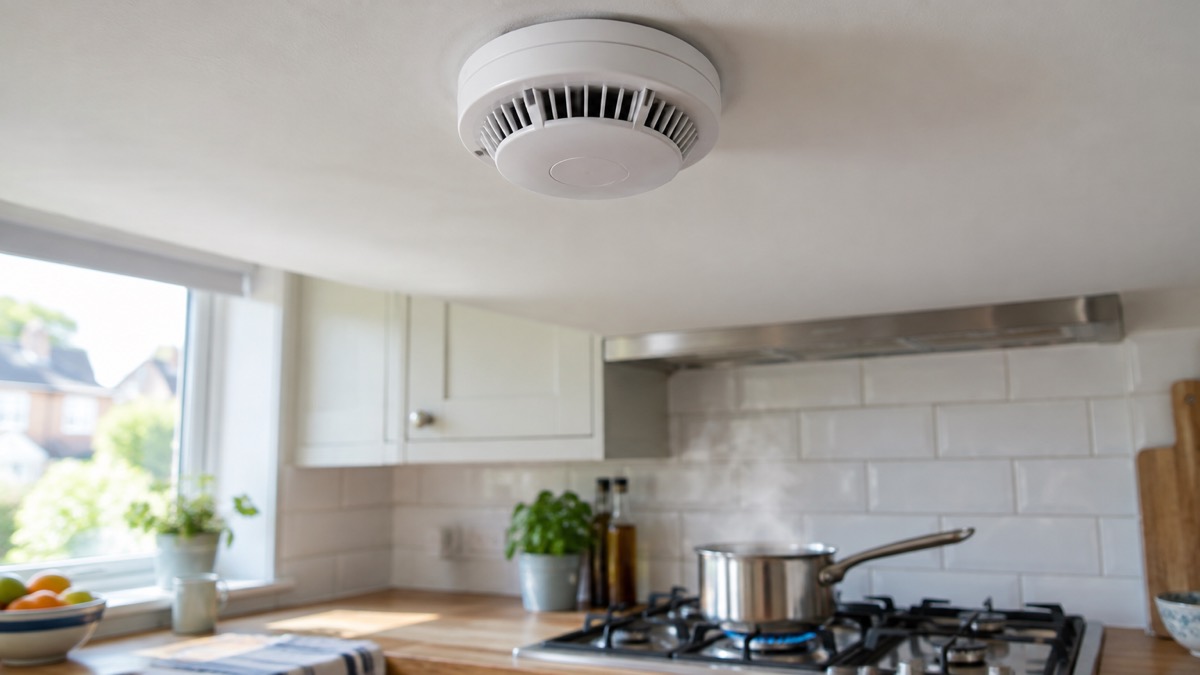
The FireAngel FA8720BW is a heat alarm: it watches for a rapid rise in temperature rather than smoke, which makes it the alarm for a kitchen or a garage where a smoke alarm would keep going off. It is certified to BS 5446-2:2003, uses Class A1 heat detection, and runs on a sealed lithium battery that the maker rates at 10 years1. It connects by Bluetooth to other FireAngel One alarms, up to 20 devices in all, so a fire in the kitchen can set every alarm in the house sounding1.
If you are fitting one, the rules that matter are simple. Put it on the ceiling, ideally in the centre of the room, not on a wall2. Keep it no more than 5.3 m from the farthest wall, from a door to any room where a fire might start, and from the next heat or smoke alarm2. Test it at least once a month by double-pressing the test button for a full-volume 85 dB check1.
This page covers what the alarm does and does not detect, its specifications and certification, where to fit it in a UK home, how to link it to other alarms and the Angel Connect app, and how to test it and know when it needs replacing. It is a heat alarm only: it will not warn you of a smouldering fire or of carbon monoxide, so it belongs in a system with smoke and CO alarms, not on its own.
What the FA8720BW is and how it detects fire
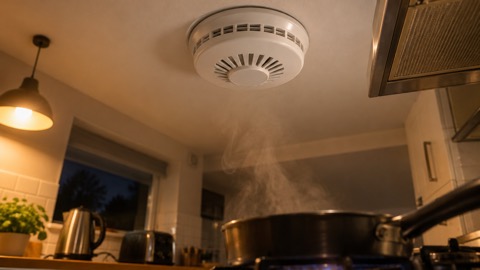
A heat alarm is a warning device that detects an increase in temperature from a fire but is insensitive to smoke3. Inside, a thermistor senses temperature changes, and the alarm sounds when heat reaches a set level4. Retailer guidance describes the trigger as a heat element that detects when the temperature rises above 57 degrees Celsius5. That is why it suits a kitchen: the alarm is not fooled by steam, cooking fumes or toast, because it is not looking for smoke at all.
FireAngel describes the FA8720BW as intelligent heat detection for connected home protection, with Class A1 heat detection and a rapid response to real fire conditions1. The maker says it is particularly good at fires caused by faulty white goods, which usually create a blast of hot fire rather than a long smoulder, and that it will not false alarm in dusty or humid rooms1. That makes it a natural fit for a utility room with a tumble dryer or a garage with dusty tools.
The trade-off is important to understand. Because it does not detect smoke, it gives no early warning of a slow, smouldering fire, the kind a smoke alarm catches while the fire is still small. The maker is explicit that heat alarms specifically detect changes in temperature and are not designed to detect smoke6. So the FA8720BW is a companion to smoke alarms, not a replacement for them. Fit smoke alarms on the escape route and in living areas, and use the heat alarm where smoke alarms would be a nuisance.
Specifications and certification
The FA8720BW is a compact, ceiling-mounted unit with a sealed battery and Bluetooth linking. The table below sets out what the maker states.
| Specification | Detail |
|---|---|
| Product type | Heat alarm with Bluetooth interconnectivity1 |
| Detection | Class A1 heat detection1 |
| Certification | BS 5446-2:2003, SGS certified (UKAS-accredited ISO/IEC 17065), CE compliant1 |
| Battery | 10-year sealed lithium1 |
| Interlinking | Up to 20 compatible FireAngel One devices by Bluetooth1 |
| Dimensions | 118 mm diameter x 44 mm depth1 |
| Alarm volume | 85 dB full-volume test1 |
| Installation | Adhesive pad included1 |
| Materials | Manufactured using recycled plastic1 |
| Suitable properties | Houses, flats, bungalows, maisonettes, caravans and motorhomes1 |
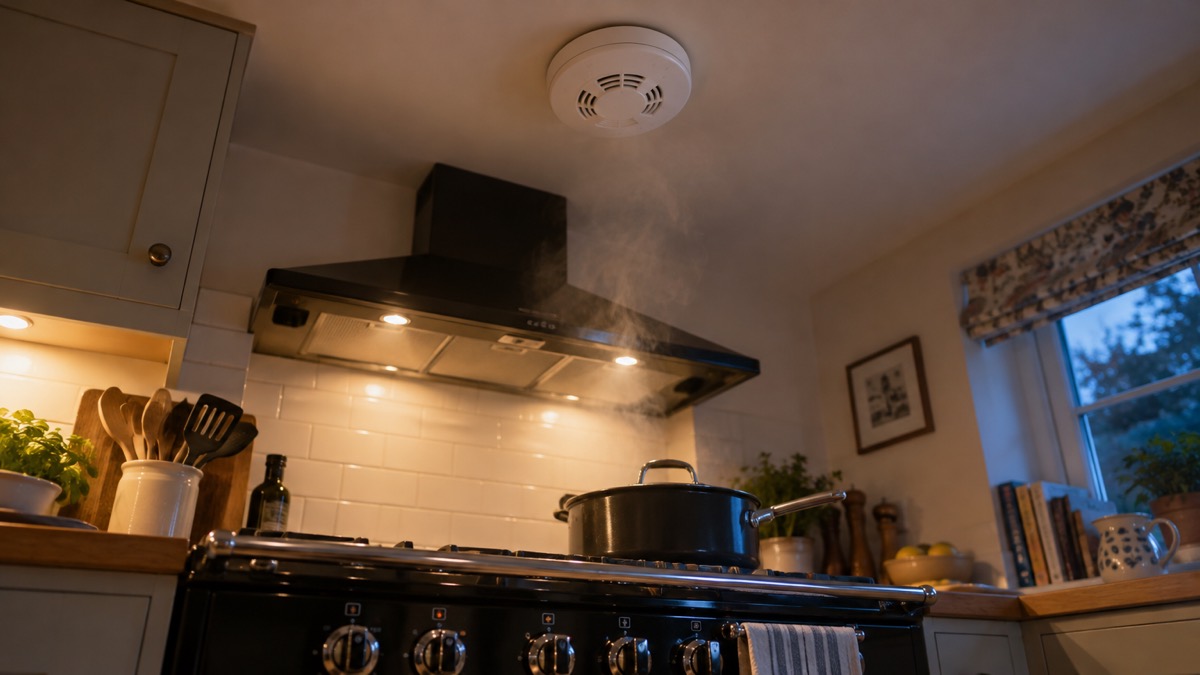
The British Standard matters because it is the benchmark official guidance uses. Scottish Government guidance on the tolerable standard says heat alarms should conform to BS 5446-27. The FA8720BW is certified to BS 5446-2:2003, so it meets that benchmark1. The SGS certification is a third-party check by a UKAS-accredited body, and the CE mark covers the European conformity requirements1.
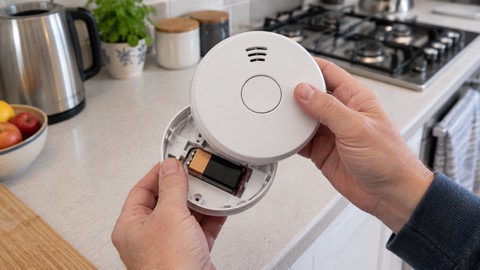
The 10-year sealed lithium battery is a design choice worth understanding. A sealed battery cannot be swapped out, so the maker's advice is that if the battery stops working you replace the battery if it is removable, or otherwise replace the entire device, and to check with customer support if you suspect a fault1. In practice, that means the alarm's service life is tied to its battery. If you want to compare the two approaches before you buy, our page on sealed or replaceable battery alarms sets out the trade-offs.
Where to fit a heat alarm in a UK home
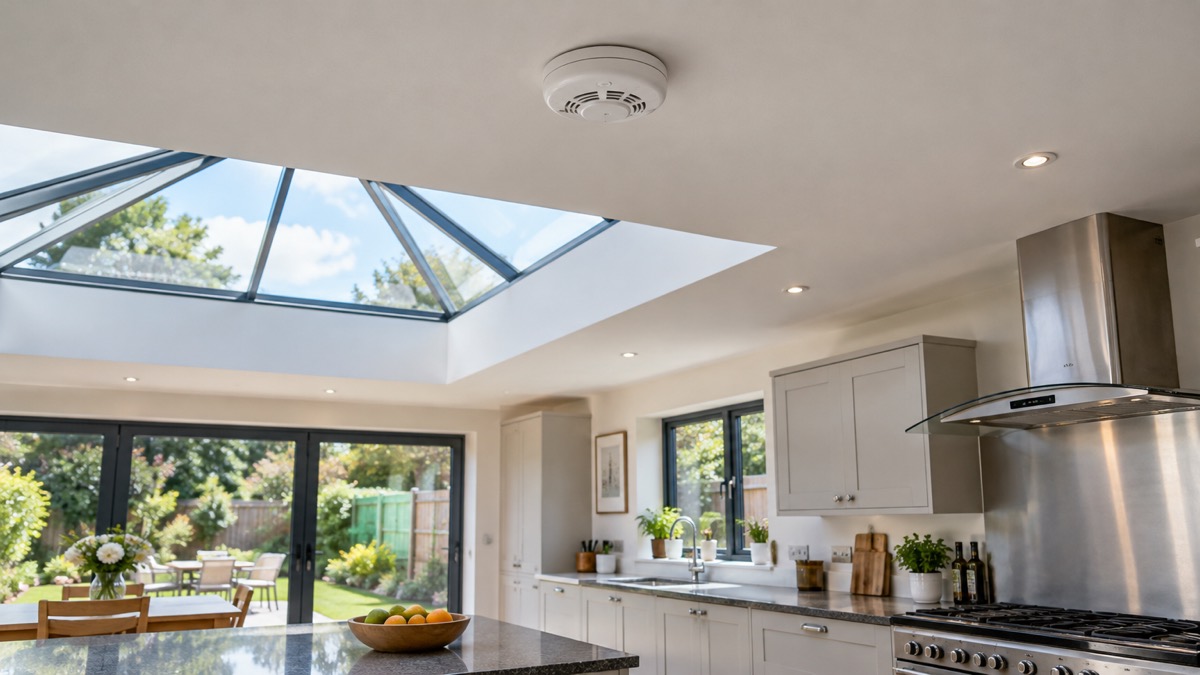
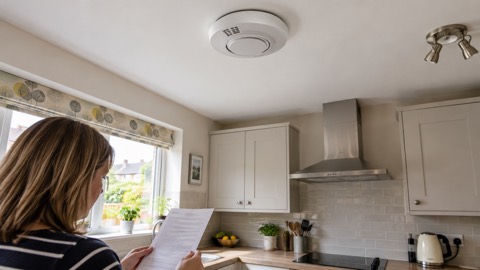
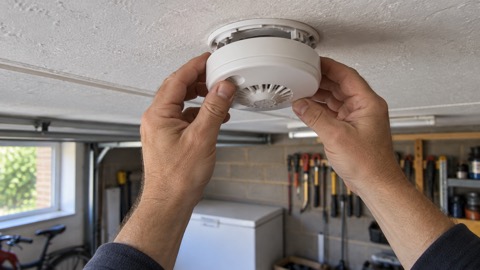
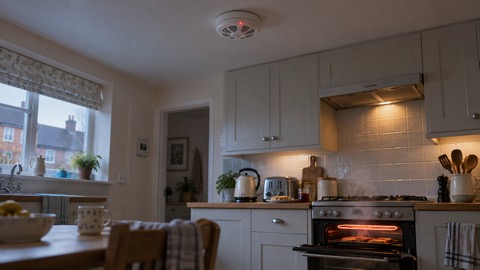
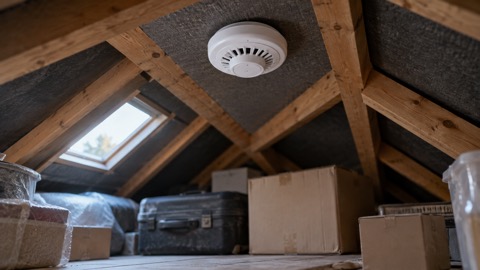
Heat alarms are designed for kitchens, garages and utility rooms, where smoke alarms would trigger false alarms from cooking or fumes4. FireAngel says the FA8720BW is designed for installation in kitchens and garages, where everyday cooking fumes, steam or dust make smoke alarms unsuitable1. Its wider guidance for heat alarms puts them in kitchens, utility rooms, boiler rooms, attics and garages9.
Official fire service advice agrees. Greater Manchester Fire and Rescue Service says to fit a heat alarm in your kitchen area3, and Warwickshire Fire and Rescue Service lists heat alarms for the kitchen and garage10. The National Fire Chiefs Council position statement additionally recommends that a heat alarm should be fitted in the kitchen11. In other words, the kitchen is the one room where a heat alarm is the standard answer rather than a compromise.
The maker's positioning guidance is the practical rulebook:
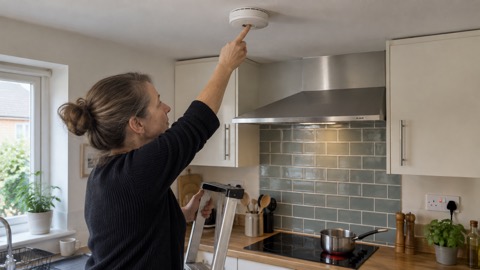
- Install heat alarms on the ceiling, ideally in the centre of the room2.
- Keep the alarm no greater than 5.3 m from the farthest wall2.
- Keep it no greater than 5.3 m from a door to any room in which a fire might start2.
- Keep it no greater than 5.3 m from the next heat or smoke alarm2.
- Do not install heat alarms on a wall2.
Those distances come from LD1 positioning, the highest of the coverage levels used in domestic alarm guidance2. In a typical kitchen they are easy to meet. In a long kitchen, a kitchen that opens into a dining room, or a garage with a workshop area, they are the reason you may need a second alarm.
Ceiling mounting and spacing
The ceiling rule is not fussiness. Hot air and smoke rise, so the ceiling is where a fire's heat arrives first. FireAngel's guidance for battery-powered heat alarms repeats the same instruction: place them on the ceiling, ideally in the centre of the room12. The mains-powered guidance says the same9.
Wall mounting is the exception, and a narrow one. Scottish official guidance says alarms may be wall mounted where the manufacturer indicates it is suitable, in spaces of limited area such as hallways, within 30 cm of the ceiling at its highest end7. That allowance exists for awkward spaces, sloped or uneven ceilings, or where drilling overhead risks disturbing asbestos8. It is not a general permission to put a heat alarm on a kitchen wall. For the FA8720BW, follow the maker's ceiling instruction2.
Sloped ceilings and awkward rooms
On a sloped ceiling, heat collects at the highest point, so that is where the alarm should go. Retailer guidance puts heat detectors within 150 mm of the peak, measured vertically from the peak13. The same guidance says that if ceiling mounting is not possible, a unit can be installed up to 125 mm below the ceiling13. Treat those as fallback positions, not first choices, and check the manual that comes with your alarm before you drill.
If your kitchen is large, divided, or has a ceiling that slopes away from the centre, the 5.3 m rules decide how many alarms you need2. Independent Age notes that heat alarms cover only a relatively small area, so you may need more than one in a large kitchen14. Two alarms on one ceiling, both within 5.3 m of the farthest wall and of each other, is a sensible arrangement in a big room.
Linking it to other FireAngel One alarms and the Angel Connect app
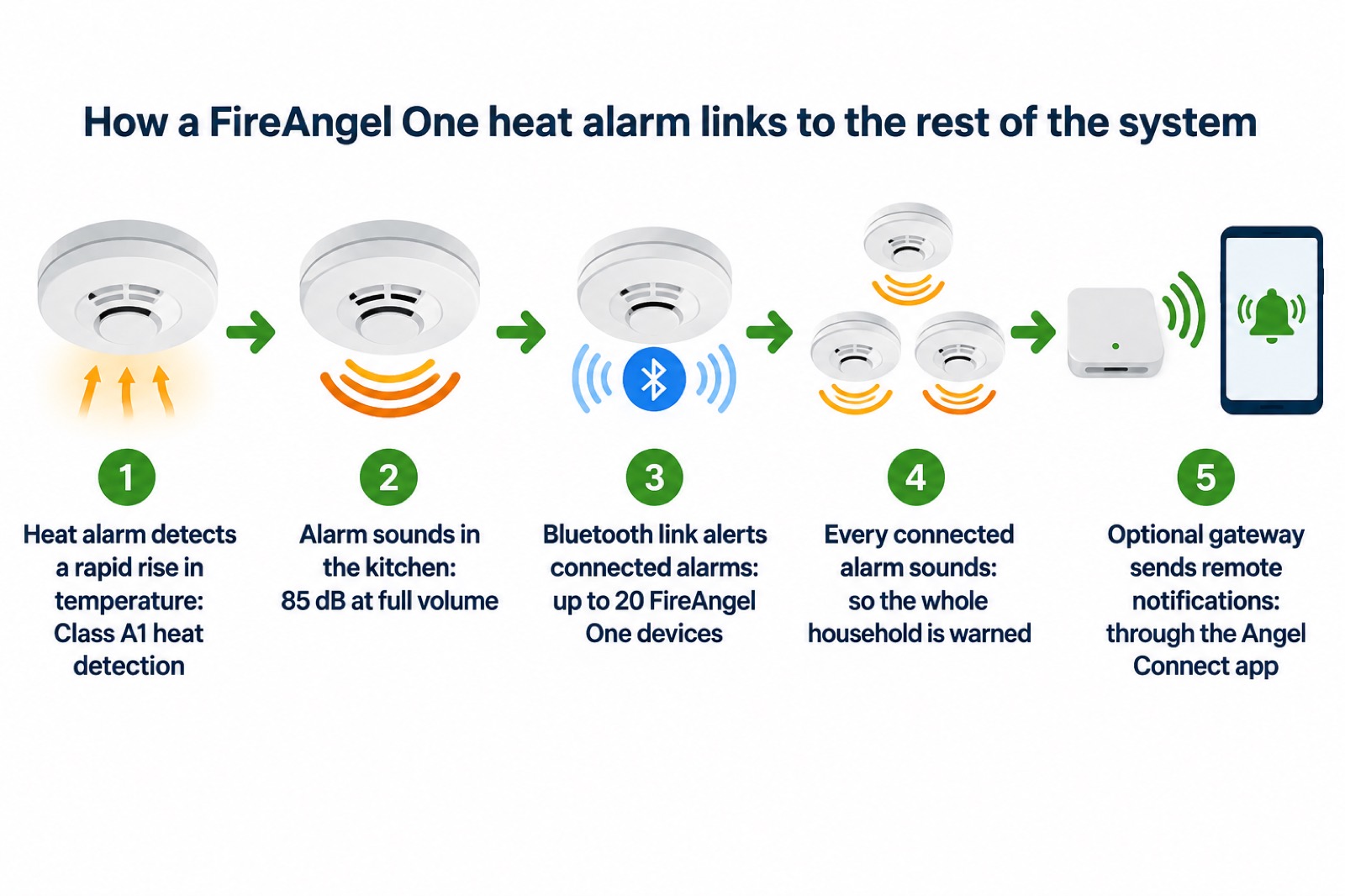
The FA8720BW is part of the FireAngel One range, which uses Bluetooth to interconnect alarms into a connected fire safety system15. The maker says the heat alarm can be interconnected with up to 20 compatible FireAngel One devices1. When one interconnected alarm detects a fire, every connected alarm sounds, which is the point: a fire in the kitchen should wake someone upstairs, not just warn the person cooking1.
The range includes smoke, heat, carbon monoxide and gateway devices that work together16. If you are building a system, our page on interlinked alarms explains how linking works across types, and our guide to the FireAngel One Smart smoke and heat alarm covers the combined unit.
The Angel Connect app adds a second layer. FireAngel says the app lets you control LED functions, test interlinked alarms and monitor your home's safety remotely, with a diagnostics report on the app dashboard17. The FA8720BW's built-in diagnostics are supported by the app, which helps keep the alarm performing at its best1. For remote notifications when you are away from home, the alarm can be paired with an optional gateway, enabling smart home integration and remote notifications through the app1. The FP1000W2 Pro Connected smart gateway is the kind of device that provides that bridge.
A few practical points. Bluetooth linking is set up at installation, so link the alarms before you finalise their positions. The app is a monitoring and testing aid, not a substitute for the alarm's own sounder: if the alarm sounds, it sounds in the room regardless of what your phone shows. And if you have trouble logging in to the app, FireAngel's customer support team is on 0330 094 583018.
Testing, battery life and replacement
Test the alarm at least once a month1. The FA8720BW has a full-volume test: double-press the test/hush button for an 85 dB check1. Do it at a time when nobody is sleeping, and warn the household first, because an interlinked system will sound every alarm in the house. If you want a wider routine, our guide to how often to test smoke and CO alarms covers the monthly habit.
The battery is sealed and rated at 10 years1. That rating is the maker's figure for the battery's service life, not a guarantee that the alarm will never need attention. FireAngel's advice if the battery stops working is to replace the battery if it is removable, or otherwise replace the entire device, and to check with customer support if a fault is suspected1. Because the FA8720BW's battery is sealed, a failed battery in practice means a replacement alarm.
When should you replace it? The maker's own rule is tied to the battery and to faults1. Our page on when to replace a smoke, heat or CO alarm sets out the general approach, and the FireAngel brand page lists the wider range if you are adding alarms. If the alarm chirps or misbehaves, our guide to why a smoke alarm keeps chirping covers the common causes, though a heat alarm's fault signals should be checked against its own manual.
Heat alarms, smoke alarms and the rest of the system
A heat alarm is one part of a home detection system, and the FA8720BW is designed to be exactly that: a kitchen and garage specialist that links to the rest. The comparison below sets out what each alarm type does, so you can see where the heat alarm fits.
| Alarm type | What it detects | Where it suits |
|---|---|---|
| Heat alarm (FA8720BW) | Rapid rise in temperature, Class A11 | Kitchens, garages, utility rooms, boiler rooms, attics1 |
| Smoke alarm | Smoke from a fire | Escape routes, living rooms, bedrooms, hallways |
| Carbon monoxide alarm | Carbon monoxide gas | Rooms with fuel-burning appliances |
The smoke and CO rows are there to show the gap, not to compare products: a heat alarm will not do their job, and they will not do its job without nuisance alarms. If you are choosing between the two main types for a given room, our comparison of heat alarm or smoke alarm goes through it room by room, and our guide to heat alarms covers the type as a whole.
For a full household system, the sensible pattern is smoke alarms on the escape route and in living areas, a heat alarm in the kitchen and garage, and CO alarms wherever there is a fuel-burning appliance. Our fire safety checklist and smoke alarms pages help you plan the rest. If you are in Scotland, the kitchen heat alarm is not optional: Scottish guidance says one heat alarm should be installed in every kitchen8, and heat alarms are required for homes in Scotland20. Our page on Wales and Northern Ireland covers the rules elsewhere.
Fitting it safely and getting support
The FA8720BW comes with an adhesive pad for easy installation1. That is useful in a rented home or where you would rather not drill a ceiling, but the maker's positioning rules still apply: ceiling, centre of the room, within 5.3 m of the farthest wall, door and next alarm2. Clean and dry the ceiling patch before you stick the pad, and check it is holding firm after a few days. If the ceiling is textured, damp or flaking, a screw fixing per the manual is the safer route.
Before you fit any alarm, read the manual that comes with it. FireAngel manuals are available in large text and other formats on request, by emailing technicalsupport@fireangeltech.com or calling 0330 094 583021. If you need help with the app, the same number reaches customer support18.
For support, FireAngel's technical team can be reached on 0330 094 5830, by email at technicalsupport@fireangeltech.com, or online at www.fireangeltech.com/support, and the company is based at Vanguard Centre, Coventry CV4 7EZ22. FireAngel asks you to have the batch number and installation date ready when you contact them19. If you are buying for a household that includes someone deaf or hard of hearing, our page on alarms for deaf and hard of hearing people covers the additional options.
Sources (22)
- FireAngel FA8720BW-R One Smart BLE Heat Alarm, FireAngel, 2026-10-28
- Smoke and heat alarm positioning, FireAngel, 2024-08-27
- Smoke and heat alarms, Greater Manchester Fire and Rescue Service, 2026-10-29
- FireAngel HT-630 kitchen heat alarm, FireAngel, 2026-08-21
- Smoke alarm buying guide, Toolstation, 2026-10-29
- Heat alarms, Aico, 2026-10-28
- Tolerable Standard guidance: satisfactory fire detection, chapter 16, Scottish Government, 2023-06
- Tolerable Standard guidance: satisfactory fire and carbon monoxide detection, Scottish Government, 2023-11-03
- Installing your FireAngel mains powered heat alarm, FireAngel, 2024-10-17
- Alarms and sprinklers, Warwickshire County Council, 2026-10-29
- NFCC home detection position statement, National Fire Chiefs Council, 2019-06
- Installing your battery powered heat alarm, FireAngel, 2024-10-17
- Where to position smoke and heat alarms, Safelincs, 2025-09-09
- Home safety quiz, Independent Age, 2026
- Angel Connect app, FireAngel, 2026-10-20
- FireAngel FA8620BW-R smoke datasheet, FireAngel, 2026-07
- FireAngel FA8080BW-R - One Smart BLE Gateway, FireAngel
- FireAngel Pro Connected app, FireAngel, 2025-09-18
- FireAngel FA6813 manual, FireAngel, 2024-09
- Fire safety essentials, Which?, 2026-05-20
- FireAngel FA8080BW-R WiFi 3 gateway manual, FireAngel, 2026
- FireAngel HW1-R manual, FireAngel, 2024-09
 FireAngel FA6720-R Heat Alarm
 FireAngel HW1 Heat Alarm
 FireAngel HW10 Heat Alarm
 FireAngel HM-SN-1 Heat Alarm
 Kidde Firex KF30 Heat Alarm
 Firehawk FHH10 Heat Alarm
 Aico Ei144e Heat Alarm