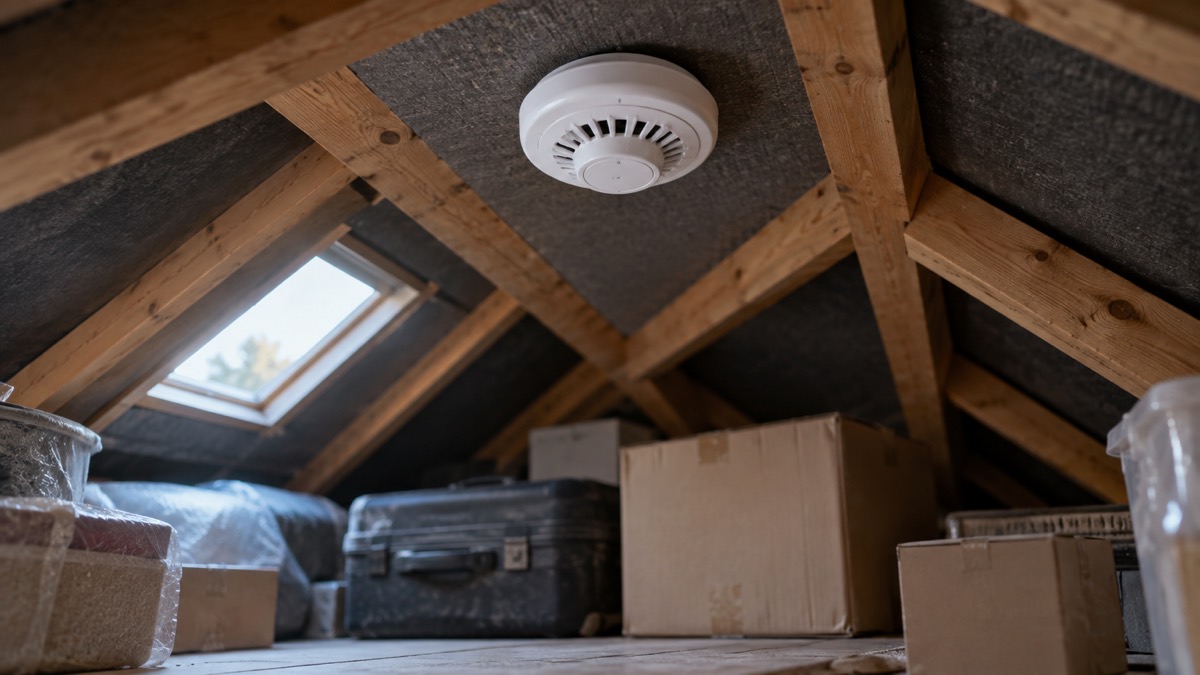
The FireAngel HM-SN-1 is a mains powered heat alarm for the rooms where a smoke alarm would keep going off for no good reason: the kitchen, the garage and the loft. It does not respond to smoke. It watches for a sudden rise in heat and sounds when the temperature reaches a preset range of 54 °C to 65 °C, which is what Class A1 heat detection means1. That makes it a kitchen alarm rather than a hallway alarm, and the maker is clear that it belongs in a complete system alongside smoke alarms, never in place of them3.
It runs on 230V AC mains with a sealed 10 year lithium battery as backup, so there is no battery to change each year, but the alarm itself has a working life and a replacement point1. It is rated Grade D1 as per BS 5839-6:2019, which is the grade many new and altered homes are built to4. Wiring must be installed by a qualified electrician in accordance with BS7671, on a circuit that cannot be switched off2.
If you are fitting one, the practical points are these: ceiling only, no more than 5.3 m from the farthest wall and from the next alarm, tested weekly, cleaned every three months, and replaced within 30 days of a low battery warning2. The rest of this page sets out what it detects, where it goes, what the specifications mean, how linking works, and what its lights and sounds are telling you.
What the HM-SN-1 is and where it belongs in a home
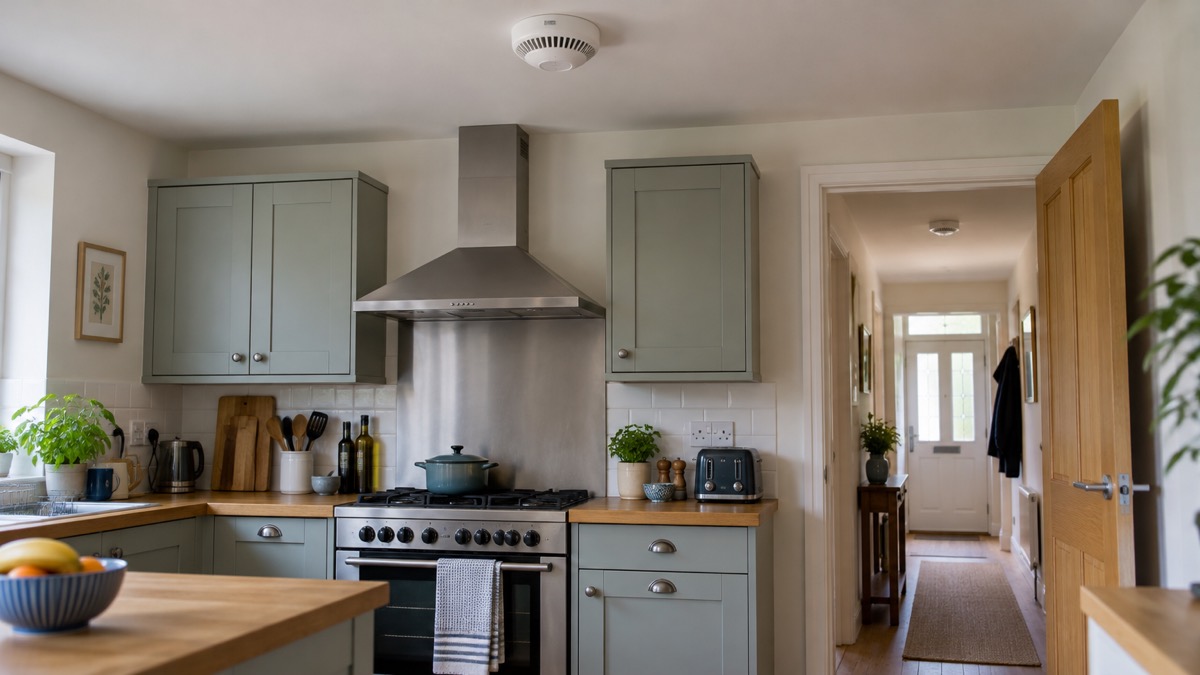
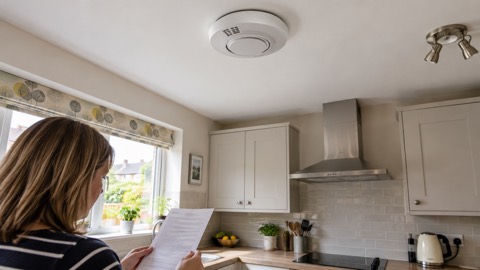
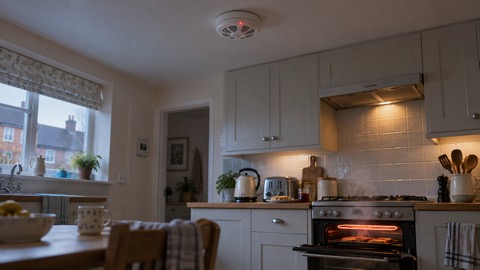
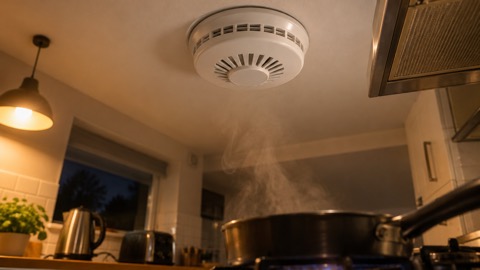
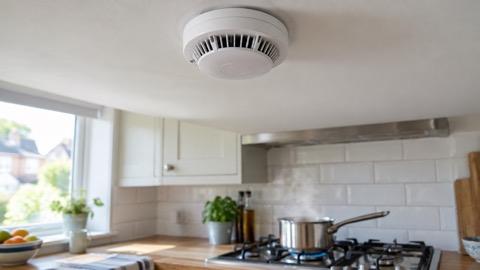
The HM-SN-1 is a fixed point heat alarm using Thermistek sensing technology, with a patented radiant heat dish, a high performance thermistor and predictive monitoring1. In plain terms, it is looking for heat rather than smoke, and it is built to ignore the steam, cooking fumes and dust that set smoke alarms off. The maker lists it for use in the kitchen, garage and loft, and describes it as suitable to protect the kitchen, which it calls the most dangerous room within a home4.
That matters because a heat alarm is not set off by smoke; it detects sudden increases in heat and goes off when it reaches a specific temperature5. A smoke alarm in a kitchen is prone to nuisance alarms, and a nuisance alarm is the one people take down or disable. The fire and rescue service message on that point is blunt: never disable smoke alarms6.
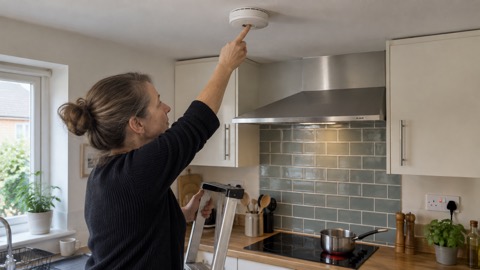
Placement follows the maker's manual. Install it at a distance no greater than 5.3 m from the farthest wall, no greater than 5.3 m from a door to any room in which a fire might start, and no greater than 5.3 m from the next heat or smoke alarm, ideally in the centre of the room on the ceiling2. The datasheet gives ceiling as the only installation position4. The manual lists installing it on a wall among the things not to do, along with installing heat alarms in escape routes instead of smoke alarms2.
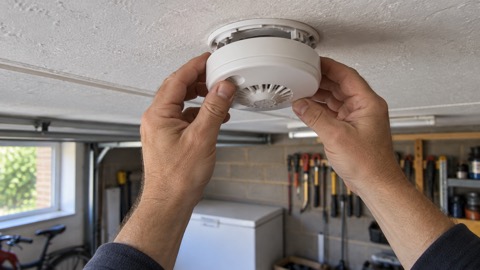
The operating range is worth checking before you commit to a spot. The datasheet gives an operating temperature of +4 C to +38 C and operating humidity up to 90% RH non-condensing4. A cold, damp garage in winter may sit outside that range, so think about where in the garage it goes, not just whether the garage has one.
A heat alarm works alongside smoke alarms, never instead of them
The single most important thing to understand about this alarm is what it does not do. It does not detect smoke, and it should not be your only alarm. The maker's manual states that heat alarms should always be installed as part of a complete fire protection system that includes smoke alarms3. The maker's installation guidance goes further: heat alarms are best suited to areas where dust, fumes and moisture can cause nuisance alarms in smoke alarms, and should not be used in escape routes instead of smoke alarms7.
The recommended pattern is a smoke alarm in the circulation space on each level of the home, the hallway and landing, as well as in living spaces and bedrooms, with interlinked heat alarms in the kitchen, garage and attic7. Interlinking means that when one alarm sounds, the others do too, so a heat alarm in the loft is heard in the bedroom.
| Room | Alarm that suits it | Why |
|---|---|---|
| Hallway and landing | Smoke alarm | Escape routes need smoke detection, not heat detection7 |
| Living spaces and bedrooms | Smoke alarm | The maker's guidance puts smoke alarms here7 |
| Kitchen | Heat alarm | Cooking fumes and steam cause nuisance alarms in smoke alarms7 |
| Garage | Heat alarm | Dust and fumes are common; check the operating range4 |
| Loft | Heat alarm | Listed by the maker for loft use1 |
If you are weighing up which alarm goes where, the comparison of heat alarms and smoke alarms sets the two side by side, and the guide to heat alarms generally explains what they can and cannot detect.
Specifications: Class A1 heat sensing, 230V mains with a sealed 10-year battery
The headline specification is Class A1 heat detection in the 54 °C to 65 °C range, on a 230V AC 50 Hz supply with a sealed 10 year lithium battery backup1. Class A1 is a standard classification for heat alarms, and the maker's manual confirms all alarms in the range are approved to class A1 and will activate when the temperature reaches that preset range3.
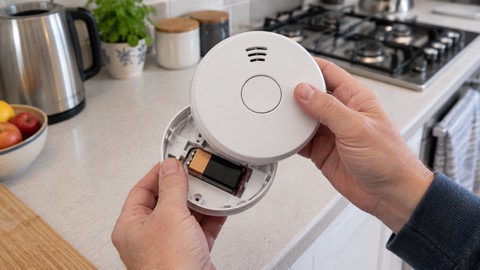
The sealed battery is the part that decides how you live with the alarm. There is no annual battery change, but the battery is not replaceable either, so when it reaches the end of its life the alarm is replaced rather than re-battered2. The maker's manual says you must replace the alarm within 30 days of a low battery warning, as it may have insufficient power to warn you of a real fire situation after that2.
| Specification | Figure | Source |
|---|---|---|
| Product type | Mains powered Thermistek enhanced heat alarm | 4 |
| Heat class | Class A1, 54 °C to 65 °C | 1 |
| Supply voltage | 230V AC, 50Hz | 4 |
| Backup battery | Sealed 10 year lithium | 1 |
| Sound level | 85dB(A) at 3m (minimum) | 4 |
| Dimensions | 141.5mm diameter x 53mm depth | 4 |
| Weight | 229g | 4 |
| Operating temperature | +4 C to +38 C | 4 |
| Operating humidity | Up to 90% RH non-condensing | 4 |
| Storage temperature | -20 C to +60 C | 4 |
| Storage humidity | Up to 93% RH non-condensing | 4 |
| Casing material | ABS, UL94 VO fire retardant | 4 |
| Grade | Grade D1 as per BS 5839-6:2019 | 4 |
| Warranty | 5 years | 4 |
| Certifications | BS 5446-2:2003 | 1 |
The maker also states that the alarm uses typically less than 10% of the average 230V AC heat alarm, and gives a carbon footprint of 1.7kg CO2 per alarm over 10 years4. Those are the maker's own figures for its own product.
Fitting it safely: what the electrician does and what you do
The HM-SN-1 is a mains device, and the maker's manual is explicit that wiring should be installed by a qualified electrician in accordance with BS7671, on a 24 hour voltage circuit that cannot be turned off by a switch2. That is not a job for a householder with a screwdriver and a weekend. What you can do is prepare the room, agree the position, and test the alarm afterwards.
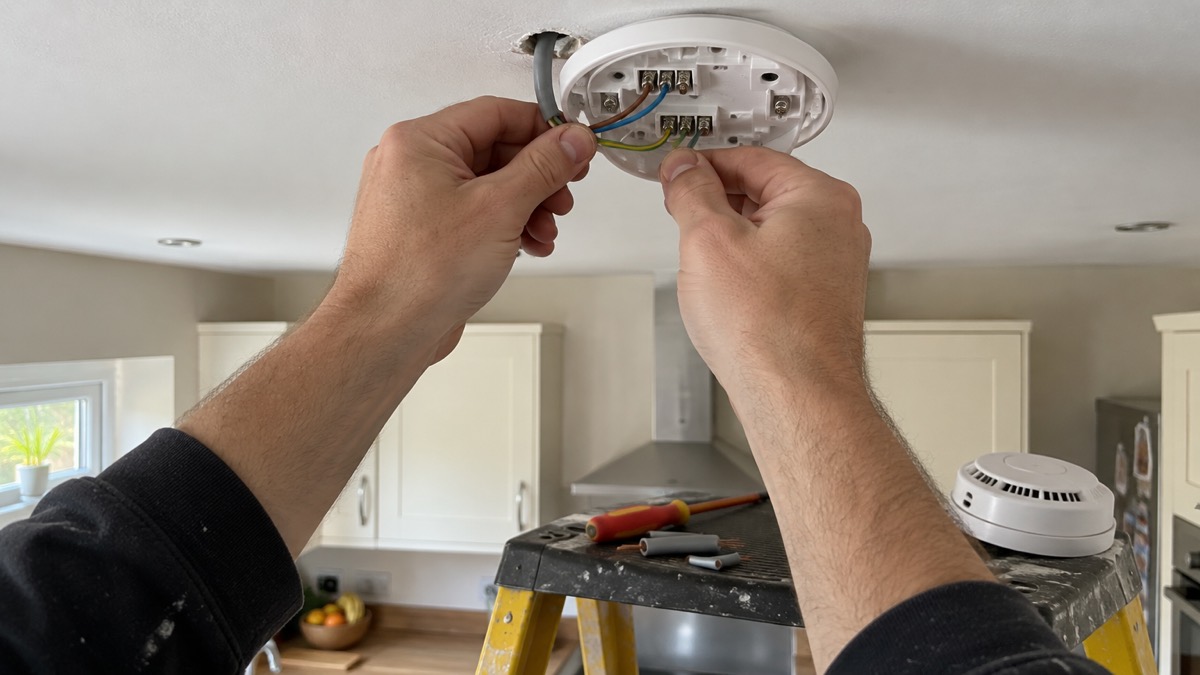
The manual sets limits on the wiring that your electrician will work to: a maximum of 30 interconnected alarms on a hardwired network, a maximum of 250 m of connecting wire per circuit, and a minimum 0.75 mm2 interconnect cable treated as Live2. It also warns that mixing the Live and Neutral connections when interconnecting alarms will damage all the alarms, and that the Earth wire must not be used for the interconnect connection2. If your home has dimmer switches or fluorescent lights, the manual says the device can be connected to the non-switching side of domestic lighting circuits where those are CE marked and conform with the relevant standards2.
Once it is fitted, check that the green LED is on and that the red LED is flashing once approximately every 45 seconds2. Press the test button and you should hear two cycles of three loud beeps, with the red LED flashing rapidly during the signal2. The maker's manual says to test your alarm weekly as well as testing any other interconnected alarms, and to test after repositioning large items of furniture2.
Maintenance is light but not optional. The manual says the alarms should be cleaned every 3 months, by first turning off the mains electricity supply and using a vacuum cleaner with a soft brush attachment2. If the alarm is dropped or damaged, the maker says remove it from the building2.
Linking it to other alarms, wired or wireless
There are two ways to link an HM-SN-1 to the rest of your alarms, and the choice affects what you buy and how the electrician wires it.
The first is hardwired interlinking. The maker's installation guidance says that if desired, you join the Interconnect wire between the alarms7. This is the traditional approach: a physical wire runs between the alarms on the same circuit, and when one sounds they all sound. The manual's limits apply: no more than 30 interconnected alarms, no more than 250 m of connecting wire per circuit2.
The second is wireless. The HM-SN-1 requires a Smart RF Module for wireless compatibility to interlink multiple Specification alarms1. Smart RF operates on FireAngel's Wi-Safe 2 networking protocol8, and the datasheet gives a maximum of 50 Smart RF devices on a network4. The Specification range supports Smart RF technology, enabling you to create wireless networks with smoke alarms9.
| Linking method | What it needs | Limit | Suits |
|---|---|---|---|
| Hardwired | Interconnect wire between alarms, installed by an electrician7 | 30 alarms, 250 m of wire per circuit2 | New wiring or a rewire, where cables can be run |
| Wireless | A Smart RF Module in the HM-SN-11 | 50 Smart RF devices4 | Retrofits where running cable is impractical |
If you mix the two, the manual says to ensure there is only one wireless connection into each hardwired network2. The datasheet lists mixed system compatibility, with Smart RF and hardwired alarms on a single network, and mains and battery powered alarms on a single network4.
One rule overrides all of this: the maker says you should never mix other manufacturer smoke, heat and CO alarms within any single network, because the products will not function correctly and this will affect the levels of fire and CO protection10. Keep a network to one maker's alarms. The guide to interlinked alarms explains the principles, and the comparison of wireless and wired interlinked alarms sets the two approaches side by side.
Lights, chirps and what they mean
The HM-SN-1 communicates through a small set of signals, and the manual is specific about each one. Knowing them saves a lot of late night worry.
- Green LED on: mains power is on2.
- Red LED flashing once every 45 seconds: normal standby2.
- Two cycles of three loud beeps: the alarm has sounded, and the red LED flashes rapidly during the signal2.
- Amber LED flashing at the same time as the chirp: low battery, and the alarm should be replaced2.
- Amber LED flashing at a different time: a fault2.
- Double flash with a chirp: the wireless module has a low battery or is faulty2.
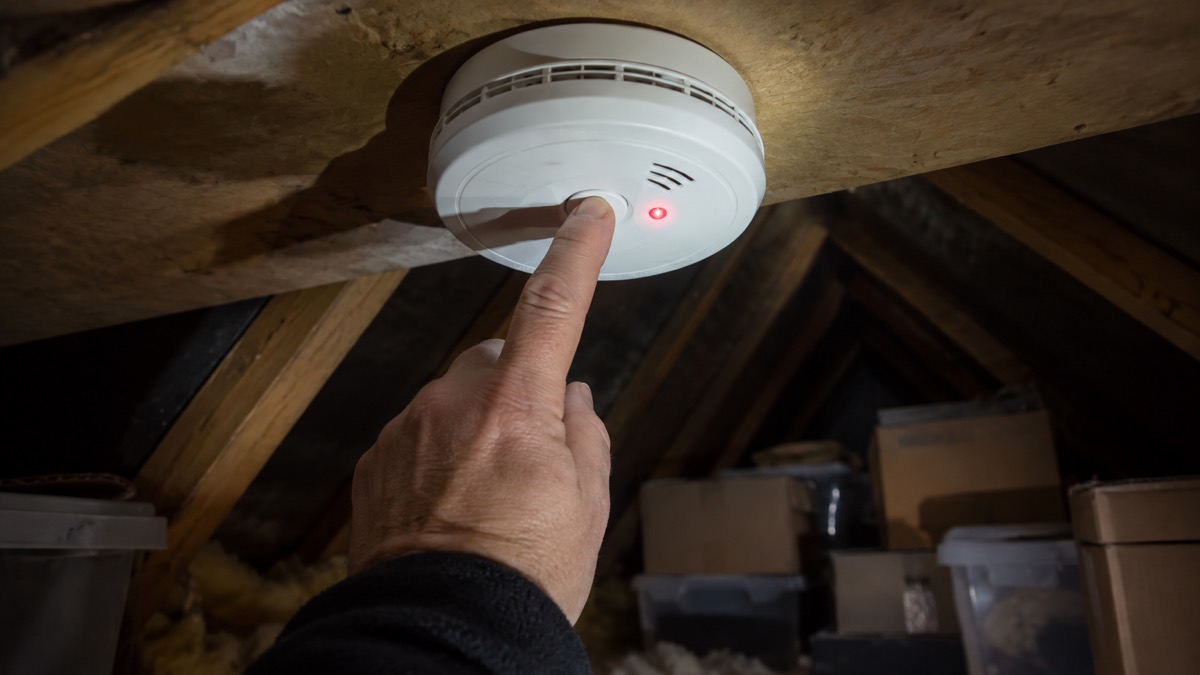
The low battery chirp is the one that wakes people up. The manual says you can silence the audible low battery chirp for a period of 8 hours by pressing the test button, repeatable a maximum of 10 times, but you must replace your alarm within 30 days2. If the chirp sounds once every 4 hours, that indicates another alarm in the network has a low battery, not this one2.
The centralised button has three functions: Test, Smart Silence and Locate4. Smart Silence reduces sensitivity for 10 minutes, with the red LED flashing approximately once every 10 seconds, and is overridden if the smoke or heat level is very high2. The alarm automatically returns to full sensitivity within 10 minutes2. If one or more interlinked units remain in alarm, other silenced units will emit their audible warning again within 4 minutes, and the manual says to vacate the property if there is a fire hazard2.
If a fault persists, the maker's technical support line is 0330 094 5830, 9am to 5pm Monday to Friday, or specification@fireangeltech.com2. FireAngel's customer support specialists are based in the UK and can help with product advice, installation queries and troubleshooting by phone, email or live chat11. If your alarm was fitted by Greater Manchester Fire and Rescue Service and is still covered by its guarantee, the fire service directs you to FireAngel on freephone 0800 141 256112.
Grade D1, building regulations and where the rules apply
Grade D1 is a system grade, not a product feature, and it is worth understanding because it decides whether this alarm is the right one for your home. The maker's product page gives the definition: a Grade D1 system is one or more mains powered detectors, each with a tamper-proof standby supply consisting of a battery1. The HM-SN-1's sealed 10 year lithium battery is that standby supply, and the datasheet rates the alarm Grade D1 as per BS 5839-6:20194.
The manual lists where a Grade D1 system is required: new or materially altered dwellings up to three storeys with no floor exceeding 200 m2, existing dwellings with poor fire protection, and individual dwelling units of two or more rooms in one or two-storey HMOs with no floor exceeding 200 m22. If you are building, extending or converting, that is the point to check with your electrician and your building control body rather than after the plastering.
FireAngel describes its range as compliant in England, Wales and Scotland13. The rules on alarms differ between the four nations, and the guide to Wales and Northern Ireland covers the arrangements there. The guide to alarm standards explains BS 5839-6 and the system grades in more detail.
The alarm carries BS 5446-2:2003 certification, and the maker's manual lists BS 5446-2: 2003, EN 14604:2005+AC:2008, KM677057, 0086 and FSTDOP19001 among its certifications3. FireAngel states that its products carry the BSI Kitemark and are independently certified13.
Support, warranty and end of life
The HM-SN-1 carries a 5 year warranty from the date of purchase, for the original retail purchaser, not transferable, and with proof of purchase required2. That is shorter than the 10 year battery life, which is worth knowing when you plan replacements: the battery may outlast the warranty, but the alarm still has to be replaced within 30 days of a low battery warning2.
FireAngel is a UK brand established since 1998, with UK support based in Coventry13. Its support team can be reached by phone, email or live chat for product advice, installation queries and troubleshooting11. The maker's own technical support line for the Specification range is 0330 094 5830, 9am to 5pm Monday to Friday, or specification@fireangeltech.com2.
At end of life, the manual says the alarm is ideally suited for disposal within the waste electronic and electrical equipment (WEEE) recycling scheme, not household waste2. Unlearn it from the network first, and note that the alarm is automatically disabled once removed from the base plate2. Do not burn it or dispose of it in fire, and if it has been dropped or damaged, remove it from the building2.
If you are replacing an alarm, the guide to when to replace a smoke, heat or CO alarm covers the timing, and the guide to testing alarms covers how often to press the button. For the wider picture of alarm types, the guide to smoke alarms explains the options, and the FireAngel brand page lists the maker's other products.
Sources (13)
- HM-SN-1 Specification Kitchen Heat Alarm, FireAngel, 2026-08-21
- HM-SN-1 Generic Smoke Heat User Manual, FireAngel, 2021-06
- SM-SN1 Generic Smoke Heat User Manual, FireAngel, 2021-06
- HM-SN-1 Data Sheet, FireAngel, 2024-09
- Fire Safety Essentials, Which?, 2026-05-20
- Ipswich Man Escapes Blaze With Family Thanks to Life Saving Smoke Alarm, Electrical Safety First, 2026-10-25
- Installing Your FireAngel Mains Powered Heat Alarm, FireAngel, 2024-10-17
- FS1524W2-T WTSL-SN-1 Manual, FireAngel, 2020-05
- FP1740W2-R Pro Connected Heat Alarm, FireAngel, 2026-10-28
- FireAngel FAQs, FireAngel, 2026-10-29
- Carbon Monoxide Safety, FireAngel, 2026-07-31
- Problem With Your Smoke or Heat Alarm, Greater Manchester Fire and Rescue Service, 2026-10-29
- Smoke Alarm Guide, FireAngel, 2026-07-15
 FireAngel FA6720-R Heat Alarm
 FireAngel HW1 Heat Alarm
 FireAngel HW10 Heat Alarm
 Kidde Firex KF30 Heat Alarm
 Firehawk FHH10 Heat Alarm
 Aico Ei144e Heat Alarm
 FireAngel FA8720BW Heat Alarm