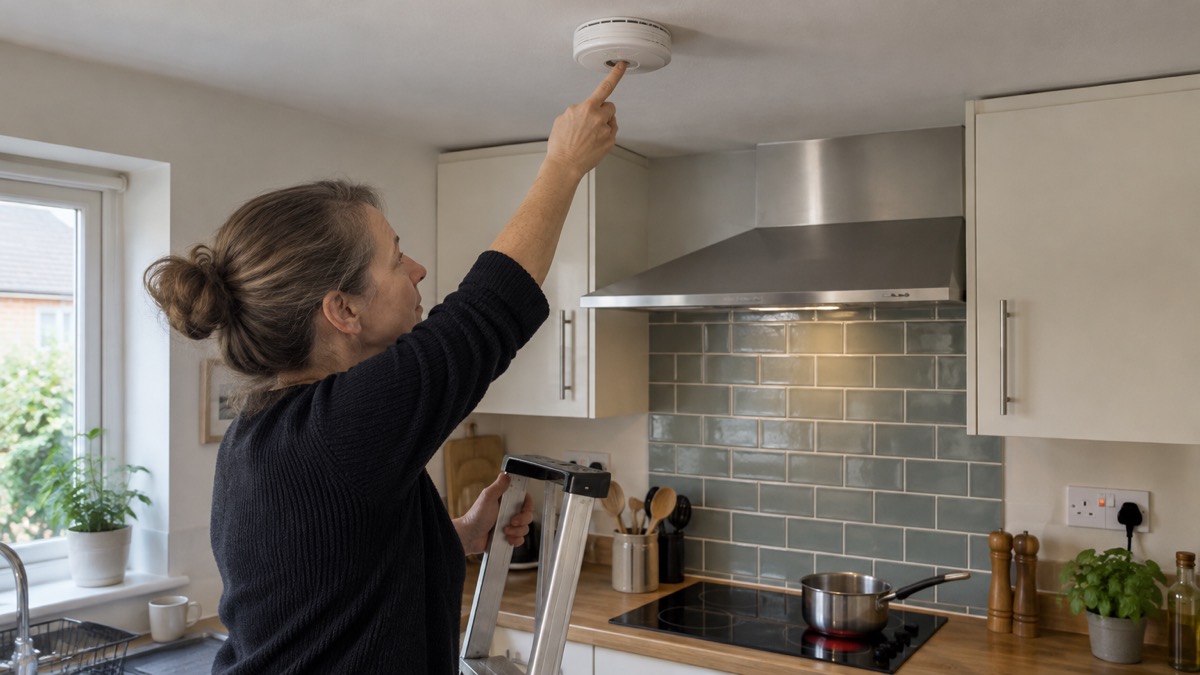
The Aico Ei144e is a mains-powered heat alarm: it sounds when the air around it gets very hot, not when it detects smoke. That makes it the alarm for a kitchen or a garage, where cooking fumes and exhaust would set a smoke alarm off. It runs on 230V AC, 50Hz mains supply with a 9V alkaline back-up battery, sounds at 85dB(A) at 3m, and has a lifespan of 10 years1.
If you are choosing an alarm for a kitchen, the decision is straightforward: a heat alarm goes there, and smoke alarms go in the hallways, landings and living rooms. A heat alarm "detects an increase in temperature from a fire but is insensitive to smoke", as Manchester Fire and Rescue Service puts it2. It will not warn you of a slow, smouldering fire, so it is part of a system, not a substitute for one.
If you already own an Ei144e, the routine is simple: test it monthly, check the back-up battery at least yearly, and replace the whole unit when its 10-year life or its replace-by date is reached. Installation and any change to its wiring must be done by a qualified electrician3.
What the Ei144e does, and why heat rather than smoke
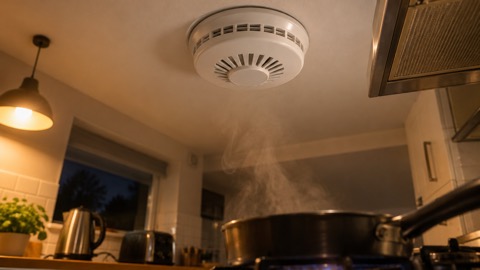
A heat alarm is a warning device that detects an increase in temperature from a fire but is insensitive to smoke2. It is not set off by smoke; it detects sudden increases in heat and goes off when they reach a specific temperature4. The Ei144e is built for exactly that job: the maker says heat alarms are best at detecting large, fast flaming fires, which are commonly caused by kitchen fires, and that the unit is more resistant to fumes such as burnt toast, so it is less likely to false alarm1.
That resistance is the point. A smoke alarm in a kitchen will complain every time you grill something, and an alarm that cries wolf gets silenced, covered or removed. A heat alarm stays quiet through normal cooking and speaks up when something is genuinely alight. The trade-off is real: because it responds to heat, it gives you less warning of a slow, smouldering fire than a smoke alarm would. That is why it belongs alongside smoke alarms on the same interlinked system, not instead of them.
The unit also checks itself. The maker states that the smoke chamber is automatically tested every 40 seconds and the unit beeps, without a red LED flash, if it is degraded1. The test button simulates a high temperature to check the thermistor, electronics and horn1. The case is made from UL 94 V0 flame retardant plastic1.
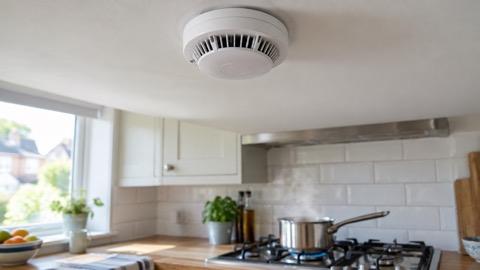
Where to fit it: kitchens, garages and similar rooms
The maker lists the Ei144e as suitable for kitchens and garages1. The Ei140e series manual, which covers the same family of alarms, sets out the siting rules in more detail: heat alarms go in kitchens and garages, and in living rooms only where nuisance alarms are very likely3.
| Room | Alarm to fit | Why |
|---|---|---|
| Kitchen | Heat alarm | Cooking fumes would set off a smoke alarm5 |
| Garage | Heat alarm | The maker lists the garage among the rooms the Ei144e is suitable for1 |
| Hallway, landing, living room | Smoke alarm | Gives earlier warning of smouldering fires2 |
| Living room, only if nuisance alarms are very likely | Heat alarm | The maker's manual allows it in this case3 |
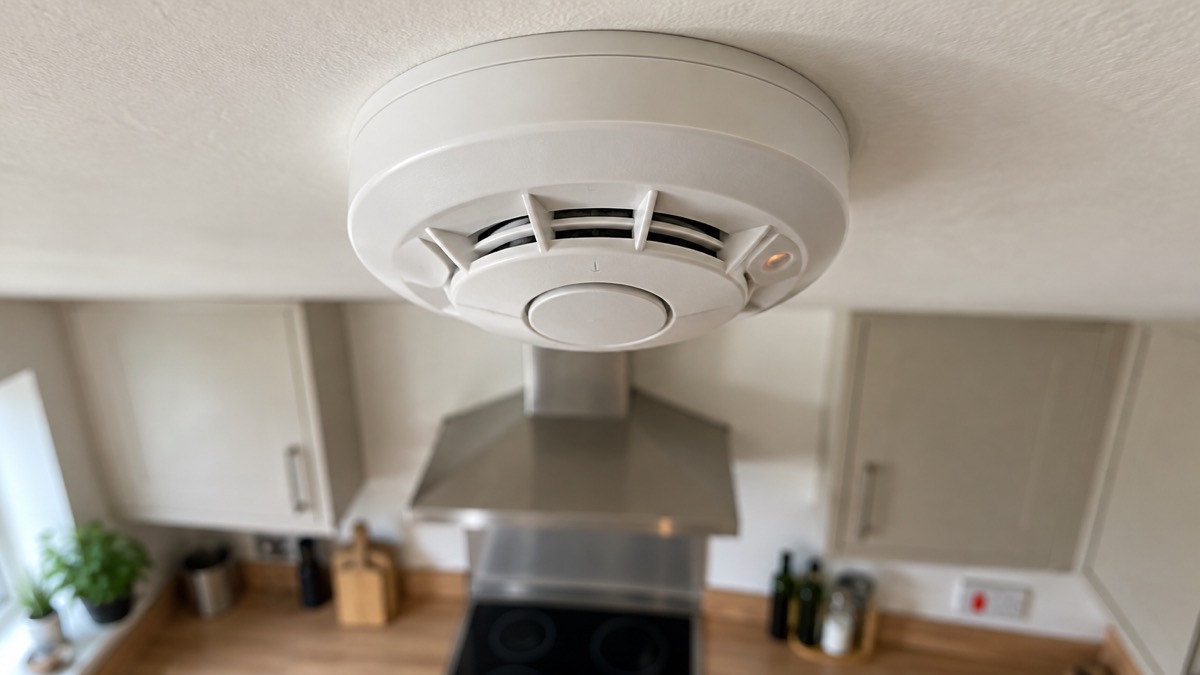
Two siting details matter if you are planning a ceiling. With a sloping or peaked ceiling, the maker's manual says to install a smoke alarm within 600mm of the peak, measured vertically, and a heat alarm within 150mm3. The manual also sets out where a Grade D system is needed: new or materially altered dwellings up to three storeys with no floor over 200m2, existing dwellings with poor structural fire precautions on the same terms, houses in multiple occupation of one or two storeys with no floor over 200m2, and individual dwelling units of two or more rooms in HMOs3.
If you are working out the whole house rather than one room, our guide to heat alarms explains the role they play, and Heat Alarm or Smoke Alarm: Which Goes Where sets the two side by side. For the wider picture on grades and standards, see Alarm Standards: BS 5839-6, BS EN 50291 and System Grades.
Specifications
The maker's published figures for the Ei144e are set out below. Where the maker's own manual for the Ei140e series gives a figure for the same family, it is shown alongside.
| Specification | Ei144e figure | Source |
|---|---|---|
| Supply voltage | 230V AC, 50Hz | Maker1 |
| Back-up battery | 9V replaceable alkaline | Maker manual3 |
| Sound level | 85dB(A) at 3m | Maker1 |
| Power consumption | 0.75W | Maker1 |
| Operating temperature | -10°C to 40°C | Maker1 |
| Humidity range | 15% to 95% relative humidity | Maker1 |
| Dimensions | 148mm x 61mm | Maker1 |
| Weight | 320g product only, 368g boxed | Maker1 |
| Approvals | BS 5446-2:2003, Kitemarked | Maker1 |
| Guarantee | 5 years | Maker1 |
| Lifespan | 10 years | Maker1 |
The Ei140e manual gives the same family's standby consumption as 0.75W and a maximum current draw of 60mA3. It also lists the family's approvals as KM522831, KM83678, EN14604:2005+AC 2008 and BS5446-2:20033. Note that the Ei144e's own product page states it is Kitemarked to BS 5446-2:20031; some distributors describe the certification differently, so check the label on the unit you are sold.
Interlinking: up to 12 alarms, by wire or wirelessly
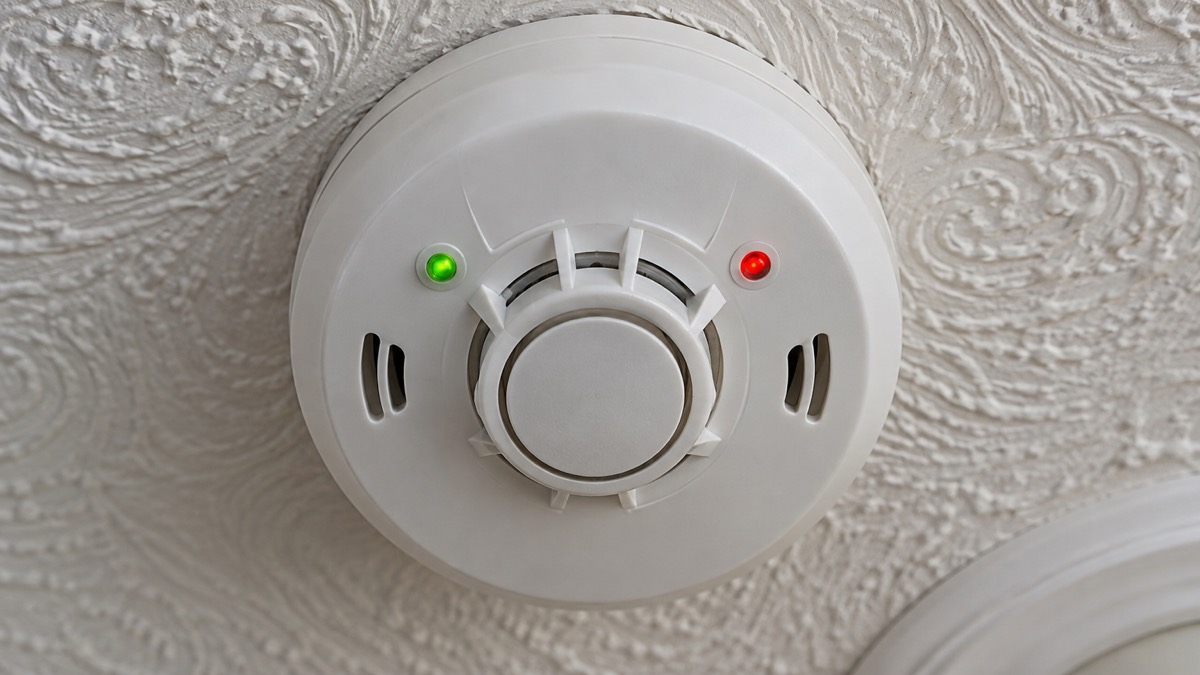
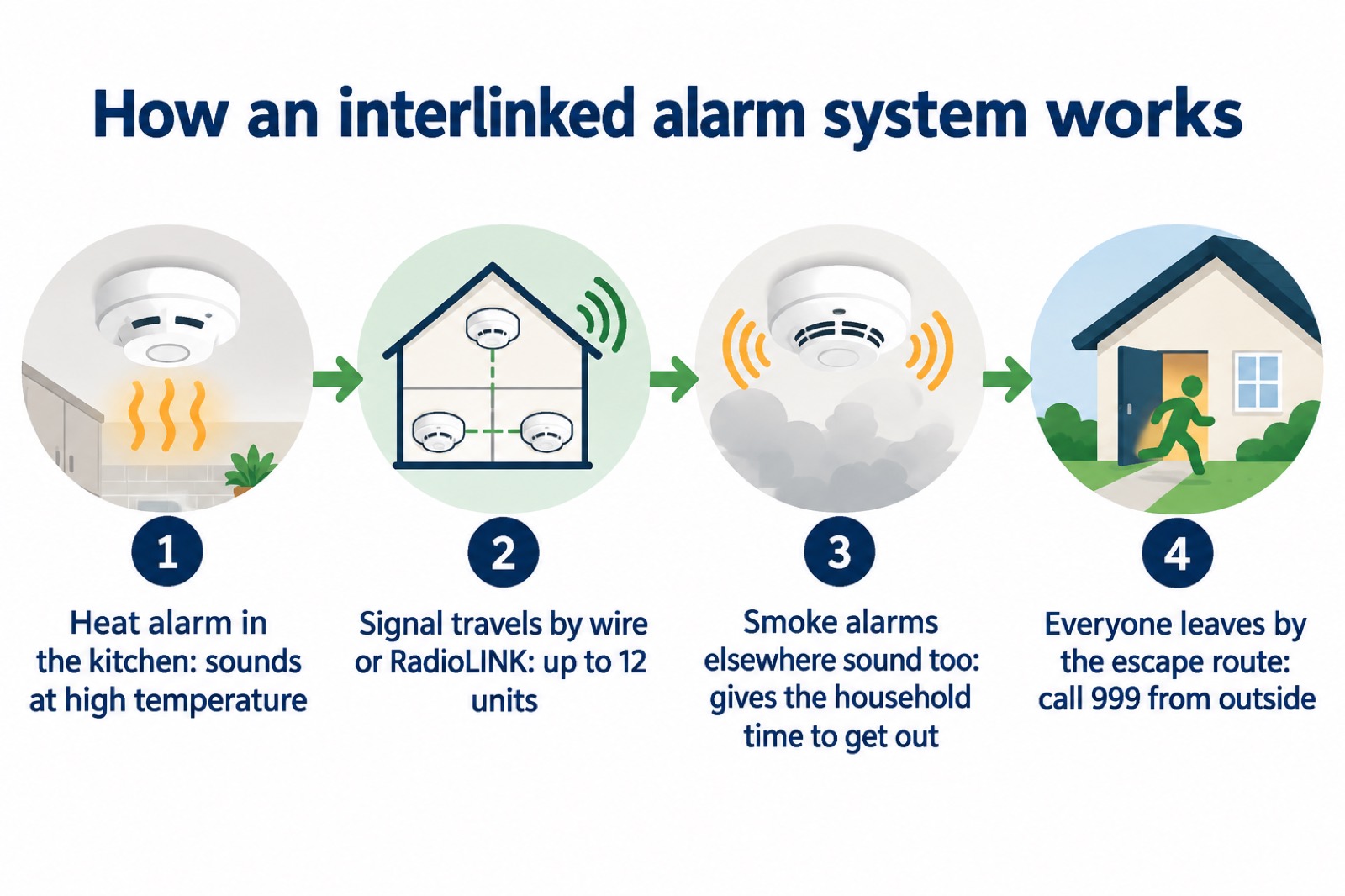
A heat alarm on its own only warns the room it is in. Interlinked, it warns the whole house: when one alarm sounds, they all do. The Ei144e can be interlinked with other Aico smoke alarms through either a hard wired or a wireless interconnection1.
The Ei140e series manual gives the limits. Up to 12 units can be interconnected via a hardwired or wireless system, using the optional Ei168RC mounting plate for the wireless route3. If you wish to connect more than 12 alarms, the maker says to contact the Aico Technical Department on 01691 6641003. On the wired side, a maximum of 250 metres of wire can be used, with a maximum resistance between detectors of 50 Ohms, and the interconnect wire must be at least 0.75mm cable and treated as if it were live3.
If you are deciding between the two routes, Wireless or Wired Interlinked Alarms sets out the trade-offs, and Interlinked Alarms: How Linking Works explains the principle. If you are adding to an existing system, the Ei140e manual's 12-unit limit is the figure to check before you buy.
Installation: a qualified electrician, every time
The maker's manual is blunt about this. It carries the warning that "Mains operated Alarms must be installed and interconnected by a qualified electrician in accordance with the local appropriate Regulations for Electrical Installations"3. The alarm must be continuously powered 24 hours a day, so it is important that it is not on a circuit that can be turned off by a switch3. It must not be exposed to dripping or splashing3.
That instruction is not the maker being cautious for its own sake. Electrical Safety First strongly recommends using a registered electrician to carry out any electrical installation work you need doing6. The Health and Safety Executive says electrical installations must be installed by someone who has the necessary training, skills and experience to carry out the work safely7. For work at home, the government advises choosing someone registered with a competent person scheme who can self-certify that their work complies with building regulations8.
If you are unsure whether previous work was done properly, you can ask a registered electrician to carry out an Electrical Installation Condition Report, which will either confirm the installation is safe or highlight hazards that need fixing9. The same report can act as documentation that work was done to standard10.
Testing, cleaning and changing the battery
The maker's testing schedule is specific: test after the system is installed, once monthly thereafter, after a prolonged absence from the dwelling such as a holiday, and after any repair or servicing of the system or household electrical works3. Check that the red LED on the cover flashes once every 40 seconds to indicate normal operation; if the memory has been set, meaning the alarm has been activated in the last 24 hours, the red LED will flash twice every 40 seconds3.
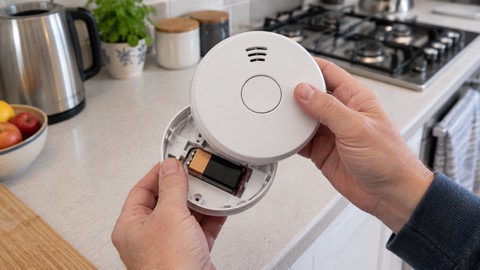
Check the functioning of the battery back-up directly after installation and then at least yearly3. The Ei144e's back-up battery will need changing over the course of its 10-year life1. The maker's manual for the family specifies only 9V alkaline batteries, naming Duracell MN1604 and Energizer 522, and warns that other batteries can cause problems3. It also recommends that the replace-by date on the battery should still have at least two years to go, because older batteries will give beeps prematurely3.
If the alarm beeps regularly, the official advice is to replace the battery, or if it has a built-in battery, replace the alarm immediately11. For more on the monthly routine, see How Often to Test Smoke and CO Alarms, and for persistent beeping, Why Does My Smoke Alarm Keep Chirping?.
Using the hush button
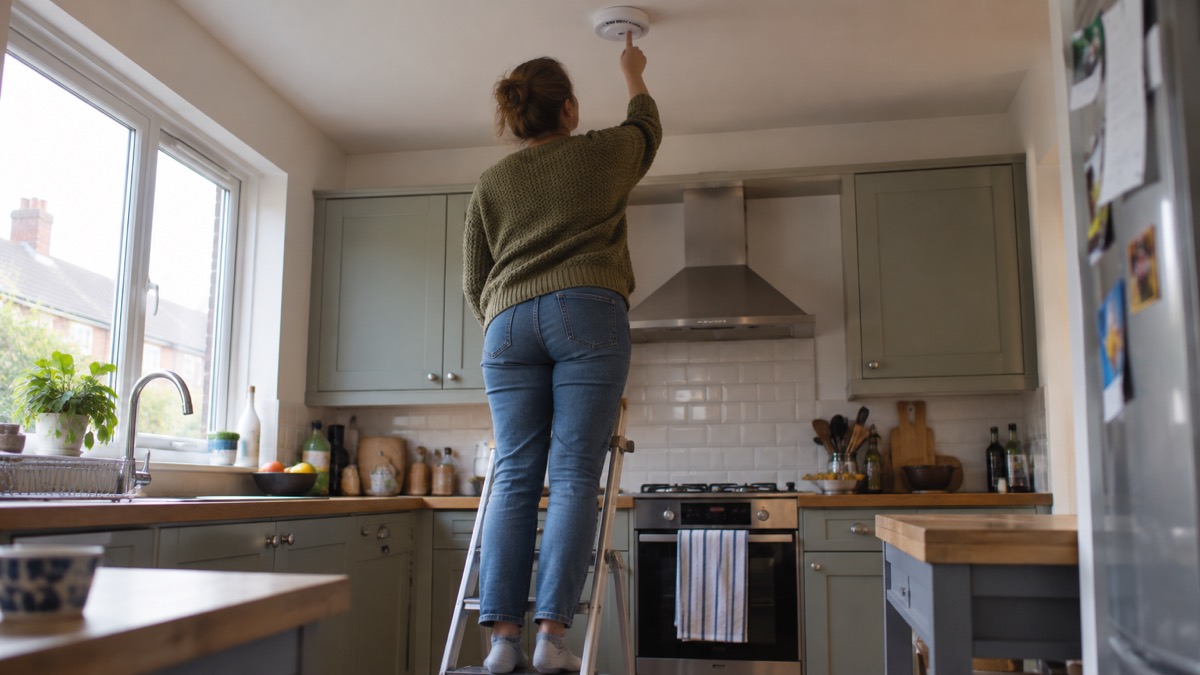
If the alarm is in alarm when the test/hush button is pressed, it silences the alarm for 10 minutes3. While it is in hush mode the red LED will continue to flash while it detects the presence of smoke or heat, and the alarm will reset to normal functionality at the end of the 10 minutes; if additional silenced time is required, simply push the test/hush button again3.
"If the unit is in alarm when pressed, it silences the alarm for 10min"
Hush is for nuisance alarms, not for fires. Before you press it, satisfy yourself that there is no fire: check the room, check the cooker, and check that nothing is smouldering. If you can see or smell smoke, leave and call 999. Our guide to kitchen fires covers what to do if cooking does catch light.
Replacing the alarm after 10 years
The Ei144e has a lifespan of 10 years1. The maker's manual says that if the replace-by date on the label at the side of the alarm has passed, replace the alarm3. That matches the wider official and independent advice: replace alarms every ten years or when the replace-by date is reached12, and mains-wired alarms should be replaced every 10 years16. A ten-year alarm needs the whole unit replacing every ten years17.
The practical rule is to write the installation date on the unit or note it in your diary, and to check the label when you move into a new home. If you cannot establish the age of an alarm, treat it as due. Our guide to replacing alarms covers the whole household routine.
If your alarm is an Ei3014: the 2025 recall
The Ei144e is not the subject of a recall. A different Aico heat detector, the Ei3014, was recalled in May 2025. The Office for Product Safety and Standards recalled the Aico Ei3014 Heat Detector because some units were labelled as detecting carbon monoxide when they detect heat only19. A small production batch carried plastic coverings wrongly stating they could also detect carbon monoxide, and the product was recalled from end users19.
If you own an Ei3014, check the recall notice and follow its instructions. Do not rely on it to detect carbon monoxide: a heat alarm cannot do that, and a carbon monoxide alarm is a separate device. Our guide to carbon monoxide alarms explains what to fit and where, and How to Check If an Electrical Product Has Been Recalled covers the general process.
Power cuts, solar and backup supplies
Because the Ei144e is mains powered with a battery back-up, it keeps working in a power cut as long as the back-up battery is sound. That is why the yearly battery check matters. The maker's manual says to check the functioning of the battery back-up directly after installation and then at least yearly20. Our guide to power cuts covers the household routine.
If you are thinking about supplying the alarm from anything other than the mains, the maker's manual sets a condition: where an alarm is connected to a power source that uses an inverter, such as a PV solar panel or a battery powered UPS, the total harmonic distortion must be less than 5%3. The alarm must also be continuously powered and not on a switched circuit3. Any such change is electrical work and should be done by a qualified electrician6. For the wider picture, see Backup Power at Home.
Warranty, support and where to buy
The Ei144e carries a 5-year guarantee1. The Ei140e manual states that the guarantee applies only to normal conditions of use and service, and does not include damage resulting from accident, neglect, misuse, unauthorised dismantling or contamination; contamination is considered normal wear and tear and is not covered3.
Aico alarms are available to purchase from a range of distributors across the UK1. For technical questions, including connecting more than 12 alarms, the maker gives the Aico Technical Department number as 01691 6641003. Aico's own product selector can help you match an alarm to a room if you are planning a system21.
If you are building out a whole-house system, our pages on the Aico Ei146e Optical Smoke Alarm, the Aico Ei3016 Optical Smoke Alarm and the Aico Ei3024 Multi-Sensor Alarm set out the alternatives, and the Aico brand page gathers them together. For the wider household routine, start with Smoke Alarms: Types and How to Choose One and the Fire Safety Checklist for Your Home.
Sources (21)
- Ei144e Heat Alarm product page, Aico, 2026
- Smoke and heat alarms, Manchester Fire and Rescue Service
- Ei140e series instructions, Aico, 2025
- Fire safety essentials, Which?, 2026-05-20
- Smoke alarms, Devon and Somerset Fire and Rescue Service, 2026
- Earthing and bonding, Electrical Safety First, 2026-10-25
- Introduction to electricity, Health and Safety Executive, 2026
- Oil storage regulations and safety, GOV.UK, 2026-10-29
- RCDs explained, Electrical Safety First, 2026-10-26
- Electrical safety after a flood, Electrical Safety First, 2026-10-25
- Fire alarms and carbon monoxide detectors, Lincolnshire County Council, 2026-10-29
- Fire prevention tips, Electrical Safety First, 2026-10-25
- Home safety quiz, Independent Age, 2026
- Fire and smoke alarms in Scottish homes, Scottish Government, 2024-08-14
- Fire safety in the home, Suffolk County Council, 2021-11
- Smoke alarms, Cornwall Fire and Rescue Service, 2021-03-19
- Strong winds and heavy rain warning, nidirect, 2026-01-27
- Strong winds weather warning, nidirect, 2026-10-24
- Product recall: Aico Ei3014 Heat Detector, Office for Product Safety and Standards, 2025-05-29
- Power cuts, Wigan Council, 2026-10-29
- Solar panels, Electrical Safety First, 2026-10-25
 FireAngel FA6720-R Heat Alarm
 FireAngel HW1 Heat Alarm
 FireAngel HW10 Heat Alarm
 FireAngel HM-SN-1 Heat Alarm
 Kidde Firex KF30 Heat Alarm
 Firehawk FHH10 Heat Alarm
 FireAngel FA8720BW Heat Alarm