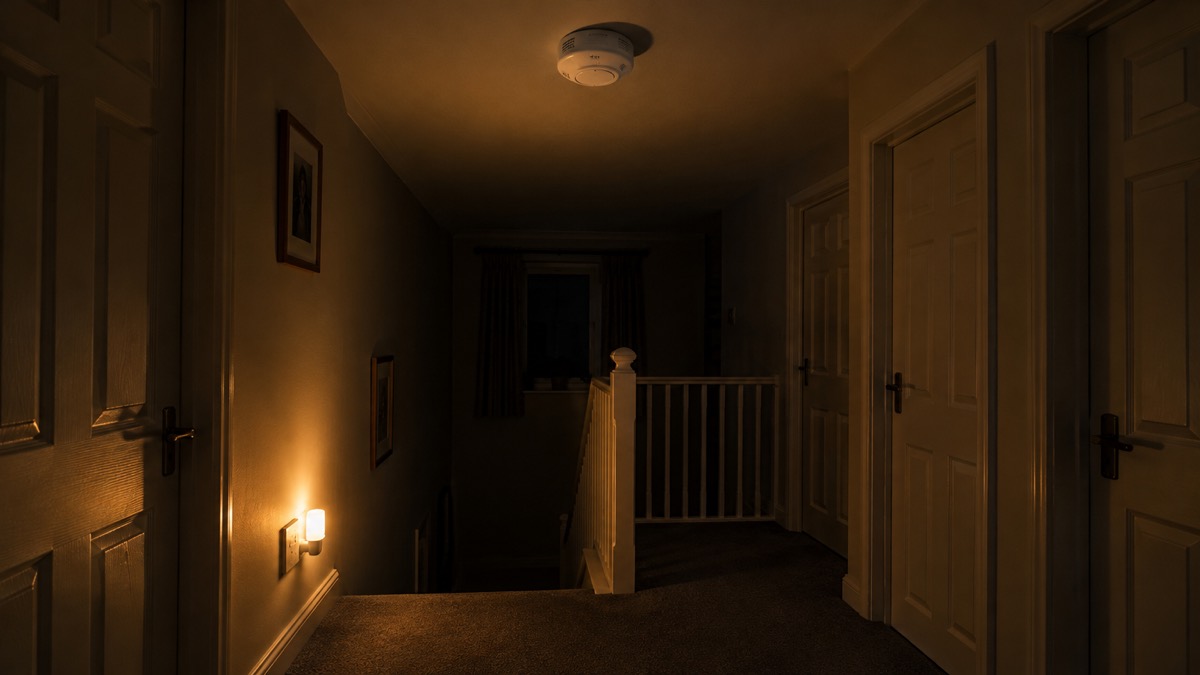
If you are fitting an Aico Ei146e, or you have moved into a home that already has one, the essentials are simple. It is a mains powered optical smoke alarm that runs on 230V AC, 50Hz and keeps a 9V alkaline battery as back-up, so it carries on protecting the room when the power goes off1. It sounds at 85dB(A) at 3m, has a 10-year lifespan and a 5-year guarantee, and it can be linked to other alarms by wire or wirelessly1.
What you do now depends on where you are. If the alarm is already fitted, test it monthly with the test button, check the back-up battery at least once a year, and note the replace-by date on the label at its side2. If you are planning to fit one, the work is a fixed mains connection: the maker's manual states that mains operated alarms must be installed and interconnected by a qualified electrician2. The Ei146e is not a plug-in or battery-only alarm.
This page sets out what the Ei146e does, the rooms it suits, where it goes on a ceiling or wall, how linking works, what its lights and chirps mean, and how to test, clean and keep it going. It is one alarm in a wider picture: for the full range of alarm types and how to choose between them, see Smoke Alarms: Types and How to Choose One.
What the Ei146e is and what it does
The Ei146e is an optical smoke alarm made by Ei Electronics and sold under the Aico name, part of the Aico Ei140e Series3. Optical sensing responds quickly to slow, smouldering fires, the kind that start in soft furnishings or wiring and give off smoke before flames1. That makes it a general-purpose alarm for the rooms where people live and sleep, rather than a kitchen or garage alarm.
It is built for long service. The maker gives it a 10-year lifespan and automatic dust compensation, which helps the sensor cope with ordinary household dust over the years1. The smoke chamber tests itself every 40 seconds and the unit beeps, without the red light flashing, if the chamber has degraded1. An insect screen with a 1.00mm mesh keeps insects and debris out of the chamber, and the plastic is UL94VO flame retardant1. It is Kitemarked to BS EN 14604:2005 and carries a Declaration of Performance under EN14604:2005 + AC:20081.
The Easi-fit base is designed for quick and simple installation, which matters when an electrician is fitting several alarms across a house1. The alarm draws 0.75W in standby and a maximum of 60mA, and it works in temperatures from -10°C to 40°C and humidity of 15% to 95% relative humidity1. It measures 148mm across and 50mm deep, and weighs 345g1.
One point to be clear about: the Ei146e is a smoke alarm only. It does not detect carbon monoxide. If you want carbon monoxide cover, that is a separate alarm, and the page on Carbon Monoxide Alarms: What They Do and How to Choose explains the options.
Specifications at a glance
| Specification | Figure | Source |
|---|---|---|
| Supply voltage | 230V AC, 50Hz | 1 |
| Power consumption | 0.75W standby | 1 |
| Maximum current draw | 60mA | 2 |
| Sound level | 85dB(A) at 3m | 1 |
| Sensor | Optical, quick response to slow smouldering fires | 1 |
| Battery back-up | 9V replaceable alkaline | 2 |
| Lifespan | 10 years | 1 |
| Guarantee | 5 years | 1 |
| Dimensions | 148mm x 50mm (product) | 1 |
| Weight | 345g (product only) | 1 |
| Operating temperature | -10°C to 40°C | 1 |
| Humidity range | 15% to 95% relative humidity | 1 |
| Standard | BS EN 14604:2005, Kitemarked | 1 |
| Grade | Grade D2, compliant with Scottish legislation | 1 |
The retailer listing for the Ei140e Series gives the same headline figures: mains powered at 230V, a 5-year guarantee and an alkaline back-up battery3. Where the maker and the retailer differ on any detail, the maker's figure is the one to rely on.
Which rooms it suits, and why optical sensing matters
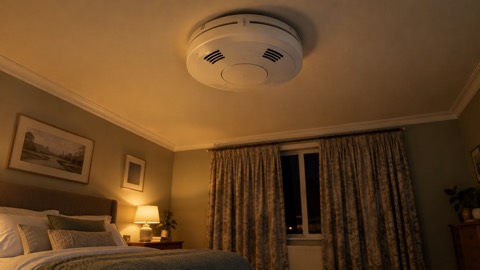
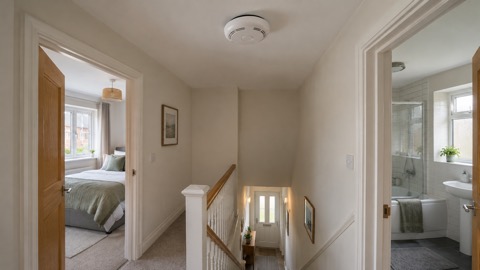
The maker lists the Ei146e for halls, corridors and escape routes, living rooms and bedrooms2. Fire and rescue services in England take the same view of optical and ionisation smoke alarms generally: they are recommended in most areas such as living rooms, hallways, landings and dining rooms4. Those are the rooms where a slow, smouldering fire can take hold while people are asleep or in another part of the house.
The manual is equally clear about where the Ei146e does not belong: kitchens and garages are marked for a heat alarm rather than this optical smoke alarm2. Cooking smoke and car fumes would set it off repeatedly, and repeated false alarms are how people end up taking alarms down. If your kitchen or garage needs cover, a heat alarm is the right device, and the page on Heat Alarms: What They Do and Where They Go explains how they work.
There is one more room worth thinking about. Where an e-scooter or e-bike is stored or charged at home, fire service guidance says the room should have a substantial door, kept closed, and be fitted with a smoke detector6. An Ei146e in that room, linked to the rest of the house, gives early warning of a battery fire starting while the door is shut.
Where to fit it: ceiling, sloping ceiling or wall
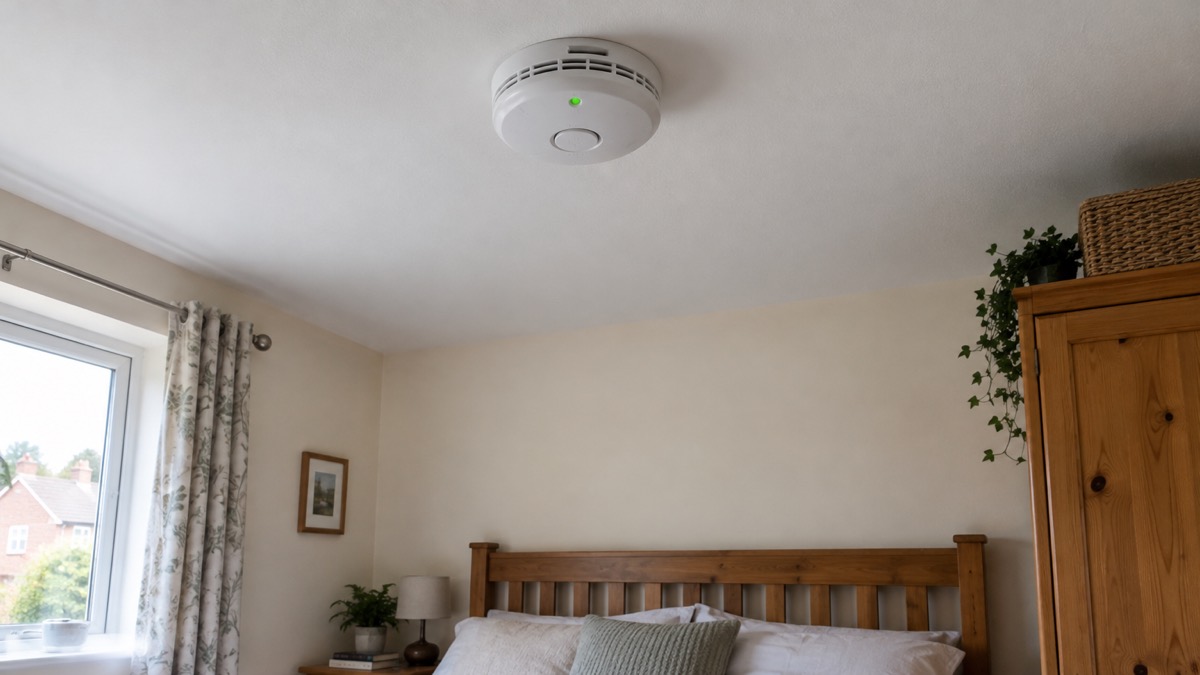
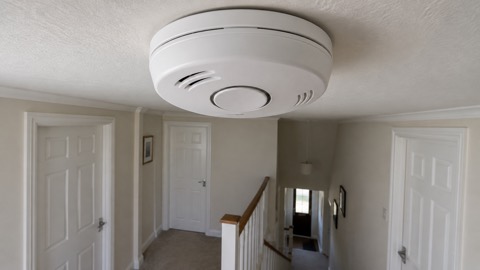
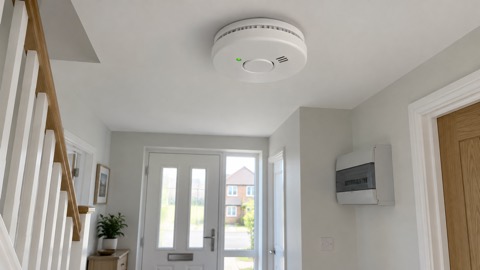
The Ei146e is designed for ceiling mounting. On a flat ceiling, fit it as central as the room allows, clear of walls and light fittings. On a sloping or peaked ceiling, the maker's rule is to install a smoke alarm within 600mm of the peak, measured vertically2. Smoke rises to the highest point, so an alarm near the peak gets the earliest warning.
Wall mounting is the exception, not the rule. The manual says that if ceiling mounting is impractical, only the Ei146e may be mounted on a wall, and then only within strict limits: the top of the detection element must be between 150mm and 300mm below the ceiling, and the bottom of the detection element must be above the level of any door openings2. In practice, that means high on the wall, above door height, and close to the ceiling.
For comparison, Scottish statutory guidance on carbon monoxide detectors uses a similar principle for wall mounting: at least 150mm below the ceiling and higher than any door or window in the room, unless the manufacturer says otherwise7. The Ei146e's own manual is the authority for this alarm, and its 150mm to 300mm band is the figure to work to.
A few practical points before the electrician arrives:
- Decide the rooms first: hall, landing, living room and each bedroom are the maker's listed locations2.
- Keep alarms away from bathrooms and anywhere they could be splashed: the maker states the alarm must not be exposed to dripping or splashing2.
- Plan the linking at the same time, so cable runs or RadioLINK modules are sorted in one visit1.
For a fuller treatment of siting, see Where to Fit Smoke Alarms.
Installation is a job for a qualified electrician
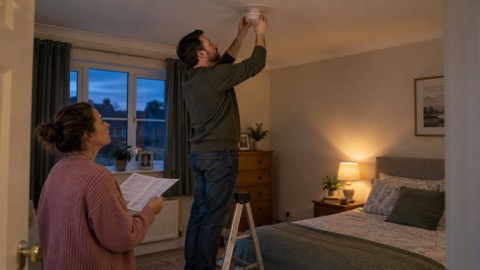
The Ei146e connects to the fixed wiring, and the maker's manual is explicit: mains operated alarms must be installed and interconnected by a qualified electrician in accordance with the local appropriate regulations for electrical installations2. Electrical Safety First strongly recommends using a registered electrician for any electrical installation work8. The Health and Safety Executive makes the same point from the other direction: electrical installations must be installed by someone with the necessary training, skills and experience to carry out the work safely9.
Two installation rules decide whether the alarm works when it matters:
- It must be permanently powered. The manual states the alarm must be continuously powered 24 hours a day, so it must not be on a circuit that can be turned off by a switch2. A switched spur that someone flicks off at bedtime defeats the whole alarm.
- The back-up battery must be checked at installation. The manual says to check the battery back-up directly after installation, and then at least yearly2.
If you are having other electrical work done, or you are unsure about work carried out before you moved in, Electrical Safety First recommends an Electrical Installation Condition Report (EICR) by a registered electrician, which confirms the installation is safe or highlights hazards to fix8. It is an added cost, but it is the documented way to know the circuit feeding your alarms is sound.
Linking up to 12 alarms by wire or RadioLINK
One alarm warns one room. Linked alarms warn the whole house, which is what you want at night: an alarm in the hall sounds in every bedroom. The Ei146e can be interconnected with other alarms and accessories by hard wire connection or, for less mess and disruption, by RadioLINK wireless interconnection1. It links with other Aico alarms through either route1.
The limit is 12. The maker's manual states that up to 12 units can be interconnected via a hardwired or wireless system, using the optional Ei168RC mounting plate for the wireless route2. If you want to connect more than 12 alarms, the manual says to contact the Aico Technical Department on 01691 6641002.
Where the hardwired route is used, the electrician works to the maker's cable rules: a maximum of 250 metres of wire, with a maximum resistance between detectors of 50 Ohms, and interconnect wire of at least 0.75mm cable, treated as if it were live2. Those are the figures that decide whether a large house or a long run can be wired in one loop.
The choice between wired and wireless is mostly about disruption and cost of installation, not performance of the alarm itself. The page on Wireless or Wired Interlinked Alarms sets the two routes side by side, and Interlinked Alarms: How Linking Works explains what happens when one alarm triggers the rest.
What the lights and chirps mean
The Ei146e tells you its condition through two lights and its sounder. The maker lists the indicators as green for power and red for alarm or fault1. The manual gives the detail:
| What you see or hear | What it means | What to do |
|---|---|---|
| Red light flashes once every 40 seconds | Normal operation | Nothing2 |
| Red light flashes twice every 40 seconds | Alarm has activated in the last 24 hours (memory set) | Check for a fire or a cause, then investigate2 |
| Green light off, red light once every 40 seconds | AC mains off | Reconnect the mains power2 |
| Green and red lights each once every 40 seconds, chirps alternating every 20 seconds | Sensor fault | Replace the alarm2 |
| Unit beeps without the red light flashing | Self-test has found the smoke chamber degraded | Check the alarm and replace if needed1 |
A chirp every minute is the standard signal on alarms with replaceable batteries that the battery needs changing11. On the Ei146e, treat any unexplained chirp as a prompt to check the battery and the alarm's condition against the manual, and replace the battery if it is due.
If the alarm sounds and there is a fire, get out, stay out and call 999. The page on What to Do If a Fire Starts in Your House walks through it step by step. If there is no fire, the next section covers silencing it.
Testing, silencing and looking after the alarm
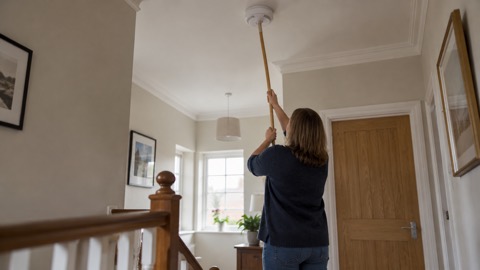
Testing. Press the test button. The maker says the button test simulates the effect of smoke and checks the chamber, electronics and horn1. The manual sets the schedule: test after installation, once monthly thereafter, after a prolonged absence from the home such as a holiday, and after any repair, servicing or household electrical work2. Check the back-up battery at least yearly2. The page on How Often to Test Smoke and CO Alarms covers the routine in more detail.
Silencing a false alarm. If there is no fire, press the test button to put the alarm into hush. The maker's manual says that if the unit is in alarm when pressed, it silences the alarm for 10 minutes2. The red light keeps flashing while smoke is still present, and the alarm resets to normal at the end of the 10 minutes; press the button again if you need more time2. Manchester Fire and Rescue Service gives the same advice for smoke alarms generally: press and release the test button to pause the alarm, and it returns to full sensitivity within 10 minutes12. Never silence an alarm without checking there is no fire. If false alarms keep happening, see How to Stop Smoke Alarm False Alarms.
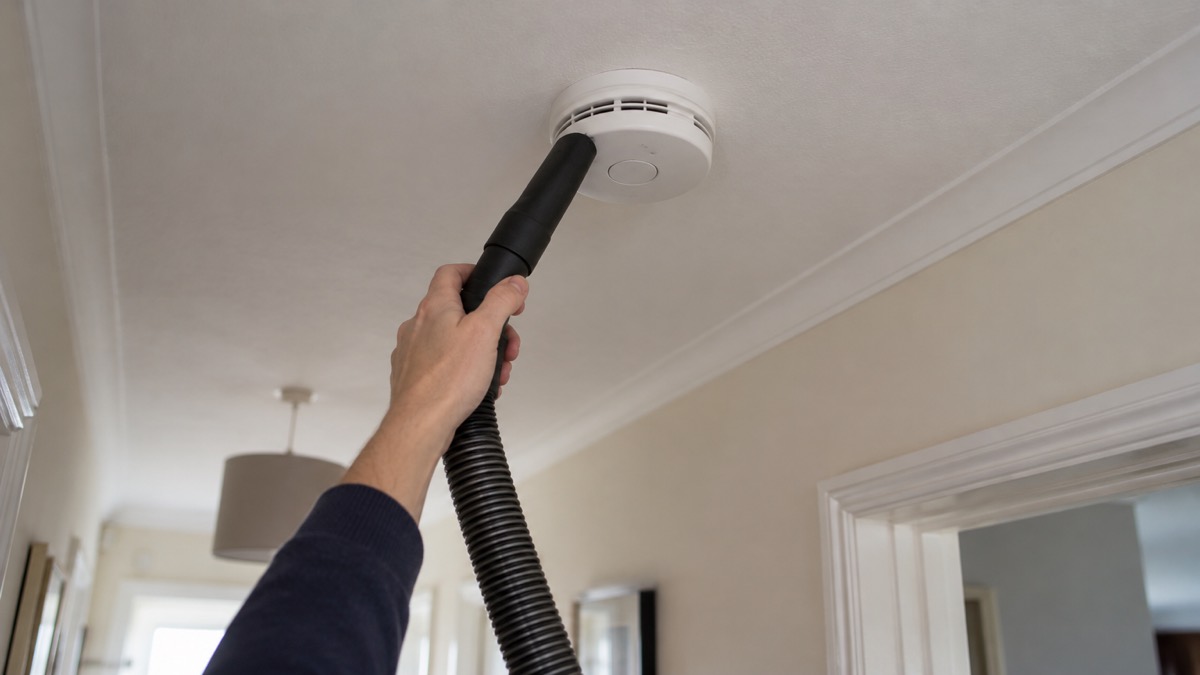
Cleaning. The manual's method is specific: use the narrow nozzle of a vacuum cleaner to remove dust, insects and cobwebs from the sides and the cover slots where air enters, and wipe the outside occasionally with a clean damp cloth, then dry thoroughly with a lint-free cloth2. Do not use cleaning agents, bleaches, detergents or polishes, including aerosols2.
The back-up battery. The Ei146e takes a 9V replaceable alkaline battery, and the maker says it will need changing over the course of the alarm's 10-year life1. The manual names the batteries to use: Duracell MN1604 or Energizer 522, with the warning that other batteries can cause problems2. It also advises that the replace-by date on the battery should still have at least 2 years to go, because older batteries give beeps prematurely2.
Replacing the alarm, the guarantee and recycling
The Ei146e has a 10-year lifespan, and the maker recommends regular testing and replacement after at most 10 years as a precaution1. There is a replace-by date on a label at the side of the alarm: if that date has passed, replace the alarm2. The page on When to Replace a Smoke, Heat or CO Alarm covers the wider question of when alarms of all types should go.
The guarantee runs for 5 years1. The manual sets out what it does not cover: damage resulting from accident, neglect, misuse, unauthorised dismantling or contamination, with contamination treated as normal wear and tear2. In practice, that means keeping the alarm clean and not tampering with it is part of keeping the guarantee meaningful.
When an old alarm comes down, do not simply bin it. Scottish Government guidance says some but not all types of alarm can be recycled at recycling centres, and advises looking on the alarm for information or checking with the manufacturer6. Your council's recycling pages will tell you what it accepts.
Power cuts, solar and back-up supplies
The Ei146e keeps working in a power cut because of its 9V alkaline back-up battery, but that protection has a limit. The maker states plainly that the alarms will not work if the mains power supply is off or disconnected and the back-up battery is depleted2. That is why the yearly battery back-up check matters: it is the difference between an alarm that rides out a power cut and one that goes silent.
Most power cuts do not last very long, but the official advice during one is still to treat the home with care: turn off irons, ovens, electric fires and fryers, and unplug the TV and computer, which can be damaged by a surge when power returns13. An alarm on a circuit that cannot be switched off will come back with the mains, and its green light confirms it2.
On solar and back-up supplies, the maker's manual has a specific condition. If the alarm is connected to a power source that uses an inverter, such as a PV solar panel or a battery powered UPS, the total harmonic distortion must be less than 5%2. That is a technical requirement for the electrician designing the supply, not a plug-in solution. Any electrical work for solar or a back-up supply should be done by a qualified and competent installer15. For the household view of keeping some power on, see Backup Power at Home: A Household Guide and Power Cuts: A Household Guide.
Scottish and Welsh rules, and where to get help
The Ei146e is Grade D2 and compliant with Scottish legislation, and it is Kitemarked to BS EN 14604:20051. Scottish statutory guidance on fire and smoke alarms sets the standard that Scottish homes are measured against, and the page on Alarm Standards: BS 5839-6, BS EN 50291 and System Grades explains what the grades mean in practice6. If you live in Wales or Northern Ireland, the rules and the fire and rescue service arrangements differ, and Wales and Northern Ireland: Alarm Rules and Fire Services sets out how.
For support with the alarm itself, the maker's manual gives the Aico Technical Department number as 01691 664100, for questions such as connecting more than 12 alarms2. Aico alarms are available from a range of distributors across the UK1. For the brand's wider range, see Aico.
If you are deaf or hard of hearing, a standard sounder may not be enough. The page on Smoke and CO Alarms for Deaf and Hard of Hearing People covers alarms with strobe lights and vibrating pads, and the fire and rescue service can advise on home fire safety visits.
Sources (16)
- Ei146e Optical Smoke Alarm, Aico, 2026
- Ei146e Instructions, Aico, 2025
- Ei140 Series Mains Powered RadioLINK Smoke and Heat Alarm Kit, Safelincs, 2026
- Home Safety: Detectors, Surrey County Council, 2026
- Smoke Alarms and Carbon Monoxide Detectors, Surrey County Council, 2026
- Installation of Alarms, Scottish Government
- Carbon Monoxide Alarms in Private Rented Properties: Guidance, Scottish Government, 2021
- RCDs Explained, Electrical Safety First, 2026
- Introduction to Electricity, Health and Safety Executive
- Earthing and Bonding, Electrical Safety First, 2026
- How to Install and Test Carbon Monoxide Detectors, Which?, 2026
- Smoke and Heat Alarms, Greater Manchester Fire and Rescue Service, 2026
- Power Cuts, UK Government, 2026
- Generators, Wiltshire and Swindon Prepared, 2026
- Plug-in Solar Panels: Safety Advice for Residents and Homeowners, London Fire Brigade, 2026
- Disabled People and Carers, Ready Scotland, 2026
 FireAngel FP2620W2-R Alarm
 FireAngel ST-632 Smoke Alarm
 FireAngel ST-750 Smoke Alarm
 FireAngel SW1 Smoke Alarm
 FireAngel SW10 Smoke Alarm
 FireAngel SB1 Smoke Alarm
 FireAngel SM-SN-1 Smoke Alarm
 FireAngel FA6611 Smoke Alarm
 FireAngel FA6615 Smoke Alarm
 FireAngel FA8620BW Alarm
 Kidde 2030-DSR Smoke Alarm
 Kidde 2030-DCR CO Alarm