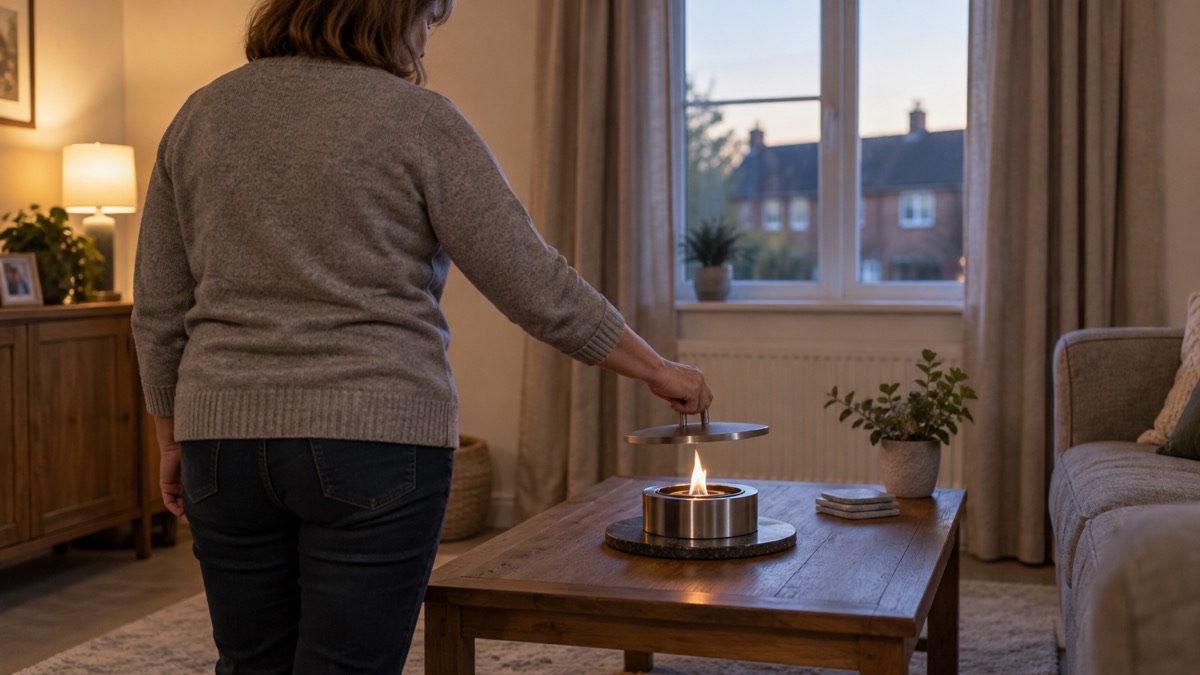
Bioethanol burners can be used indoors safely, but only with care. Fire and rescue services across the UK are clear about the two main risks: fire and burns. Bioethanol is a highly flammable liquid, and there have been incidents across the UK of people being burned in accidents using these appliances, most often when refuelling1. The burners do not emit smoke or ash, but they are flammable and can cause serious harm2.
The good news is that the safety rules are short and practical. Never leave a burning burner unattended3. Refuel only when the fire has been extinguished and is cold1. Use the fuel the burner was designed for, in the approved containers2. Put the flame out with the snuffer lid or extinguishing tool, never with water2. And because the burner produces carbon monoxide and moisture while burning, use it in a well-ventilated room and fit an audible carbon monoxide alarm3.
One thing to settle at the outset: these are decorative appliances. Both gel and liquid bioethanol fires put out a moderate amount of heat, but they are usually purchased for the visual effect of a real flame1. If you are looking for a way to heat your home during a power cut or heating failure, a bioethanol burner is not the answer: see portable heaters, wood burners or keeping one room warm instead.
What a bioethanol burner is, and what it is not
Bioethanol burners can be used indoors or outdoors, for heating or decorative purposes5. They burn bioethanol, a highly flammable liquid used in fireplaces and lanterns4. Bioethanol flame-effect fires have the same look and feel as living flames but do not need a chimney or flue2, and they do not require the installation of a flue or chimney at all1. That is their main appeal for households without an open fireplace, and also part of the danger.
Because these appliances do not need a chimney and are often portable, the risk of fire increases if fuel is spilled or handled incorrectly4. A wood burner sits fixed on a hearth with a flue carrying combustion gases outside; a bioethanol burner can be carried from room to room, placed on a table, or moved while warm. Every one of those freedoms is a chance for fuel to be spilt near a flame, or for the burner to be set down somewhere unstable.
They also differ from open fires in what comes out of them. Bioethanol burners produce heat and release carbon dioxide and moisture into the air3. They do not emit smoke or ash2, which is why no chimney is needed, but they do produce carbon monoxide during combustion3. That has two consequences for your household: you need ventilation while the burner is on, and you need a working carbon monoxide alarm in your home. Both are covered in full below.
Refuelling: when most people get burned
If there is one part of using a bioethanol burner to get right, it is this one. There have been incidents across the UK of people being burned in accidents using these appliances, most often when refuelling1. The pattern is consistent: fuel is poured into a burner that is still lit, or still hot, and the fuel ignites in the container, the stream of fuel, or the person's hands.
The rules from the fire and rescue services are simple and absolute:
- Refuel only when the fire has been extinguished and is cold1
- Never add fuel to a burning fire, and never overfill a fuel container4
- Never add liquid fuel when a fire is lit or burning: this applies to firebowls, fireboxes and burners using ethanol or bioethanol6
- Always check the flame is fully extinguished and hot areas have cooled before filling with any new liquid6
- Do not refuel when under the influence of alcohol: spillages of fuel could more easily happen and go unnoticed1
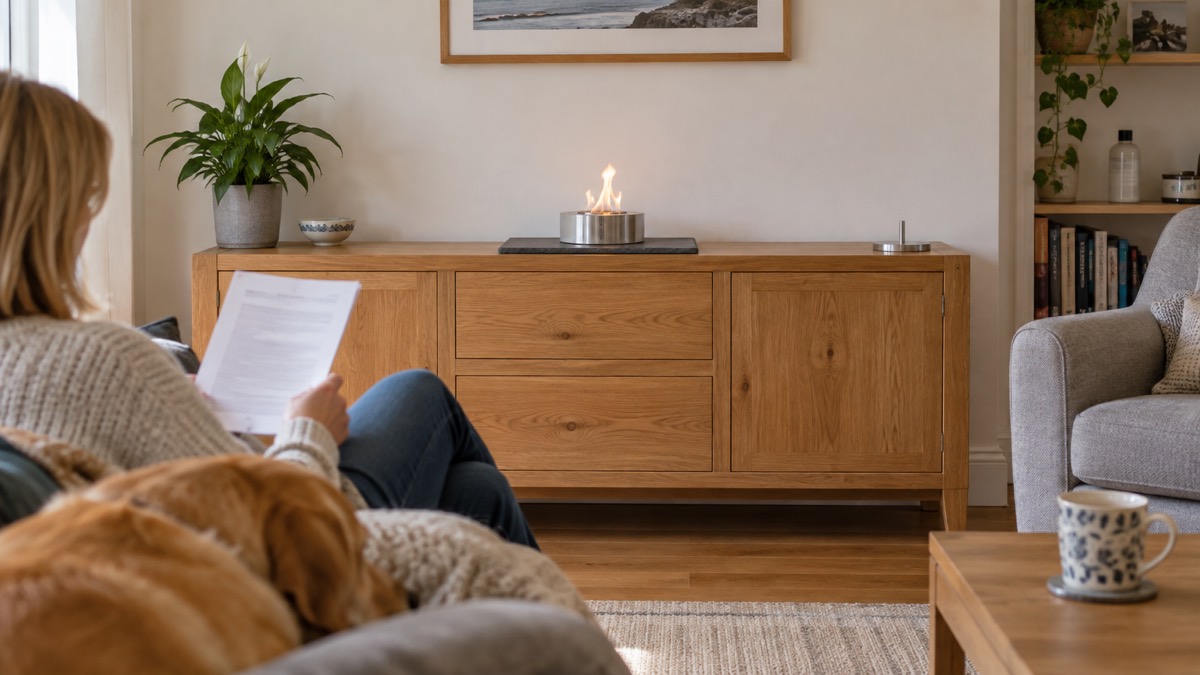
There is a reason the "cold" instruction matters as much as the "out" instruction. The flame of a bioethanol fire can be almost invisible, especially when the fuel level becomes low1. A burner that looks unlit may still be burning, and a burner that has just gone out may still be hot enough to ignite fresh fuel as it is poured. Devon and Somerset Fire and Rescue Service advise that it is best to wait until the fire has naturally died and all the fuel is used up2 before you refill, so there is no doubt about either the flame or the heat.
When you do refuel, always use the approved small containers to refuel, as well as the appropriate fuel type2. Pouring from a large bottle makes spills more likely and harder to control. If you do spill fuel, let the spill evaporate and the area cool completely before lighting anything.
Most burns around these fires happen at the point of refuelling, and every one of them is preventable by following the maker's fuel-handling rules. Never add fuel to a burning fire, never overfill a fuel container, and never fill up a firebox fuel container that is still hot. Let the burner cool fully before you go near it with the fuel bottle, and pour only into the designated container, to the marked level and no further.
Gel or liquid fuel: how each one behaves
There are two types of bioethanol fire: those fuelled by bioethanol gel, and those that take liquid bioethanol fuel1. Whether liquid or gel, bioethanol fuel is highly flammable5, so neither type is "the safe one". But they behave differently, and knowing which you have changes how you use and extinguish it.
| Gel fuelled | Liquid fuelled | |
|---|---|---|
| How it is fuelled | A pre-packed metal can of fuel is inserted into the fire grate; when lit, the can itself is the burner1 | You pour the liquid into the burner before lighting it2 |
| Flame effect | Usually less impressive | Often better than that of a gel fire1 |
| Flame control | Flames cannot be regulated1 | Depends on the burner design |
| Extinguishing | Gel fuel is sometimes not readily extinguished once lit, depending on the design of the fire1 | Use the provided extinguishing tool or snuffer lid3 |
| Refuelling | Replace the can; still only when out and cold | Pour only into a cold, unlit burner, using approved containers2 |
The gel type deserves particular care over extinguishing. Because the gel fuel is sometimes not readily extinguished once lit, depending on the specific design of the fire1, you cannot assume that a snuffer or a lid has done the job. Check that the flame is fully out, and treat the can as hot until you are certain it has cooled. Because the flames of gel fires cannot be regulated1, you also cannot turn a gel fire down if it becomes too large for the space: plan for the flame you will get, not the flame you would like.
The liquid type shifts the risk to refuelling, since you handle the fuel yourself. For bioethanol fires fuelled with a liquid, you pour the fuel into the burner before lighting it7: never after, and never while any part of the burner is warm.
Use only fuel made for your burner
Only use bioethanol fuel specifically designed for bioethanol burners. Using alternative fuels can cause hazards such as excessive smoke or heightened fire risk3. The same principle the fire services apply to barbecues applies here: never use petrol or paraffin to start or revive a fire; use only recognised fuels8. Bioethanol burners are designed around one fuel, and substituting anything else changes how it burns.
This matters for carbon monoxide as well as for fire. Carbon-based fuels are safe to use; it is only when the fuel does not burn properly that excess carbon monoxide is produced, which is poisonous9. The wrong fuel, an overfilled container or a damaged burner can all cause incomplete combustion, so the fuel rule and the maintenance rule (below) are both carbon monoxide rules too.
Always use the approved small containers to refuel as well as the appropriate fuel type2. Keep the fuel in its original labelled container so that no one in the household mistakes it for anything else.
Storing the fuel safely
Store bioethanol fuel in appropriate containers, away from any naked flame, and think carefully about where to keep it5. Devon and Somerset Fire and Rescue Service advise always storing bioethanol in a cool, dry place, away from direct sunlight and naked flames, and recommend storing it in garages and sheds, but making sure the fuel cannot be reached by children or pets10. The same advice appears in their gel-fuel guidance: store it in garages and sheds, but make sure the fuel cannot be reached by children or pets2.
Do not keep spare fuel in the room with the burner, and do not store it near where you refuel. A spill or a knock during refuelling is far less dangerous when the rest of your supply is elsewhere.
Where to place a burner, and what to keep away from it
Fireboxes and containers should always be placed on a flat, stable surface away from any combustible materials5. London Fire Brigade adds that fireboxes and containers should always be placed on a stable surface, and that when using biofuel you should always follow the manufacturer's guidelines and instructions11. The same principles the fire services apply to candles apply to tabletop burners: place them on a stable, heat-resistant surface, away from soft furnishings, and on a non-flammable surface such as a plate or tile wherever possible12.
Before you light a burner, check:
- The surface is flat and stable, and heat-resistant or protected by a plate or tile5
- Nothing combustible is near it: curtains, paper, card, soft furnishings5
- It is out of reach of children and pets2
- It is not somewhere it can be knocked or brushed against as people move past
- The room can be ventilated: a window that opens, or an extractor fan3
When moving your fire, make sure to use a safe location: away from flammable materials, children and pets2. And never move your fire when the burner is lit2. A lit burner carried across a room is a pan of burning liquid in your hands.
For households with children, Surrey's fire safety advice for parents and carers is blunt: never leave burning candles or fires unattended13. North Yorkshire Fire and Rescue Service makes the same point for open fires and log burners, adding that combustible materials should be kept at least one metre away from the fireplace or stove14. A metre is a sensible working distance for a bioethanol burner too, especially the larger freestanding fireboxes.
Putting the flame out safely
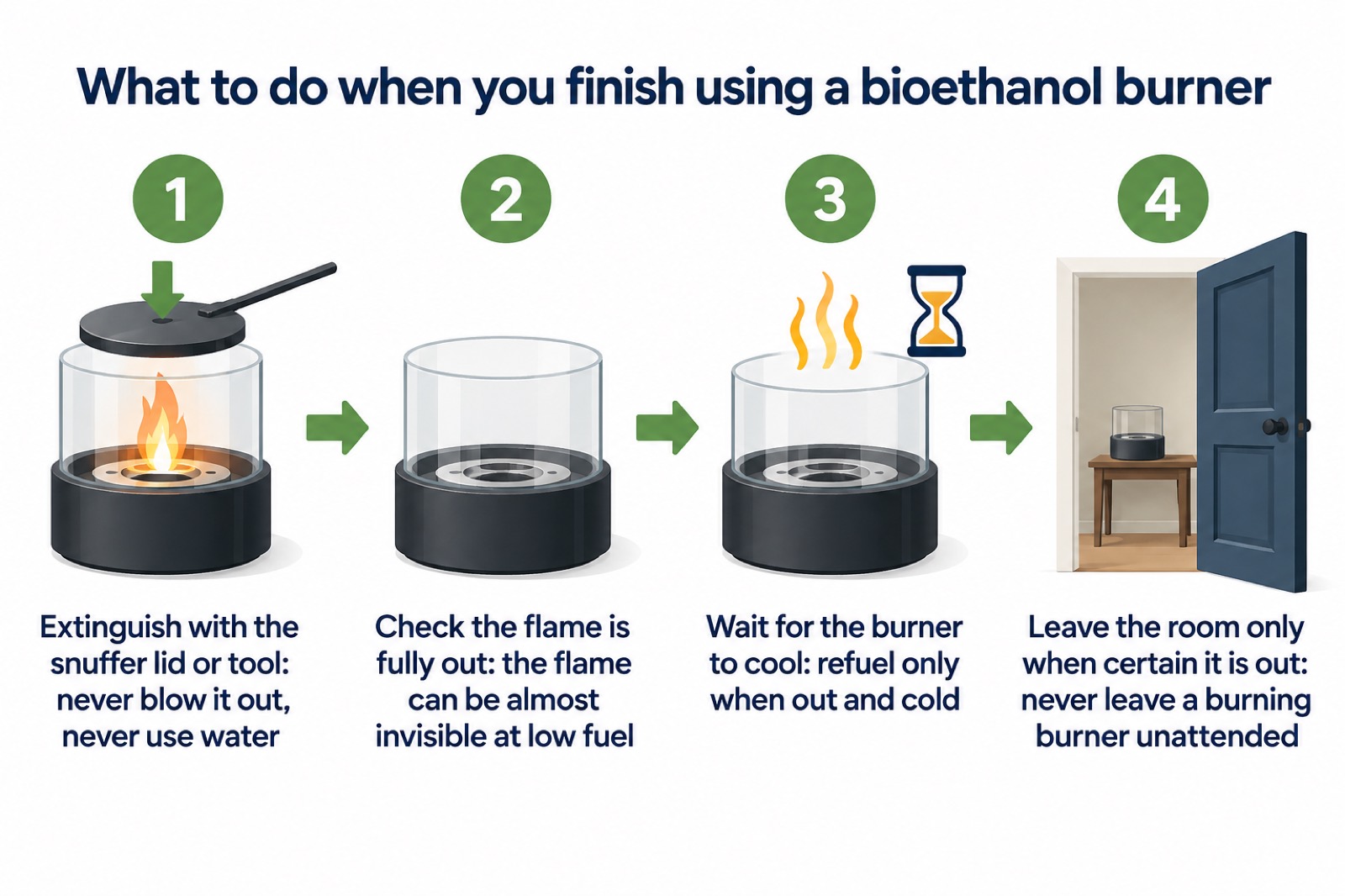
To extinguish the flames of a bioethanol burner, use the provided extinguishing tool or snuffer lid rather than blowing out the flames directly, to prevent accidental fuel spillage3. Blowing can disturb the liquid fuel and send burning fuel out of the container. If your burner did not come with a snuffer or extinguishing tool, contact the manufacturer before improvising one.
Two further rules from Devon and Somerset Fire and Rescue Service:
- Do not use water to try and put out the flames, as this will spread them further2
- If the fire is out of control and cannot be extinguished with the in-built mechanism: get out, closing doors behind you; stay out; call the fire service on 9992
The water rule is the one people most often get wrong, because water feels like the universal answer to fire. With a liquid fuel burning in an open container, water can splash burning fuel outwards and spread the fire across the surface it stands on. Smothering, not cooling, is what puts a bioethanol flame out.
Before you walk away after extinguishing, remember that the flame can be almost invisible when the fuel level is low1. Look closely, wait, and look again. Only when you are sure the flame is fully out and the burner has cooled should you leave it, move it or refill it.
Never leave a lit burner unattended
Never leave a burning bioethanol burner unattended, and ensure the flame is extinguished fully before leaving the room or going to sleep3. The same rule runs through fire safety advice for every kind of open flame in the home. The Scottish Fire and Rescue Service puts it plainly for outdoor heating: never leave any open flame unattended6.
For a bioethanol burner, "unattended" includes asleep in the same room. Do not light one and go to bed, and do not use one in a room where someone is sleeping. Extinguish the flame fully before you leave the room or settle for the night3, and never move the fire while the burner is lit3.
Carbon monoxide, ventilation and moisture
Bioethanol burners produce carbon monoxide during combustion3, and they also release carbon dioxide and moisture into the air3. None of this is a reason not to use one; it is a reason to use it in a well-ventilated room. If indoors, always use bioethanol fireboxes and containers in a well-ventilated room5. Ventilation can be achieved by opening windows or using an extractor fan to circulate fresh air3.
The Health and Safety Executive for Northern Ireland notes that carbon monoxide poisoning can occur when fuel-burning equipment is used in small enclosed spaces15, and Mid and West Wales Fire and Rescue Service list the household risk factors: an appliance that was badly installed, has not been safety checked and serviced annually, a blocked or unswept chimney or flue, or no audible carbon monoxide alarm fitted and working in your home16. A bioethanol burner has no flue to block, but the alarm point applies directly: fit an audible carbon monoxide alarm and keep it working.
If you or anyone in your household experiences symptoms of carbon monoxide poisoning while using a bioethanol burner, immediately ventilate the area, evacuate, and seek medical attention3. Do not go back into the room until it has been aired and the burner is out and cold.
Choosing, checking and maintaining a burner
Choose a high-quality burner from a reputable manufacturer, and ensure it complies with safety standards and is made from durable materials3. A cheap or badly made burner is more likely to leak fuel, fail to extinguish properly, or be unstable on a surface. Check what the manufacturer supplies with it: a proper snuffer lid or extinguishing tool3, clear instructions11, and approved refuelling containers2 are all signs of a product designed to be used safely.
Once you own it, schedule regular maintenance and inspections. Clean the burner according to the manufacturer's recommendations, and inspect it for damage or wear, addressing issues promptly3. Before each use, look over the fuel container and the body of the burner for cracks, dents or fuel residue. Do not light a burner that is damaged or that has been dropped until you have checked it.
A bioethanol burner needs no flue, no chimney and no sweep, but it still needs its own inspection routine before each use. Check the fuel container and the body of the burner for damage, make sure the extinguishing tool or snuffer lid is to hand, and confirm the room can be ventilated before you light it.
Using a bioethanol burner outdoors
Bioethanol burners can be used outdoors as well as indoors, for heating or decorative purposes5. Outdoors, the same rules apply without exception: a flat, stable surface away from combustible materials5, away from children and pets2, never refuel while lit or hot6, and never leave any open flame unattended6.
Outdoor use does not remove the refuelling risk. The Scottish Fire and Rescue Service's advice for firebowls, fireboxes and burners using ethanol or bioethanol is the same wherever you use them: always check that the flame is fully extinguished and hot areas have cooled before filling with any new liquid, and never add liquid fuel when a fire is lit or burning6. And when you finish, dispose of everything safely, ensuring all fire and ashes are completely extinguished8.
What outdoor use must never mean is bringing an outdoor heating or cooking appliance into an enclosed space to keep warm. Cumbria Fire and Rescue Service's camping and caravanning advice is never to use a barbecue inside to keep you warm8, and Devon and Somerset Fire and Rescue Service warn that when barbecues cool they release carbon monoxide, which can be deadly: do not put the barbecue or burnt charcoal in your car or tent17. The same instinct, moving a flame into a tent, awning, caravan or small closed room to get warm, is exactly what turns a decorative burner into a carbon monoxide hazard. If you need heat in a tent or caravan, see keeping warm in tents and caravans.
Where this fits in your household plans
A bioethanol burner is a pleasant decorative flame for an evening, and nothing more. It gives a moderate amount of heat1, it needs ventilation5, and its fuel is highly flammable4. For real heating during a power cut or gas failure, look at the heating and cooking guide, at portable heater safety, or at using a wood burner in a power cut. For light when the power is off, torches and lanterns are safer than any open flame.
If you keep a burner, keep the rules with it: out and cold before refuelling, the right fuel in the right container, a stable surface away from everything combustible, a snuffer lid to put it out, a room with fresh air, an alarm that works, and never, at any point, a flame left on its own.
Sources (17)
- Bioethanol fires, Dorset and Wiltshire Fire and Rescue Service, 2023
- Bio-ethanol and gel fuels, Devon and Somerset Fire and Rescue Service, 2026
- Safe home heating tips, Warwickshire County Council, 2026
- Bio-ethanol burners, Cheshire Fire and Rescue Service, 2026
- Bioethanol burners, Manchester Fire and Rescue Service, 2026
- Outdoor heating safety, Scottish Fire and Rescue Service, 2024
- RoSPA- Preventing accidents in the home | RoSPA safety advice , RoSPA
- Safety outdoors, Cumbria Fire and Rescue Service, 2026
- Carbon monoxide awareness, Staffordshire Fire and Rescue Service, 2026
- Storing fuel safely, Devon and Somerset Fire and Rescue Service, 2026
- Portable heaters, gas fires and open fires, London Fire Brigade, 2026
- Candle safety, Mid and West Wales Fire and Rescue Service, 2026
- Fire safety for parents and carers, Surrey County Council, 2026
- Chimney fire safety week, North Yorkshire Fire and Rescue Service, 2026
- Carbon monoxide, Health and Safety Executive for Northern Ireland, 2026
- Carbon monoxide safety, Mid and West Wales Fire and Rescue Service, 2026
- Barbecues, Devon and Somerset Fire and Rescue Service, 2026
 Before-Winter Heating Checks
 Backup Stove Kit Checklist
 Wood Burner Lighting Kit
 Keeping One Room Warm
 Clothing and Bedding for Cold
 Stopping Draughts
 Hot Water Bottle Safety
 Wheat Bags and Fire Risk
 Electric Blanket Safety
 Portable Heater Types
 Portable Heater Safety
 Wood Burners in a Power Cut
 Using a Wood Burner Safely
 Open Fires and Fire Guards
 Firewood and Seasoning Logs