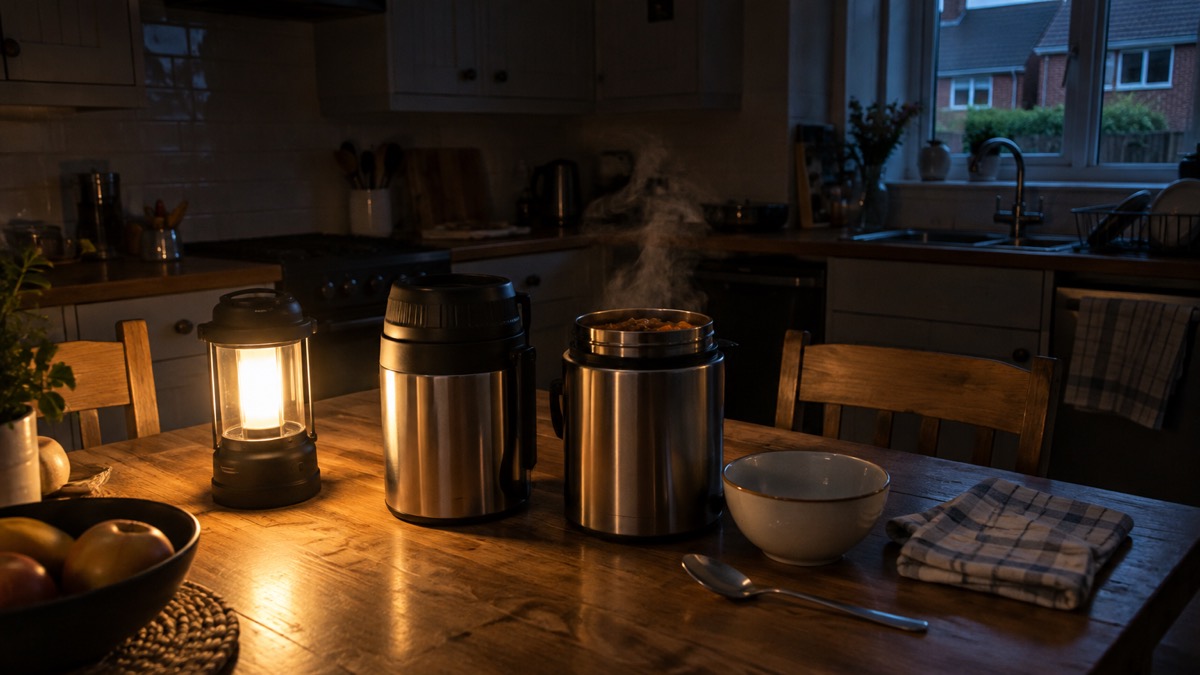
When the power or gas goes off, one of the first things you lose is the ability to heat food. A vacuum flask is the simplest answer: official power cut advice from Northern Powergrid is to "use a vacuum flask to store hot water"1, and parish council power cut guidance suggests boiling water and keeping it in a thermos flask so you can still make hot drinks or fill a hot water bottle if it gets cold2. A food flask goes one step further and holds a whole hot meal, hours after the hob went cold.
The numbers to know are the makers' own heat retention figures. Thermos states its Stainless King Food Flask keeps meals hot for 9 hours and cold for 14 hours3, and its Icon Food Flask with Handle keeps food hot for 8 hours and cold for 18 hours4. Those are the figures for a flask filled properly with food that is already steaming hot. This page explains how the insulation works, how to fill a flask safely, how to keep the food inside it safe to eat, and what to do when things go wrong.
Keeping a hot meal hot when the power or gas is off
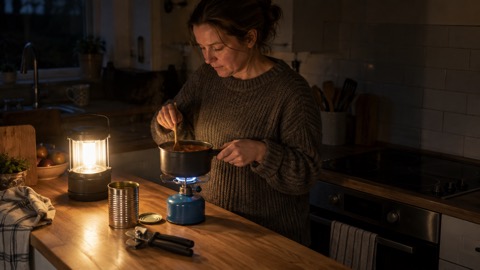
The point of a flask in an emergency is that you heat food or water once, while you still can, and it stays usable for hours afterwards. Wiltshire and Swindon Local Resilience Forum's gas outage guidance suggests that if you are able to use a camping stove outside, it may be worth boiling some water to keep in a flask so that hot soups or a hot drink can be made later6. Scottish Borders Council's personal resilience advice asks the same question directly: have you got a gas stove or means of heating water and food in a power outage?8 A flask is the bridge between that one heating session and the meal you want later in the day.
The same logic applies whichever way the failure runs. Buckinghamshire Council notes that if your property is powered mainly by gas, alternative electrical appliances such as microwaves can let you still cook when the gas oven or hob is not working9. When both are off, Food Standards Scotland says you can cook food and heat water using a camping stove, barbecue or bottled gas stove, checking the manufacturer's instructions for safe use5. Heat what you need in one session, fill the flask, and you are not standing over a stove in the dark at every mealtime.
Two safety rules sit above everything else on this page. First, camping stoves and barbecues are for outdoors: the gas outage guidance specifies use outside6. Second, whatever heat source you use, stay with it. The fire and rescue service's Fire Kills campaign says to stay in the kitchen when cooking and never leave pans unattended, especially when frying or using high heat10, and North Yorkshire Fire and Rescue Service says that if you have to leave the kitchen when a meal is bubbling away on the hob, turn off the heat until you go back11. A flask reduces the number of times you need to cook at all, which is itself a safety gain.
For planning around a cut more widely, see our guides to power cuts, gas and heating failures and heating and cooking without mains power.
How vacuum insulation keeps food hot
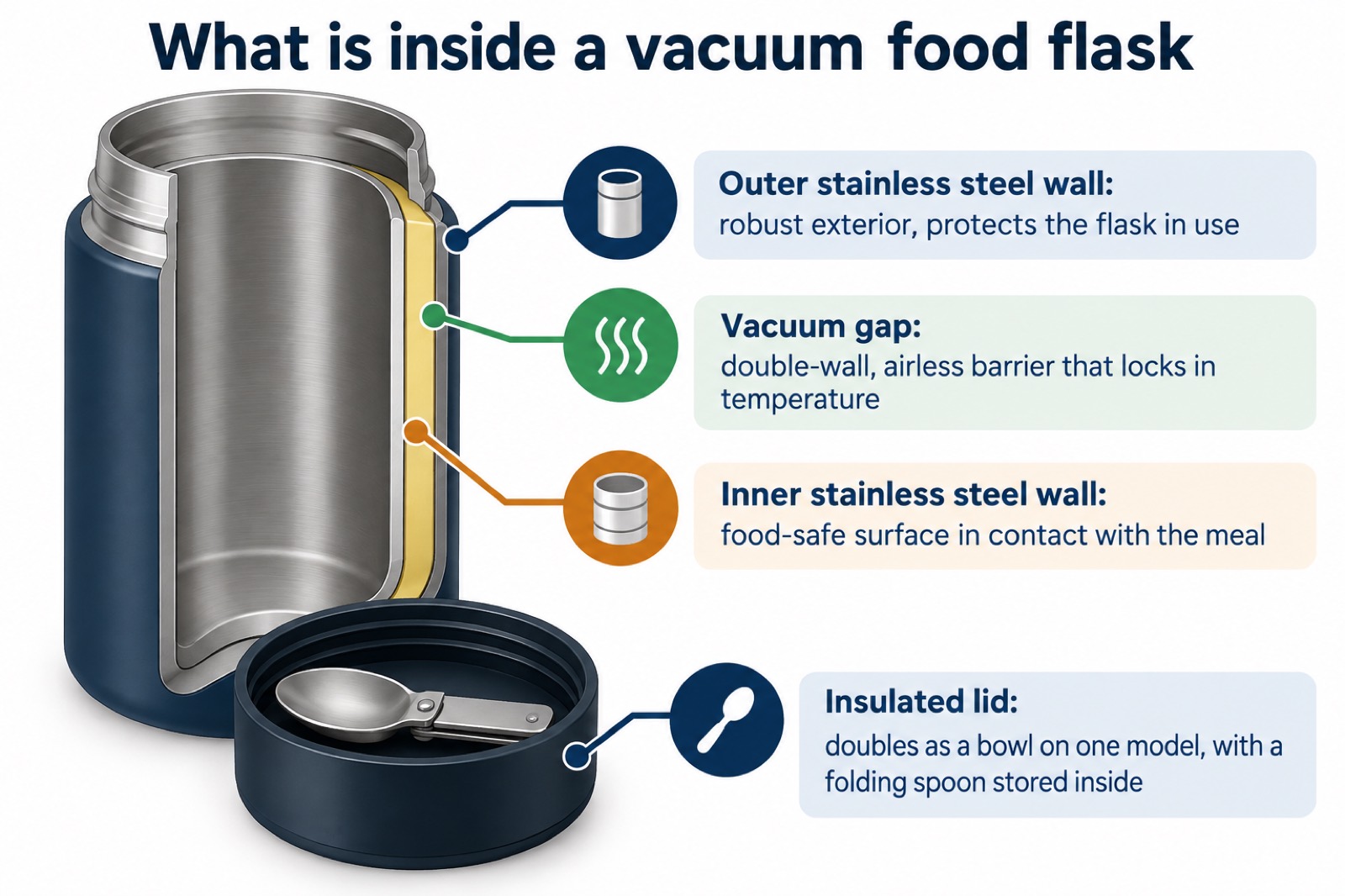
Heat moves by conduction and convection: a hot pan on a worktop warms the air around it, and the air carries the heat away. A vacuum flask interrupts both. Thermos describes its vacuum insulation as a double-wall, airless barrier that locks in temperature4. With no air between the two walls, there is almost nothing to carry heat out of the flask, so a hot stew stays hot and a cold drink stays cold for hours.
The principle is the same one behind other emergency insulation tricks. Northern Ireland Electricity Networks advises tropical fish owners during a power cut to wrap the tank in blankets, use hot water bottles to retain heat and cover the top to trap warmth12. A flask simply does this in miniature and more effectively: instead of blankets slowing the heat loss, the vacuum between the walls nearly stops it.
What the vacuum cannot do is create heat. Everything the flask does depends on what you put in it: food that goes in steaming hot comes out hot hours later, and food that goes in lukewarm comes out lukewarm sooner. That is why the filling stage matters as much as the flask itself, and why the makers' figures assume a hot fill. Both Thermos food flasks pair the vacuum insulation with stainless steel interior and exterior3, which adds a robust outer layer and a food-safe inner surface.
Filling the flask: boiling water and a hot fill
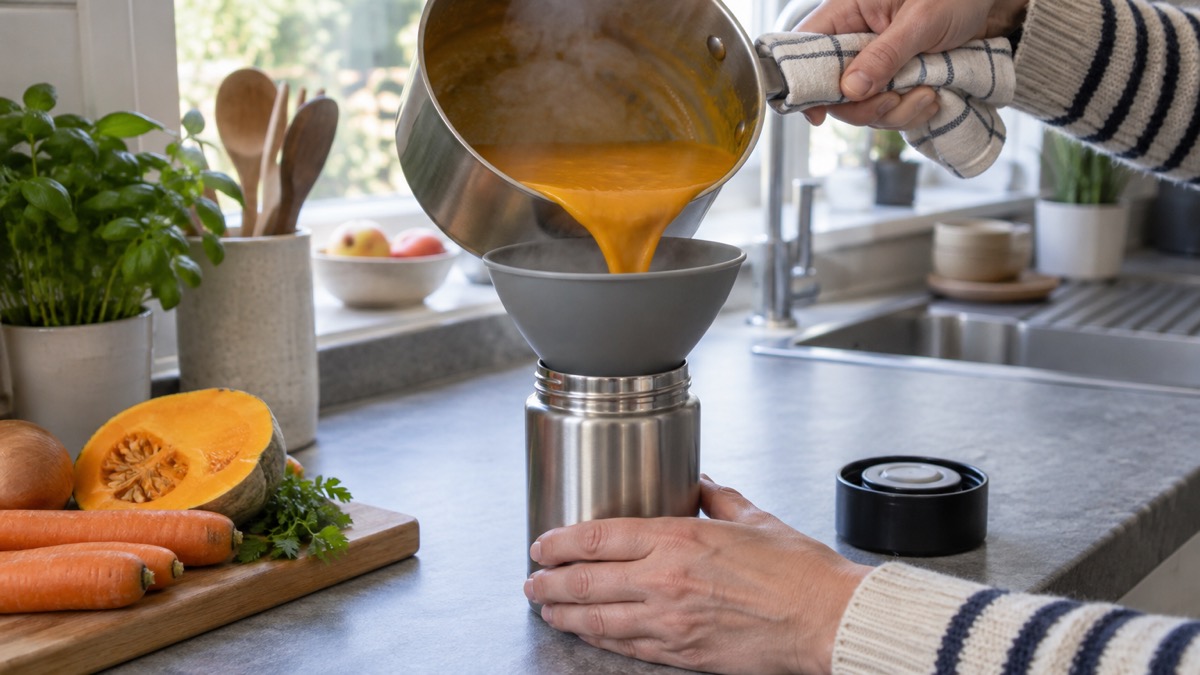
Official emergency guidance treats a flask of boiled water as standard kit. The power cut tips say to boil some water and keep it in a thermos flask, to make hot drinks or fill a hot water bottle if it gets cold2. Northern Ireland direct.gov.uk's storm advice for households with a baby goes further: prepare a flask of hot water to heat bottles and baby food13. So the basic drill in a cut is: when you have heat, boil a full flask's worth of water and fill it straight away.
Handle boiling water with respect. NHS burns guidance for hot water bottles says to allow the boiled water to cool for a few minutes before filling, not to overfill, to let the air out carefully before stoppering, and to screw the stopper on tightly14. Those last points carry over to any sealed hot container: fill it short of the brim, release trapped air carefully, and close it properly. For scald prevention generally, follow the NHS guidance on burns and scalds14.
For food, the fill rule comes from food safety guidance: food must be hot throughout before consumption, following manufacturers' guidelines15, and when reheating food make sure it is steaming hot and heated all the way through16. Food Standards Scotland adds that cooking with camping stoves, barbecues or bottled gas stoves can take longer than your usual ways of cooking, so you need to make sure food is steaming hot and cooked all the way through5. Fill the flask only from that state. A flask filled with food that was merely warm will spend its insulation keeping food in the danger zone rather than out of it, which is covered under food safety below.
Food flask or drinks flask: what each one does
A drinks flask and a food flask use the same insulation but are shaped for different jobs. A drinks flask has a narrow neck for pouring tea or coffee; a food flask has a wide mouth. Thermos describes the Stainless King Food Flask's wide mouth design as allowing easy filling, eating and cleaning3, and says the same of the Icon Food Flask with Handle4. That wide mouth is the whole difference: you can eat straight from a food flask with a spoon, and you can wash it properly afterwards.
The food flask lid does extra work too. On the Stainless King, the insulated lid doubles as a bowl and contains a folding spoon3. That means one item in your bag gives you a container, a serving bowl and a utensil. The Icon Food Flask with Handle is described by its maker as built for life on the go, with a handle and a folding spoon4.
Which one a household needs depends on how they will use it:
| Drinks flask | Food flask | |
|---|---|---|
| Typical use | A warm drink in a flask, as official emergency kit advice recommends if you have to leave your home2 | A hot meal on the go, as the maker describes for the Icon Food Flask3 |
| Lid | Secure push-button lid with a locking catch that prevents leaks, with a covered spout to keep your drink area clean4 | Insulated lid that doubles as a bowl, with a folding spoon on some models3 |
| Handle | Not part of the design | Fitted on some models, such as the Icon Food Flask3 |
For an emergency kit, official guidance points both ways. Neath Port Talbot Council's emergency kit checklist says to take ready-to-eat food, a warm drink in a flask and bottled water if you have to leave your home17. That is a drinks flask's job. But if you want hot meals through a longer cut at home, a food flask is the one that delivers them. Many households will find one of each covers both needs: the drinks flask for the warm drink the council checklist asks for, and the food flask for a hot meal.
Choosing a flask by capacity and how long it holds heat
Two things decide a flask's usefulness: how much it holds, and how long it holds heat. On the second, the makers' stated figures for the two Thermos food flasks are:
| Flask | Keeps hot | Keeps cold | Notable features |
|---|---|---|---|
| Thermos Stainless King Food Flask | 9 hours3 | 14 hours3 | Insulated lid doubles as a bowl, folding spoon stored in the lid, wide mouth3 |
| Thermos Icon Food Flask with Handle | 8 hours4 | 18 hours4 | Handle, wide mouth, two-stage pressure-release stopper4 |
One point of caution on the Icon Food Flask: the maker's heat retention figure is stated as 8 hours in one place and up to 14 hours in another. Plan around the lower figure of 8 hours, since it is the specific stated performance claim, and treat the higher figure as the maker's upper claim rather than a figure to rely on.
Read those hours as a window, not a guarantee. The figures come from the maker and assume a hot fill; a flask opened repeatedly, filled with cooler food, or left in a cold room will do less well. Planning around 8 to 9 hours means one hot fill at breakfast covers a hot lunch, and a fill at the last cooking session of the evening covers breakfast the next morning. Beyond that, plan to reheat, which means keeping a means of heating food that does not depend on mains power8.
On capacity, the pack's maker information gives one figure: the Icon Food Flask with Handle is a 355ml flask4. Choose capacity by who is eating: a small flask suits one person's lunch; a household eating together will want the largest food flask they can fill, or several flasks filled in the same cooking session. Pair the choice with your wider food plans using our guides on how much emergency food to store per person and meals without power.
Keeping hot food safe to eat
A flask holds food at temperature; it does not make unsafe food safe. The food safety rules that apply in your kitchen apply inside the flask. Food Standards Scotland's food poisoning guidance lists the causes of contamination: food not cooked or reheated thoroughly, not stored correctly, left out for too long, handled by someone ill or who has not washed their hands, or eaten after its use by date18. Shropshire Council's guidance for parties adds two rules that fit an emergency exactly: do not prepare food too far in advance, and keep the food either piping hot or refrigerated until it is served19. A flask is the "piping hot" side of that rule.
The practical rules for flask food:
- Cook and reheat food until it is steaming hot and heated all the way through before filling16.
- Follow the manufacturers' guidelines and make sure food is hot throughout before consumption15.
- Do not prepare food too far in advance; keep it piping hot or refrigerated until served19.
- Anyone with diarrhoea, vomiting or nausea must not prepare food19.
- Wash hands thoroughly before, during and after preparing food20.
- Always check food labels so you are sure about the right way to store your food21.
One thing a flask cannot do is tell you what is inside it. Shropshire Council's guidance is blunt: you cannot detect contaminated food, because even food which looks and tastes good can cause food poisoning19. So the safety has to happen before the fill, not at the meal. If food has sat lukewarm in a flask for longer than the maker's stated hot-retention window, treat it as food that has been left out for too long, one of the recognised contamination causes18.
For babies and young children, the flask has a specific official role. Northern Ireland direct.gov.uk advises households with a baby to prepare a flask of hot water to heat bottles and baby food, noting it is always safer to make up a fresh feed, and that when this is not possible, feeds should never be stored for longer than 24 hours13. If you have no gas or electricity to boil water, the same guidance says to use unboiled bottled water (table, spring or mineral water) to make a baby feed, but you must give the feed to the baby immediately22. NHS guidance on children's drinks adds that bottle fed babies aged 0 to 6 months can have a little cooled boiled water in addition to their usual milk feeds, and babies from around 6 months can be offered sips of water from a cup or beaker with meals23. See our dedicated guide to making up baby formula in a power cut.
What can go wrong with a food flask
Most flask failures are seal failures. A worn or damaged lid or stopper breaks the vacuum seal's effectiveness and lets the contents leak. The general official rule for food containers applies here: check jars, lids and containers for damage and discard damaged ones20. On the stopper itself, Thermos fits the Icon Food Flask with a two-stage pressure-release stopper, which the maker says ensures safe, easy opening4.
The second failure is food safety failure, and it is the more serious one. Food poisoning comes from food that was not cooked or reheated thoroughly, not stored correctly, left out too long, handled by someone ill, or past its use by date18. A flask filled with food that was not properly hot simply delays the moment you notice. The rule from flooding guidance applies to any doubtful food: if you are not sure if food is safe to eat, throw it out7. The same guidance orders discarding food in refrigerators or freezers that have come into contact with flood water, because the seals are not watertight7, a reminder that seals are a weak point in storage generally.
A third failure is around the flask rather than in it: the equipment people reach for alongside it. A 2025 product safety notice for the Bauer Electric Hot Water Bottle reports a serious risk of fire because the plug was fitted with an inappropriately rated fuse, and a 13-amp fuse could allow too much current to flow, potentially leading to overheating and fire24. Check any electrical item you use to heat water or food before you rely on it in an emergency. For the symptoms and warning signs of illness, see our guide to food poisoning.
Cleaning and storing a flask between uses
A flask that is not cleaned properly becomes a food safety problem of its own. The wide mouth that makes a food flask easy to fill and eat from also makes it possible to clean properly3, which is a genuine advantage over a narrow-necked drinks flask. The official rules for preparing food safely apply to the flask as they do to any container: wash hands thoroughly before, during and after preparing food, and make sure equipment and containers are clean before use20.
After each use:
- Make sure equipment and containers are clean before use, the home food preservation guidance says, and that includes the flask, its lid and seal20.
- Use clean, sealable, reusable containers rather than cling film where you can, official storage guidance suggests, when decanting leftovers21.
- Keep cupboard and pantry food in sealed bags or containers to keep it fresh and stop anything falling into the food by accident21.
- Check jars, lids and containers for damage and discard damaged ones, the same guidance advises20.
- Store the flask clean and dry, with the lid off so it can air.
If you are storing a flask as part of an emergency kit rather than using it weekly, remember that kit has a shelf life. Denbighshire Council's emergency supplies kit guidance notes that bottled water, for example, will have to be replaced every six months25. Check your stored flask periodically: seals perish, and a flask that has sat for years may not hold heat as its maker claims. The home food preservation guidance asks you to regularly check stored foods for spoilage20, and the same habit should extend to the kit stored around them.
For the wider rules on storing food safely, see keeping a long-term store cool, dry and free of pests and shelf life, use by and best before dates.
Where to get help with food in an emergency
A flask covers the hot meal; it does not cover the food supply. If a cut stretches beyond your stores, or you cannot get to shops, help exists. Our guide to getting emergency food help sets out food banks, councils and local support, and how to get a food bank voucher referral explains the referral route. Households with babies or medical diets have specific needs covered in our guide to babies, young children and medical diets in an emergency.
During an emergency, food and drink already indoors, including tap water and food in shops, will be safe to consume, and covered or sealed food is free of contamination once removed from its wrapping, according to the government's chemical emergency guidance26. That guidance is for a specific scenario, but the underlying point is general: sealed food you already hold is usually your safest resource, and a flask lets you serve some of it hot.
If someone does become ill, NHS inform's food poisoning guidance says to phone 999 or go to A&E in severe cases18. For the detail, read our pages on food poisoning symptoms and when to get help, reporting food poisoning to your council, and food after a flood.
Sources (26)
- What to do in a power cut, Northern Powergrid
- 12 tips to prepare for a power cut, Horsted Keynes Parish Council
- Stainless King Food Flask, Thermos, 2026-10-28
- Icon Food Flask with Handle, Thermos, 2026-10-28
- Food safety in the kitchen: power cuts, Food Standards Scotland, 2026-10-25
- What you might need in a gas outage, Wiltshire and Swindon Local Resilience Forum, 2026-10-25
- Food safety in the kitchen: flooding, Food Standards Scotland, 2026-10-25
- Be more resilient in 30 simple ways in 30 days, Scottish Borders Council, 2026-10-29
- Gas supply issues: prepare for adverse weather, Buckinghamshire Council, 2026-10-29
- Fire Kills: prevention, Fire Kills campaign, 2026-03-25
- Kitchen safety, North Yorkshire Fire and Rescue Service, 2026-03-23
- What about my tropical fish?, Northern Ireland Electricity Networks, 2026-10-25
- Strong winds and heavy rain warning: information and advice, nidirect, 2026-01-27
- Burns and scalds, Cambridgeshire and Peterborough Children's Health, 2026-06-23
- Infectious diseases control, Northumberland County Council, 2026-10-28
- Preparing and cooking food safely, NHS inform, 2025-02-21
- NPT Prepared: emergency kit checklist, Neath Port Talbot Council, 2026-10-29
- Food poisoning, NHS inform, 2026-08-17
- Food poisoning and waterborne infections, Shropshire Council, 2026-10-29
- Consumer advice for food preservation at home, HM Government, 2026-10-26
- Food safety in the kitchen: food storage, Food Standards Scotland, 2026-10-25
- Keeping children safe during a flood, nidirect, 2025-12-09
- Keeping safe in the sun, Hillingdon Children and Young People's Services, 2026-10-29
- Product safety report: Bauer Electric Hot Water Bottle, HM Government, 2025-03-06
- Emergency supplies kit, Denbighshire County Council, 2020
- What to do in a chemical emergency, HM Government, 2024-10-10
 Long-Term Storage Kit Checklist
 Store Cupboard Checklist
 30-Day Household Checklist
 How Much Emergency Food to Store
 What to Store in an Emergency
 Starting a Store Cupboard
 Shelf Life and Date Labels
 Rotating Your Food Store
 Long-Term Storage Conditions
 Meals Without Power
 Self-Heating Meals
 Tinned Food Guide
 Rice, Pasta and Pulses Storage
 Freeze-Dried Meals
 Emergency Ration Packs