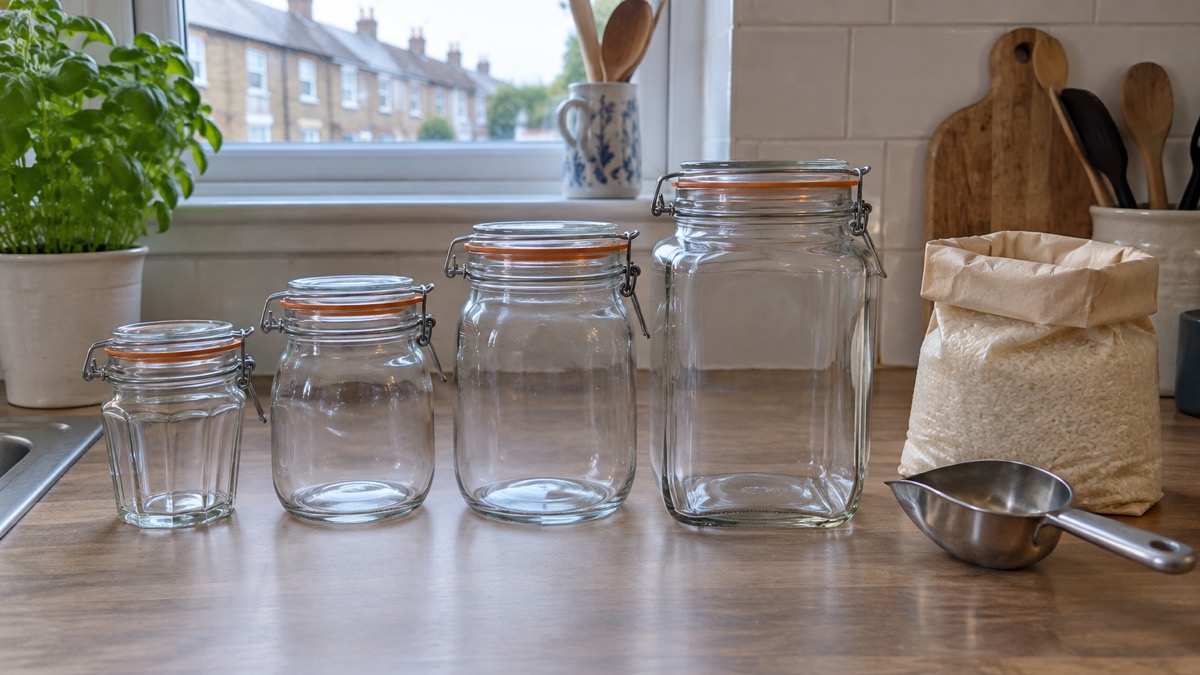
A Kilner clip top jar is a glass preserving and storage jar with a stainless steel clip and a rubber seal that hold the lid down tight. The original Kilner Jar was invented by John Kilner and Co. in England over 180 years ago and is still loved and successful now1. The clip system is engineered to create the tension for an airtight and secure seal every time, and each jar comes with a durable rubber seal2. For a household building a store cupboard, that seal is the point: it keeps dry food away from damp and pests and holds the contents fresh.
If you are deciding what to buy, the choice comes down to two things: how much you want to store in one jar, and whether you want a square shape that lines up neatly on a shelf or the smaller facetted jar. The square jars are described by Kilner as space saving and ideal for pantry storage1. The 0.95 litre facetted jar is the smallest of the clip top range and Kilner suggests it for chunky chutneys, whole fruits and dry foods such as flour, biscuits and cereals2.
Whichever you pick, the care is simple. Wash the jar before first use, and do not pour boiling water directly into it2. The clip top jars are suitable for use in the dishwasher3. Each jar contains a detailed instruction leaflet, so read that before you start preserving1.
What a Kilner clip top jar is and what it is for
The clip top jar is a glass jar with a lid held shut by a metal clip that presses a rubber seal against the rim. Kilner describes the jar as perfect for preserving healthy, home grown foods1. The same jar then does a second job as pantry storage: the airtight seal is what makes it useful for dry goods as well as for preserves.
The seal is the part that matters. Kilner states that the high grade stainless steel clip system is engineered to create the perfect tension, providing an airtight and secure seal every time, and that each jar comes with a durable rubber seal3. The set of 3 facetted jars puts it plainly: the distinctive iconic Kilner airtight clip system is designed to keep foods fresher for longer5. That is a maker's claim about its own product, and it is the reason a clip top jar is worth having in a store cupboard rather than an ordinary open container.
The jars are made from high quality sodalime glass with consistent wall thickness, which Kilner says ensures no weak points4. Kilner also states that the glass is BPA free and does not absorb odours, flavours or stains, so a jar that held pickled onions can later hold flour without carrying the taste across4. Each jar carries the traditional Kilner styling with the authentic embossed logo1.
Sizes: from the 0.95 litre facetted jar to the 2 litre square
The clip top range runs from a small facetted jar to a large square one, and the size you want depends on what goes in it. Kilner gives each jar a suggested use, and they differ: the smaller jars suit chutneys and dry foods, the larger ones suit whole fruits and big vegetables.
| Jar | Capacity | Dimensions (L x W x H) | What Kilner suggests it for |
|---|---|---|---|
| Facetted clip top | 0.95 litre / 950ml | 140mm x 110mm x 180mm2 | Chunky chutneys, whole fruits, dry foods such as flour, biscuits and cereals2 |
| Square clip top | 1 litre / 1000ml | 115mm x 115mm x 150mm3 | Pickling vegetables, preserving chunky chutneys and storing dry foods3 |
| Square clip top | 1.5 litre / 1500ml | 120mm x 120mm x 195mm6 | Pickling large vegetables, preserving whole fruits, dry foods such as flour, pasta and lentils6 |
| Square clip top | 2 litre / 2000ml | 120mm x 120mm x 215mm1 | Pickling large vegetables, preserving whole fruits1 |
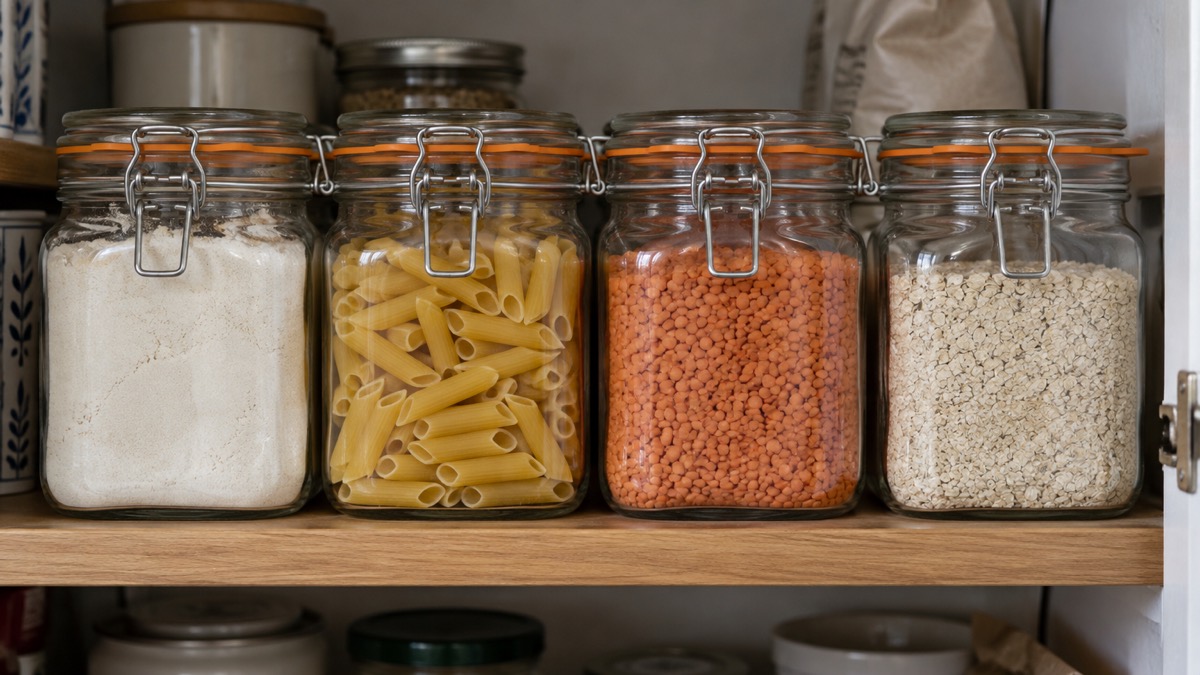
The 2 litre square jar is the biggest of the clip top range. The 1.5 litre jar is described by Kilner as the perfect size for pickling large vegetables, preserving whole fruits and storing dry foods like flour, pasta and lentils1. The 1 litre square jar is the middle size, and Kilner describes it as the perfect size for pickling vegetables, preserving whole fruits and chunky chutneys2.
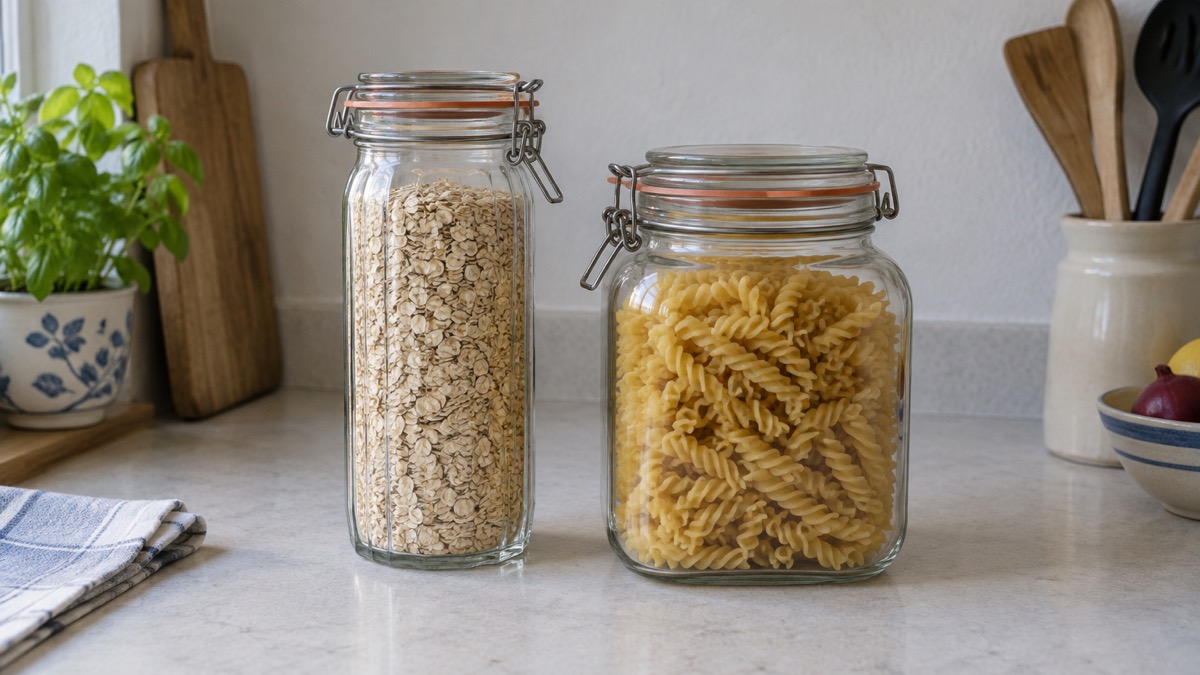
The 0.95 litre facetted jar is the odd one out in shape. It is narrower than the square jars at 110mm wide, and its facetted sides give it a different look on the shelf2. If you want several jars to sit flush against each other in a cupboard, the square shape is the one Kilner designed for that: the contemporary square jar shape is space saving, making it ideal for pantry storage3.
The stainless steel clip system and the airtight seal
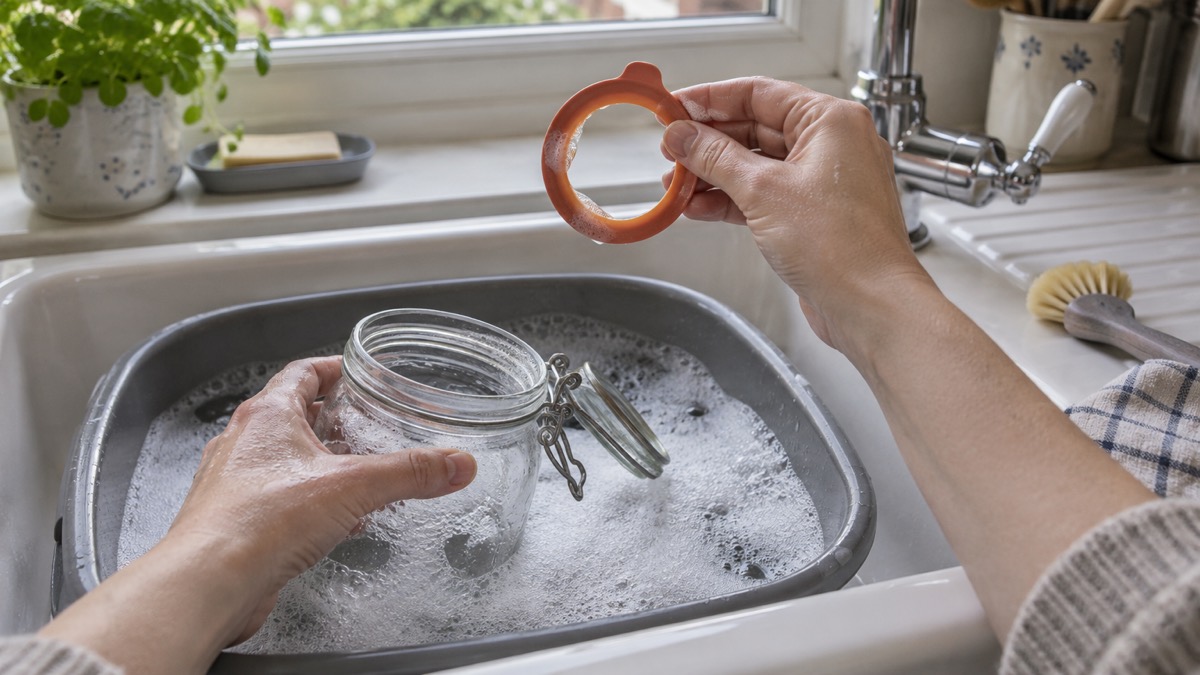
The clip is a lever. Press it down and it pulls the lid tight against the rubber seal, and Kilner says the tension is engineered so the seal is airtight and secure every time1. Each jar comes with a durable rubber seal1. If a seal perishes or goes hard, the jar will no longer hold its airtightness, so check the seal when you wash the jar and replace it if it looks worn.
The seal is also what separates a clip top jar from the other Kilner lids. The twist top jars use a screw lid instead: the hexagonal 110ml and 280ml jars have a gingham printed one-piece lid that Kilner says assures an airtight seal to keep the contents fresher for longer1. The Universal push top jars use a glass lid with a silicone gasket for a secure and airtight seal2. All three approaches seal, but only the clip top uses the steel clip and rubber seal, and only the clip top comes in the larger 1.5 and 2 litre sizes.
"Featuring a high grade stainless steel clip system, engineered to create the perfect tension providing an airtight and secure seal every time."
Storing dried, preserved and pickled food for an emergency
An emergency store cupboard is built on food that keeps without a fridge and does not need cooking. Official guidance is consistent on this: Greater Manchester Combined Authority advises storing non-perishable tinned food that does not need cooking, such as ready-to-eat tinned meat, fruit or vegetables, along with a tin opener1. North Devon Council advises a few days of food that does not need refrigeration or cooking, plus a tin opener2. Denbighshire Council's emergency supplies list goes further, naming ready-to-eat meats or tuna, fruits, vegetables, UHT milk, soup, crackers or cereal bars, biscuits, boiled sweets and powdered milk3.
A clip top jar earns its place alongside the tins by holding the dry side of that store. Which? recommends prioritising dried or tinned proteins such as beans, lentils or chickpeas, jars of peanut butter, unsalted nuts and canned fish1. Those dried pulses are exactly what the 1.5 litre square jar is described for, alongside flour and pasta2. The 0.95 litre facetted jar suits smaller quantities of flour, biscuits and cereals3.
A few practical points follow from the facts:
- Keep the jar sealed between uses. The clip system is engineered to create an airtight and secure seal every time, so clip it shut rather than leaving the lid resting on top1.
- Match the jar to the food. Large vegetables and whole fruits go in the 2 litre jar; flour, pasta and lentils suit the 1.5 litre2.
- Check dates on what you store. An airtight jar keeps food fresher for longer, but it does not extend a use by date, so rotate your store and use the oldest first. Our guide to rotating your store explains how.
- Keep the store dry and cool. A sealed jar protects against damp and pests, but the cupboard itself still matters. See keeping a long-term store cool, dry and free of pests.
If you are deciding between glass jars and other methods for dry food, our comparison of Mylar bags or glass jars for dry food sets the two side by side. For the wider picture of what to keep, start with what to keep in an emergency store cupboard.
Wash before first use, and how to clean and care for the jars
Kilner's instruction on every clip top jar is the same: wash before first use6. Do that before the jar goes anywhere near food, and read the instruction leaflet that comes inside it, which covers preserving as well as cleaning1.
For routine cleaning, the clip top jars are suitable for use in the dishwasher3. That applies to the 0.95 litre facetted jar, the 1 litre square jar, the 2 litre square jar and the set of 3 one litre square jars1. It does not apply across the whole Kilner range: the 4 litre Universal push top jar is handwash only7. If you keep a mix of Kilner jars, check each one rather than assuming.
The same warning appears on the 1 litre square jar, the 1.5 litre square jar and the set of 3 one litre square jars6. It is a maker's safety instruction for its own product, and it is worth passing on to anyone else in the household who uses the jars.
If a jar has been through a flood, the cleaning advice changes. The UK Health Security Agency advises that all crockery, cutlery and cooking utensils should be thoroughly washed with hot soapy water and disinfected with a food-safe disinfectant, ideally in a dishwasher, before use1. Treat jars that were in flood water the same way, and throw away any food that was inside them at the time. Our guide to food after a flood covers what to keep and what to throw away.
Single jars or a set of 3
Kilner sells the clip top jars both singly and in sets. The 0.95 litre facetted jar and the 1 litre square jar each come as a set of 3, and both are also sold as single jars3. The 1.5 litre and 2 litre square jars are sold as single jars1.
| Option | What you get | Suits |
|---|---|---|
| Single jar | One jar, with a rubber seal and an instruction leaflet inside1 | Trying one size, or adding to a store you have already started |
| Set of 3, 1 litre square | 3 x 1 litre square clip top jars4 | Filling a shelf in one go with a single size |
| Set of 3, 0.95 litre facetted | 3 x 0.95 litre facetted clip top jars5 | Smaller quantities, or a matching set for chutneys and dry goods |
A set is the simpler way to start if you know you want several jars of the same size, and the 1 litre square set gives you three identical jars that stack and line up together4. Single jars let you build a mixed store: a 2 litre jar for whole fruit, a 1.5 litre for pasta and lentils, and a 0.95 litre for flour1. There is no wrong answer, only what fits your cupboard and what you actually cook with.
Square or facetted: which shape to choose
The square jars are designed around storage. Kilner describes the contemporary square jar shape as space saving and ideal for pantry storage, and repeats that description across the 1 litre, 1.5 litre and 2 litre sizes1. Square jars sit flush against each other and against the side of a cupboard, so you waste less shelf space.
The facetted jar is a different proposition. At 0.95 litre it is the smallest of the clip top range, and its facetted sides give it a shape that sets it apart from the square jars1. It is the one to choose if you mainly make chutneys and preserves in small batches, or if you want a jar that looks good on an open shelf.
If you are storing for an emergency, the square jars are the more practical choice for volume: the 1.5 litre jar holds flour, pasta and lentils, and the 2 litre holds large vegetables and whole fruits1. The facetted jar is the one to add for smaller dry goods and for the preserves you make yourself.
Twist top and push top alternatives in the Kilner range
The clip top is not the only Kilner lid, and the alternatives suit different jobs. The twist top jars are smaller and aimed at herbs, spices and preserves: the hexagonal 110ml jar is described for dried foods such as herbs, spices and strong flavoured dips and sauces, and as a gift jar for home-made preserves8. The 280ml hexagonal jar covers dried foods such as herbs and spices along with jams and jellies9. The round 370ml twist top jar has a wide neck for easy filling and decanting, and Kilner suggests it for jams, jellies, marmalades, chutneys and dried foods such as herbs and spices10.
The Universal push top jars are the storage end of the range, with a glass lid and silicone gasket for a secure and airtight seal7. They are described for countertop biscuits, sweets and treats and for dried food ingredients kept in cupboards and pantries7. They are not a substitute for a clip top jar if you want to preserve: the clip top is the one Kilner describes for preserving home grown foods1.
For a household store, the sensible split is a clip top jar or two for the bulk dry goods and preserves, and smaller twist top jars for the herbs and spices that lose their flavour fastest. If you are preserving at home, our guide to preserving at home safely covers jams, pickles and bottling, and how to sterilise jars for preserving covers the step before the jar is filled.
Where the Kilner name comes from
Kilner is an English brand, and the name on the jar is the original one. Kilner states that the original Kilner Jar was invented by John Kilner and Co. in England over 180 years ago, and that it is as much loved and successful now as it was then4. The jars carry the traditional Kilner styling with the authentic embossed logo1.
That history is the reason the clip top jar is so widely recognised, but it is not a reason to treat the jar as indestructible. It is glass, and the maker's own instruction not to pour boiling water directly into it applies whatever the age of the design2. Treated with care, a clip top jar is a long-lived piece of kitchen kit that does two jobs: preserving in autumn, and holding the dry half of an emergency store the rest of the year.
For the wider picture of building a food store, start with our emergency food guide, and for how much to keep per person, see how much emergency food to store per person.
Sources (10)
- Kilner Clip Top Square Jar 2 Litre, Kilner, 2026-10-28
- Kilner Facetted Clip Top Jar 0.95 Litre, Kilner, 2026-10-28
- Kilner Clip Top Square Jar 1 Litre, Kilner, 2026-10-28
- Kilner Set of 3 Clip Top Square Jar 1 Litre, Kilner, 2026-10-29
- Kilner Set of 3 Facetted Clip Top Jars 0.95 Litre, Kilner, 2026-10-29
- Kilner Clip Top Square Jar 1.5 Litre, Kilner, 2026-10-28
- Kilner Universal Glass Push Top Storage Jar 4 Litre, Kilner, 2026-10-28
- Kilner Hexagonal Twist Top Jar 110ml, Kilner, 2026-10-28
- Kilner Hexagonal Twist Top Jar 280ml, Kilner, 2026-10-28
- Kilner Round Twist Top Jar 370ml, Kilner, 2026-10-28