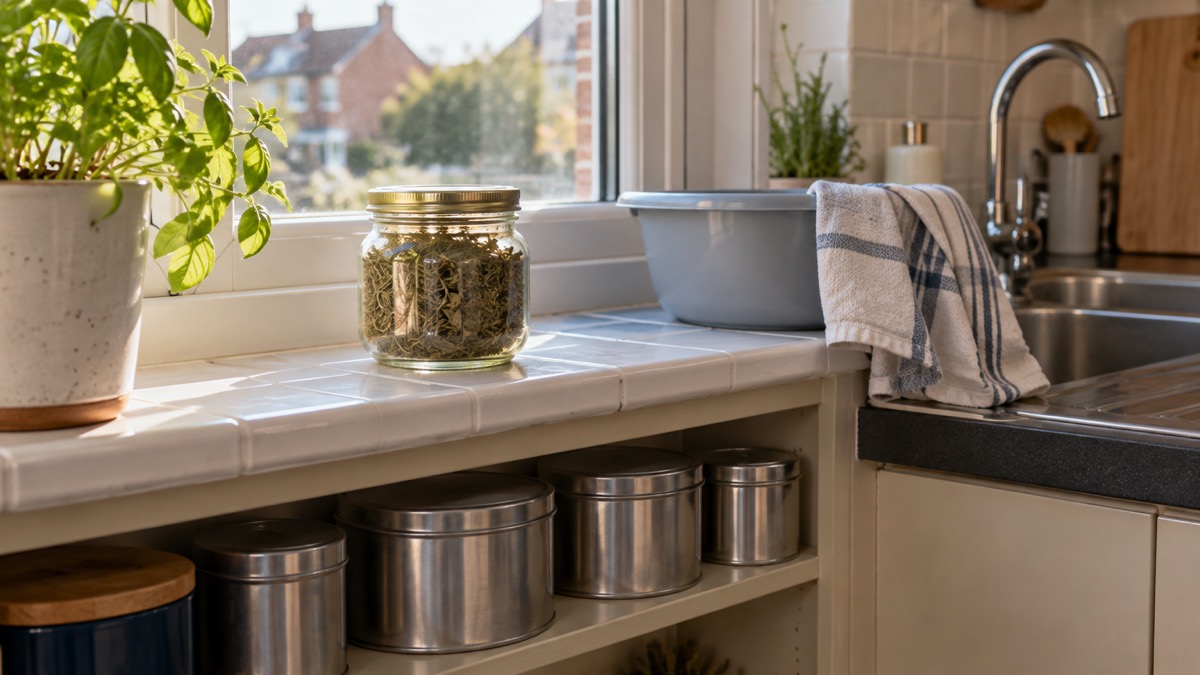
The Kilner Round Twist Top Jar is a 370ml glass preserving jar made in England, sold by the maker as a jar for home-made jams, jellies, marmalades, chutneys and dried foods such as herbs and spices1. For a household getting ready for a power cut, a flood or a spell when shops are disrupted, it is a small, reusable container for the dry side of an emergency store: the herbs, spices and small quantities of dry goods that are easy to lose to damp or pests once a bag is opened.
It holds 370ml, has a wide neck for filling and decanting, and comes with a gingham printed one-piece lid that the maker says gives an airtight seal to keep contents fresher for longer1. The glass is described as BPA free and as not absorbing odours, flavours or stains, and the jar is dishwasher safe1. It is not a pressure canner, a water bath and not a substitute for proper preserving equipment; it is a jar you fill, seal, store and reuse.
If you are building a store cupboard, the jar's job is narrow and useful: it keeps a working quantity of a dry ingredient close to hand, sealed against the air, in a container you can wash and refill. The sections below set out what it is, what the specifications mean for a household, what to put in it, and how to wash, fill and reuse it.
A 370ml preserving jar made in England
The maker describes the Kilner Round Twist Top Jar as perfect for preserving batches of home-made jams, jellies, marmalades, chutneys and dried foods such as herbs and spices1. That description sets its two roles. The first is traditional preserving: a jar for a batch of jam or chutney made when fruit is cheap or gluts need using up. The second, and the one that matters most for emergency preparation, is dry storage: herbs and spices, and small quantities of dry goods, kept sealed and to hand.
The jar is made in England using 30% recycled glass from kerbside collection services1. For a household thinking about supply chains, a domestically made glass jar is a small point in favour: it is not dependent on a long import route, and glass is a material that can be washed and reused indefinitely rather than thrown away after one filling. The maker describes the jars as sustainable glass jars that are reusable time and time again1.
It is worth being clear about what the jar is not. It is a 370ml container, so it suits a working quantity, not a bulk store. It is not described by the maker as suitable for pressure canning, and the maker gives no instruction for heat processing in it. If you are preserving at home, follow the guidance on preserving at home safely and on how to sterilise jars rather than assuming any glass jar can be used for any method. The jar's own maker instructions cover washing, filling and the lid, and those are the ones to follow for this product.
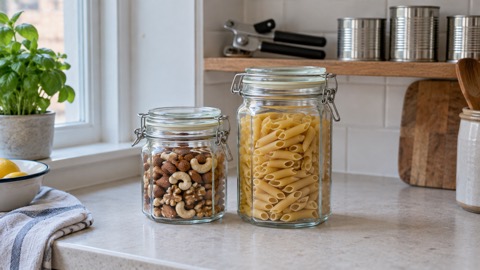
For a household plan, the jar fits at the point where a large bag of rice, herbs or spices is opened and starts to take in damp or attract pests. Decanting a working quantity into a sealed glass jar keeps the rest of the bag fresher and gives you a container you can carry to the table or the hob. The page on keeping a long-term store cool, dry and free of pests explains why that matters more than the container itself.
Round Twist Top Jar, 370ml jar or Round twist top: the names and what they share
The same jar appears under slightly different names. The maker's product page calls it the Round Twist Top Jar 370ml1, and the maker's jar range page lists it as the Kilner Round 370ml Twist Top Jar2. Shops and households may shorten it to "round twist top" or "370ml jar". These are names for one product, not different sizes or versions, and both the product page and the range page give the capacity as 370ml1.
The "twist top" part refers to the closure: a one-piece lid that twists on, as distinct from the clip-top jars and push-top jars the maker also sells. The maker's range page groups its jars by closure type into Screw Top Jars, Clip Top Jars, Twist Top Jars and Push Top Jars2. That grouping is the useful thing to know when you are choosing: the closure decides how the jar is opened and resealed, and therefore what it suits.
| Name used | Where it appears | Capacity given |
|---|---|---|
| Round Twist Top Jar 370ml | Maker product page1 | 370ml1 |
| Kilner Round 370ml Twist Top Jar | Maker range page2 | 370ml2 |
If you are comparing jar types for a store cupboard, the choice usually comes down to how often you open the jar and how much air you want to keep out between uses. A twist top with a one-piece lid is quick to open and reseal, which suits a jar you dip into for cooking. A clip top, with its separate lid and rubber seal, is a different arrangement. The page on Mylar bags or glass jars for dry food sets the two approaches side by side, and the Kilner Clip Top Jar page covers that style if you want to compare within the same maker's range.
Specifications: 370ml capacity, wide neck and soda-lime glass
The headline specification is the capacity: 370ml1. That is a little over a third of a litre, which in practice means a jar that holds a working quantity of a spice or herb, a small batch of chutney, or a portion of dry goods you will use within a few weeks of opening. It is not sized for storing a kilogram of rice; for that you want a larger container, and the page on what size Mylar bag you need covers the bulk side.
The maker gives the dimensions as 75mm length, 75mm width and 115mm height1. A jar 75mm square and 115mm tall stands comfortably on a shelf and stacks or lines up neatly, which matters if you are fitting a store into a cupboard rather than a dedicated room. The wide neck is called out by the maker as allowing for easy filling and decanting1: you can fill it from a pan or a bag without a funnel, and spoon or pour contents out again.
The glass is described as high quality sodalime glass material with pristine clarity and consistent wall thickness ensuring no weak points1. Soda-lime glass is the ordinary glass used for most household jars and bottles. The maker's claim of consistent wall thickness is its own description of its manufacturing; it is not an independent test result, and it does not mean the jar is unbreakable. Treat glass as glass: check the rim and body for chips or cracks before filling, and do not use a damaged jar for food.
| Specification | Detail |
|---|---|
| Capacity | 370ml1 |
| Length | 75mm1 |
| Width | 75mm1 |
| Height | 115mm1 |
| Glass | High quality sodalime glass, consistent wall thickness1 |
| Neck | Wide neck for easy filling and decanting1 |
| Lid | Gingham printed one-piece lid with airtight seal1 |
| Dishwasher safe | Yes1 |
What to keep in a 370ml jar: preserves, herbs and spices
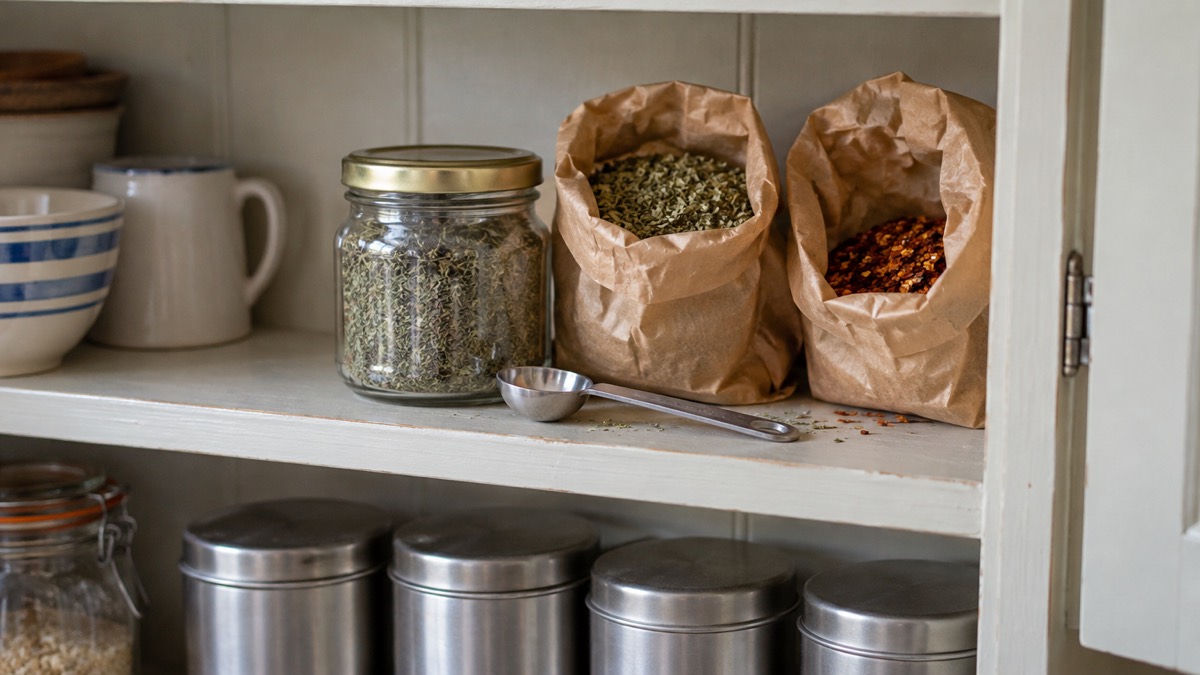
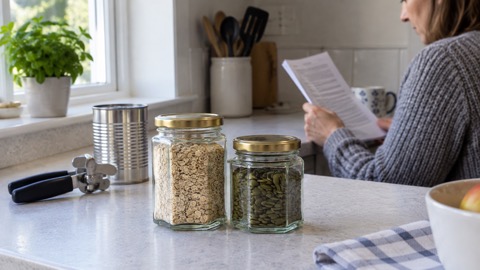
The maker names two uses: preserving batches of home-made jams, jellies, marmalades and chutneys, and storing dried foods such as herbs and spices1. For an emergency store, the second is the more directly useful. Herbs and spices lose their punch when exposed to air and damp, and a sealed glass jar slows that. A 370ml jar holds enough of a frequently used spice to last a household weeks, with the rest of the bag kept closed.
The jar also suits small quantities of dry staples you have decanted from a larger bag: a portion of rice, lentils or oats for the week ahead, kept sealed and pest-free. The page on what to keep in an emergency store cupboard sets out the categories worth holding, and rice, pasta, oats and pulses for long-term storage covers the bulk side. The jar is the working container at the front of the cupboard, not the long-term store at the back.
For preserves, the jar is a container for a batch you have made and processed by a safe method. The maker's product description does not give a heat-processing method for this jar, so follow the guidance on preserving at home safely and how to sterilise jars for the method, and use the jar to hold the finished preserve once it is ready. If you are unsure whether a preserve has kept, the page on how to tell if preserved food has gone off sets out the signs.
A short list of what the jar suits:
- Herbs and spices decanted from a larger bag into a working jar
- Small batches of jam, jelly, marmalade or chutney, made in quantities a household will use up
- Working quantities of dry staples such as rice or lentils, taken from a bulk store
- Home-dried foods, if you dry your own; the page on drying food at home covers that
Glass that is BPA free, 30% recycled and consistent in thickness
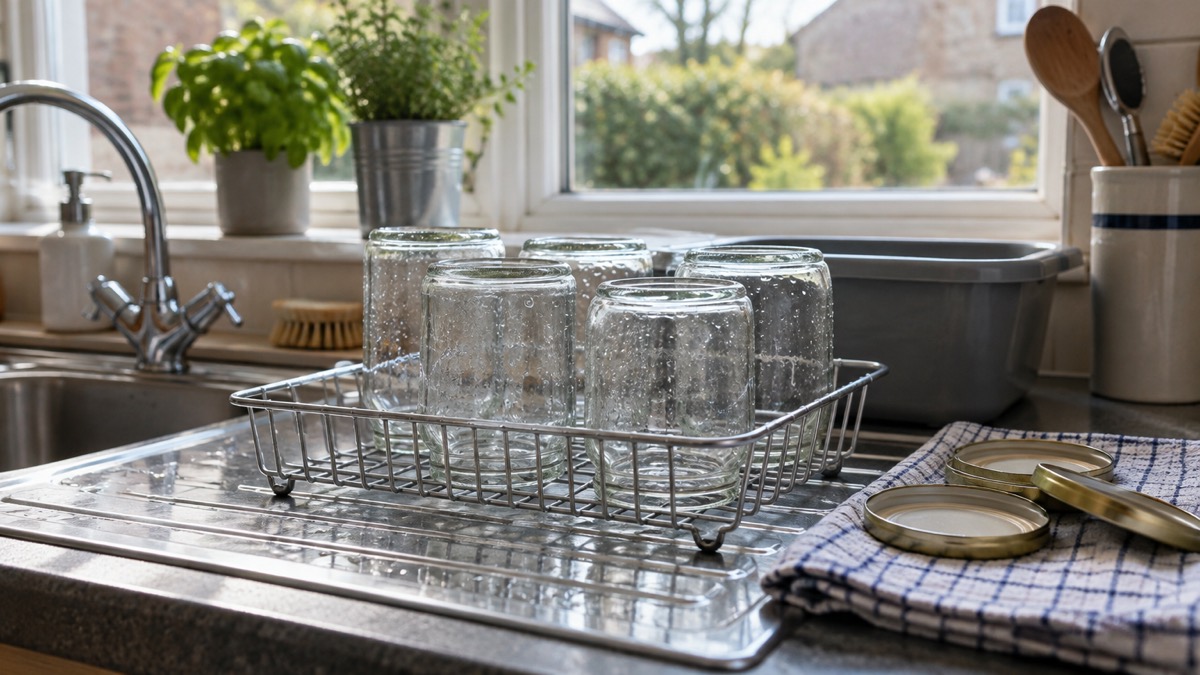
Three material facts matter to a household. First, the maker states that the glass is BPA free and does not absorb odours, flavours or stains1. That is the practical advantage of glass over plastic for a store cupboard: a jar that has held garlic or a strong spice can be washed and used for something delicate without carrying the smell across. It also means the jar does not take on the colour of a chutney or the taint of an old bag of herbs.
Second, the jar is made using 30% recycled glass from kerbside collection services1. That is the maker's stated recycled content, and it comes from household glass put out for council collection. The maker does not break the figure down further. For a household, the point is simply that the jar is made partly from reprocessed domestic glass and is itself reusable time and time again1, so it sits well in a store you intend to keep and refill rather than replace.
Third, the maker describes consistent wall thickness ensuring no weak points1. This is the maker's own description of its glass, not an independent test, and it should be read as a quality claim rather than a guarantee against breakage. Glass jars break when dropped, knocked against a hard edge or subjected to sudden temperature change. Check each jar before filling, especially one that has been in storage or moved, and retire any jar with a chip or crack at the rim or neck.
The lid is a gingham printed one-piece lid that the maker says assures an airtight seal to keep the contents fresher for longer1. A one-piece twist lid is simple to use: there is no separate rubber seal to lose or perish, as there is on a clip-top jar. That simplicity suits an emergency store, where you want fewer small parts to keep track of. The trade-off is that the seal is in the lid itself, so if the lid is damaged or badly dented, the jar loses its airtightness. Keep spare lids if you rely on the jar for long storage, and check the lid seats squarely each time you close it.
Washing, filling and reusing the jar
The maker's care instruction is short: wash before first use1. The jar is also dishwasher safe1, so routine cleaning is straightforward. For a store cupboard, the routine that keeps jars ready is worth setting out as a sequence.
- Wash before first use, by hand or in the dishwasher as the maker instructs1.
- Dry fully before filling with dry goods, so no moisture is sealed in with the herbs or spices.
- Check the rim and lid for chips, cracks or dents before each filling, and retire damaged jars from food use.
- Fill with dry, cool contents, leaving the wide neck clear so the lid seats squarely.
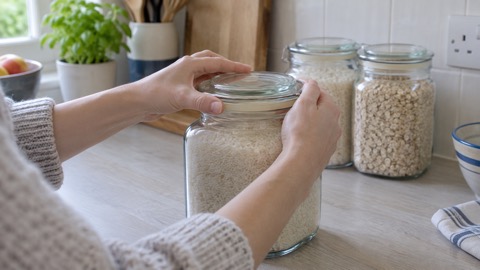
- Seal with the one-piece lid, checking it is straight and tight.
- Store cool and dry, away from damp and pests; the page on storage conditions explains why.
- Wash and refill when the jar runs low, rather than topping up an old jar with fresh stock.
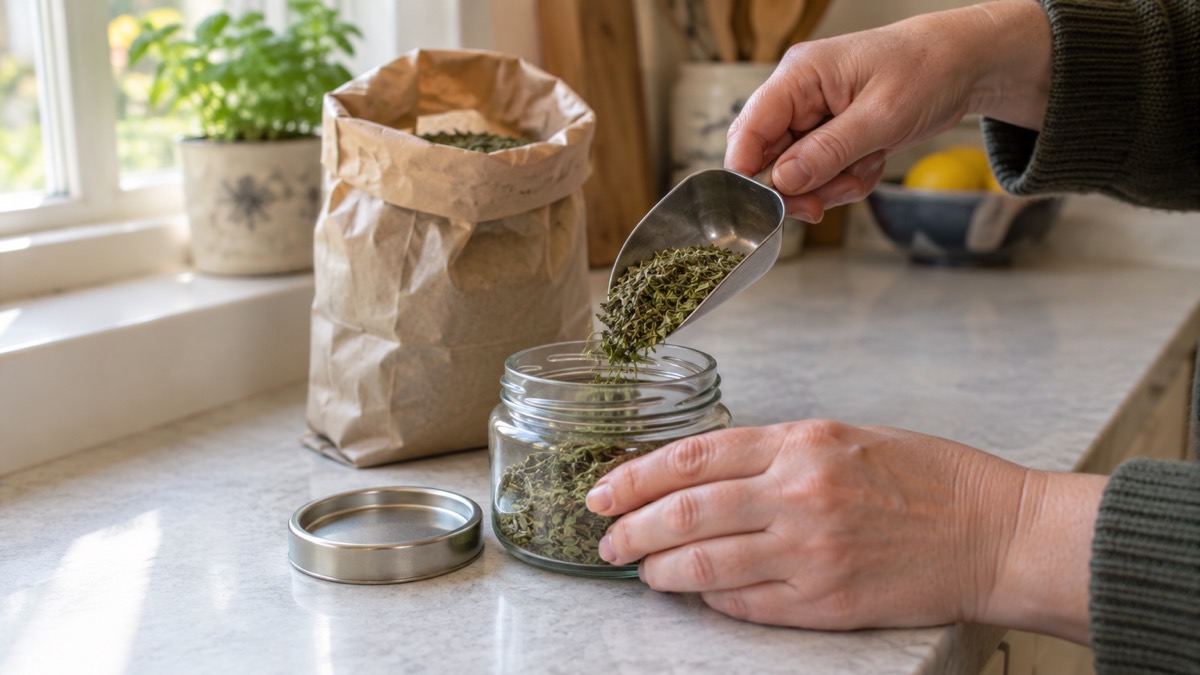
That last point is the one households most often get wrong. Topping up a jar with new herbs or spices on top of old ones means the oldest material sits at the bottom and is used last, so it can be years old before it is reached. Empty the jar, wash and dry it, then refill. The page on rotating your store, first in first out sets out the same principle for the store as a whole.
For preserving, the jar is the container, not the method. Make and process the preserve by a safe method, following preserving at home safely and how to sterilise jars, then fill the jar and seal it with its lid. If you are pouring hot preserve into glass, warm the jar first and avoid sudden temperature change; the page on whether you can pour boiling water into a glass jar covers that risk. Once filled, label the jar with what it is and when it was made, so rotation is easy.
Wash the jar before its first use, as the maker instructs1, and it is ready to be filled, emptied and washed again. A household that keeps a dozen jars washed, dried and ready can decant a bulk store into working quantities as bags are opened, keeping the rest sealed. That is a small routine, but it is the kind of routine that keeps a store usable rather than a cupboard of half-open bags.
Where the jar fits a household plan
The Kilner Round Twist Top Jar is a small piece of a store cupboard, not a system on its own. Its place is at the working end: the jar on the shelf that holds the herbs, the spices, the lentils for the week, sealed and to hand. The bulk of an emergency store belongs in larger containers, and the pages on how much emergency food to store per person and starting a store cupboard supply step by step set out the quantities and the order to build it in.
If you are choosing between container types, the decision usually turns on how often you open the container and how much air you need to keep out. The page on Mylar bags or glass jars for dry food compares the two approaches, and the long-term food storage kit checklist lists what a full set-up includes. Within the maker's range, the Kilner Hexagonal Twist Top Jar and the Kilner Universal Push Top Jar are other shapes and closures to compare if you want a set that stacks.
For the wider picture of what a household should hold and why, start with the emergency food guide and the getting started guide. The maker's own range is described on the Kilner page.
Sources (2)
- Round Twist Top Jar 370ml, Kilner, 2026-10-28
- Kilner Jars, Kilner, 2026-11-02

 Expedition Foods 1 Week Rations
 NRG-5 Emergency Ration
 NRG-5 ZERO Ration
 Kilner Clip Top Jar
 Kilner Facetted Clip Top Jar
 Kilner Hexagonal Twist Top Jar
 Kilner Universal Push Top Jar
 Expedition Foods Rolled Oats
 OxyFree Oxygen Absorbers