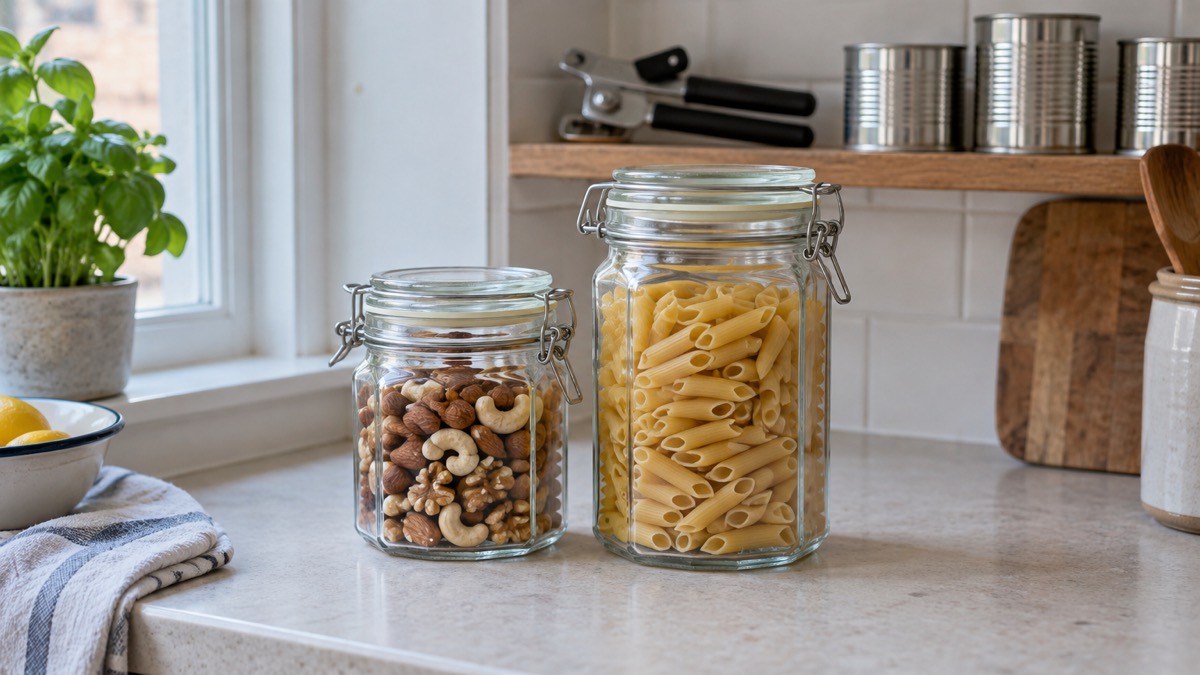
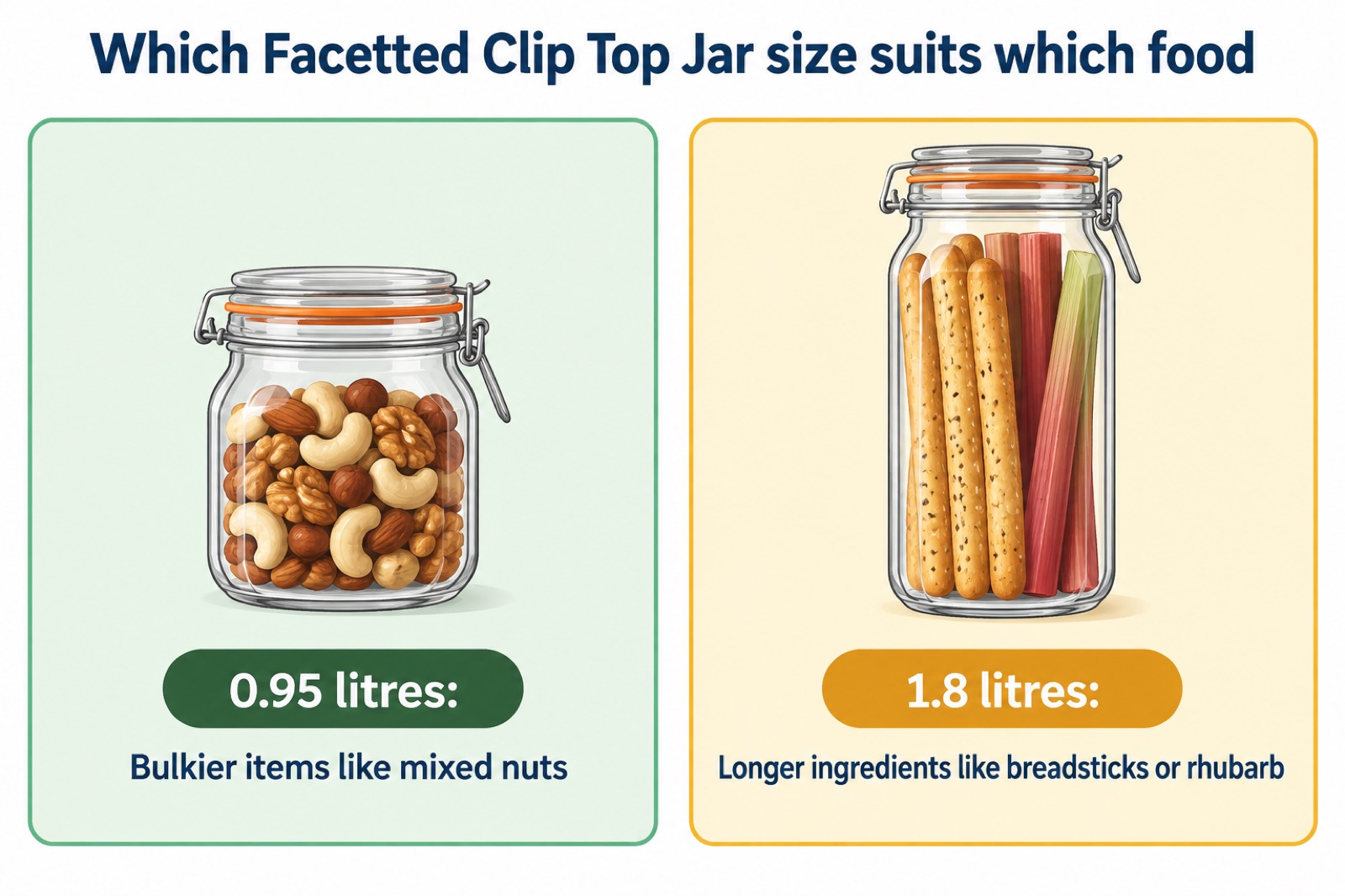
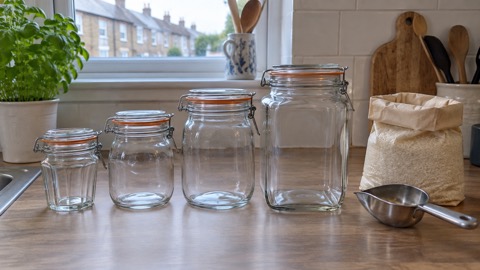
The Kilner Facetted Clip Top Jar is a glass storage jar with a clip closure, sold in two sizes: 0.95 litres and 1.8 litres. For a household building an emergency food store, it is a way to keep dry goods that you will open and close often, such as nuts or long pasta shapes, in a rigid container that stands on a shelf and shows you at a glance what is inside. Kilner's own size guide gives each size a job: the 0.95 litre is "Great for bulkier items like mixed nuts", and the 1.8 litre is "Made for longer ingredients like breadsticks or rhubarb"1.
What it is not is a preservation method. The jar holds food; it does not extend the shelf life printed on the food's packaging, and Kilner's published guidance covers which size suits which food rather than how long anything keeps. Treat it as part of your storage kit, alongside the dates on the packets and a cool, dry cupboard, not as a substitute for either.
If you are deciding between the two sizes, the choice comes down to the shape of what you store. Bulky, handful-sized items go in the smaller jar. Anything long enough to need height goes in the larger one. The sections below set out what each size is for, how the jar fits a household emergency plan, and what the maker's guidance leaves you to work out for yourself.
What the jar is for in a household store
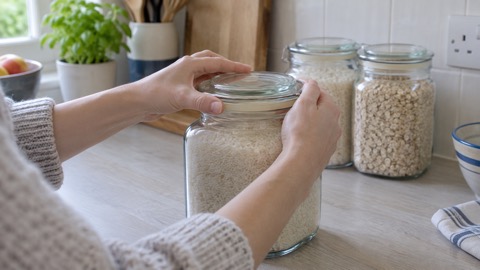
A clip top jar earns its place in an emergency store for three reasons that have nothing to do with brand: it is rigid, it is see-through, and it opens and closes without tools. In a power cut, when you are working by torchlight and trying to assemble a meal from what is on the shelf, those three things matter more than they sound. A rigid jar does not split when a tin falls against it the way a bag can. A clear jar tells you what is left without opening it. A clip lid can be worked one-handed.
Kilner makes jars across several closure types: screw top, clip top, twist top and push top2. The clip top is the one with the metal clasp and rubber seal, and it is the type the Facetted range uses. The Kilner brand page sets out the ranges; the Kilner Clip Top Jar page covers the clip top family more broadly, and the twist top and push top ranges have their own pages if you are comparing closures.
Where the jar fits your plan is in the "open and use" part of the store rather than the "sealed and put away" part. A jar you open weekly is a jar that keeps its contents visible and to hand, which is what you want for the foods you will actually eat during a disruption. For the longer-term, sealed side of a store, Mylar bags or glass jars compares the two approaches on the things that decide it: pest resistance, how they survive a knock, and how much space they take.
Sizes: 0.95 litre and 1.8 litre
The Facetted Clip Top Jar is listed in two capacities, 0.95 litre and 1.8 litre1.
| Size | Kilner's recommended use | Good for |
|---|---|---|
| 0.95 litres | "Great for bulkier items like mixed nuts" | Handful-sized dry goods you open often |
| 1.8 litres | "Made for longer ingredients like breadsticks or rhubarb" | Long items that need height |
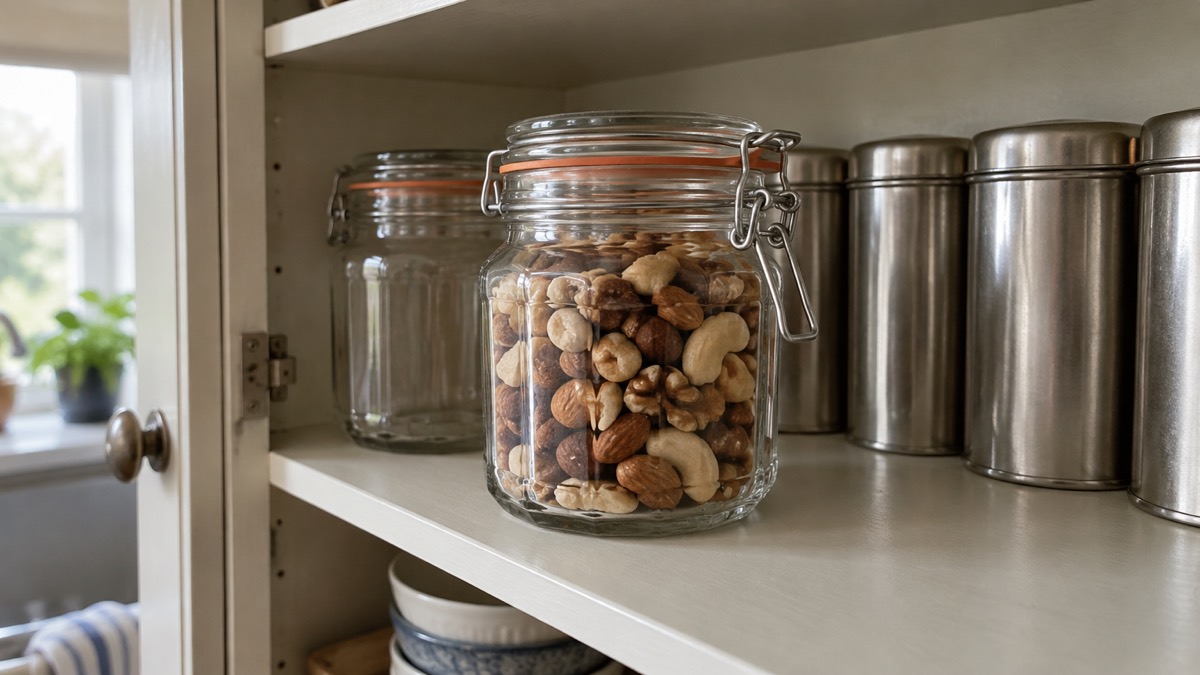
The same size guide covers Kilner's other jar shapes, and the pattern is consistent: each size is given a job rather than a volume alone. Round Clip Top Jars are described as great for countertop storage at 0.5 litres, sized for everyday items like cereals and whole fruits at 1.5 litres, perfect to store grains, pasta nests and rice at 1 litre, and great for family sized ingredients at 3 litres. Square Clip Top Jars at 2 litres are described as made for bulk buyers or storing pet food1. That range is useful context: it tells you the Facetted sizes sit in the middle of what Kilner makes, and that if your need is grains or family-sized quantities, other shapes in the range are aimed at exactly that.
For an emergency store, the practical question is not which jar is biggest but which jar matches what you will actually keep in it. A 1.8 litre jar filled with a food you eat slowly takes up shelf space for a long time. A 0.95 litre jar that you refill every few weeks is doing more work.
The 0.95 litre jar: bulkier items like mixed nuts
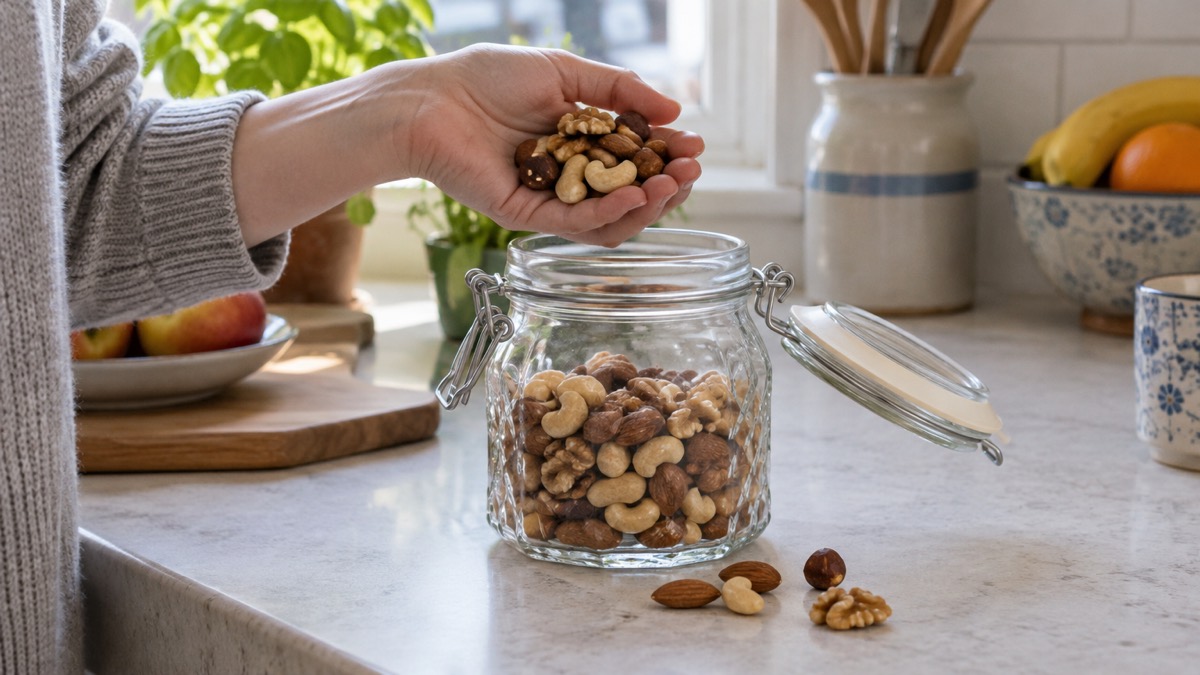
Kilner's guidance for the 0.95 litre Facetted Clip Top Jar is short and specific: it is "Great for bulkier items like mixed nuts"1. That is the maker telling you the jar's proportions suit foods that take up room per item rather than foods that pour.
Mixed nuts are a sensible thing to keep in an emergency store. They need no cooking, no water and no heat, which makes them useful on a day when the power is off and you are assembling a cold meal. A jar you can open, take a handful from and clip shut again keeps them accessible without decanting a whole bag into something flimsier. For more on cold meals that need no power at all, see Meals Without Power.
The jar does not change how long the nuts keep. Follow the best before date on the pack they came in, and check the contents before eating, particularly if the jar has sat at the back of a cupboard for months. Shelf Life, Use By and Best Before Dates Explained covers what those dates mean and how much leeway they give.
The 1.8 litre jar: longer ingredients like breadsticks or rhubarb
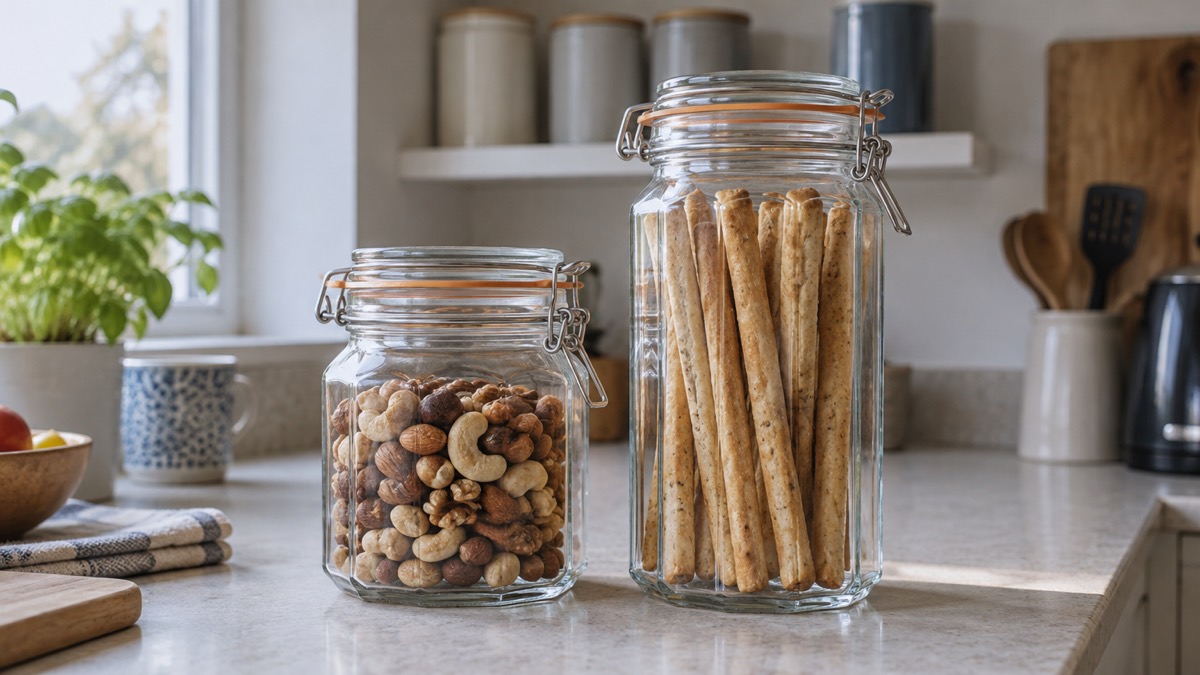
The 1.8 litre Facetted Clip Top Jar is described as "Made for longer ingredients like breadsticks or rhubarb"1. The point of the larger size here is height: long items can stand upright rather than being broken to fit.
Breadsticks are the obvious dry store example. They are a no-cook food that keeps for a long time in its own packaging, and standing them upright in a tall jar keeps them whole and visible. Rhubarb is a different case: it is a fresh ingredient, and Kilner's mention of it points towards preserving or bottling rather than dry storage. If you are preserving rhubarb, the jar is the container, and the preserving method is what makes it safe. Preserving at Home Safely sets out the methods, and How to Sterilise Jars for Preserving covers preparing the jar itself.
Which size suits what you want to store
The choice between the two sizes comes down to three questions about the food, not about the jar.
- How big is each piece? Bulky, handful-sized items suit the 0.95 litre. Long items that need height suit the 1.8 litre.
- How often will you open it? A jar you open weekly is best kept to a size you will get through. A large jar of a slow-moving food occupies shelf space for a long time.
- Is it dry storage or preserving? Dry goods go straight in. Preserving has its own method and its own safety rules, and the jar is only the container.
For a household building a store from scratch, the sensible approach is to decide what you will actually eat, then buy the jar that fits it. What to Keep in an Emergency Store Cupboard and the Emergency Store Cupboard Checklist help with the list; Starting a Store Cupboard Supply Step by Step sets out the order to build it in. How Much Emergency Food to Store per Person covers quantities, which is what decides whether a 0.95 litre jar is a week's nuts or a month's.
Keeping the jar and its contents ready
A glass jar in an emergency store needs a little care to stay useful. None of this comes from Kilner's published guidance, which covers sizes and uses rather than storage conditions; it follows from what the jar is and what is in it.
- Keep it cool, dry and dark. A cupboard away from the oven and the window is where dry stores last best. Keeping a Long-Term Store Cool, Dry and Free of Pests covers the conditions in detail.
- Check the seal before you rely on it. A clip top jar depends on its rubber seal and clasp. If the seal has perished or the clasp is loose, the jar will not hold its contents as it should.
- Label the jar with the date you filled it. The food's own best before date is the one that matters, and a label on the jar saves you emptying it to find out.
- Keep glass off high shelves in a flood-prone or busy kitchen. A jar that falls is a jar of food lost and glass to clear up. Where to Keep an Emergency Store If Your Area Floods covers siting a store with water in mind.
- Rotate what is in it. Eat from the jar and refill it, so nothing sits at the back indefinitely. Rotating Your Store: First In, First Out explains the routine.
What the maker's guidance does not cover
Kilner's published material on the Facetted Clip Top Jar does two things: it lists the two sizes, and it gives each a recommended use1. It does not give a shelf life for food stored in the jar, a maximum fill level, washing instructions, or a statement about what the jar can and cannot be used for beyond those examples. Where you need those answers, they come from the food's own packaging and from a tested preserving method, not from the jar.
That matters for planning. A jar is a container, and a container is only one link in the chain that keeps food good: the food's own condition when it went in, the temperature and humidity where it is kept, and how often it is opened all do more work than the glass. If you are weighing up glass against other methods for a long-term store, Mylar Bags or Glass Jars for Dry Food sets the trade-offs out side by side, and the Long-Term Food Storage Kit Checklist lists what a full set-up includes.
For the wider picture of how a store fits a household plan, start with Emergency Food and Getting Started.
Sources (2)
- Kilner Jar Size Guide, Kilner, 2026-10-28
- Kilner Jars, Kilner, 2026-11-02
 Expedition Foods 1 Week Rations
 NRG-5 Emergency Ration
 NRG-5 ZERO Ration
 Kilner Clip Top Jar
 Kilner Round Twist Top Jar
 Kilner Hexagonal Twist Top Jar
 Kilner Universal Push Top Jar
 Expedition Foods Rolled Oats
 OxyFree Oxygen Absorbers