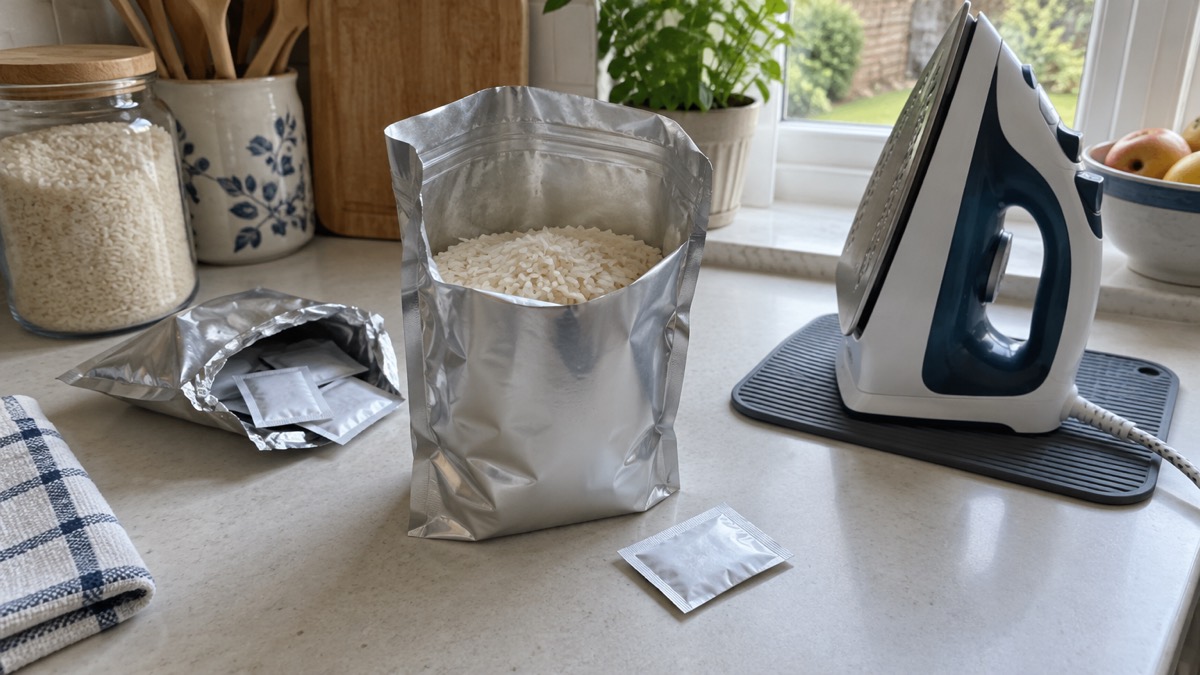
OxyFree oxygen absorbers are small sachets that pull the oxygen out of a sealed container so that dry food keeps far longer without added preservatives. For a household building a store cupboard against a power cut, flood or storm, they are the difference between food that lasts months and food that goes stale, rancid or mouldy in a bag. The 2,000cc size is the one sold for larger Mylar bags, and it comes in standard packs of 101.
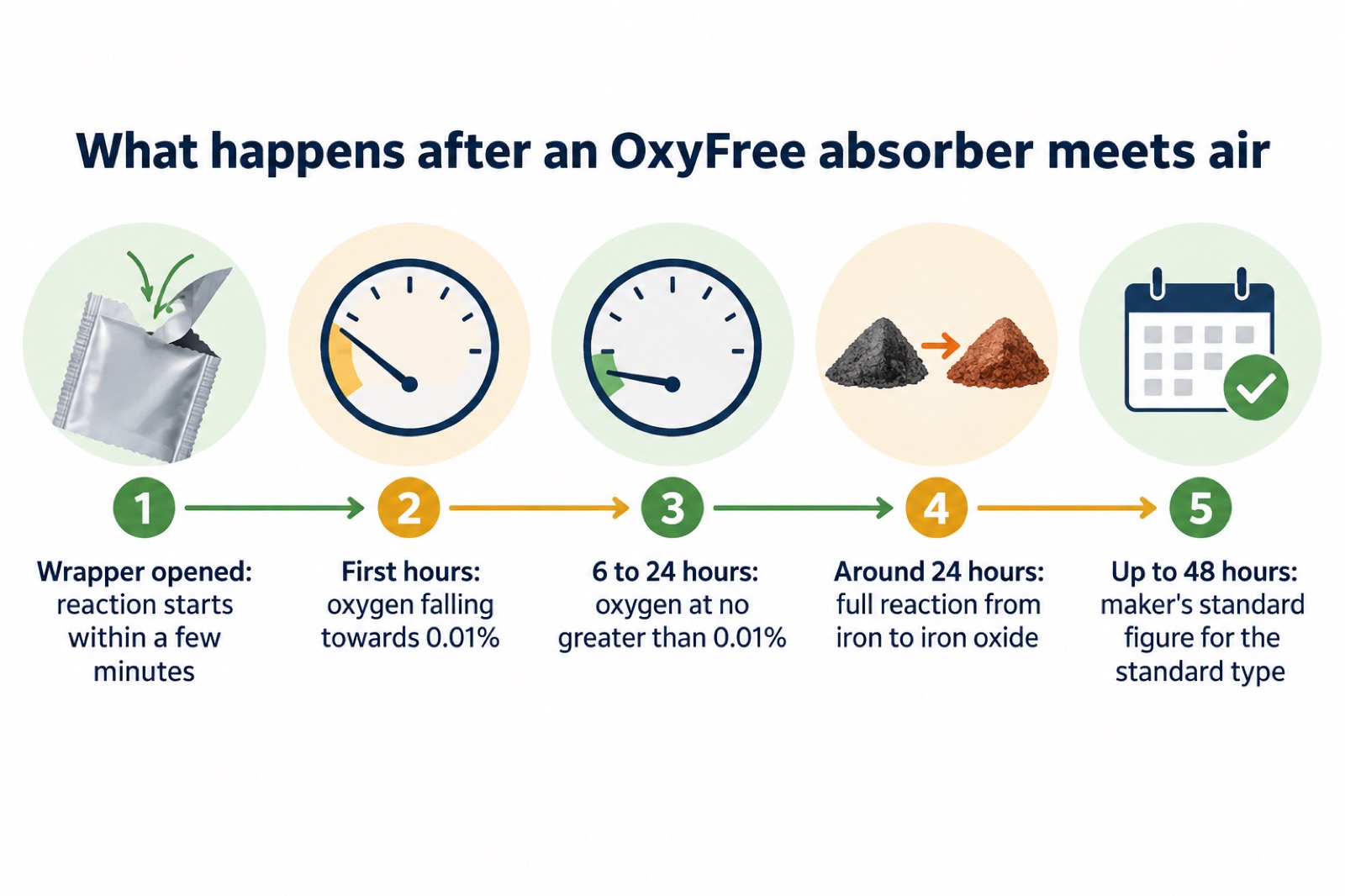
What matters when you use them is speed and a good seal. OxyFree absorbers start reacting within a few minutes of being exposed to oxygen, bring the level inside a sealed bag down to no greater than 0.01% within 6 to 24 hours, and hold it there3. The full reaction from iron to iron oxide takes around 24 hours4. The maker's own support article gives 48 hours as the standard figure for the standard type, so treat a bag as settled only after the longer end of that range5.
This page covers what OxyFree makes, how the sachets behave once opened, which bag sizes the 2,000cc absorber suits, how to store spares, and how absorbers differ from silica gel. It is written for a household getting a dry store ready, not for a commercial packer.
What OxyFree makes, and what it does for a household store
OxyFree is the brand name on a range of oxygen scavengers and silica gels, supplied both loose and on belts1. The oxygen absorber range has grown to 8 different absorbers for different applications, developed from the original 504 absorber3. All OxyFree products are described as food-safe and non-toxic, complying with FDA and EU regulations and produced in an ISO9001 certified environment3.
For a household, the job is simple to state. An oxygen absorber is a small packet of material used to prolong the shelf life of food5. It does that by removing the oxygen that aerobic bacteria and fungi need in order to grow7. The same absence of oxygen slows the changes that make stored food less pleasant: it helps prevent food colour change and stops oils in foods from becoming rancid5.
That matters most in the situations this site is built around. Official advice for a power cut is to keep non-perishable food that does not need cooking, plus a tin opener, ready-made baby formula and pet food if needed8. Flood guidance says to select foods that require no refrigeration, preparation or cooking, and little or no water, and that are compact and lightweight9. Emergency planning advice from councils says the same in plainer terms: a few days of food that does not need refrigeration or cooking, plus a tin opener10. A dry store of rice, pasta, oats and pulses packed with absorbers is exactly that kind of food, and it is the kind that benefits most from being packed properly. For the wider picture, see Emergency Food: A Household Guide to Stores, Safety and Meals Without Power and Mylar Bags and Oxygen Absorbers for Dry Stores.
The range is not only absorbers. OxyFree also supplies silica gels, both loose and on belts1. The two products do different jobs and are often used together, which is covered below.
How fast they work: oxygen down to 0.01% in 6 to 24 hours
The headline figure is the one to plan around. OxyFree oxygen absorbers reduce oxygen content to no greater than 0.01% oxygen within 6 to 24 hours and maintain this low level3. That is the working window in which a sealed bag goes from ordinary air to a preserved environment.
The stages behind that window are worth knowing because they decide when you can put a bag away and stop worrying about it.
- Exposure. OxyFree oxygen absorbers start reacting within a few minutes of being exposed to oxygen4. Once the wrapper is open, the clock is running.
- Pull-down. Oxygen falls to no greater than 0.01% within 6 to 24 hours3.
- Completion. The full reaction from iron to iron oxide takes around 24 hours4.
- The maker's standard figure. The maker's support article states that the standard is 48 hours for the standard type5.
Those last figures do not agree, and it is worth saying so plainly: the distributor's articles give 6 to 24 hours for the pull-down and around 24 hours for the full reaction, while the maker's support article gives 48 hours as the standard for the standard type3. The safe way to read them together is to allow the longer end before you treat a bag as finished, and to judge the result by the bag, not the clock.
Keeping stored food free from added preservatives
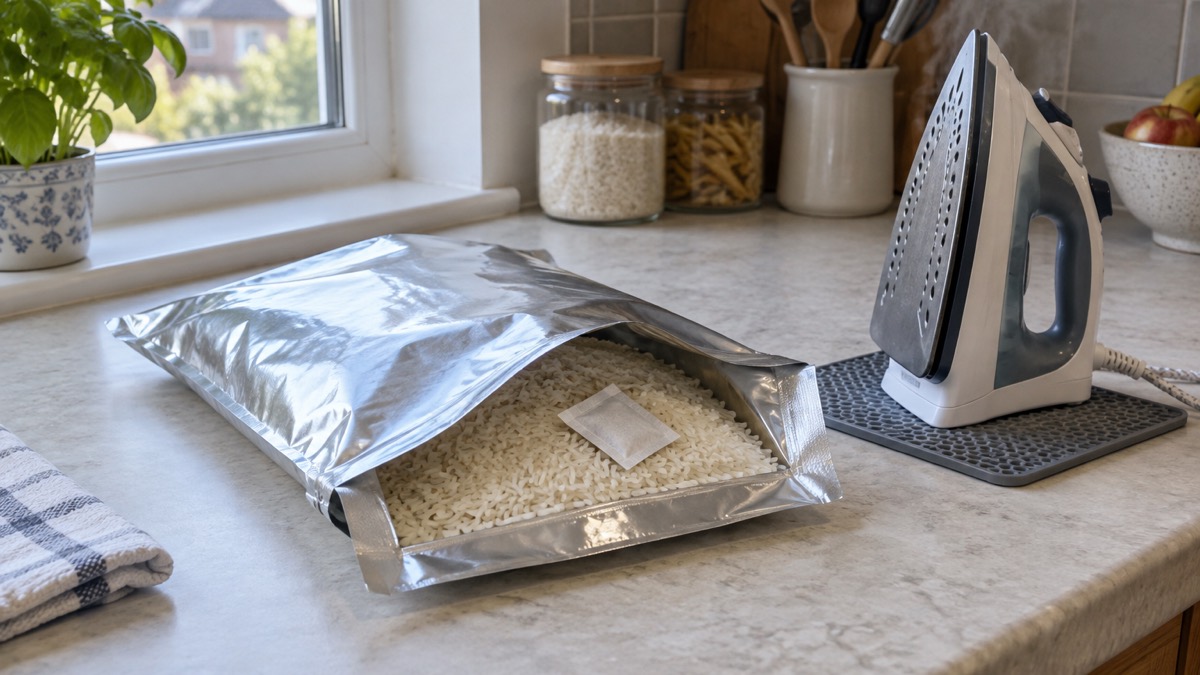
The reason households reach for absorbers rather than a longer list of additives is straightforward. Using OxyFree oxygen absorbers for food preservation reduces or eliminates the need for other preservatives, keeping food free from artificial preservatives3. The mechanism is physical rather than chemical: eliminating oxygen means that aerobic bacteria and fungi are unable to grow7.
That is a meaningful gain for an emergency store, because it lets you build a supply out of ordinary dry staples rather than specialist long-life products. It also means the store is only as good as the seal around it. An absorber in a bag that lets air back in will be used up and the food will spoil anyway.
There is a limit worth stating. Absorbers deal with oxygen, not with moisture, and not with every kind of spoilage. Official guidance on preserving at home describes pickling as submerging and marinating food in acidic solutions like vinegar or brine, and without oxygen, to prevent microbiological growth11. That is a different process with a different purpose, and an absorber is not a substitute for it. For the wider subject, see Preserving at Home Safely: Jams, Pickles and Bottling and How Long Food Lasts in Mylar Bags With Oxygen Absorbers.
How many absorbers a container needs depends on the food as well as the volume. The maker advises adjusting the number up a little for less dense foods such as pasta or some lentils, because the bags contain more air than for dense foods such as rice or wheat5. Air is what the absorber has to clear, so a bag of hollow pasta shapes is a harder job than the same weight of rice.
2,000cc absorbers for larger Mylar bags
The 2,000cc absorber is the size sold for bigger containers. The distributor describes it as the perfect size for their larger Mylar bags6. It comes in standard packs of 104, and full packs of 10 and above carry the OxyEye indicator6.
Matching absorber to container is the part households most often get wrong, in both directions. Too few and the oxygen is not cleared; too many is simply wasted, because an absorber that has done its work has no further effect. The maker's own figures for larger containers are the place to start:
- 5-gallon bags: use 1 2000cc and 1 500cc oxygen absorber5.
- 1-gallon bags: the maker gives 1 500cc per 1 gallon bag as the easiest new answer, covering far more cases with far fewer failures, and says freeze-dried food should definitely have 2 absorbers5. The same maker article also gives 1 500cc or 2 300cc for 1-gallon bags, so the two figures sit side by side rather than one replacing the other5.
For a household packing a large bag of rice or pulses, the 2,000cc sachet is the workhorse. For smaller jars and bags, a smaller size does the same job with less waste. The Long-Term Food Storage Kit Checklist sets out the rest of what a packing session needs.
Which bags suit the 2,000cc size
The 2,000cc absorber is described as ideal for three bag sizes: 35cm x 50cm, 48cm x 74cm, and the heavy duty 48cm x 74cm6. Those are the containers to buy it for. If your bags are smaller, a smaller absorber is the better match.
| Bag | Absorber guidance | Source |
|---|---|---|
| 35cm x 50cm Mylar bag | 2,000cc described as ideal | 6 |
| 48cm x 74cm Mylar bag | 2,000cc described as ideal | 6 |
| Heavy duty 48cm x 74cm Mylar bag | 2,000cc described as ideal | 6 |
| 5-gallon bag | 1 2000cc and 1 500cc absorber | 5 |
| 1-gallon bag | 1 500cc, or 2 absorbers for freeze-dried food | 5 |
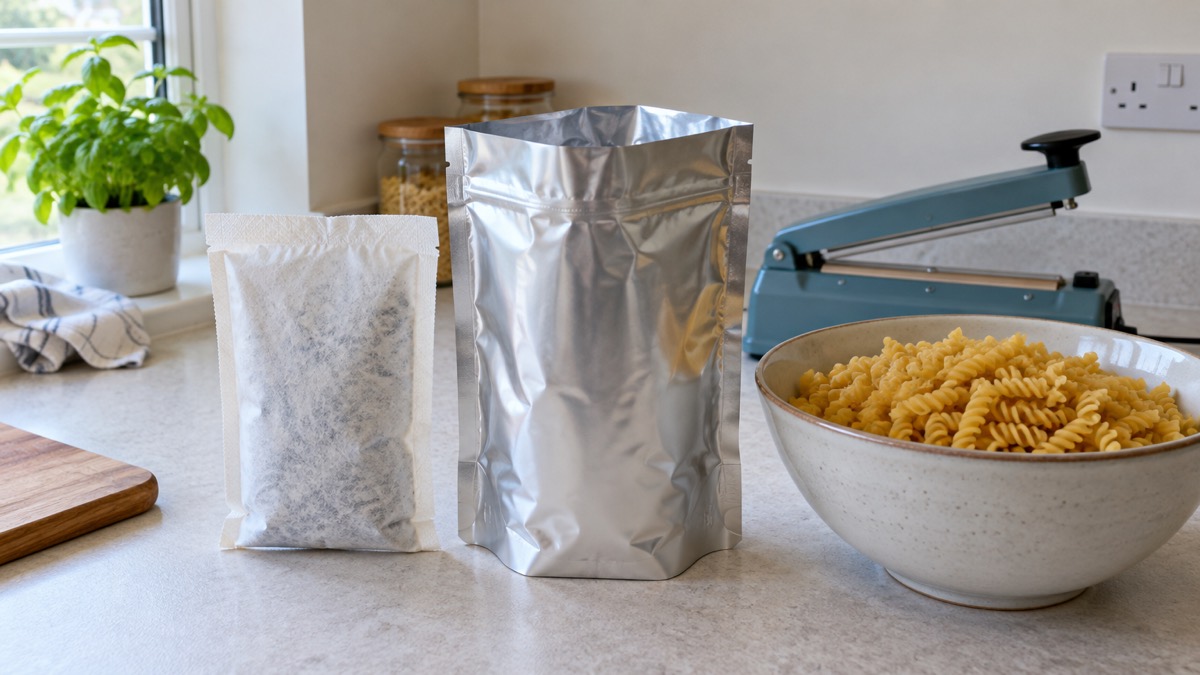
Two practical points follow from that table. First, the heavy duty bag takes the same absorber as the standard bag of the same dimensions, so a thicker film does not by itself call for a bigger sachet. Second, the maker's guidance for 5-gallon bags pairs a 2,000cc absorber with a 500cc one, which is a reminder that the 2,000cc size is not intended to work alone in the very largest containers.
Sealing matters as much as sizing. If you do not have a heat sealer, How to Seal Mylar Bags Without a Heat Sealer covers the alternatives, and What Size Mylar Bag You Need for Rice, Pasta and Beans helps you choose the bag in the first place.
Storing unused absorbers once the pack is open
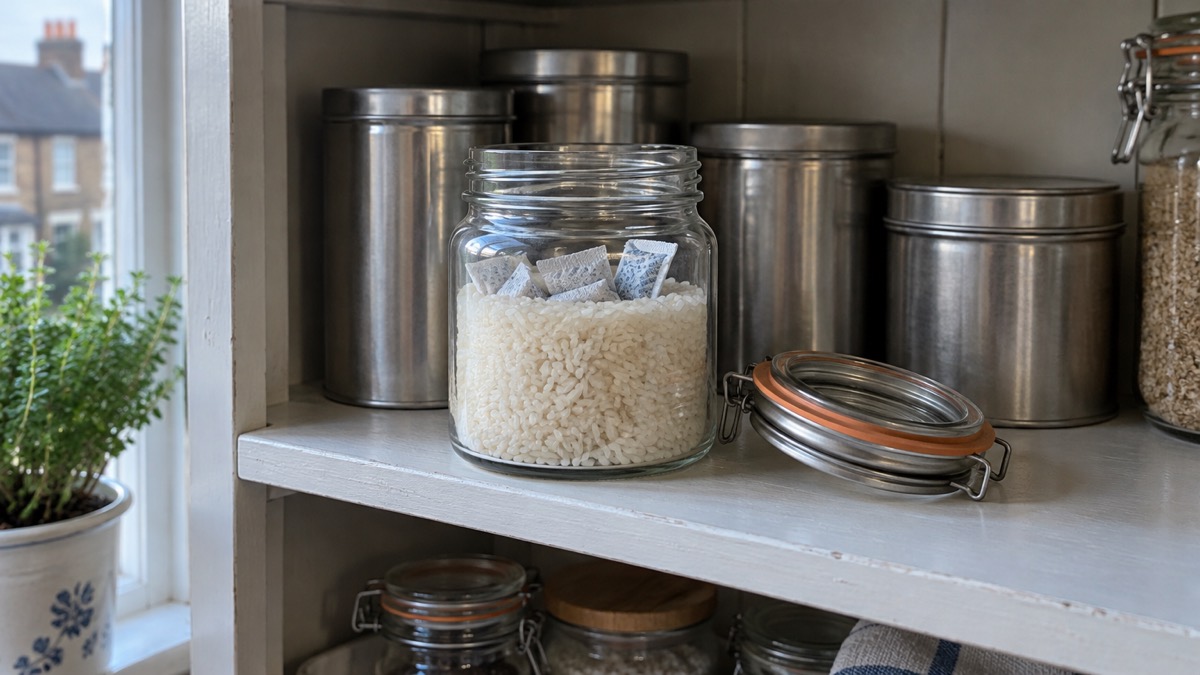
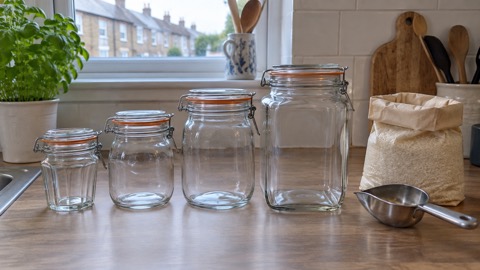
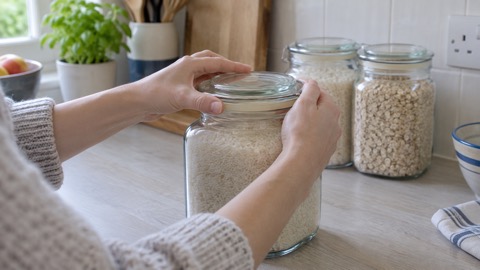
An absorber begins working the moment it meets air, so an open pack left in a cupboard is a pack slowly spending itself. The maker's method for keeping spares is specific and worth following exactly.
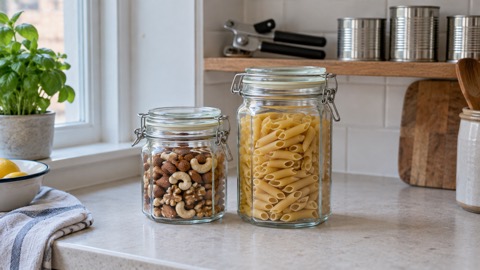
Two further tips from the distributor help the same cause. Fill any unused space in the jar or bag with rice, to reduce the amount of free air available4. And keep the jar sealed between sessions rather than opening it to count sachets.
The practical routine for a packing session looks like this:
- Gather everything first: bags, food, labels, heat sealer and the jar for spares.
- Open the absorber pack only when you are ready to fill bags.
- Take out what you need, reseal the rest in the mason jar straight away.
- Fill any headspace in the jar with rice to cut the free air4.
- Work steadily: the absorbers are reacting within a few minutes of exposure4.
Silica gel versus oxygen absorbers
These two products are often bought together and often confused. They are not interchangeable.
| Oxygen absorber | Silica gel | |
|---|---|---|
| What it removes | Oxygen from the sealed container5 | Moisture |
| What that prevents | Growth of aerobic bacteria and fungi; colour change and rancid oils5 | Damp and the spoilage that follows from it |
| OxyFree form | Loose or on belts1 | Loose or on belts1 |
| Example product | 2,000cc absorber in packs of 104 | 100g silica desiccant sachets, described as having an absorption efficiency 35% greater than similar desiccant products12 |
The simplest way to hold the difference in mind is that an absorber looks after the air inside the bag and silica gel looks after the water in it. A dry store benefits from both being right: food that goes in damp will not be saved by removing the oxygen around it. For more on the moisture side, see Using Silica Gel Sachets With Stored Food.
Where it fits a household emergency plan
An oxygen absorber is a small item with a narrow job, and it earns its place in a store cupboard only as part of a wider plan. The plan is the one official advice describes: food that needs no refrigeration, preparation or cooking, and little or no water, chosen to be compact and lightweight9; a few days of it, with a tin opener10; and something to eat that does not require electricity or heat preparation13.
Absorbers make that store last longer and taste better when it is opened. They do not replace it, and they do not remove the need to rotate stock. The pages that carry the rest of the work are How Much Emergency Food to Store per Person, What to Keep in an Emergency Store Cupboard, Starting a Store Cupboard Supply Step by Step, Rotating Your Store: First In, First Out and Keeping a Long-Term Store Cool, Dry and Free of Pests.
That warning is included because the word oxygen appears in both subjects and households do sometimes mix them up. Food-grade absorbers belong in the kitchen cupboard; medical oxygen belongs with the fire safety advice from your fire and rescue service, and the two should never be confused. If you need help with medical equipment at home, see Extra Help in an Emergency: Older, Disabled and Medically Dependent Households.
Support, safety and where to get help
OxyFree's own site carries the product range and a support section with answers to common questions1. The distributor's articles cover how to use the absorbers with Mylar bags and how to store unused ones, and are the source of most of the practical guidance on this page4. The brand's page on this site is at OxyFree.
On safety, the points that matter are modest but real:
- Keep the sachets out of reach of children and pets. They are food-safe in use but are not food.
- Do not open a sachet. It is designed to be sealed into a container whole.
- Store spares sealed, in the smallest jar you have, with the headspace filled with rice4.
- Label every bag with what is inside and when it was packed, so rotation stays simple.
If a household needs help with food in an emergency, the routes are the same whether or not they pack with absorbers: Getting Emergency Food Help: Food Banks, Councils and Local Support sets out who to contact, and How to Get a Food Bank Voucher Referral explains the referral step. Households with babies or medical diets should read Babies, Young Children and Medical Diets in an Emergency before building a store around dry staples alone.
For the wider subject of getting a household ready, start at Getting Started: Preparing Your Household for an Emergency and Emergency Kit: What a UK Household Should Keep Ready.
Sources (17)
- OxyFree, OxyFree, 2024
- OxyFree Oxygen Absorbers, Mylar Shop, 2023-11-06
- OxyFree FAQ, OxyFree, 2026-11-02
- Storing Unused Oxygen Absorbers, Mylar Shop, 2024-01-29
- Using Mylar Bags and Oxygen Absorbers, Mylar Shop, 2023-11-15
- Large Mylar Bag 48cm x 74cm, Mylar Shop, 2026-10-12
- 100g Silica Desiccant Sachets, Mylar Shop, 2026-10-10
- Power Cuts, Be Ready, 2026-10-21
- Create a Flood Pack, Bradford Council, 2026-10-29
- Be Prepared for Emergencies, North Devon Council, 2026-10-29
- Consumer Advice for Food Preservation at Home, GOV.UK, 2026-10-26
- Mylar Shop, Mylar Shop, 2025-08-11
- 12 Tips to Prepare for a Power Cut, Horsted Keynes Parish Council, 2026
- Home Fire Safety, Northern Ireland Fire and Rescue Service, 2026-10-14
- Medical Oxygen, Scottish Fire and Rescue Service, 2026-10-28
- Fire Kills Briefing Pack, National Fire Chiefs Council, 2026-06
- Specialist Health Equipment, Devon and Somerset Fire and Rescue Service, 2026

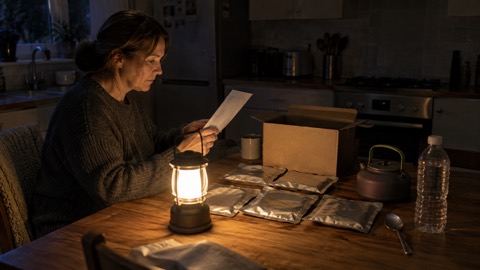 Expedition Foods 1 Week Rations
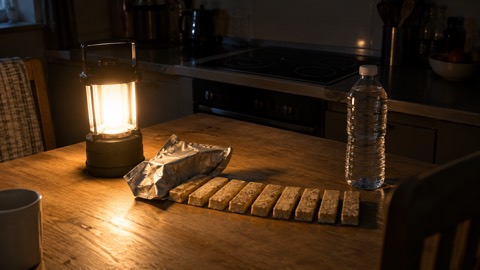 NRG-5 Emergency Ration
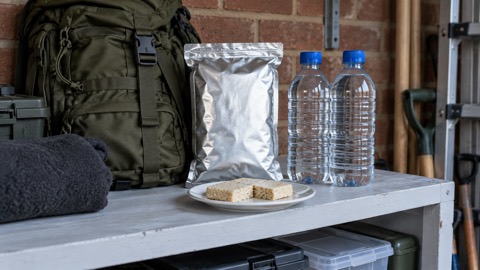 NRG-5 ZERO Ration
 Kilner Clip Top Jar
 Kilner Facetted Clip Top Jar
 Kilner Round Twist Top Jar
 Kilner Hexagonal Twist Top Jar
 Kilner Universal Push Top Jar
 Expedition Foods Rolled Oats