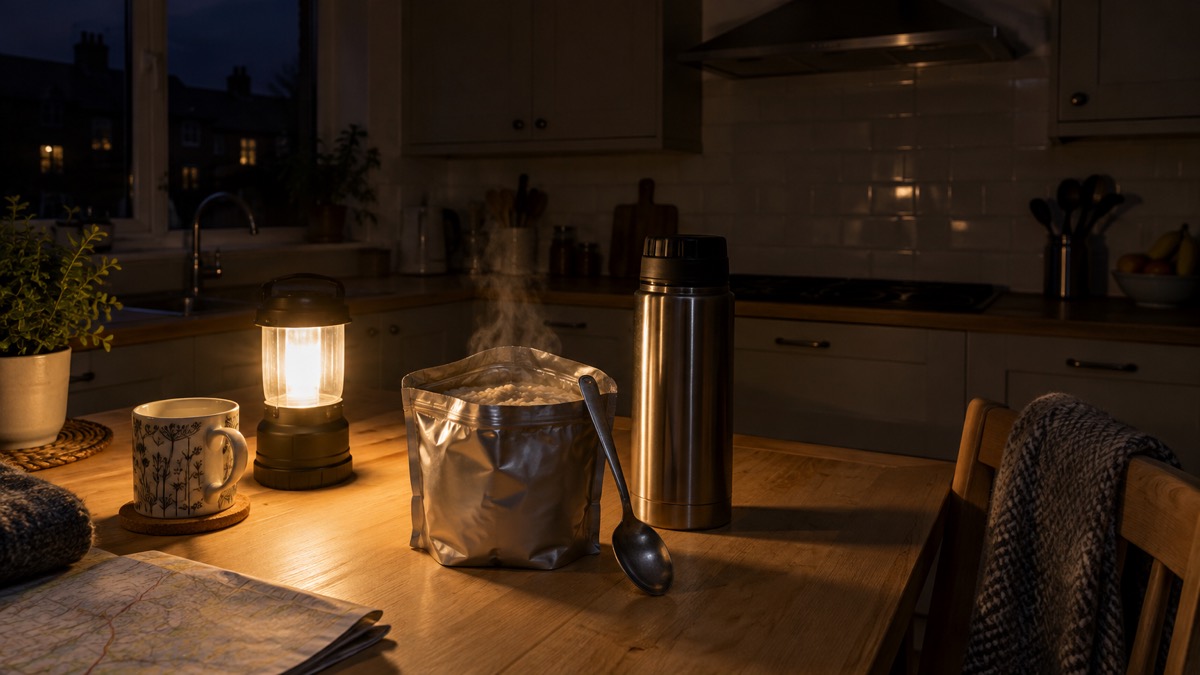
Expedition Foods Rolled Oats, Apple and Blackcurrant is a freeze-dried breakfast pouch: oats, sugar, coconut milk powder, freeze-dried blackcurrants and freeze-dried diced apple, made by adding water. It comes in three sizes, 450kcal, 800kcal and 1000kcal, needs between 250ml and 450ml of water depending on which you buy, and is ready in 5 minutes with hot water1. The maker gives it a shelf life of up to 5 years, which is what makes it worth keeping in a cupboard for a morning when the power is off or the shops are shut1.
For a household getting ready for emergencies, the useful points are simple. It needs no fridge, no cooking and no electricity, only water, and the maker states that all of its meals can be prepared with room temperature or cold water if you give them longer to rehydrate2. Official advice for power cuts is to keep food in that does not need electricity to prepare, so a pouch like this fits the plan directly3.
This page sets out what is in the pouch, how to make it, how to make it without hot water, how to store it as a ration, and the allergen points that decide whether it suits your household. It is one product among many; for the wider picture, start with Emergency Food: A Household Guide to Stores, Safety and Meals Without Power.
Three pack sizes and what each one weighs
The pouch comes in three servings, which the maker labels single serving at 450kcal, high energy serving at 800kcal and double serving at 1000kcal1. The same three sizes run across the maker's meal range, so the labelling is consistent if you buy other pouches from the same brand2. Choosing between them is a question of how much weight you are willing to carry against how much energy you get from one pouch.
| Pack | Dry weight | Gross weight (with pouch) | Water needed | Prepared weight |
|---|---|---|---|---|
| 450kcal | 114g | 129g | 250ml | 379g |
| 800kcal | 202g | 222g | 350ml | 572g |
| 1000kcal | 252g | 272g | 450ml | 722g |
All figures from the maker's product page1.
The pattern is worth reading carefully. The 1000kcal pack weighs 272g gross and gives you 722g of prepared breakfast, but it also takes 450ml of your drinking water to make up. The 450kcal pack weighs 129g and takes 250ml. If water is the scarce thing in your store rather than space in your bag, the smaller pack is the lighter draw on your supply per serving, while the larger pack gives more energy for the weight you carry. The maker describes the product as having the highest calorie-to-weight ratio, which is the claim behind the larger sizes1.
For a household storing food at home rather than carrying it, weight matters less than cupboard space and water. A 1000kcal pouch is a substantial breakfast for one person, and the 450kcal pouch suits a lighter eater or a child. If you are working out how much to keep in total, the guide to how much emergency food to store per person sets out the arithmetic.
How to make it, and how to make it without hot water
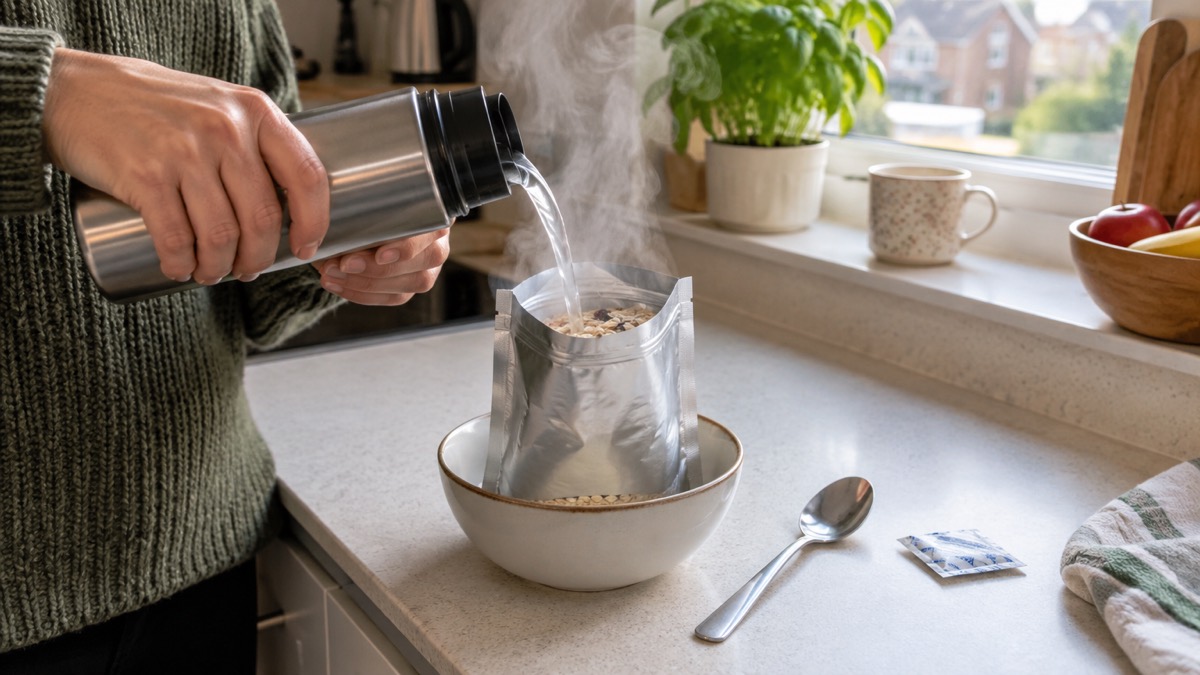
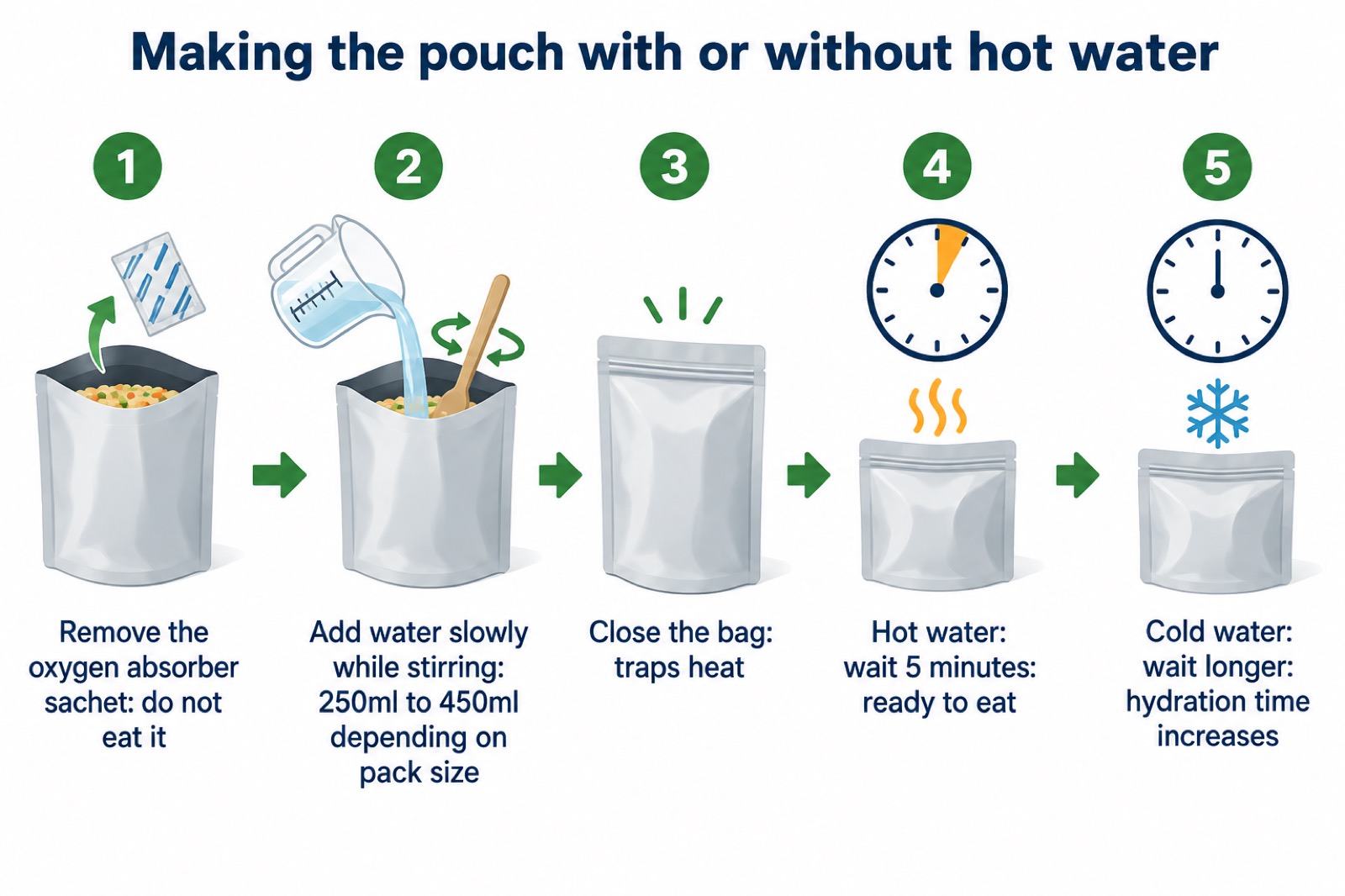
The maker's instructions are short and worth following in order1:
- Remove the oxygen absorber sachet from inside the pouch.
- Slowly add hot water, stirring as you pour.
- Close the bag.
- Wait 5 minutes for the food to rehydrate.
The maker's general guidance for its meals is the same: slowly add hot water while stirring until the meal is fully rehydrated2. Stirring as you pour is what stops the powder clumping at the bottom of the pouch, and closing the bag traps the heat while the oats soften.
In a power cut, or on a day when you have no way to boil a kettle, the same pouch still works. The maker states that all of its meals can be prepared with room temperature or cold water, and that you should expect the hydration time to increase2. The product page repeats this for this breakfast specifically: cold water will suffice, but the rehydration time is longer1. So the method is unchanged, only the waiting. Give it well beyond 5 minutes, stir again partway through, and expect a cooler, slightly firmer bowl.
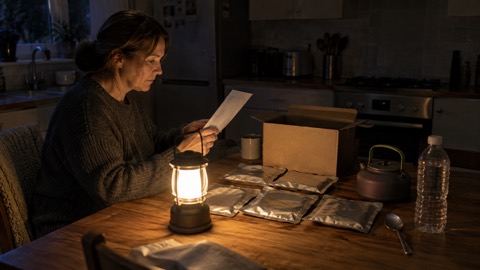
This is exactly the kind of food official advice points to when the power goes off. Lancashire Preparedness advises households to have a supply of food items that do not require electricity to prepare3, and National Grid's power cut tips say to make sure there is something available to eat that does not require electricity or heat preparation4. The Food Standards Scotland guidance on power cuts sets out an order for using food up: chilled fridge foods first, then defrosted frozen food that does not need cooking, then room-temperature perishable food such as bread, and finally room-temperature tinned, bottled and dried food5. A dried breakfast pouch sits in that last group, which means it is the food you fall back on once the fridge and freezer have been dealt with. Emergency guidance is also clear that you should not rely on the fridge or freezer for food, and suggests food and bottled water for 3 days6.
Remove the oxygen absorber, and never eat it
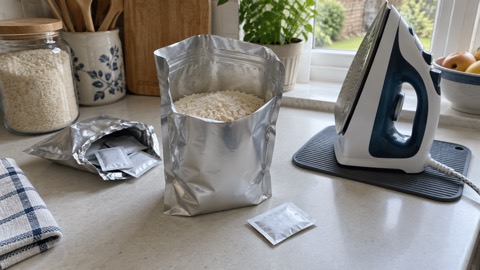
Every pouch contains a small sachet, and the maker's instruction is blunt: the oxygen absorber helps maintain product freshness and is non toxic, but do not eat it1. It is there to scavenge oxygen from the sealed pouch so the dried food keeps its quality for years, and it has done its job by the time you open the bag. Take it out first, before the water goes in, and put it straight in the bin so it cannot be mistaken for food, particularly by a child helping with breakfast.
The same care applies to the pouch once opened. A part-used pouch is no longer protected by the absorber, so make up what you need rather than leaving dry mix sitting open. If you are storing pouches long term, keep them sealed until the morning you need them; the guide to how long freeze-dried emergency meals keep explains why the seal matters more than the date alone.
Storing it as an emergency ration
The maker gives the product a shelf life of up to 5 years, and states that its meals generally have a shelf life of up to 5 years in the unopened pouch1. That is the figure to plan around: buy a pouch, write the date on it, and it will still be there for a winter power cut several years later.
How much to keep is a household decision, but official guidance gives a frame. One council booklet advises enough emergency reserves at home for up to ten days, including essential medications, food and water6. Another advises food and bottled water for 3 days, and warns not to rely on the fridge or freezer for food7. A breakfast pouch is one item in that store, not the whole of it. The guide to what to keep in an emergency store cupboard sets out the rest.
A few practical points for keeping pouches ready:
- Store them cool and dry, in the same place as the rest of your emergency food, so you are not hunting for them in the dark.
- Keep them out of the fridge and freezer: emergency guidance is to have food and bottled water for 3 days and not to rely on the fridge or freezer for food7.
- Note the water each pouch needs, because your stored water has to cover both drinking and making up dried food.
- Rotate them: eat the oldest and replace it, so the store never drifts past its date. The guide to rotating your store explains first in, first out.
Water is the part people underestimate. Official guidance recommends a minimum of 2.5 to 3 litres of drinking water per person per day, a figure attributed to the World Health Organization8. A 1000kcal pouch takes 450ml of that, so a household making up several pouches for breakfast is drawing on the same store it drinks from. Keep the two sums together when you plan, and see Water in an Emergency: A Household Guide for the wider picture.
Ingredients, allergens and who it suits
The ingredients are rolled oats at 65%, granulated sugar, coconut milk powder at 9%, freeze-dried blackcurrants at 4% and freeze-dried diced apple at 3%1. The maker describes it as a simple breakfast of rolled oats, diced apples and blackcurrants made with coconut milk1, and lists it as vegan, dairy-free, palm oil-free and preservative-free10. The product page states it is suitable for vegans1, and the maker's wider range includes gluten free, dairy free, vegetarian and vegan meals2.
The allergen line is the one to read before you buy. The maker declares oats as the allergen1. Oats are not one of the cereals the maker names in its gluten-free range, so this pouch should not be assumed gluten-free. If someone in the household has coeliac disease or a wheat allergy, treat it as an oat product and check the label. The guide to emergency food for medical, religious and allergy diets covers building a store around a restricted diet.
| Question | Answer for this pouch |
|---|---|
| Vegan | Yes, suitable for vegans1 |
| Dairy-free | Yes, made with coconut milk powder instead of cows' milk1 |
| Palm oil | No, palm oil-free10 |
| Preservatives | No, preservative-free10 |
| Allergen | Oats1 |
| Gluten-free | Not stated as such; oats are the declared allergen1 |
Allergies are worth taking seriously in an emergency store, because the usual alternatives may not be to hand. The NHS lists foods such as nuts, cows' milk, eggs, fish or sesame seeds among the common causes of anaphylaxis, a severe allergic reaction11, and NHS advice for parents names nuts, shellfish, eggs and dairy among common triggers12. If you are buying for someone with a food allergy, the Food Standards Agency's alerts include information about the risk and advice on what to do if you have bought the product13. A recent example shows why the alerts matter: in October 2026 a recall of flapjack products was issued because they contained almonds, soya and wheat, making them a possible health risk for anyone with an allergy to almonds, an allergy to soya, or an allergy or intolerance to wheat containing gluten, or with coeliac disease14. Check the recalls and alerts page before relying on any stored product, and read the pouch you actually have rather than the one you remember buying13.
Where it fits in a household plan
This is a breakfast, and it earns its place in a store for three reasons: it needs no fridge, no cooking and no electricity, it keeps for up to 5 years, and it can be made with cold water if the kettle cannot be used1. Those are the properties official power cut advice asks for when it tells households to keep food that does not need electricity to prepare3.
It is not a complete plan on its own. A household store needs drinking water at 2.5 to 3 litres per person per day8, food for several days6, and a way to make hot drinks and hot food if the gas and electricity are both off. For the wider kit, see Emergency Kit: What a UK Household Should Keep Ready and Meals Without Power: No-Cook and Low-Fuel Ideas. If you are comparing types of emergency meal, Freeze-Dried Meals: What They Are and How to Choose and Tinned or Freeze-Dried Meals set the options side by side.
In hot weather, the same pouch is useful for a different reason. Official heat advice is to plan ahead and make sure you have enough supplies, such as food, water and any medications you need15, and to drink fluids regularly, drinking enough that your pee is a pale straw colour16. NHS heat exhaustion advice includes drinking cool water or a rehydration drink, or eating cold and water-rich foods17. A cold-water breakfast fits that advice when you do not want to heat a kitchen.
The maker is Expedition Foods, and the pouch is sold as an emergency ration as well as food for outdoor activities1. For a household building a store, the sensible approach is to buy a few, date them, eat one to check you like it, and keep the rest for the morning you need them.
Sources (17)
- Rolled Oats, Apple and Blackcurrant, Expedition Foods, 2026-10-29
- FAQs, Expedition Foods, 2026-11-02
- How you can prepare for a power cut, Lancashire Prepared, 2026-10-29
- Tips to prepare for a power cut, National Grid, 2026-10-25
- Power cuts, Food Standards Scotland, 2026-10-25
- Are You Ready booklet, Culham Parish Council, 2025-09
- Don't Panic, Prepare booklet, West Yorkshire Prepared, 2020-11
- Emergency pack, Lancashire Prepared, 2026-10-29
- Emergency kit packing list, Which?, 2026-09-30
- The Great Outdoors review, Expedition Foods, 2025-09-29
- Anaphylaxis, NHS, 2023-06-21
- Basic first aid, Royal Wolverhampton NHS Trust, 2026-10-29
- Recalls and alerts, Food Standards Agency, 2026-07-07
- Food alert: flapjack products recalled, Food Standards Agency, 2026-10-21
- Hot weather advice, Public Health Agency, 2026-06-23
- Beat the heat: staying safe in hot weather, UK Health Security Agency, 2026-07-21
- Heatwave advice, Guy's and St Thomas' NHS Foundation Trust, 2026-06

 Expedition Foods 1 Week Rations
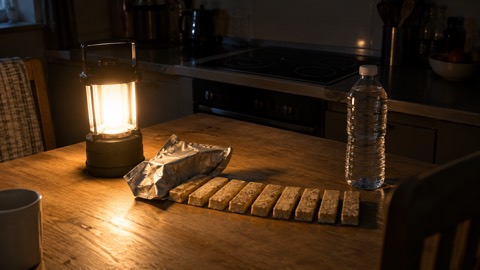 NRG-5 Emergency Ration
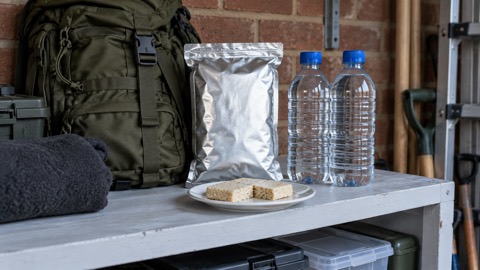 NRG-5 ZERO Ration
 Kilner Clip Top Jar
 Kilner Facetted Clip Top Jar
 Kilner Round Twist Top Jar
 Kilner Hexagonal Twist Top Jar
 Kilner Universal Push Top Jar
 OxyFree Oxygen Absorbers