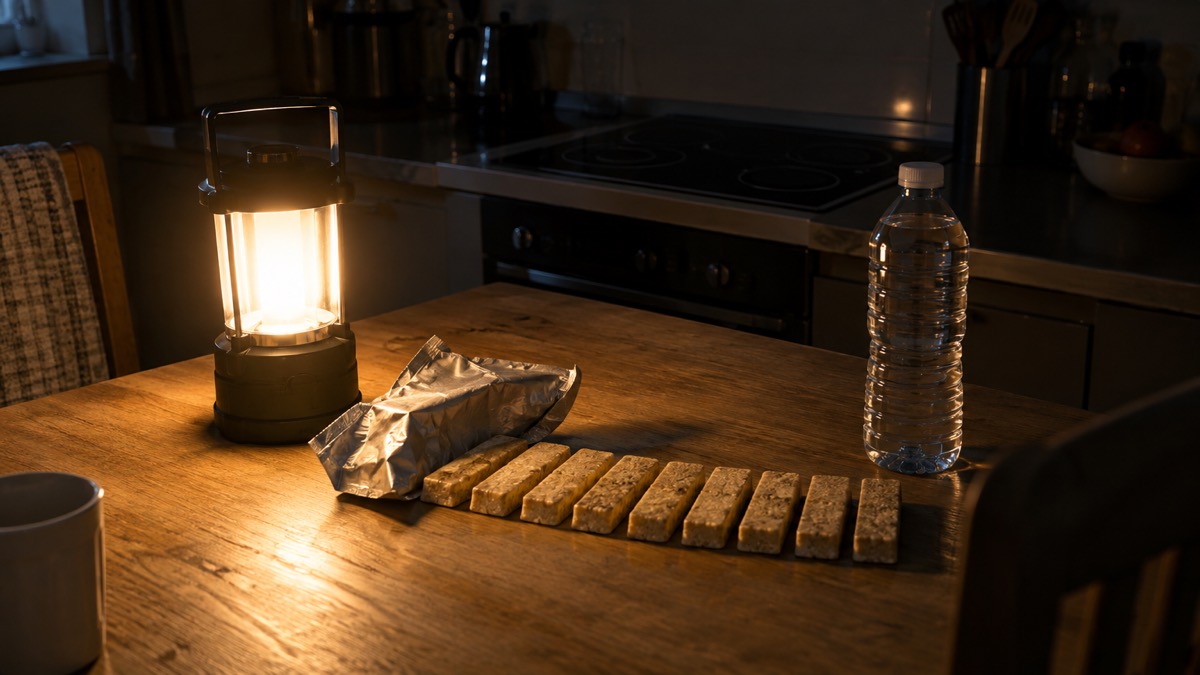
An NRG-5 Emergency Food Ration is a 500g pack of compressed bars that the maker states gives 2300 kcal, enough to cover the daily energy requirements of an adult1. It is ready to eat with no heating or boiling, and the maker gives it a 20-year shelf life1. For a household building an emergency food store, that combination, a known calorie count, no cooking and a long storage life, is what makes it worth understanding before you buy.
It is a dense, fortified bar ration, and the maker says it can be eaten as it is or crushed and mixed with water to make a mash or an energy drink, depending on how much water you add1. It is vegan and lactose free, and it contains wheat and soy, so it is not suitable for every household1.
This page sets out what the maker states about the ration: its specifications, its nutrition, who can eat it, how long it keeps and how to store it at home. It does not tell you it is the right choice for you. It gives you the figures so you can decide how it fits alongside the rest of your store.
What an NRG-5 pack is and what it gives you
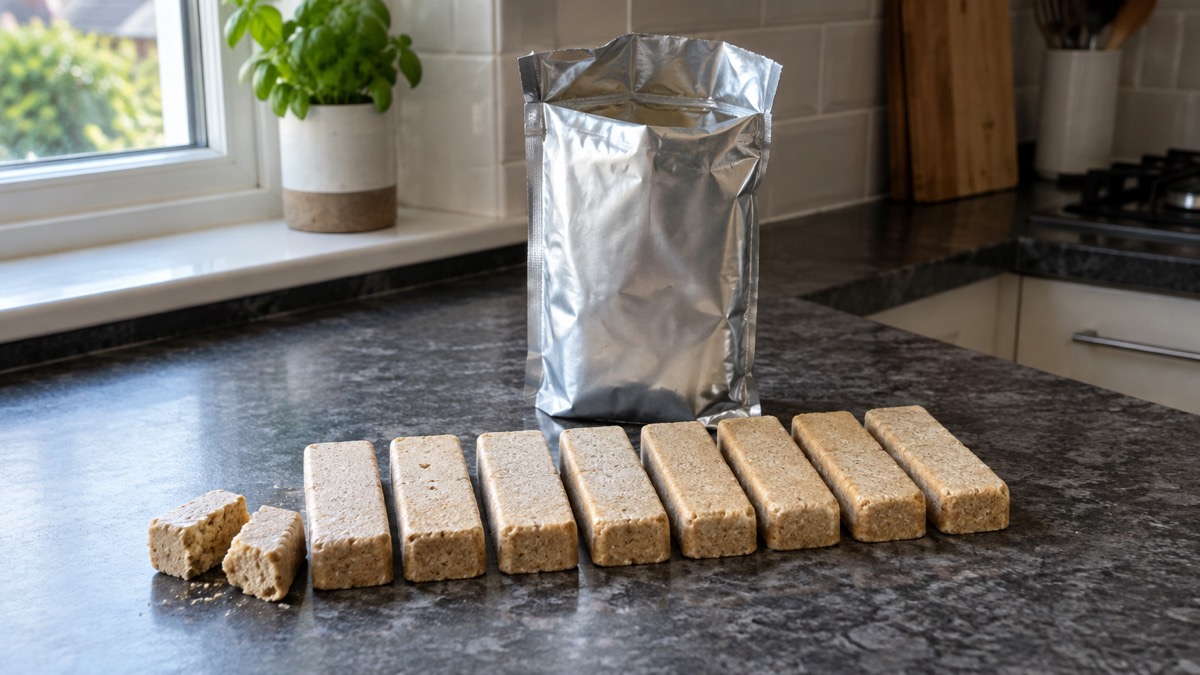
NRG-5 is an emergency food ration made of compressed bars, fortified with vitamins and minerals1. The 500g pack carries 2300 kcal, which the maker states covers the daily energy requirements of an adult1. The datasheet gives the same energy content as 9,600 kJ per 500g ration2.
That means the bars are portions of a day's ration rather than separate meals. The maker's own preparation instructions say to add hot water, stir and follow the instructions on the pouch4. The datasheet is clear that no heating or boiling is required2.
What the ration is not is a substitute for water. It is a dry, dense food, and the maker's own suggestion of mixing it with water points to the fact that you will want drinking water alongside it. Water is a separate part of any household store, and the water section covers how much to keep.
The maker's figures are built around the 500g pack, and the same daily-energy statement is made for it5. If you are working out quantities, that is the unit to count in.
One pack, one adult, one day
The maker's central claim is simple: a pack of NRG-5 (500g / 2300 kcal) covers the daily energy requirements of an adult1. That is the figure to plan around. It is an energy statement, not a promise that a pack is a complete diet for weeks on end, and it says nothing about what else an adult needs, such as water.
For a household, the arithmetic is straightforward. Count the adults, decide how many days you want to cover, and multiply. UK official guidance commonly puts the baseline at three days: the Be Ready checklist says non-perishable food for 3 days6, and a Dumfries and Galloway household plan says enough emergency food for three days and a can opener7. A West Yorkshire household plan says food and bottled water for 3 days, and warns not to rely on the fridge or freezer for food8. One Culham Parish booklet goes further and suggests emergency reserves for up to ten days, including essential medications, food and water9.
| Household | Packs for 3 days |
|---|---|
| 1 adult | 3 |
| 2 adults | 6 |
| 4 adults | 12 |
The table is arithmetic on the maker's one-pack-per-adult-per-day figure1 against the three-day and ten-day planning horizons in the guidance6. It does not account for children, who eat less, or for anyone with a medical or dietary need that the ration does not meet. The how much emergency food to store page goes through the wider calculation, including food other than ration packs.
Feeding children from 6 months
The maker states that NRG-5 can be given to children as of 6 months old1. That is the age limit the maker sets, and it appears consistently on the product page and in both datasheets1.
The age limit matters because it is the only guidance the maker gives on children. It does not give a portion size for a child, and it does not say a child should eat a whole pack. A 500g pack at 2300 kcal is sized for an adult's daily energy needs1, so a young child will not need anything like that amount. Treat the 6-month figure as the point from which the food is considered suitable, not as a serving instruction.
For households with babies and young children, the wider question is what else they need. The babies, young children and medical diets page covers formula, first foods and the things a ration bar cannot provide. NRG-5 is a fortified bar, not a baby food, and it should sit alongside, not instead of, the food a young child normally eats.
If you are storing packs for a family, keep the age limit in mind when you count. A household with two adults and two children under six months is, for this product, a two-adult household. A household with older children is somewhere between, and only you can judge how much of their diet a bar ration would realistically replace.
Nutrition per 100g
The maker publishes two sets of nutrition figures, and they do not match. The product page gives one set1; the 2025 datasheet gives another2. Where they differ, the newer datasheet is the maker's current statement, but the product page is still live, so both are shown here.
| Nutrient (per 100g) | Product page1 | 2025 datasheet2 |
|---|---|---|
| Energy | 1,920 kJ / 460 kcal | 1,925 kJ / 460 kcal |
| Fat | 18.5 g | 18.5 g |
| of which saturates | 8.6 g | 17.1 g |
| Carbohydrate | 60.2 g | 60.2 g |
| of which sugars | 15.4 g | 18.3 g |
| Fibre | 7.1 g | 7.1 g |
| Protein | 13.4 g | 13.4 g |
The two documents disagree on fat, saturates, carbohydrate, sugars, protein and salt, and on energy by 5 kJ. The saturates figure is the widest gap: 8.6 g on the product page against 17.1 g in the datasheet1. The 2024 datasheet gives 8.6 g for saturates and 15.4 g for sugars, matching the product page on those two10.
The vitamins and minerals are given as 20% of the daily reference value per 100g for vitamin A, vitamin D3, vitamin E, vitamin C, vitamin B12 and calcium10. The 2024 datasheet gives potassium at 400.0 mg (20%) and iron at 2.8 mg (20%), while the 2025 datasheet gives potassium at 500.0 mg (25%) and iron at 4.2 mg (30%)10. The two datasheets disagree on these two figures.
Ingredients, allergens and diet
The maker lists the ingredients as baked wheat, palm fat, sugar, soy protein, barley malt extract, di-potassium phosphate, potassium chloride, tri-calcium phosphate, calcium carbonate, magnesium oxide, dextrose anhydrous, ascorbic acid (vitamin C), ferrous sulfate, DL-alpha tocopheryl acetate (vitamin E), retinyl (vitamin A) acetate, cholecalciferol (vitamin D3) and cyanocobalamin (vitamin B12)1. The 2025 datasheet gives a shorter list: baked wheat, sugar, palm fat, soy protein concentrate, barley malt extract, potassium phosphate, potassium citrate, calcium carbonate, magnesium oxide, ferrous gluconate and potassium iodate2.
What is consistent is the diet information. The maker states the ration is vegan and lactose free1, and the 2025 datasheet adds GMO free2. The allergens statement on the product page is lactose free1.
The ingredient list is also a reminder that a ration pack is a manufactured food with a fixed recipe. The emergency food for medical, religious and allergy diets page covers how to build a store around a restricted diet.
Shelf life and storing packs at home
That is the headline figure, and it is the reason a pack can sit in a cupboard for years and still be there when it is needed. The condition attached to it is storage: the datasheet says keep cool and dry, with an ideal temperature of 20°C ± 52.
That range, 20°C ± 5, is an ordinary indoor temperature for most UK homes. The practical advice is to keep packs out of damp and away from heat. A cupboard in a cool room is better than a shed, a loft or a garage, where temperatures swing and damp can get in. The keeping a long-term store cool, dry and free of pests page goes through the wider storage question.
Official guidance on food storage points the same way. The Food Standards Scotland advice is to keep the storage area dry and not too warm, and to follow label storage instructions for anything that needs the fridge once opened11. Tinned foods should be kept in a dry place where the temperature is fairly cool, and boxed food in tightly closed containers to protect it from pests12. For an emergency kit, Carmarthenshire council says to keep it in a safe place at home where you can reach it easily, in a waterproof bag13. Wiltshire council's kit list includes emergency medication and food for pets alongside the household's own supplies14. The maker's own storage conditions for NRG-5 are to keep it cool and dry, at an ideal temperature of 20°C ± 52.
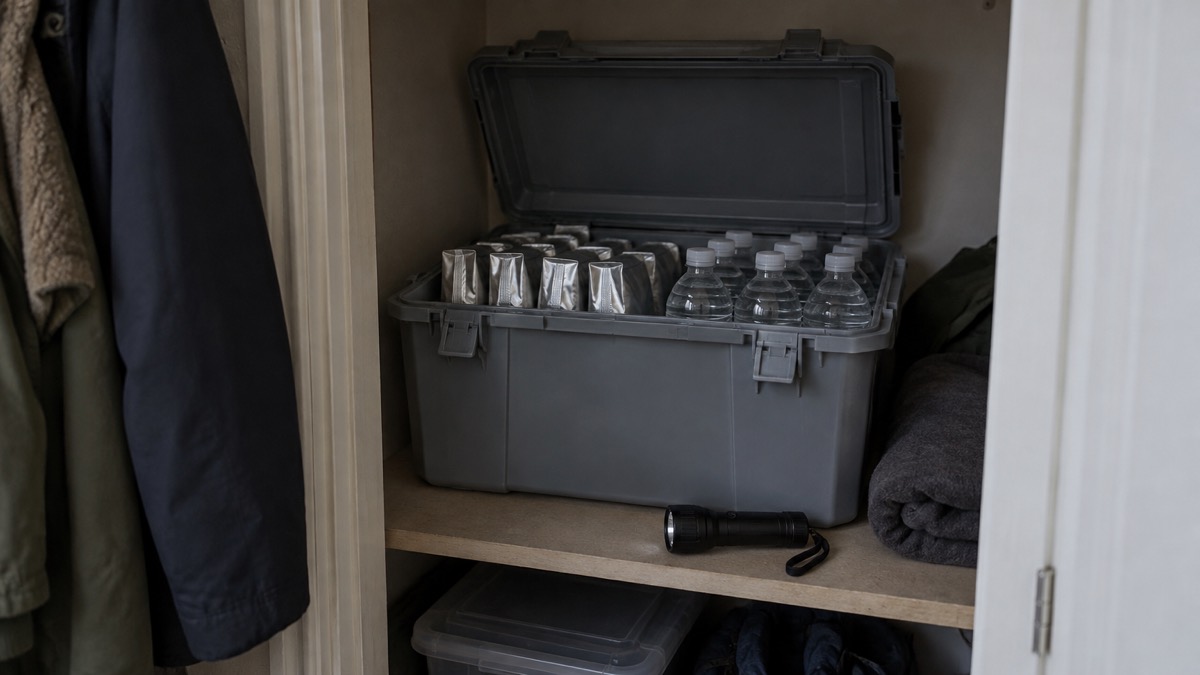
A waterproof container is worth having for the packs themselves. A sealed box keeps damp, pests and flood water away from the food, and it keeps the packs together so you can find them in the dark. The where to keep an emergency store if your area floods page covers the flood question specifically.
How it fits with the rest of your emergency food
A ration pack is one tool among several. The UK guidance most households will meet first is the three-day baseline: the Be Ready checklist says non-perishable food for 3 days6, the British Red Cross says three days' supply of long-life or ready-to-eat food15, and the West Yorkshire plan says food and bottled water for 3 days, with the warning not to rely on the fridge or freezer8. NRG-5 fits that baseline neatly because it needs no cooking and no fridge.
Where it fits less neatly is in variety and in the everyday. A store built only from ration packs gives you energy and fortification but no hot meal, no familiar food and nothing to lift the mood. The what to keep in an emergency store cupboard page sets out the wider list, and the emergency ration packs page compares the calorie, weight and contents questions across pack types.
Power cuts are the other reason a no-cook ration earns its place. Northern Ireland Networks says food should keep for between 4-6 hours in the fridge and 15-24 hours in the freezer if you can avoid opening it16. After that, the fridge and freezer stop being a food store. A pack that needs no cooking and no cold bridges the gap. The meals without power page has more no-cook and low-fuel ideas.
Specifications
These are the figures to use if you are checking a pack, planning storage space or asking a retailer what they hold.
| Specification | Figure |
|---|---|
| Article number | 302001 |
| EAN barcode | 42602014600341 |
| Product number (separate listing) | 302104 |
| Net weight | 500 g1 |
| Bars per pack | 9 bars = 500 g ration2 |
| Energy per pack | 2300 kcal / 9,600 kJ2 |
| Shelf life | 20 years1 |
| Ideal storage temperature | 20°C ± 52 |
| Packaging languages | EN, DE, FR, NL, PL, SV, DA, NO2 |
| Country of origin | DE2 |
| Customs code | 190190992 |
| Carton contents | 24 x 500 g2 |
| Carton dimensions | 36.5 x 17.5 x 30 cm2 |
| Carton weight | 12 kg net / 13.1 kg gross2 |
| Pallet contents | 42 cartons, 1008 pieces2 |
| 20ft container, loose | 1500 cartons = 36,000 rations10 |
The carton and pallet figures are trade quantities. They tell you how the product is packed for bulk supply, not what a household needs. If you are buying for a group, a workplace or a community store, the carton of 24 x 500g is the unit to ask about2. Whether a UK retailer sells by the carton is a question for the retailer, not something the maker's datasheet settles.
The packaging languages are EN, DE, FR, NL, PL, SV, DA and NO2. That is English, German, French, Dutch, Polish, Swedish, Danish and Norwegian. A pack bought in the UK may carry all of them, so the label you read will be shared with several other countries.
Where to get it and who makes it
NRG-5 is a Katadyn Group brand2. The product pages, datasheets and the emergency series collection are published by Katadyn on its own website1. The country of origin is given as DE, Germany2.
For support, the maker's product page is the starting point. It carries the article number, the barcode and the current product description1. If you have a question about a specific pack, quote the article number 30200 and the EAN 42602014600341. The datasheet is the document to check for carton and pallet quantities2.
If you are comparing pack sizes, check which one a retailer is actually selling, because the article numbers differ.
Sources (17)
- NRG-5 Emergency Food Ration 500g product page, Katadyn, 2026-10-28
- NRG-5 500g datasheet, version 250707, Katadyn, 2025-07-07
- NRG-5 collection page, Katadyn, 2026-10-28
- NRG-5 product page, 30210, Katadyn, 2026-10-28
- NRG-5 Emergency Food Ration 250g product page, Katadyn, 2026-10-28
- Be Ready checklist, UK Government, 2026
- Create a household emergency plan, Dumfries and Galloway Council, 2026
- Household emergency plan, West Yorkshire Prepared, 2020-10
- Are You Ready booklet, Culham Parish Council, 2025-09
- NRG-5 500g datasheet, version 240718, Katadyn, 2024-07-18
- Food storage, Food Standards Scotland, 2026-10-25
- Emergency supplies kit, Denbighshire Council, 2020
- Get prepared, Carmarthenshire Council, 2026-10-25
- Planning for an emergency kit, Wiltshire Council, 2026-10-29
- Prepare an emergency kit, British Red Cross, 2026-10-25
- Emergency power cuts, Northern Ireland Networks, 2026-10-25
- Katadyn emergency series collection, Katadyn, 2026-10-28
 Expedition Foods 1 Week Rations
 NRG-5 ZERO Ration