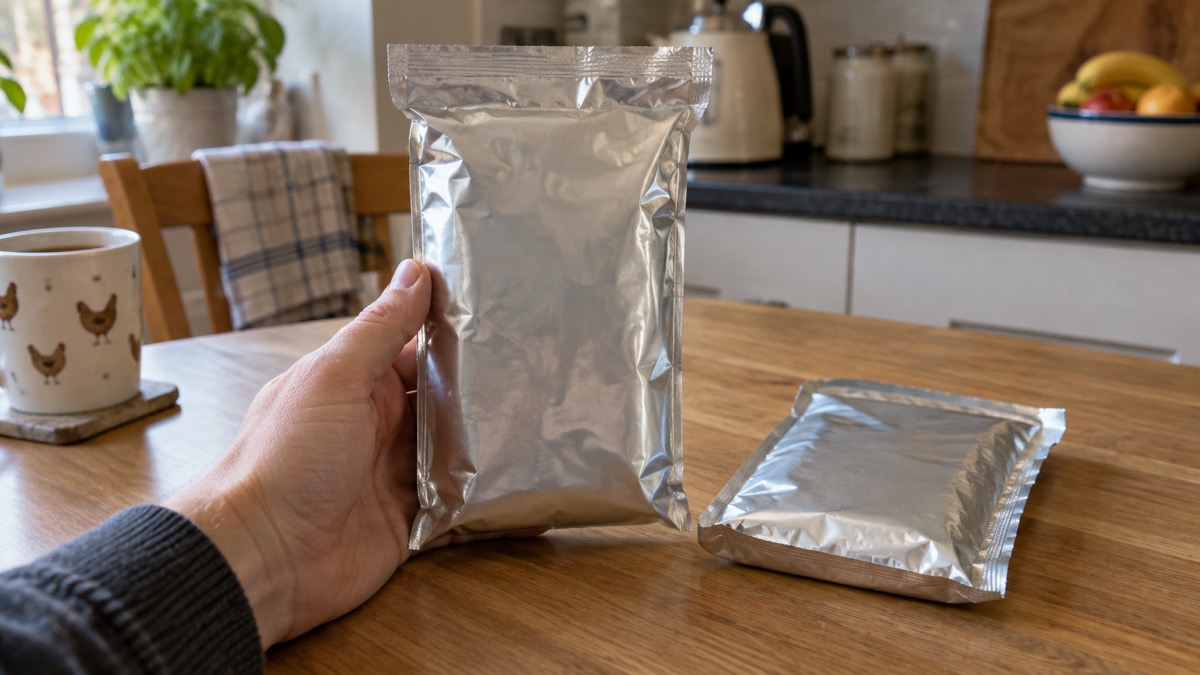
NRG-5 is a compressed emergency food ration made by Katadyn, sold as bars in sealed packs. The headline for a household is simple: a 500g pack holds 2300 kcal, which the maker states covers the daily energy requirements of an adult, and it is ready to eat with no heating or boiling1. That makes it the kind of food you can put in a cupboard and forget about until a power cut, a flood or a storm means the shops are shut or the cooker will not work.
It is not a meal replacement for everyday life. It is a store cupboard backstop: something with a long shelf life that needs nothing done to it. The maker gives the standard 500g ration a 20-year shelf life, and the 125g and 250g packs are listed with the same 20-year figure2. NRG-5 ZERO, the rice-based version, is listed with a 15-year shelf life5.
This page covers what the range is, what is in it, how to eat it, who it suits and how to keep it ready. It is written for a UK household building an emergency food store, so it sticks to what matters when the power is off and the kettle will not boil.
What NRG-5 is and where it fits in a household store
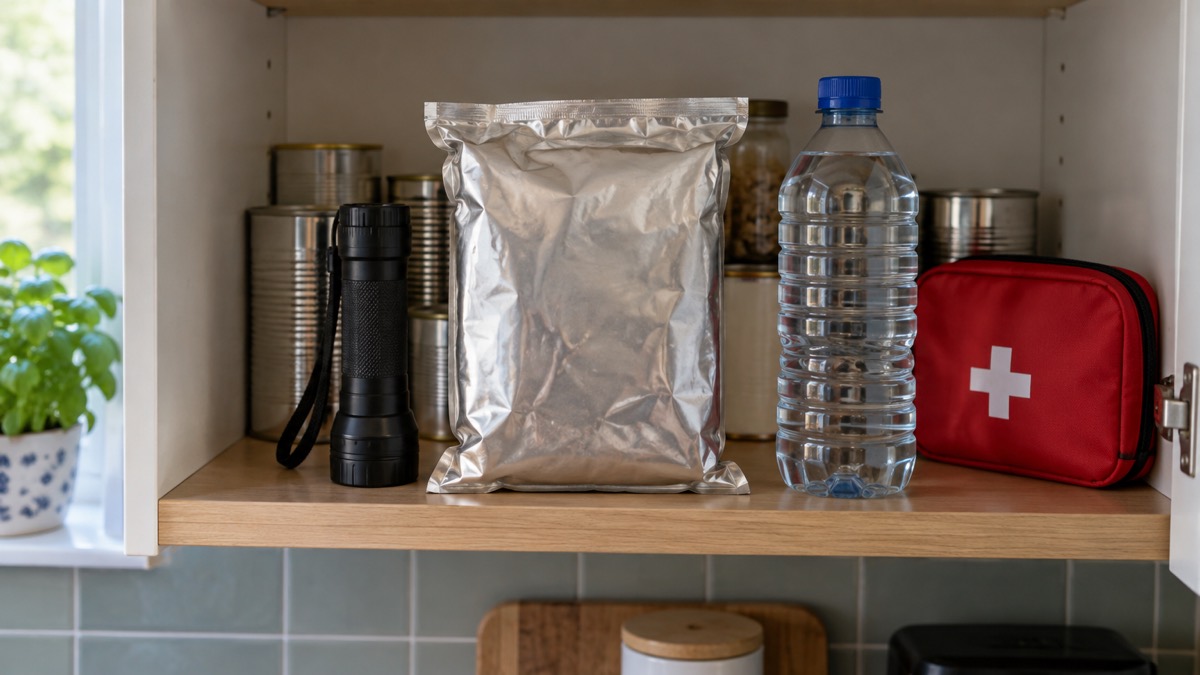
NRG-5 is an emergency food ration, fortified with high quality ingredients, sold as compressed bars in robust, airtight and watertight packs2. The range is made by Katadyn, and the datasheet carries the line that NRG-5 is a Katadyn Group brand7. The bars are compressed rather than loose, which is why a 500g pack is a compact block rather than a bag of crumbs.
For a household, the point of a ration like this is that it removes decisions. Official guidance on emergency supplies suggests storing foods that can be readily eaten without heating or water, such as ready-to-eat meats or tuna, fruits, vegetables, canned or boxed juices, UHT milk, soup, high energy food like crackers or cereal bars, vitamins, food for infants or persons on special diets, biscuits, boiled sweets and powdered milk8. A compressed ration does the same job in a single sealed pack: no tin opener, no pan, no water needed to make it edible.
That matters most in the situations where the kitchen stops working. A power cut takes out the kettle, the microwave and the fridge at once. A flood can cut a household off from shops for days. A storm can close roads. In each case the question is not what you would like to eat but what you can eat with nothing but your hands. NRG-5 answers that question directly.
The range comes in several sizes so you can match the store to the household. The 500g pack is the daily-energy unit. The 250g and 125g packs are smaller units for a bag, a car or a shorter gap. NRG-5 ZERO is the variant for households that need to avoid gluten. The emergency food guide sets out how a food store fits alongside water, cooking and the rest of a household plan.
2300 kcal in a 500g pack: one adult's daily energy
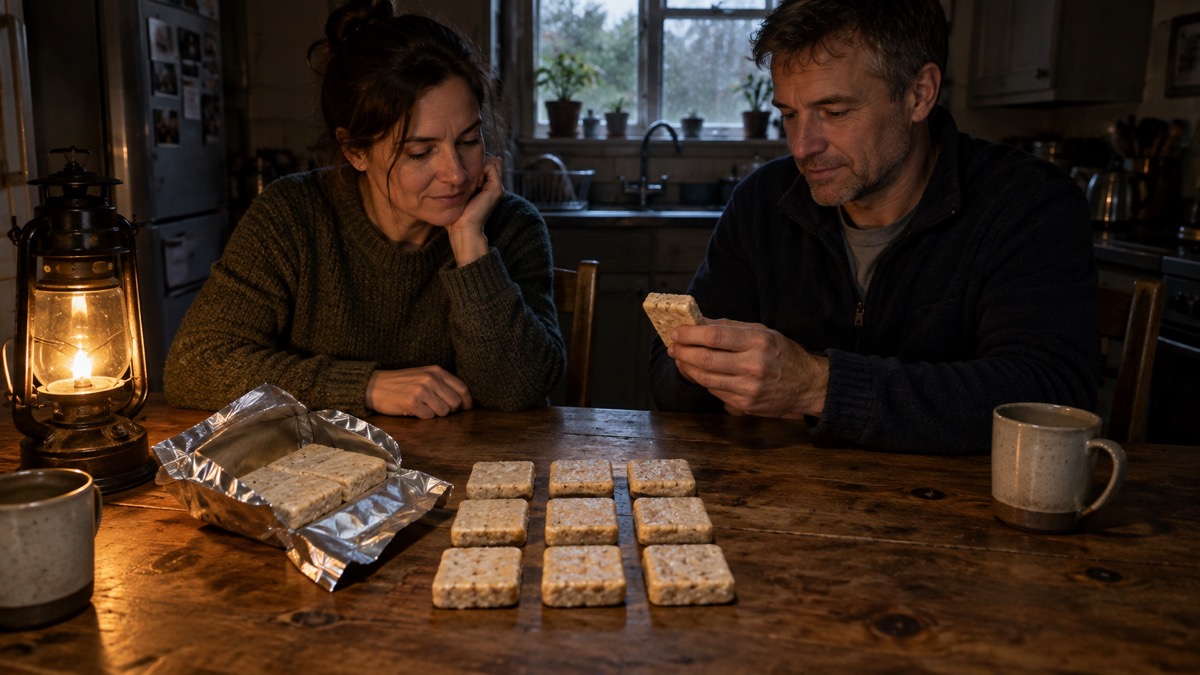
The maker's figure is consistent across the product pages and datasheets: a pack of NRG-5 (500g / 2300 kcal) covers the daily energy requirements of an adult2. The datasheet gives the same energy as 9600 kJ per 500g ration7. Per 100g, the standard ration is listed at 1925 kJ / 460 kcal7.
That single figure is the most useful number on the page, because it lets you size a store without guesswork. One adult, one day, one 500g pack. A household of four storing a week of food for everyone is looking at 28 packs by the maker's own reckoning. You do not have to plan it that way, but the arithmetic is there to be done.
| Product | Pack size | Energy per pack | Stated daily cover |
|---|---|---|---|
| NRG-5 | 500g | 2300 kcal | One adult's daily energy requirements1 |
| NRG-5 | 250g | Listed with the 500g energy figure on the range page | Half a 500g pack by weight9 |
| NRG-5 | 125g | 575 kcal per 125g ration | A quarter of a 500g pack by weight6 |
| NRG-5 ZERO | 500g | 2325 kcal | One adult's daily energy requirements5 |
Two cautions. First, the daily-energy claim is the maker's, and it describes energy, not a balanced diet over weeks. A store built only on ration bars covers calories; it does not replace the variety that official guidance suggests for a household kit8. Second, the 250g pack's energy is not stated separately on the pages used here, so treat the 250g and 125g packs as portions of the 500g unit rather than as separately rated daily rations.
Eat it straight from the pack: no heating or boiling needed
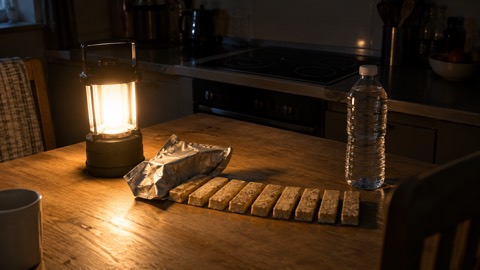
The maker's instruction is unambiguous: ready-to-eat, no heating or boiling required2. You open the pack and eat the bar. Nothing else is needed: no water, no heat, no utensils. For a household in a power cut or a flood, that is the whole point.
This is also where the ration earns its place against ordinary tinned food. A tin of soup is cheap and familiar, but it needs a ring pull or an opener and, to be hot, a hob. A ration bar needs nothing. Keep it somewhere you can reach without going into a dark kitchen, and it works on the first night of an outage as well as the fifth.
The packaging helps here. The 125g pack is described as being in robust, airtight and watertight packs, in a convenient, compact pocket size3. Watertight matters in a flood or a damp cupboard: a pack that survives a soaking is a pack you can still eat.
Store the packs where you will find them in the dark, and check the date on the pack against the shelf-life figure rather than trusting memory. The emergency kit guide covers how to lay out a store so that food, torch and water are together.
Making a mash or a drink with water
If you have water to spare, the ration becomes more than a bar. By crushing the compressed bars and adding water, you can prepare a nutritious mash or an energy drink, depending on how much water you add2. The same instruction is given for NRG-5 ZERO5.
This is a comfort measure more than a necessity. A mash is easier for someone with poor teeth or a small appetite to eat than a dry compressed bar, and a drink stretches a pack across a longer, hungrier evening. It also gives children something that feels more like a meal.
The catch is water. In a water outage, every drop you use on food is a drop you cannot drink. The water guide explains how to plan a household water store; the short version is that you should not count on having spare water for mixing. Treat the mash and drink options as something you do when water is plentiful, and eat the bars dry when it is not.
If someone in the household is unwell with sickness or diarrhoea, a pharmacist may recommend oral rehydration powder that you mix with water to make a drink10. That is a separate product from NRG-5 and should not be confused with it.
Feeding children from 6 months
The maker states that NRG-5 can be given to children as of 6 months old2. The same age is given for NRG-5 ZERO5. That is a useful line for a household with a baby or toddler, because it means one food in the store can serve the whole family.
It is not a licence to feed a baby a bar and nothing else. Babies under 6 months are especially vulnerable as their only nutrition is breast or infant formula milk and they are dependent on a trusted adult for all their needs12. For a household with a baby under 6 months, the store needs breast or formula feeding supplies, not ration bars. The extra help guide covers households with additional needs, including medically dependent family members.
For children over 6 months, a crushed bar mixed with water into a mash is the practical way to serve it, and a smaller portion than an adult's is the obvious starting point. The pack is dense and dry, so watch that a child drinks with it.
Ingredients and dietary suitability
The standard NRG-5 ration is built on baked wheat. The 125g product page lists the ingredients as baked wheat, sugar, palm fat, soya protein concentrate, malt extract powder, potassium phosphate, potassium citrate, calcium carbonate, magnesium oxide, iron gluconate and potassium iodate3. The 500g datasheet gives a similar list, with barley malt extract and added vitamins including vitamin C, vitamin E, vitamin A, vitamin D3 and vitamin B122.
The dietary position is set out plainly by the maker:
- Lactose free: stated for the standard ration and for NRG-5 ZERO2.
- Vegan: stated for the standard ration and for NRG-5 ZERO2.
- Gluten: the standard ration contains gluten and soya, as stated on the 125g product page3. It is not a gluten-free food.
- GMO free: stated on the 500g datasheet7.
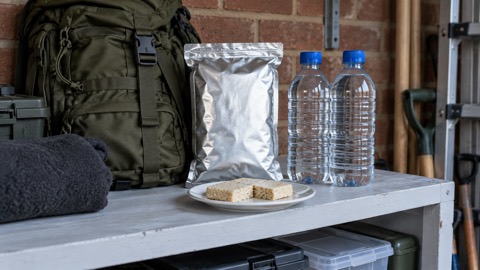
NRG-5 ZERO is the answer for a household that needs to avoid gluten. It is rice based, and the maker lists it as gluten free, lactose free and vegan5. Its ingredients are baked rice, palm fat, sugar, rice protein and natural flavouring11.
Nutrition per 100g: energy, protein, vitamins and minerals
The ration is fortified, which is what makes it more than a biscuit. Per 100g, the standard NRG-5 is listed at 1925 kJ / 460 kcal, with 13.4g of protein, 18.5g of fat (of which 17.1g saturates), 60.2g of carbohydrate (of which 18.3g sugars) and 0.1g of salt7. Fibre is given as 7.1g per 100g on an earlier datasheet14.
The vitamins and minerals are dosed at around a fifth of the daily reference value per 100g for many nutrients, which is the maker's way of spreading a day's micronutrients across a pack:
| Nutrient | Per 100g | Stated daily value |
|---|---|---|
| Vitamin A | 160.0 mcg | 20%14 |
| Vitamin C | 16.0 mg | 20%14 |
| Vitamin D3 | 1.0 mcg | 20%14 |
| Vitamin E | 2.4 mg | 20%14 |
| Vitamin B12 | 0.5 mcg | 20%14 |
| Calcium | 160.0 mg | 20%7 |
| Magnesium | 75.0 mg | 20%7 |
| Iron | 4.2 mg | 30%7 |
| Potassium | 500.0 mg | 25%7 |
| Iodine | 30 mcg | 20%14 |
NRG-5 ZERO is listed at 1930 kJ / 465 kcal per 100g, with 14,5g of protein5. The figures differ slightly between the 125g and 500g datasheets for some nutrients, so use the panel on the pack you actually hold if a precise number matters to you.
Shelf life: 20 years if kept cool and dry
The standard NRG-5 ration is listed with a 20-year shelf life2. The 125g datasheet is more precise: the expiry date is 20 years from the date of production6. NRG-5 ZERO is listed with a 15-year shelf life, also counted from the date of production5.
The storage condition is the part that decides whether you get those years. The maker's instruction is to keep the packs cool and dry, with an ideal temperature of 20°C ± 57. In practice that means a cupboard away from a radiator, a boiler or a sunny window, and not a shed or garage that swings between damp and heat.
| Product | Shelf life | Storage |
|---|---|---|
| NRG-5 500g | 20 years2 | Cool and dry, ideal 20°C ± 57 |
| NRG-5 250g | 20 years4 | Cool and dry |
| NRG-5 125g | 20 years from production6 | Cool and dry, ideal 20°C ± 56 |
| NRG-5 ZERO 500g | 15 years from production11 | Cool and dry, ideal 20°C ± 511 |
A fridge is set to keep food at 5°C or colder15, well below the 20°C ± 5 the maker gives as the ideal storage temperature2. A cool, dry cupboard is the right home.
The food guide covers how to rotate a store so that older packs are eaten first, and how to check a store once a year.
The rest of the range: sizes and NRG-5 ZERO
The range exists so a household can buy the unit that fits its plan rather than one size for everything.
- NRG-5 500g (article 30200): the daily-energy unit, 2300 kcal, 9 bars to a pack1. The one to build a household store around.
- NRG-5 250g (item 30250): half the weight of the 500g pack, for a bag or a shorter gap4.
- NRG-5 125g (article 30125): 2 bars to a 125g ration, 575 kcal, in a compact pocket size6. Suits a car, a coat pocket or a grab bag.
- NRG-5 ZERO 500g (article 30300): rice based, gluten free, lactose free and vegan, 2325 kcal, 15-year shelf life5.
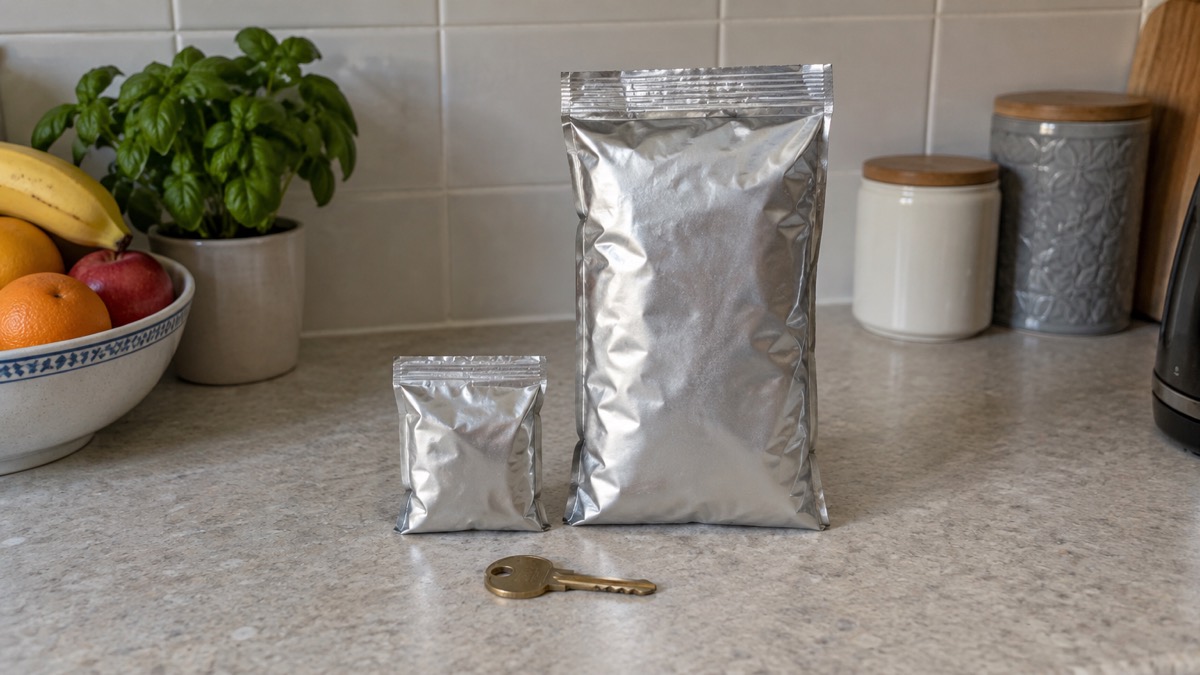
The 125g pack is the one that fits a grab bag best, and the maker describes its packs as robust, airtight and watertight3, so a small ration travels well alongside the rest of a bag. The getting started guide sets out how to build a household plan around stores like these.
Support, codes and what to check before you buy
NRG-5 is a Katadyn Group brand, and support runs through Katadyn7. If a pack arrives damaged, or you need to confirm a date or a batch, use the contact details on the Katadyn site and quote the article and EAN codes so the query is unambiguous.
| Product | Article or item code | EAN |
|---|---|---|
| NRG-5 500g | 302007 | 42602014600347 |
| NRG-5 250g | 302504 | 40157533025054 |
| NRG-5 125g | 301256 | 42602014600586 |
| NRG-5 ZERO 500g | 3030011 | 426020146020111 |
Buying by the carton is possible: a carton holds 24 x 500g packs, weighs 12 kg net and 13.1 kg gross, and measures 36.5 x 17.5 x 30 cm7. That is the sensible unit for a large household or a community group storing food together, and the community resilience guide covers group stores.
The packaging languages vary by product. The 500g pack lists EN, DE, FR, NL, PL, SV, DA and NO7; the 125g pack lists DE, EN, FR, IT, NL, DA, FI and SV6; NRG-5 ZERO lists EN, DE and FR11. English is on all of them.
No product recall for NRG-5 appears in the information used for this page. Check the pack on arrival for damage to the seal, and store it cool and dry as the maker instructs2.
Sources (15)
- NRG-5 500g product page, Katadyn, 2026-10-28
- NRG-5 Emergency Food Ration 500g, Katadyn, 2026-10-28
- NRG-5 Emergency Food Ration 125g, Katadyn, 2026-10-28
- NRG-5 Emergency Food Ration 250g, Katadyn, 2026-10-28
- NRG-5 ZERO Emergency Food Ration, Katadyn, 2026-10-28
- NRG-5 125g datasheet, Katadyn, 2024-09-24
- NRG-5 500g datasheet, Katadyn, 2025-07-07
- Emergency Supplies Kit, Denbighshire County Council, 2020
- NRG-5 collection, Katadyn, 2026-10-28
- Norovirus, NHS, 2024-12-31
- NRG-5 ZERO datasheet, Katadyn, 2024-07-18
- Feeding your baby in an emergency situation, The Breastfeeding Network, 2026-10-13
- Winter care for your adrenaline auto-injectors, Anaphylaxis UK, 2023-12-11
- NRG-5 500g datasheet, earlier edition, Katadyn, 2024-07-18
- How to store and prepare convenience foods safely, safefood, 2026-10-30
 NRG-5 Emergency Food Ration
 NRG-5 ZERO Ration: Gluten and Lactose Free