

Expedition Foods is a maker of freeze-dried meals sold both as individual pouches and as ready-assembled emergency ration packs for households. Its ration packs range from a one-week store of 7 breakfasts, 7 lunches and 7 dinners1 through two-week, six-month and twelve-month packs, the largest containing 365 breakfasts, 365 lunches and 365 dinner meals2. Each meal is freeze-dried, keeps for up to five years1 and can be rehydrated with hot or cold water1, which is what makes this kind of food useful when you have no mains power and limited water.
For a UK household building an emergency food store, that combination matters. Official preparedness advice is to keep food with a long shelf life that needs no refrigeration or cooking, and to buy food you would usually eat3. Freeze-dried meals meet the first test easily; the second is a matter of choosing varieties your household will actually eat, and the range includes familiar dishes such as spaghetti bolognese, macaroni and cheese and chicken korma with rice4. This page sets out what Expedition Foods makes, how the packs are put together, how much energy and water each meal involves, and how to store and check the pouches.
What Expedition Foods makes for UK households
Expedition Foods makes two kinds of product, and both appear in its own listings under the headings Emergency Rations and Food for Outdoor Activities8. The first is individual freeze-dried meals in pouches: breakfasts such as Porridge with Blueberries8 and Rolled Oats, Apple and Blackcurrant6, plus a range of main meals. The second is pre-assembled ration packs that bundle those meals into a complete store for a set period.
The ration packs are the products most relevant to household preparedness, and they come in four sizes:
| Pack | Meals included | Notes |
|---|---|---|
| Emergency Rations for 1 Week | 7 breakfasts, 7 lunches, 7 dinners1 | One of each meal per day for one person |
| Emergency Rations for 2 Weeks | 14 breakfasts, 14 lunches, 14 dinners4 | Doubles the one-week pack |
| Emergency Rations for 6 Months | 180 breakfasts, 180 lunches, 180 dinners5 | One of each meal per day for six months |
| Emergency Rations for 12 Months | 365 breakfasts, 365 lunches, 365 dinners2 | A full year of three meals a day |
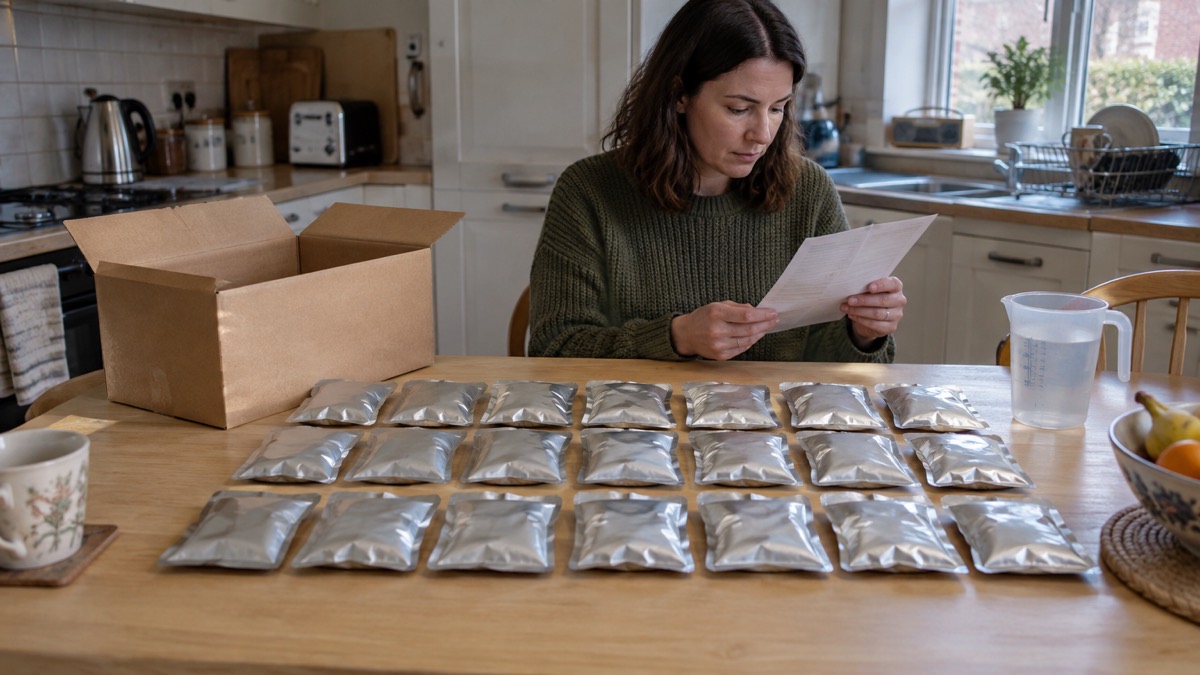
The one-week pack is the natural starting point if you want to cover the period official guidance points to. Argyll and Bute Council's severe weather advice is to keep at least three days' supply of food, bottled water and other essentials, including tinned and dry foods which store safely without electricity7, and a seven-day pack gives you margin beyond that. The larger packs suit households that want a longer store or are covering more than one person; a six-month pack feeds one person for six months or a household of two for three. If you are new to household preparedness, start with our getting started guide and the emergency kit checklist.
Freeze-dried meals for an emergency food store
Freeze-drying removes the water from a cooked meal, which is what gives the pouches their long life and light weight. You add the water back when you eat. The maker states its meals have a shelf life of up to five years1, and labels individual products such as the Porridge with Blueberries with a shelf life of up to 5 years8. That is far longer than tinned or dried foods from a supermarket, and it is the main practical argument for a freeze-dried store: you buy it once, store it, and forget about it until you need it.
Whether it is the right choice for your household depends on what else you keep. The government's Be Ready checklist advises food with a long shelf life that doesn't need refrigeration or cooking, such as tinned meat, fish or vegetables, dried fruit and nuts, and says it is best to buy food you'd usually eat3. Greater Manchester's resilience guidance similarly suggests non-perishable tinned food that doesn't need cooking, plus ready-made baby formula and pet food if needed9. A sensible household store often mixes the two: everyday tins and packets you rotate through normal shopping, plus a freeze-dried core that never needs rotating more than once every few years.
Freeze-dried meals do need water and, ideally, heat, so they are not a complete answer on their own. A home emergency plan should include non-perishable foods, including baby food and pet food, as grab bag essentials10, and Bradford Council's flood pack advice is to select foods that require no refrigeration, preparation or cooking, and little or no water11. Keep some ready-to-eat food that needs nothing at all, and treat the freeze-dried store as the layer behind it. Our emergency food guide covers how to build the full store.
Breakfasts, main meals and desserts
The range divides into breakfasts and main meals, and the ration packs draw on both. The breakfast selection across the packs may contain Porridge with Blueberries, Porridge with Strawberries, Granola with Raspberries or Very Berry Muesli1, with the twelve-month pack also listing Three Cheese Scrambled Eggs among its possible breakfasts2.
The main meal selection is shared across the lunch and dinner slots in every pack. The maker lists the possible varieties as:
- Asian Noodles with Chicken and Mixed Vegetables
- Beef and Potato Hotpot
- Beef Stroganoff with Rice
- Chicken Korma with Rice
- Chicken Rice with Vegetables
- Chicken Tikka with Rice
- Chilli Con Carne with Rice
- Couscous with Cajun Spices and Vegetables
- Fish and Potato with Parsley Sauce
- Macaroni and Cheese
- Mediterranean Vegetable Pasta
- Spaghetti Bolognese
- Spaghetti Carbonara
- Sweet and Sour Chicken with Rice
- Thai Green Chicken Curry with Rice
- Vegetable Tikka with Rice4
Two things follow from that list. First, the packs are described as containing a selection, and the maker says they "may contain" particular varieties4, so you do not choose the exact menu yourself when buying a pack. If a member of your household cannot eat one of these dishes, check with the maker before ordering, or build your store from individual pouches instead. Second, the same sixteen dishes appear in both the lunch and dinner selections of the six-month and twelve-month packs5, so a year-long store means eating from the same menu repeatedly. That is normal for an emergency store, but it is worth knowing before you buy.
The individual breakfast products give a sense of the range. Porridge with Blueberries is made with milk, single cream, oats (14.5%), sugar and blueberries (3.1%)8. Rolled Oats, Apple and Blackcurrant is a breakfast of rolled oats, diced apples and blackcurrants made with coconut milk, and the maker states it is suitable for vegans6. Both are labelled for Emergency Rations and Food for Outdoor Activities8, which reflects the maker's origins in outdoor food: the same pouch works on a hillside and in a power cut.
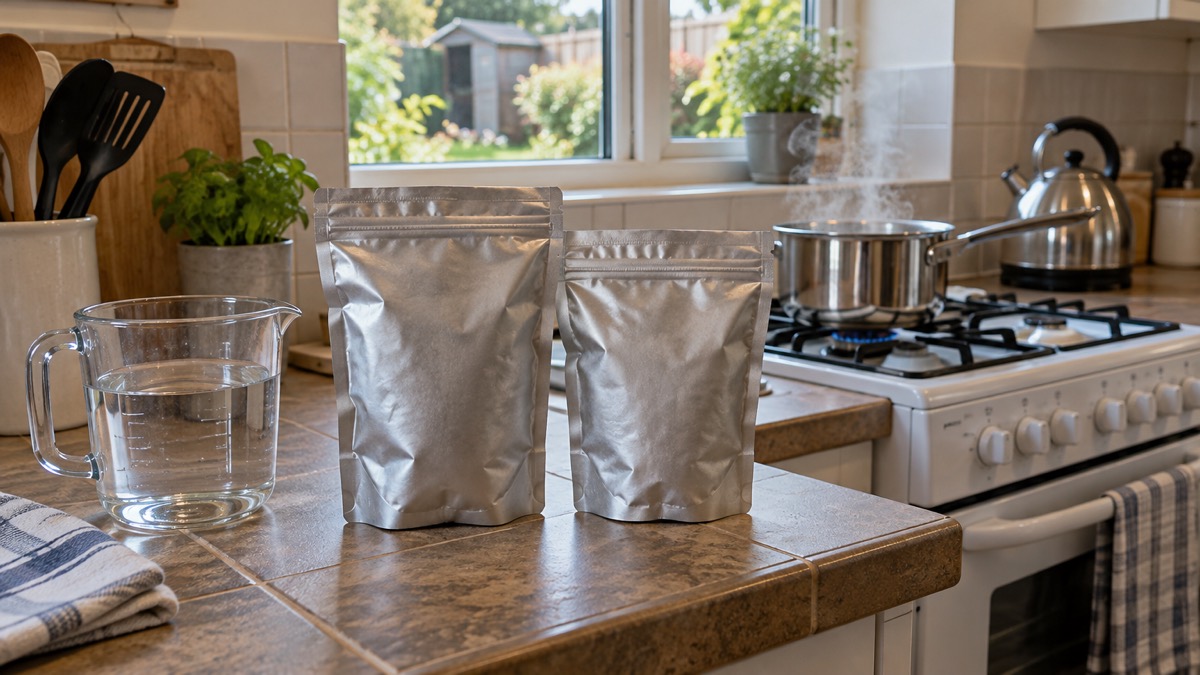
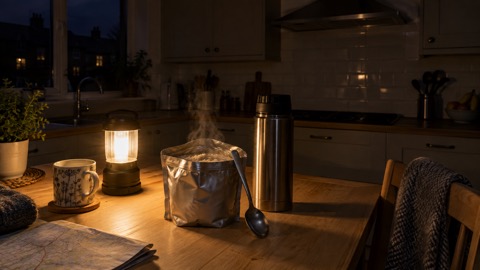
*A freeze-dried breakfast pouch, a measuring jug and hot water: everything needed to prepare one meal.
Energy and portion sizes: planning meals for your household
The ration packs are built to a fixed energy pattern, and it is the same across the one-week, two-week, six-month and twelve-month packs: lunches contain 450 calories per meal and dinners contain 800 calories per meal1. The twelve-month pack lists a breakfast total of 292,000 kcal across its 365 breakfasts2.
| Meal slot | Calories per meal | Applies to |
|---|---|---|
| Breakfast | 800 calories per meal5 | All packs |
| Lunch | 450 calories5 | All packs |
| Dinner | 800 calories5 | All packs |
Individual pouches come in different serving sizes, which is where planning comes in. The Rolled Oats, Apple and Blackcurrant breakfast is available in 450kcal, 800kcal and 1000kcal servings, needing 250ml, 350ml and 450ml of water respectively6. Porridge with Blueberries needs 250ml for an 800kcal high energy serving and 400ml for a 1000kcal double serving8. Larger servings mean fewer pouches but more water per meal, so match the serving size to the water you can store.
How much energy your household needs depends on who is in it and what the emergency involves. A pack feeding one adult three meals a day at the pack's pattern gives a set daily total from the figures above; children need smaller portions, and one pouch may stretch across two small children. The same discipline applies to an emergency store: plan your meals a week at a time12, and work out how many meals you actually need for the people in your household, for the period you are covering, before choosing a pack size. In hot weather, official health advice is not to stop eating but to try smaller, more frequent light meals with plenty of fruit and salad, which help hydration13; a freeze-dried store covers the emergency case, not everyday heatwave eating.
Preparing a meal with limited water and no mains power
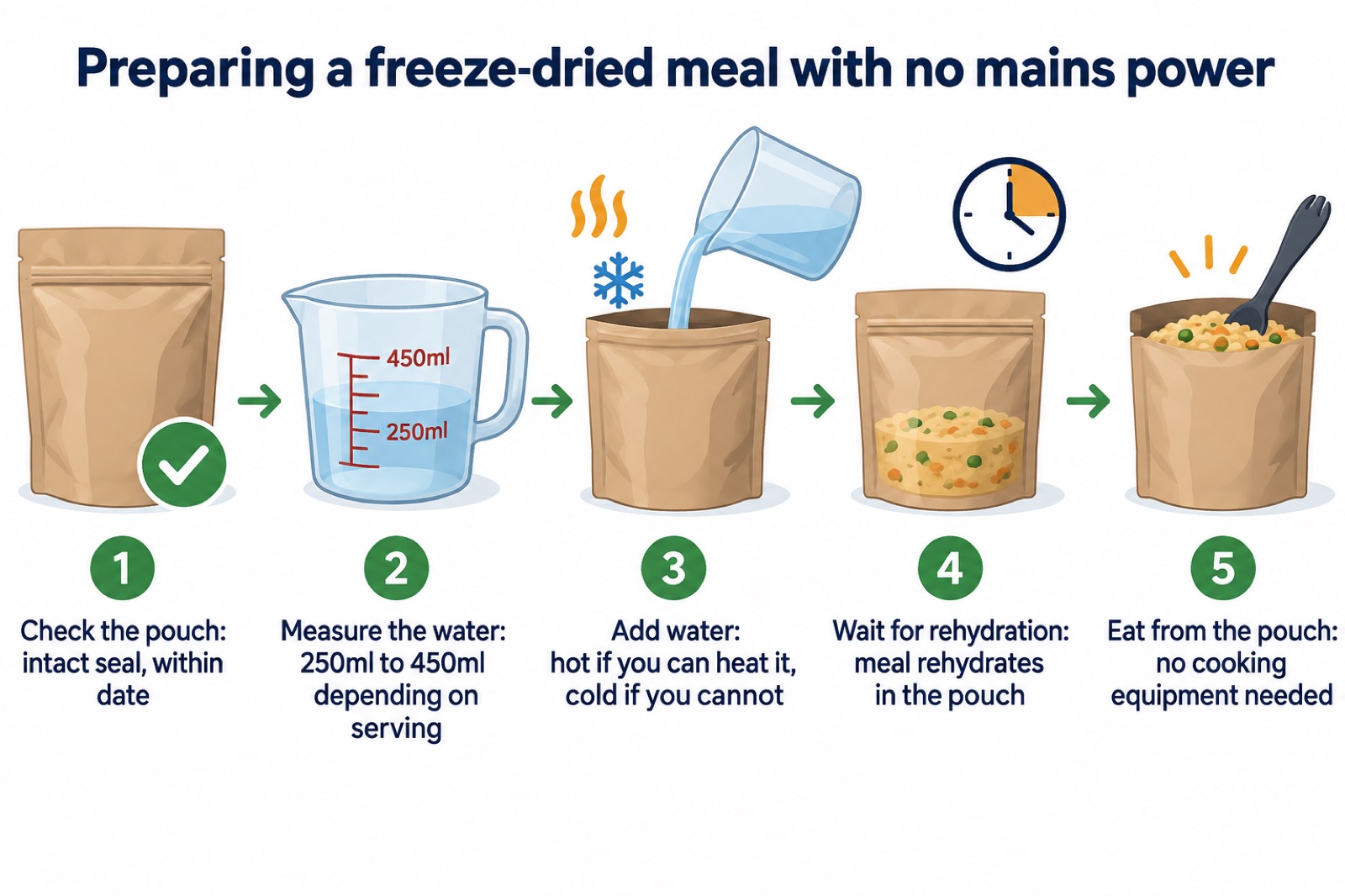
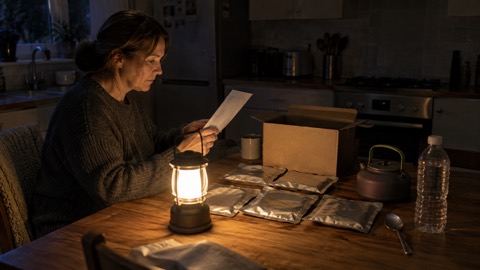
The maker states its meals can be rehydrated with hot or cold water1. That single sentence is what makes the store usable in a power cut: you do not need a stove, a kettle or any heating equipment to eat. Cold-water rehydration leaves you with a cold meal, and it is slower, but it works, and Horsted Keynes Parish Council's power cut advice is to make sure there's something available to eat that doesn't require electricity or heat preparation14. Freeze-dried meals with cold water sit exactly in that gap between ready-to-eat tins and proper cooking.
Water is the real constraint. Each meal needs between 250ml and 450ml depending on the product and serving size8, and that water has to be safe to drink, because it becomes part of the meal. The government's water outage guidance is that whilst there is no mains water supply, you should use alternative water supplies such as bottled water solely for drinking, washing your hands and food preparation15. Work out your water need as: drinking water for everyone, plus hand washing, plus the rehydration water for every meal you plan to eat from the store. Our water guide covers how much to store and how to keep it safe.
| Product and serving | Water required |
|---|---|
| Rolled Oats, Apple and Blackcurrant, 450kcal serving | 250ml6 |
| Rolled Oats, Apple and Blackcurrant, 800kcal serving | 350ml6 |
| Rolled Oats, Apple and Blackcurrant, 1000kcal serving | 450ml6 |
| Porridge with Blueberries, 800kcal serving | 250ml8 |
| Porridge with Blueberries, 1000kcal double serving | 400ml8 |
If you do have a way to heat water, a flask of boiled water poured into a pouch rehydrates it faster and gives you a hot meal. Heating options during a power cut are covered in our guides on heating and cooking without mains power and backup power. Flintshire Council's extreme weather advice is to have sufficient heating fuel and emergency heating equipment in case electricity is cut off16, and Essex Prepared lists power cuts and disruption to gas or water supplies among the situations to prepare for17. A camping stove kept solely for emergencies, used outdoors or in line with the maker's safety instructions, is the usual way to heat rehydration water.
Storing meals safely at home
Freeze-dried pouches are among the easiest emergency foods to store, because they need no refrigeration and are designed to keep for years. Denbighshire Council's emergency supplies guidance is to keep tinned foods in a dry place where the temperature is fairly cool, and to store boxed food in tightly closed plastic or metal containers to protect it from pests18. The same conditions suit freeze-dried pouches: a cool, dry cupboard, away from anything damp, with the pouches protected from being punctured.
Food Standards Scotland advises keeping cupboard and pantry foods in sealed bags or containers, which helps keep food fresh and stops anything falling into the food by accident19. A plastic storage box with a lid does both jobs for a ration pack: it keeps the pouches together, protects them from pests and knocks, and makes the store easy to carry or grab if you have to leave in a hurry. Keep the box off the floor in case of flooding, and check the best-before dates once or twice a year.
Two rules from official food safety advice apply directly. First, a best-before date will only be valid if the food is stored according to the instructions on the label20, so the five-year shelf life depends on the storage conditions you provide. Second, the government's home food preservation guidance is to understand the preservation method you are using, follow trusted instructions exactly, and avoid taking risks if you are unsure whether a food has been preserved safely21. For freeze-dried food that means: follow the maker's rehydration instructions, and if a pouch looks or smells wrong, do not eat it.
Allergens, dietary needs and reading the label
Every Expedition Foods product page lists ingredients and allergen information, and this is the part of the label to read before you buy, not after. The Porridge with Blueberries lists its allergens as milk and oats, with ingredients of milk, single cream (milk), oats (14.5%), sugar and blueberries (3.1%)8. The Rolled Oats, Apple and Blackcurrant lists oats as its allergen6 and is made with coconut milk, which is why the maker states it is suitable for vegans6.
For vegetarian and vegan households, the main meal list includes several meat-free dishes: Macaroni and Cheese, Mediterranean Vegetable Pasta, Couscous with Cajun Spices and Vegetables, and Vegetable Tikka with Rice4. Because a ration pack is sold as a selection of main meals rather than a fixed menu, a household with an allergy to milk, oats, fish or any other listed ingredient should not rely on a standard pack. Buy individual pouches instead, where the allergen list is specific to the product, or contact the maker to ask what a pack contains before ordering.
The label also matters for children and for anyone with special dietary needs. Official guidance for household emergency kits is to include ready-made baby formula and pet food if needed9, and a home emergency plan should include baby food and pet food among grab bag essentials10. Freeze-dried meals are portioned for adults, so plan children's portions from the same pouches rather than assuming one pouch equals one child's meal.
Safety notices and recalls
There are no recalls or safety notices affecting Expedition Foods products in the material reviewed for this page. It is still worth knowing how food recalls work, because any long-life food you store could one day be affected.
Food Standards Scotland explains that food is recalled when it is unsafe, and that incorrect or missing allergen information can also lead to an allergen recall22. That is directly relevant to a freeze-dried store: if a maker discovers that a pouch was labelled with the wrong allergen information, the recall is about the label, not the food, and it matters most to the households with that allergy. The UK government's recalls and alerts service publishes recall notifications that include information about what the risk is and advice about what you should do if you have bought the product being recalled23.
Recent examples show the pattern. In August 2026 A.Vogel Ltd recalled a sprouting seed product because of contamination with E. coli STEC, with point of sale notices displayed in retail stores and on the website24, and in June 2026 the Food Standards Agency issued an allergy alert under the reference FSA-AA-32-202625. Neither involves Expedition Foods, but both show what a notice looks like and why you should act on one.
For a household with a long-life food store, the practical habits are:
- Check for food and allergy alert notices occasionally, especially after adding to your store: foods are sometimes withdrawn or recalled if there is a risk to consumers, for example because allergy labelling is missing or incorrect23
- Keep a note of what is in your store and when you bought it, so a recall notice can be matched against your pouches
- If a pouch is swollen, punctured or leaking, do not eat it; the seal that keeps it safe for years has failed, and official advice is to avoid taking risks if you are unsure whether a food has been preserved safely21
The same discipline applies to any electrical equipment you keep for heating water or lighting during an emergency. London Fire Brigade notes that the Office for Product Safety and Standards issues recalls and alert notices on their website26, and Manchester Fire and Rescue Service advises registering electrical items with the manufacturer so you are informed of any safety recalls27. Our home emergencies guide covers fire and carbon monoxide risks from emergency heating and cooking equipment.
Customer support and where to get help
Expedition Foods publishes full product information on its own product pages, including ingredients, allergens, shelf life and water requirements for each meal8, and those pages are the first place to check a question about a specific product. For anything the pages do not answer, such as the exact contents of a ration pack before you order, or where the meals are made, contact the maker directly; the product pages reviewed here do not state the country of manufacture.
If an emergency has already begun and you need food help, local services exist. NHS Western Isles' resilience page lists a Food Support contact for the Western Isles on 01851 600501 through Comhairle nan Eilean Siar28, which shows the pattern: councils and health boards across the UK run local support lines during emergencies. Check your own council's website for the equivalent service in your area, and keep the numbers in your home emergency plan alongside your emergency kit.
For broader help during an emergency, our guides on staying informed and extra help for households that need it set out who to contact and how to register in advance for priority services. Households that depend on electricity for medical equipment, or that include older or disabled members, should arrange that support before any emergency, not during one.
Sources (28)
- Expedition Foods Emergency Rations for 1 Week, Expedition Foods, 2026
- Expedition Foods Emergency Rations for 12 Months, Expedition Foods, 2026
- Be Ready Checklist, UK Government Be Ready campaign, 2026
- Expedition Foods Emergency Rations for 2 Weeks, Expedition Foods, 2026
- Expedition Foods Emergency Rations for 6 Months, Expedition Foods, 2026
- Rolled Oats, Apple and Blackcurrant, Expedition Foods, 2026
- Be Prepared at Home and in Your Community, Argyll and Bute Council, 2026
- Porridge with Blueberries, Expedition Foods, 2026
- Loss of Essential Services, Greater Manchester Combined Authority, 2026
- Emergency Home Emergency Plan, Royal Borough of Windsor and Maidenhead, 2025
- Create a Flood Pack, Bradford Council, 2026
- Keeping Warm and Well in Cold Weather, Kidney Care UK, 2025
- Hot Weather Advice, NHS Central East Integrated Care Board, 2026
- 12 Tips to Prepare for a Power Cut, Horsted Keynes Parish Council, 2026
- Water Supply Interruptions or Outages, UK Government Prepare campaign, 2026
- Extreme Weather, Flintshire County Council, 2026
- Preparing Your Family, Essex Prepared, 2026
- Emergency Supplies Kit, Denbighshire County Council, 2020
- Food Storage, Food Standards Scotland, 2026
- Use By and Best Before Dates, Food Standards Scotland, 2026
- Consumer Advice for Food Preservation at Home, UK Government, 2026
- Why Food Is Recalled, Food Standards Scotland, 2026
- Recalls and Alerts, UK Government, 2026
- A.Vogel Ltd Recalls Rapunzel BioSnacky Seeds, Food Standards Scotland, 2026
- Food Alert FSA-AA-32-2026, Food Standards Agency, 2026
- Electrical Items, London Fire Brigade, 2026
- Electrical Fire Safety, Manchester Fire and Rescue Service, 2026
- Resilience, NHS Western Isles, 2026
 Expedition Foods Emergency Rations for 1 Week
 Expedition Foods Rolled Oats, Apple and Blackcurrant