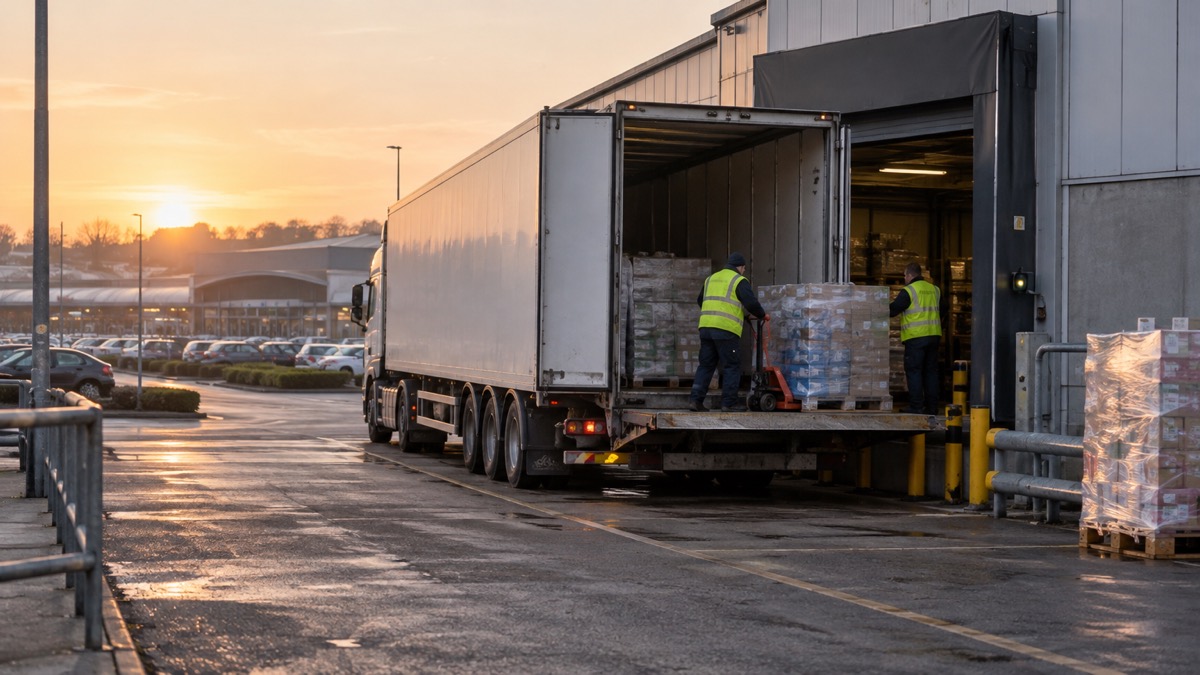
Food reaches your kitchen through a chain of private businesses: farmers, hauliers, processors, warehouses and supermarkets, most of which plan and react without government direction. The government's own auditor, the National Audit Office (NAO), reported on 4 September 2026 that this system is "primarily industry-led, and businesses are responsible for managing their own operations and resilience to disruptions", and that the Department for Environment, Food and Rural Affairs (Defra) "has largely relied on the private sector to manage disruptions to food supply"1. That works well for ordinary hiccups, such as a brief fuel disruption or a storm closing a distribution depot for a day. The open question the NAO raised is whether it works for the rare, most severe events.
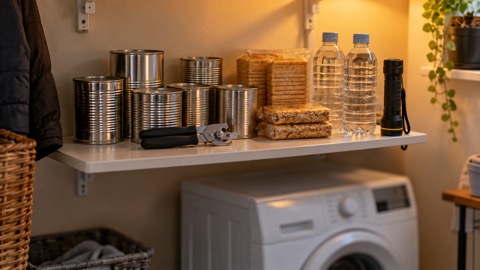
The NAO's central finding was blunt: Defra's actions in recent years "have not been sufficient to ensure the supply chain is resilient to catastrophic events", and the sector's ability to withstand them "has not been tested"1. For a household, that means two things. First, short disruptions are handled routinely and shops refill quickly. Second, nobody has rehearsed a truly severe event, so a household's own preparations, a store cupboard, some water, a torch and a radio, carry more weight than they might appear to.
Who actually keeps the UK fed
The UK food supply chain is not a government operation. It is a commercial system in which each business manages its own continuity: a supermarket decides how much stock to hold, a haulier reroutes around a closed motorway, a processor switches suppliers when one fails. The NAO describes the system as "primarily industry-led", with businesses responsible for their own resilience1. Government's role is narrower: food is designated one of 13 Critical National Infrastructure (CNI) sectors the government considers essential1, which gives Defra a coordinating and monitoring role rather than day-to-day control.
This structure explains most of what a household experiences during a disruption. When a problem is local or brief, the chain absorbs it, which is why UK fuel availability is "generally very good" despite recent examples of brief disruptions at regional and national levels3. Shops restock within days because it is in every business's commercial interest to do so. The same structure has a limit, and the NAO named it: for the most severe events, the ones requiring an emergency response, the chain faces acute risks including "extreme weather, cyber-attacks, energy disruptions and animal, plant or human disease outbreaks", alongside longer-term chronic risks such as climate change, "which can gradually erode resilience over time"1.
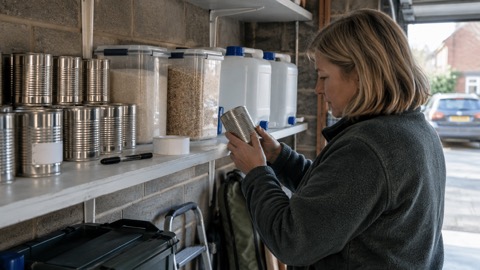
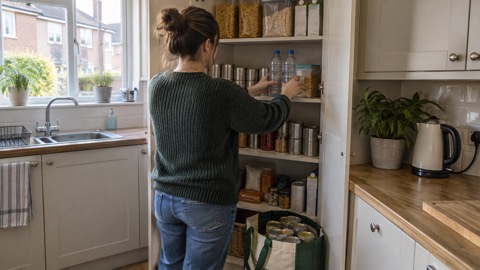
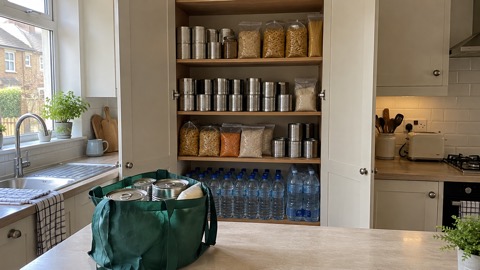
For households, the practical reading is proportionate. Ordinary disruptions are routine and short; a modest store cupboard covers them comfortably, and our pages on how much emergency food to store per person and what to keep in an emergency store cupboard set that out. Severe, national events are different in kind, and the sections below cover the two the government rates most seriously: power loss and drought.
What the National Audit Office found about severe disruption
The NAO's September 2026 report (HC: 587, 2026-27) examined how resilient the food supply chain is to disruptions, and its conclusions were uncomfortable for government. Defra has increased its capacity to support strategic work on resilience in the supply chain, communities and households, but the NAO found this work "remains at an early stage"1. More pointedly, it concluded that the sector's ability to withstand the most severe events causing severe disruption has not been tested, and that Defra's actions in recent years have not been sufficient to ensure resilience to them1.
The report grouped the risks facing the chain into two kinds. Acute risks are events requiring an emergency response: extreme weather, cyber-attacks, energy disruptions and disease outbreaks in animals, plants or humans. Chronic risks, chiefly climate change, erode resilience gradually over time rather than striking on a single day1. Among the most severe scenarios the report considered were a national power outage, a pandemic, a nuclear accident, or a large-scale chemical, biological, radiological or nuclear attack, all classed as low likelihood but highest impact1.
The NAO also noted practical steps Defra is taking, such as using the government's CNI Knowledge Base tool to identify critical food supply chain infrastructure1. For a household, the report's significance is not its detail but its direction of travel: government is building its capacity, the work is early, and the private sector remains the first line of response. That is the context in which your own preparations sit.
What the government is doing to build resilience
Government activity has accelerated since the NAO's findings were forming. The UK Government Resilience Action Plan, published in July 20254, sets three objectives for this Parliament: continuously assess how resilient the UK is; enable the whole of society to take action to increase its resilience; and strengthen the core public sector resilience system5. The phrase "whole of society" comes from the 2022 UK Government Resilience Framework6, and it is not decoration: the Action Plan explicitly reaches individuals, households and communities, alongside central and devolved government, local government, Local Resilience Forums, the NHS and emergency responders4.
Concrete measures include a new Supply Chain Centre, announced in the Industrial Strategy, which will work with businesses and international allies to diagnose acute vulnerabilities and threats and develop targeted interventions to improve the UK's ability to withstand future disruptions5. An upcoming Cyber Security and Resilience Bill is intended to ensure that critical infrastructure and the digital services UK citizens and businesses rely on are secure5. A Four Nations Ministerial group has been established to address and align resilience issues across the UK5.
Two things matter for households in all this. First, resilience policy now explicitly includes you: the government's own framing treats household preparedness as part of the national system, not a fringe activity. Second, the machinery is being built now, which means the protections it will provide are not all in place yet. The small, simple steps a household can take while that national work matures are the ones set out on this site, starting with what to store and how to build a store gradually.
Where drought and power loss sit on the National Risk Register
The National Risk Register is the government's assessment of the emergencies the UK should prepare for, and the two that bear most directly on food and water supply are drought and the failure of the national electricity transmission system.
Drought is featured as a risk facing England on the National Risk Register2. Local risk registers translate it for their areas: Wiltshire and Swindon's community risk register lists drought as risk NRR52 with a likelihood of Medium Low (2) and an impact of Moderate (3), giving it an overall Medium risk level7. The London Risk Register rates water supply restrictions and low water at likelihood 2 and impact 58, reflecting the capital's dependence on transferred water. In Wales, Natural Resources Wales manages drought planning, and its drought stage is defined as a significant period of low river levels and shortage of rainfall, with significantly impacted ecosystems, pressures on agriculture and high stress on the water supply system with potentially severe restrictions9.
A national power outage is listed on the National Risk Register as "failure of the national electricity transmission system (NETS)"10. The London Risk Register rates failure of the national electricity transmission system as VERY HIGH impact8. Public health advice prepared for a national power outage notes that emergency communications to the public would be limited to radio, BBC Radio 2 and Radio 4, "which is the most power resilient form of communication"10.
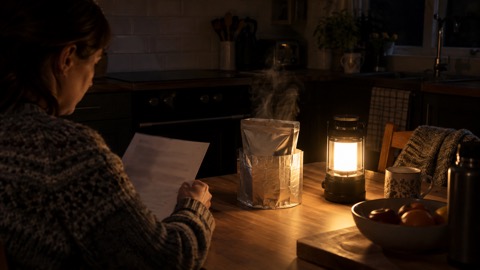
A power cut closes shops, petrol stations and cash machines
A power outage is when the electrical power goes out unexpectedly11, and its effects reach far beyond a dark house. Official guidance from Wiltshire and Swindon Prepared sets out what a power outage may do: disrupt communications, water and transportation; close retail businesses, grocery stores, petrol stations, cash machines, banks and other services; and cause food spoilage and water contamination11. Essex Prepared's utility failure guidance adds that gas supply failures carry a risk of food shortages as restaurants and food production facilities shut down12.
That list is the reason a power cut can feel like a food emergency even when your own home is otherwise fine. If the shops, the tills and the card machines are all off, buying food becomes difficult for everyone at once. Northern Ireland's direct.gov guidance advises that if a power cut has affected your home and you have no electricity supply, it is important you continue to store and prepare food safely13, and our pages on meals without power and fridge and freezer temperatures cover that in detail.
What to do when the power goes, in order:
- Check whether the cut is on your street or just your home, then report it to your network operator; Scottish and Southern Energy has prepared useful advice on what to do in case of a power cut and how to prepare14.
- Keep fridge and freezer doors shut to hold the cold in, and continue to store and prepare food safely13.
- Switch to a torch rather than flames; nidirect's severe weather advice includes keeping a supply of candles13, but treat them as a last resort and never leave them unattended.
- Keep an analogue phone connected in your house, as it will still work if a power cut impacts the mobile network15.
- Tune a battery or wind-up radio to local radio, or in a national outage to BBC Radio 2 or Radio 4, the most power resilient form of communication10.
For keeping food cold without a fridge, see our guide to cool boxes and cool bags.
Drought: how a water shortage reaches farms, taps and homes

All droughts are characterised by a prolonged period of low rainfall creating a shortage of water, but there is no single definition of drought2. In England, the Environment Agency decides when drought conditions exist, working with water companies to reduce the impact on people in affected areas16. Water companies in England depend on adequate water resources to meet the needs of over 57 million people2, and it is a statutory requirement for water companies in England and Wales to produce drought plans, updating them every five years after consulting customers and other organisations9.
Drought reaches households through several routes at once. A drought may cause interruptions to water supplies, like a drop in water pressure17. It reduces agricultural and horticultural crop yields, which is where the food supply chain feels it2. And in the uplands of the north and west of England, water resources deplete relatively quickly after just 2 or 3 consecutive months of below average rainfall, because there is little groundwater base flow to support the rivers2. Droughts can occur during prolonged periods of dry weather, which are becoming more frequent in England18.
England's drought framework uses colour-coded stages. At the amber Drought stage, expect stress on public and private water supply sources, reduced crop yields, localised wildfires and long-term habitat and wildlife impacts. At the red Severe drought stage, the possible impacts include widespread long-term environmental damage, widespread wildfires, failure of crops or plants, shortage of fodder and drinking water for livestock, and failure of public and private water supplies2. Water utilities' drought communication plans follow a 6-stage process from Normal Operation through to End of Drought19, and drought messaging across UK water utilities has a high degree of uniformity across geographic regions19, so the advice you hear will be broadly the same wherever you live.
| Stage | What it means for households |
|---|---|
| Normal (green) | Localised environmental incidents during a short summer heatwave or dry spell, for example fish kills2 |
| Drought (amber) | Stress on public and private water supplies; reduced crop yields; localised wildfires2 |
| Severe drought (red) | Failure of public and private water supplies; crop failure; shortage of fodder and drinking water for livestock; widespread wildfires2 |
Two cross-border points are worth knowing. Most of England's water supply comes from England, but some areas are supplied with water from Wales, so a drought in Wales can affect public water supply in England2. And in Scotland, NHS inform warns that houses with a private water supply may be more vulnerable to drought because private supplies often rely on small water sources that can dry up quickly17.
Private water supplies
A private water supply is any water supply which is not provided by a water company; most are in remote, rural parts of the country, and the source may be a well, borehole, spring, stream, river, lake or pond, serving one property or several20. In Scotland, private water supplies are regulated by local authorities21, and outbreaks of disease attributed to private water supplies have occurred there22. If your private supply runs dry in Argyll and Bute, the responsibility lies with the users of the supply or any third party who manages it by contract23. Cornwall Council advises households on private supplies whose supply becomes insufficient to consider alternative drinking water supplies, bottled water for drinking and food preparation, water delivery by tanker, and reducing water-intensive activities24.
Cutting water use at home when supplies are short
When supplies tighten, the first steps for private supply users are reducing current usage to conserve the supply and considering where you could access drinking water should the supply cease25. That advice, from Argyll and Bute Council, applies equally to mains households facing restrictions. Keeping water usage to a minimum will also prolong alternative sources of water such as water tanks25.
Practical steps when water is short:
- Reduce non-essential water use straight away, before restrictions are imposed25.
- Identify where you could access drinking water if your supply ceases, and check whether there is a nearby mains supply you could connect to20.
- Speak to neighbours to find out if they have access to a supply20.
- Ensure containers used to transfer water are cleaned and disinfected to prevent contamination20.
- If water levels are very low, take action to seek an alternative supply of water20.
- Farmers should monitor water levels and quality closely during drought, reduce non-essential use, and have plans in place for alternative supplies for livestock and essential farm operations before supplies become critical24.
On water quality, the public water supply in England and Wales is safe by any standard: the industry figure for compliance with the regulations is well above 99.9%26. The risk sits mainly with private supplies during drought, which is why disinfecting containers matters.
Where to get information during a disruption
Most emergencies in the UK are handled at the local level by the emergency services, local authorities and other relevant organisations such as utility companies and transport operators6. The structure behind that is a set of local partnerships: 38 Local Resilience Forums in England, four in Wales, and three Regional Resilience Partnerships in Scotland6. They plan together and, when something happens, coordinate the response and the public information.
During a disruption, Moray Council's emergency planning guidance states that information will be available on local radio stations, on social media, at Rest Centres or other facilities, and on emergency services and council websites14. In a national power outage, the broadcast scripts prepared for public health use state that emergency communications to the public would be limited to radio, BBC Radio 2 and Radio 4, the most power resilient form of communication10. That is the single strongest argument for a battery-powered or wind-up radio in the house.
A household information plan, in order:
- Keep a battery or wind-up radio, and know your local station as well as BBC Radio 2 and Radio 410.
- Keep an analogue phone connected in the house, as it will still work if a power cut impacts the mobile network15.
- Bookmark your council's website and your utility companies' outage pages before anything happens14.
- Know who to call: your electricity network operator for power cuts, your water company for supply problems, and in Scotland check the latest drought situation on your water supplier's website, for example United Utilities in its region18.
- If you are evacuated or your home is affected, Rest Centres are where official information and support are provided14.
Recent events: the 2025 to 2026 drought and the North Hyde outage
Two recent events show how these risks play out in practice. The 2025 drought in England, documented in a Defra report published in January 202628, developed into a drought period that by 23 March 2026 had fully recovered2. But dry weather returned: in the week ending 13 October 2026, reservoir levels in England were exceptionally low, with national storage at 54% of capacity, around 21% below the long-term average for that time of year, and 42 flexible abstraction requests had been received from the agriculture sector to date29. Drought, in other words, is not a historical risk; it is current.
On the power side, the outage at North Hyde electricity substation, which affected Heathrow Airport, prompted a review by the National Energy System Operator (NESO) covering England, Scotland and Wales30. The review's terms of reference covered three areas: the resilience of energy infrastructure, including the root cause and sequence of events; response and restoration, assessing whether contingency plans were enacted as planned; and recommendations for improving the resilience of essential services, including critical national infrastructure, to power disruption31. The government's response included action on enhancing the resilience of critical infrastructure to energy disruption32. The Kelly Review, commissioned by Heathrow Airport Limited, found the overall risk of a loss of supply had been appropriately understood, but details about the length of the possible outage and its precise impact on systems were less well known outside the technical team33.
The lesson a household should take from North Hyde is the one the reviews themselves drew: even well-run critical infrastructure can fail in ways its operators considered unlikely, and the contingency plans had never been fully tested under real conditions. The same conclusion, at national scale, is the NAO's finding on food supply1. Preparation at home is not pessimism; it is the "whole of society" resilience the government now formally asks for6.
A drought timeline, from first dry months to full recovery.
Sources (33)
- Resilience of the food supply chain to disruptions, National Audit Office, 2026-09-04
- Drought: how it is managed in England, Defra and Environment Agency, 2026-04-08
- Fuel shortage, community risk register, Darlington Borough Council, 2026-10-29
- The UK Government Resilience Action Plan, UK Government, 2025-07
- UK Government Resilience Action Plan, Cabinet Office, 2025
- What is a Local Resilience Forum, Essex Prepared, 2026-10-29
- Drought risk, Wiltshire and Swindon Prepared, Wiltshire and Swindon Prepared, 2026-10-25
- London Risk Register v14, Greater London Authority, 2025-01
- Drought, household guidance, Ofwat, 2026-10-29
- Keeping warm or cool in extreme weather: scripts for broadcast media, UK Government, 2025-12-16
- What is a national power outage, Wiltshire and Swindon Prepared, 2026-10-25
- Utility failure, ongoing risks, Essex Prepared, 2026-10-29
- Strong winds weather warning: information and advice, nidirect, 2026-10-24
- Emergency preparations you can do, Moray Council, 2026-10-29
- Power cuts, West Yorkshire Prepared, 2026-10-29
- Drought risk, Wiltshire and Swindon Prepared, Wiltshire and Swindon Prepared, 2026-10-25
- How to stay safe during a drought, NHS inform Scotland, 2026-05-12
- How to stay safe during hot weather, Cumberland Council, 2026
- Public messaging for summer concurrent risks, UK Government, 2025-12-16
- Drought planning and management, Natural Resources Wales, 2026-10-29
- Private water supplies: owners and users, Drinking Water Quality Regulator for Scotland, 2026-10-28
- Private supply, Drinking Water Quality Regulator for Scotland, 2026-10-29
- Private water supplies, Argyll and Bute Council, 2026
- Private water supplies, Cornwall Council, 2026-10-29
- Loss of supply for private water supply users, Argyll and Bute Council, 2026
- Water testing, Drinking Water Inspectorate, 2025-12-09
- Electrical fire safety, Warwickshire County Council, 2026-10-29
- 2025 drought: how it developed in England, Defra and Environment Agency, 2026-01-26
- Dry weather and drought in England: 9 to 15 October 2026, Defra and Environment Agency, 2026
- NESO review into the North Hyde Substation outage: terms of reference, UK Government, 2025-03-28
- Review into the North Hyde Substation outage: terms of reference, UK Government, 2025-03-28
- NESO's North Hyde report: government response, UK Government, 2025-11-18
- NESO review report, National Energy System Operator, 2025-06-30
 Long-Term Storage Kit Checklist
 Store Cupboard Checklist
 30-Day Household Checklist
 How Much Emergency Food to Store
 What to Store in an Emergency
 Starting a Store Cupboard
 Shelf Life and Date Labels
 Rotating Your Food Store
 Long-Term Storage Conditions
 Meals Without Power
 Self-Heating Meals
 Tinned Food Guide
 Rice, Pasta and Pulses Storage
 Freeze-Dried Meals
 Emergency Ration Packs