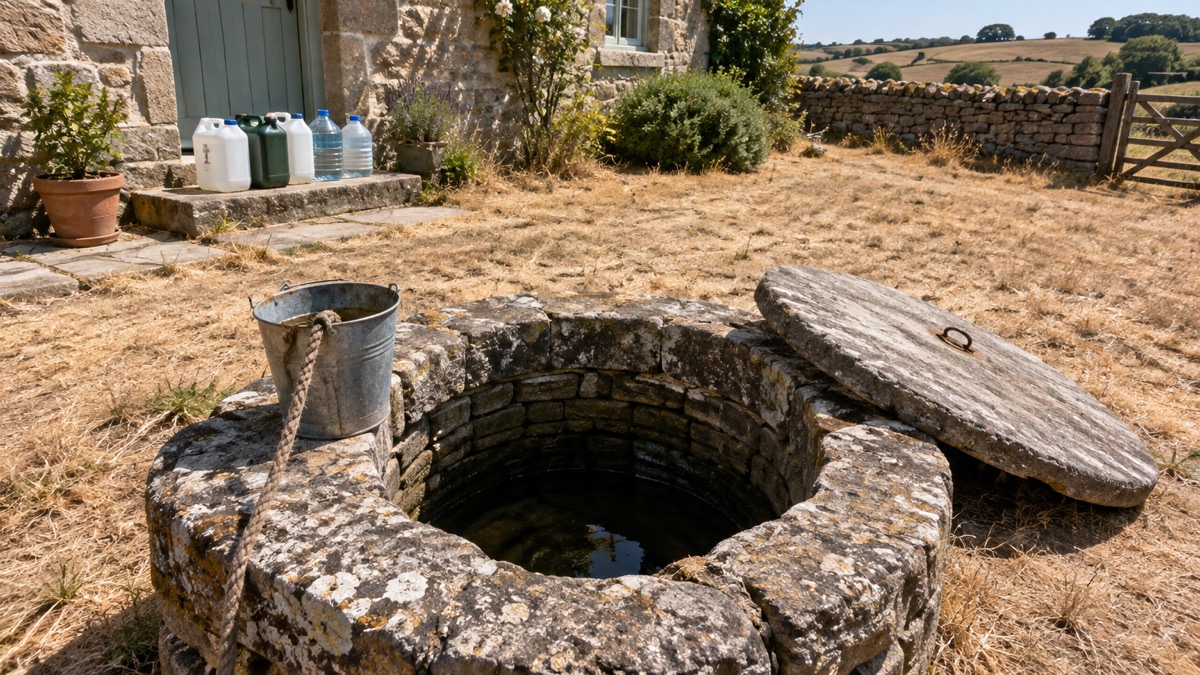
If your spring, well or borehole has run dry, the first thing to do is cut your water use right back and work out where drinking water will come from if the supply stops altogether. Councils give the same advice every summer, because private supplies drying up is a familiar problem: Somerset Council says it gets calls each summer from private supply users whose springs, wells or boreholes have dried up, sometimes for many months1. The Scottish Borders guidance puts the first steps plainly: reduce current usage to conserve the supply, and consider where you could access drinking water should the supply stop2.
Then report it. If you have a private supply, usually a well, borehole or spring, GOV.UK says to report any problems to your council's environmental health department3. Your council is also the body that samples and risk assesses private supplies, and in Scotland it can point you to testing and to the private water supply grant4.
Treat the water you have left with care. Water quality in a private supply can decline during drought, and low water levels make contamination more likely, which could make someone who drinks it unwell6. A private supply is any supply not provided by a water company, and most are in rural areas where mains water is not available7.
First steps when your spring, well or borehole runs dry
Cut use before you do anything else. The advice from Scottish Borders, Argyll and Bute and Somerset councils is consistent: reduce current usage to conserve the supply, and think now about where you could get drinking water if the supply ceases3. That means stopping anything non-essential, and it means having a plan for drinking water that does not depend on the supply recovering.
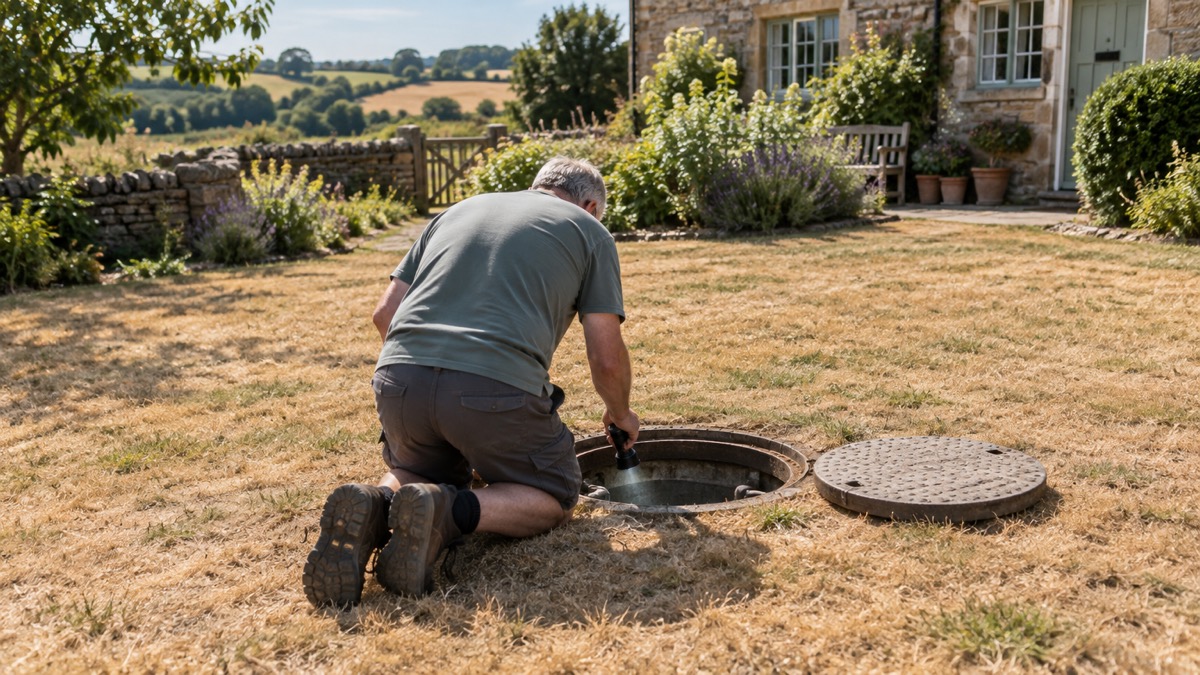
A private supply can come from a spring, a well, a borehole, a river, a stream or a pond, and in Scotland also from lochs11. Which one you have shapes how quickly it recovers: a shallow spring responds to rainfall within days or weeks, while a borehole drawing on deeper groundwater may take much longer.
Supplies fail for reasons other than drought, and it is worth ruling them out before you assume the worst. Scottish Borders lists periods of drought or severe cold weather, when the source dries up or freezes, but also undetected leaks, pipe bursts, pump failures and pipework that has been disconnected3. The Drinking Water Inspectorate adds inadequate supply arrangements to that list12. A pump that has failed looks exactly like a well that has run dry, so check the obvious mechanical causes first.
If the supply has stopped, the priority is drinking water. Your council's environmental health team can advise, and in Wales you can contact your water company or local council for information on connecting to a nearby mains supply13. Where a domestic supply fails, the local authority may be able to require water companies to assist under certain conditions13. Keep a store of bottled water for drinking and cooking, and use any water you can still draw for flushing and washing only until you know it is safe.
Report the problem to your council's environmental health team
Your council is the first call, and the right one. GOV.UK's drinking water quality guidance says that if you have a private supply, usually a well, borehole or spring, you should report any problems to your council's environmental health department3. In Scotland, if your water supply is cut off or contaminated, contact Scottish Water for public supplies or your local authority if you use a private supply14. SEPA's advice to private supply users having problems due to dry weather is the same: contact your local authority15.
What the council can do depends on where you live and what your supply serves.
| Nation | Who to contact | What they can offer |
|---|---|---|
| England | Council environmental health department3 | Advice, sampling and risk assessment of private supplies4 |
| Scotland | Local authority; Scottish Water for public supplies14 | Testing information, charges and the private water supply grant5 |
| Wales | Water company or local council13 | Information on connecting to a mains supply; the local authority may require water companies to assist where domestic supplies fail13 |
In Cornwall, the council's private water supplies team has a legal responsibility to sample and risk assess private water supplies, and carries out risk assessments through professionals who identify any vulnerability in the supply and advise on protecting the water source from contamination4. If you have recently received a letter from the council asking about your supply, you can complete the online survey or the form sent with it, or use the council's forms at any time to report a new supply or changes to an existing one4.
For lead concerns on a private supply in Scotland, contact your local council environmental health department, whose details are on the CoSLA website16. Lead can dissolve into water from old pipework, and the NHS advises that this is a reason to have your water checked rather than assume it is fine16.
Water quality can fall during a drought, so treat what is left with care
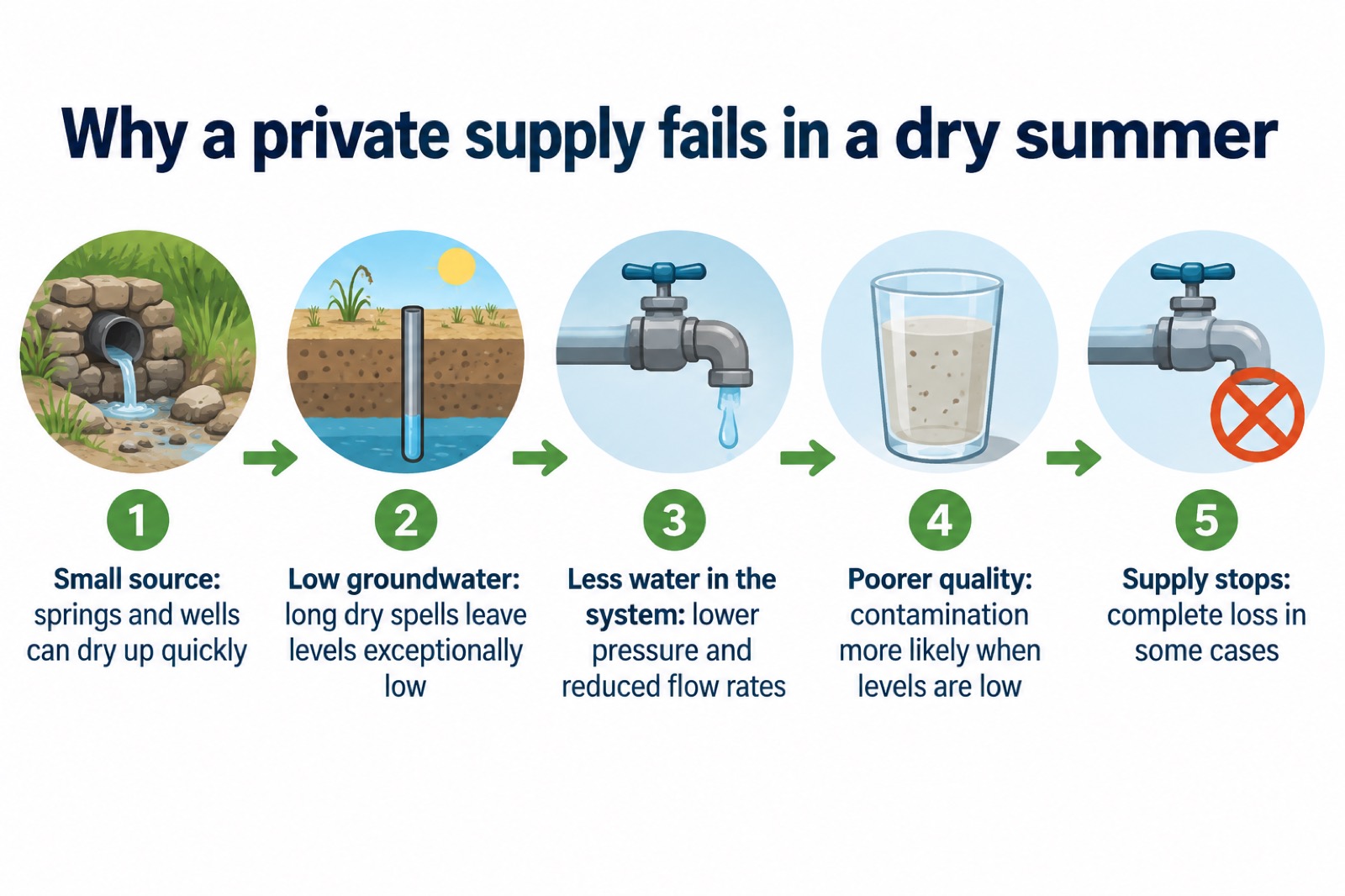
Low water is not just less water; it can be worse water. NHS Inform states that private water supplies can become contaminated when water levels are low, which could make someone who drinks that water unwell6. Cornwall Council sets out what prolonged dry weather does to a supply: reduced water levels in springs, wells, boreholes and streams, lower water pressure and reduced flow rates, complete loss of supply in some cases, and changes in water quality due to lower water volumes4. Natural Resources Wales adds that when there is a lack of rainfall over a long period, groundwater levels can become exceptionally low, causing spring sources to dry up or pumps to run dry13.
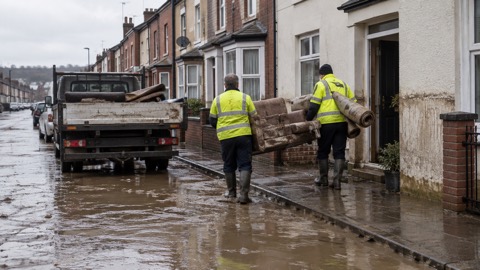
Heavy rain after a dry spell is a particular hazard. Argyll and Bute Council explains that dry spells often end with heavy rain that causes run off into abstraction areas, which can mean high levels of sediment reaching tanks and affecting treatment10. Floodwater can contain sewage and harmful microorganisms, and a private supply may be contaminated with it and not suitable for drinking18.
The risks to a private supply are not only biological. Highland Council lists animal waste, fertiliser or pesticide runoff, high mineral levels such as iron or manganese, low or high pH, and changes in water colour among the things that can affect a private supply7. These can make water unsafe to drink, and there have been disease outbreaks in Scotland linked to private water supplies7. If you are in any doubt about the water, use bottled or other alternative supplies for drinking, cooking and brushing teeth until your council confirms it is safe.
Why private supplies are more vulnerable to drought
A private supply is any water supply not provided by a water utility company2. Most are in rural areas where mains water is not available7. That independence is the point of them, and also the weakness: NHS Inform notes that houses with a private water supply may be more vulnerable to drought because private supplies often rely on small water sources that can dry up quickly6.
The Drinking Water Inspectorate describes how insufficiency arises: challenging weather conditions such as drought or severe cold weather, sources drying up or freezing, undetected leaks, pipe bursts, pump failure, inadequate supply arrangements and disconnection of pipework12. Argyll and Bute Council gives the same picture, adding that problems can come from drought or severe cold weather when the source dries up or freezes, but also from undetected leaks, pipe bursts or pump failures10.
The trend is not in householders' favour. Somerset Council says insufficiency is becoming an ever increasing problem with private supplies, due to the impact of climate change1. Dwr Cymru warns that with longer-term climate changes your private supply may be becoming less reliable19. That is a reason to plan for next summer now rather than after the next dry spell.
Abstraction limits matter for larger users. Somerset Council advises that if you plan to abstract more than 20 cubic metres per day you will need to check guidance on the Environment Agency's abstraction licences1. In Scotland, SEPA has issued temporary restrictions on some licences to abstract water from the environment in areas that have reached significant water scarcity20. Even public suppliers face limits: Southern Water says strict abstraction licences on the River Test and River Itchen mean it cannot keep taking water when river levels drop to a certain level21. If your supply feeds a business or several properties, check whether a licence condition affects you before the next dry spell.
Getting ready for next summer: risk assessments, testing and grants
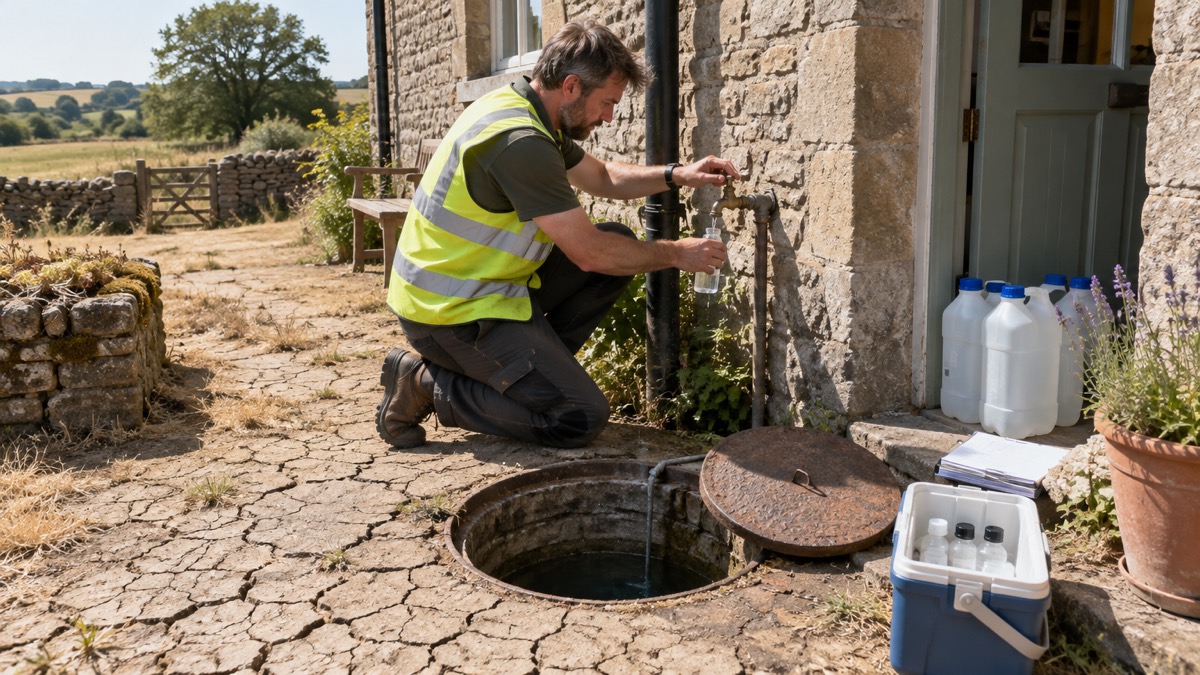
The time to fix a fragile supply is when it is running. A private water supply used for domestic purposes that supplies two or more dwellings and/or other properties must be risk assessed every 5 years and regularly tested in accordance with the regulatory requirements by the local authority9. Domestic purposes include drinking, washing, bathing and showering, washing laundry, toilet flushing and central heating9.
For a single household, testing is on request22. Some councils say plainly that a single domestic supply may not have been sampled and there are currently no plans to sample it unless a problem is drawn to their attention11. If you want your water checked, ask. Councils test private water supplies for bacteria, chemicals and metals22.
A risk assessment is the route to improvement. Argyll and Bute Council says a feedback letter and report will detail improvements if required, providing the basis for obtaining quotes from tradesmen for the grant10. In Scotland, mygov.scot sets out information about getting your private water supply tested, the charges for this, and the private water supply grant to help improve your supply5. NHS Inform also notes you may be entitled to a grant to help make improvements to your private water supply6.
Simple source protection is worth doing whatever your supply. The Drinking Water Inspectorate advises preventing the storage or spreading of manure within 50 metres of the water source23. It also advises diverting rain water run off so it does not flow into your supply, for example with a small ditch leading away from it2. For rainwater harvesting systems, remove or avoid roof-mounted aerials and overhanging trees in the collection area, discourage birds from perching on roof collection areas, and consider diverting the first flush of rainwater to waste23.
If you rent your home, or let a property on a private supply, different rules apply. Rented homes and holiday accommodation count as commercial use7. Commercial properties on a supply, including self-catering accommodation, must legally have a formal risk assessment carried out and are subject to routine sampling, and a drinking water poster must be displayed24. If you rent and your home is flooded, contact your landlord to report it; they may arrange repairs or provide alternative accommodation25. Many more people encounter private supplies when they stay in holiday accommodation in the more remote parts of Scotland26.
For the wider picture on managing low water at home, see how to save water at home when supplies are low and the heatwaves and drought household guide. If your supply fails during a wider emergency, the water in an emergency guide covers storing and rationing.
Sources (26)
- Private water supplies, Somerset Council
- Private water supplies, Scottish Borders Council, 2026-08-12
- Check drinking water quality, GOV.UK, 2026-10-29
- Private water supplies, Cornwall Council, 2026-10-29
- Owners and users of private water supplies, Drinking Water Quality Regulator for Scotland, 2026-10-28
- How to stay safe during a drought, NHS Inform, 2026-05-12
- Private water supplies, Highland Council, 2025-10-10
- Private water supplies, Drinking Water Inspectorate, 2026-10-28
- Buying a dwelling with a private water supply, Drinking Water Inspectorate, 2026-10-28
- Private water supplies, Argyll and Bute Council, 2026
- Private water supplies, Argyll and Bute Council, 2026
- Managing insufficiency of private water supplies, Drinking Water Inspectorate, 2025-12-15
- Drought planning and management, Natural Resources Wales, 2026-10-29
- How to protect your health when flooding occurs, NHS Inform, 2025-11-07
- FAQs for private water supply users | Beta | SEPA | Scottish Environment Protection Agency, Scottish Environment Protection Agency (SEPA)
- Lead poisoning, NHS Inform, 2026-09-07
- Flooding advice for properties using a private water supply | Shropshire Council, Shropshire Council
- Private water supplies after floods or storms, Argyll and Bute Council, 2026
- Private water supplies and the water regulations, Dwr Cymru Welsh Water, 2026-10-28
- Water scarcity report, 15 October 2026, SEPA, 2026-10-15
- Save a little water, Southern Water, 2026-10-28
- Types of private water supply, Cumberland Council, 2026
- Protecting your private water supply, Drinking Water Inspectorate, 2026-10-28
- Private water supplies: your property, Argyll and Bute Council, 2026
- Housing help if your home is flooded, Somerset Council, 2026-06-04
- Private water supplies, Drinking Water Quality Regulator for Scotland, 2026-10-28
 Flood Warning Checklist
 First Steps After a Flood
 Insurance Claim Records
 Barbecues and Wildfire Risk
 Hosepipe Ban Exemptions
 Hosepipe Ban Fines and Reporting
 Hosepipe Bans and the Garden
 Hosepipe Ban Rules
 Pools, Ponds and Car Washing
 Wildfire Home Protection
 What to Do Near a Wildfire