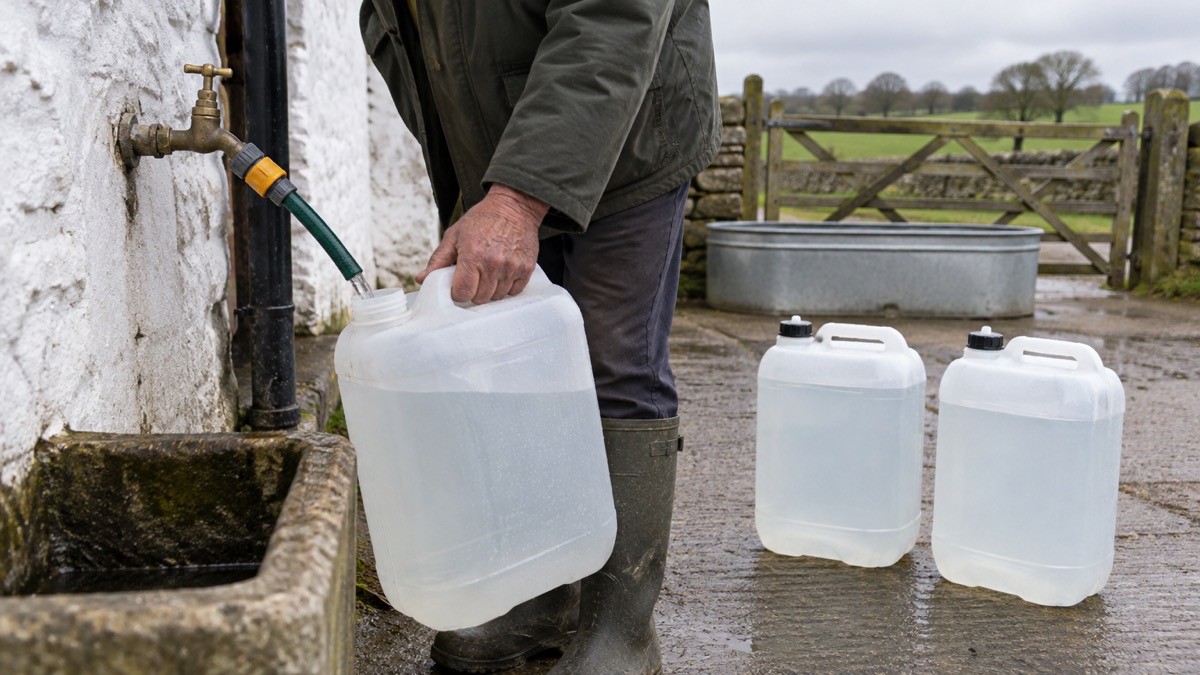
If the water to your animals stops, the first move is to cut what you are using and work out where the next clean water comes from. Official guidance for private supplies says first steps are likely to include reducing current usage to conserve the supply and considering where you could access drinking water should the supply stop1. For a farm or smallholding, the same guidance is firmer: have plans in place for alternative water supplies for both livestock and essential farm operations before supplies become critical2.
Do not wait for the tap to run dry. Water companies tell you if they are going to turn off your water, so check your supplier's website and local news for updates3. While there is no mains supply, use bottled water solely for drinking, washing your hands and food preparation4. For animals, that means a stored or delivered supply of your own, planned in advance and kept above flood level.
This page sets out what to do first, how to store and carry water, where animals must never drink, and who to ring when you need help. It is written for England first, with the differences in Scotland, Wales and Northern Ireland noted where they matter.
What to do first when the water stops
Start by protecting what you have. Reduce current usage to conserve the supply, and think now about where you could access drinking water if it stops altogether1. On a farm, plan ahead for alternative water supplies for livestock and essential farm operations before supplies become critical, and monitor water levels and water quality closely during drought conditions2.
Then check the cause and the likely duration. Water companies tell you if they are going to turn off your water, and they publish information and updates on their websites9. Follow the advice from the water company, keep bottled water available, and follow the instructions of the emergency services and your local authority10. In a drought, check your local news and your water company's website regularly for advice on water availability in your area and the water management actions in force11.
If you are on a private supply, the local authority has a role. Contact your water company or local council for information on connecting to a mains supply; the local authority may be able to require water companies to assist where supplies fail in domestic properties under certain conditions12. That is a route worth knowing before an emergency, not during one.
How much water livestock need each day
The published figures in this guidance are for people and pets, not for cattle, sheep or horses, and no per-head livestock figure is given here. What the official material does say is that you should store enough to last until clean water and food can be delivered, kept above flood level5. For pets, the benchmark is a week's worth of food, water, medication, cat litter or any other regular supplies6.
That gives you a planning rule rather than a number: work out what your animals drink on a normal day, multiply it by the number of days you might be cut off, and store that much before you need it. The official drought picture shows why. At the severe drought stage, possible impacts include failure of crops or plants and shortage of fodder and drinking water for livestock, alongside failure of public and private water supplies13. A shortage of drinking water for livestock is treated as a serious consequence, not an inconvenience.
For people, the health advice is to drink at least 2 litres of liquid per day, which is approximately 8 cups14. That is a useful reminder of how much a household gets through, and how quickly a small store disappears when it is shared with animals.
Bottled water stations and what your water company provides
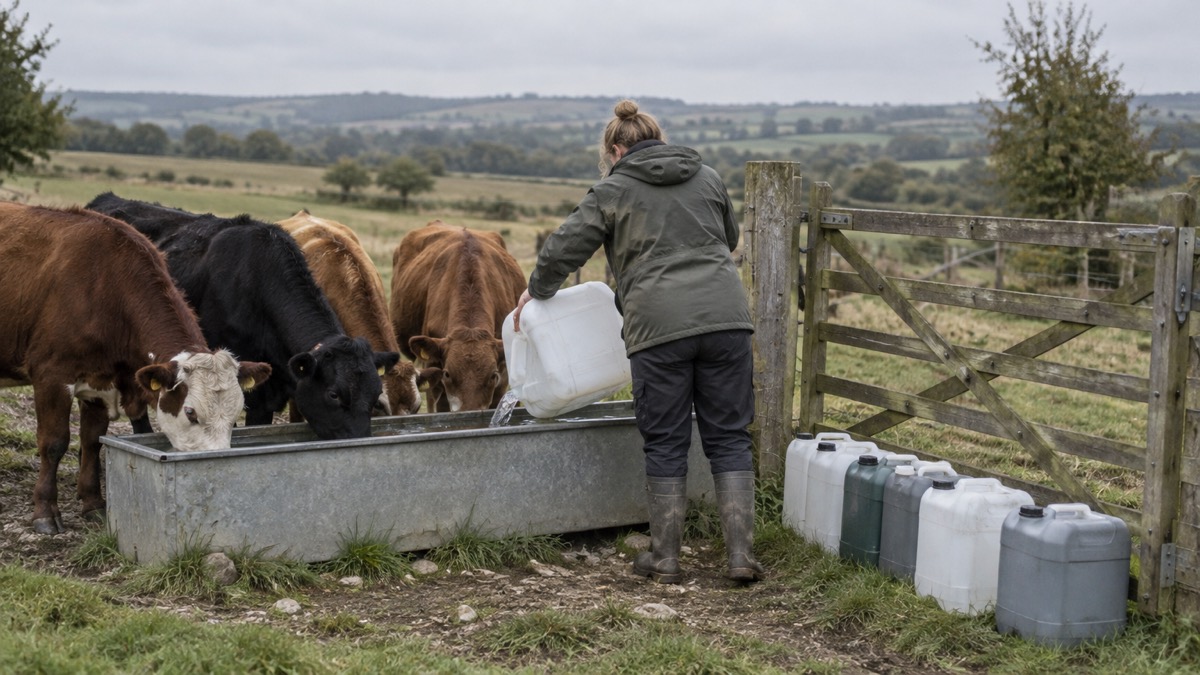
During a mains interruption, you may be given bottled water or have water tankers or bowsers parked near your home for you to collect water from15. These are the standard water company arrangements, and they are aimed at households. Treat them as a top-up for drinking and food preparation, not as a way to fill a trough.
While there is no mains water supply, official advice is to use alternative water supplies such as bottled water solely for drinking, washing your hands and food preparation4. That is a clear priority order, and animals come after it unless you have your own supply arranged.
| What is provided | What it is for | What it is not |
|---|---|---|
| Bottled water | Drinking, hand washing, food preparation4 | Filling troughs or watering a field |
| Water tankers and bowsers near your home | Collection by households15 | A delivery service to your field |
| Your own stored supply | Livestock and essential farm operations2 | A substitute for planning |
If you keep animals, the practical conclusion is that the bowser is your backup for the house, and your own store is the backup for the animals. Plan them as two separate systems.
Storing and carrying water for animals
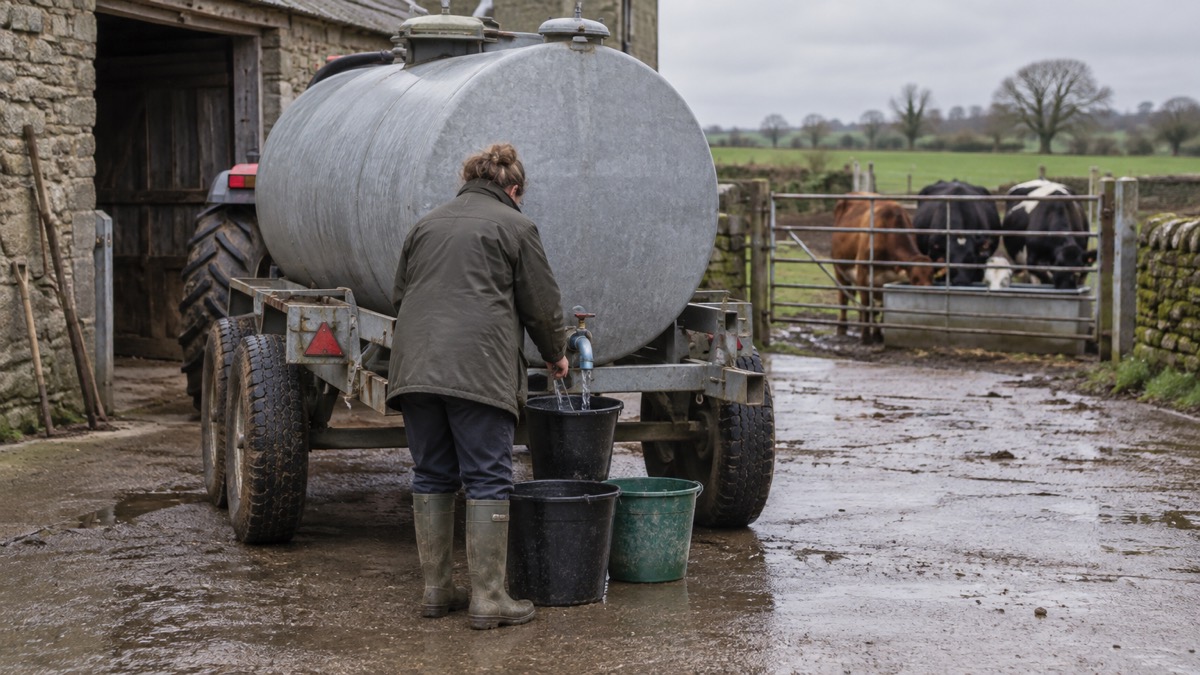
Store as much feed and water as possible above flood level, enough to last until clean water and food can be delivered5. That single instruction covers most of the planning: height, quantity and duration. Water kept at ground level in a flood-prone yard is water you may lose exactly when you need it.
Keep the store reachable and movable. For pets, official advice is to keep their food, water and bedding somewhere safe, keep portable pet carriers and leads close at hand, and consider moving small animals upstairs16. The same logic applies at a larger scale: containers you can lift, a route you can walk, and a store that is not behind a gate that floods.
Some houses have a cold-water tank in the loft, which will allow some water for a short period in an outage; official guidance is to use it only for critical purposes17. That is a household reserve, not a livestock supply, but it is worth knowing it exists.
In freezing weather, protect the supply before it freezes. Make sure you have enough insulation around your water tank or tanks, the loft and any external water pipes, and keep de-icer, salt or grit and tools to keep your home clear of snow and ice18. If you can use a camping stove outside, boil some water to keep in a flask so hot soups or a hot drink can be made19. Never use a camping stove indoors.
For animals, store as much feed and water as possible above flood level, enough to last until clean water and food can be delivered20. Keep a supply of food for you and your animals in case of evacuation1, and keep pets' food, water and bedding somewhere safe, with portable carriers and leads close at hand16. If you rely on heated tanks or aquariums, consider a battery-powered backup or insulation methods21. Check that pets and livestock kept outside can move freely and escape rising water22.
Where livestock must never drink from
Floodwater is the first danger. Avoid it at all costs7, and never walk in floodwater8. Do not consume any food or drink that has been contaminated by floodwater, and discard all tins, bottles and cans containing food or drink if they have come into contact with flood water23. The same caution applies to water your animals would drink.
Keep animals away from the source of a private supply. Official guidance is to restrict the access of livestock from the vicinity of the source, which may be up to 50m depending on ground conditions, topography and the presence of swallow holes20. That protects the supply itself as well as the animals.
Check that pets and livestock kept outside can move freely and escape rising water22. On a flood warning, bring pets indoors and provide a litter tray25. Before a flood, farmers should consider moving livestock and equipment away from areas likely to flood8.
Getting help from your water company and your council
Your water company is the first call. It tells you if it is going to turn off your water, and it publishes updates during an interruption9. Follow its advice, keep bottled water available, and follow the instructions of the emergency services and your local authority10.
If you are a vulnerable customer in need of extra support, you can register with your water company as a priority customer10. If you are eligible, sign up to your water supplier's Priority Service Register to let them know you need additional support, including when there is an interruption to your supply4. You can register via thepsr.co.uk1. Find out who your water supplier is and ring them; they will add you to the register for vulnerable people10. Being on the register means you can receive additional support from your water, gas and electricity suppliers during emergencies or service disruptions, which may include access to bottled water during a water supply interruption, priority assistance and tailored support in a power or gas outage26.
For a private supply, contact your water company or local council for information on connecting to a mains supply12. After flooding, your local council can help with the collection, retention and disposal of damaged household contents and with arrangements to clean up your home and garden27. You can ask your local fire brigade for help pumping out water; they might charge a fee and can help you get a permit28.
For live flooding information and advice on how to prepare for or cope with flooding, Floodline is available 24 hours a day, 7 days a week29. In Northern Ireland, check the nidirect guidance on what to do if a flood happens27.
Protecting the supply before the weather turns
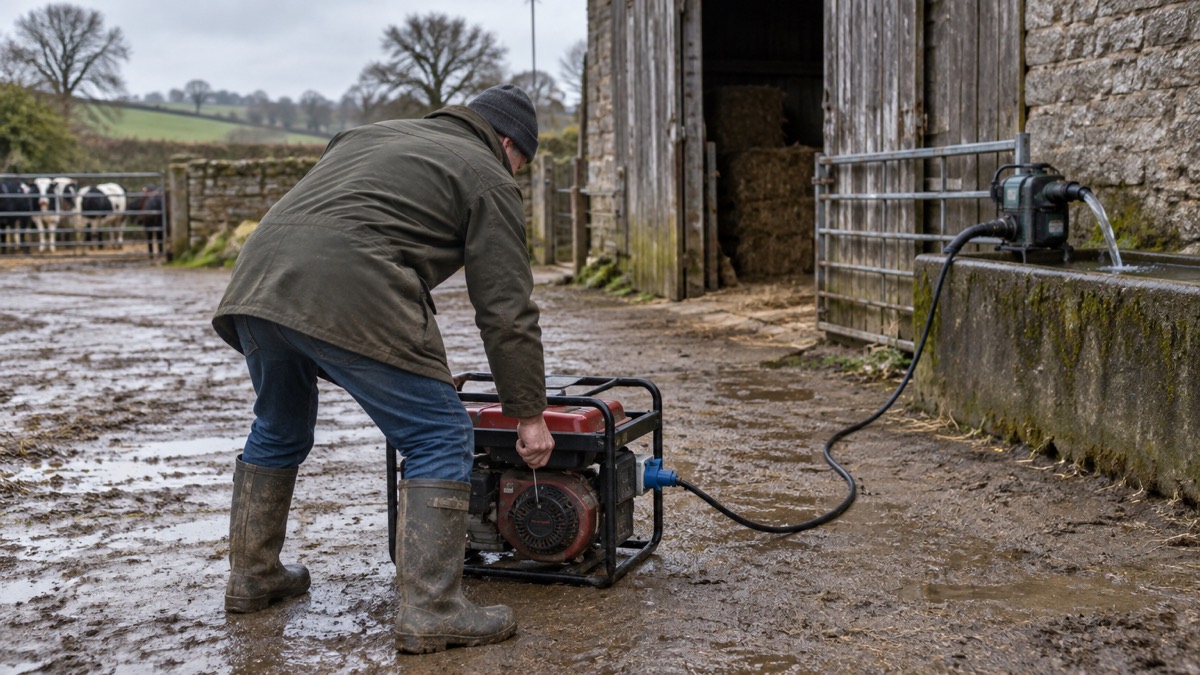
Farmers and livestock owners should check and test backup generators and equipment ahead of storm conditions31. A pump that will not start is the same as no water at all.
For rainwater harvesting systems, remove or avoid roof-mounted aerials or overhanging trees in the collection area, discourage birds from perching on roof collection areas, and consider diverting the first flush of rainwater to waste20. These steps protect the quality of what you collect.
In Wales, a flood alert means preparing a flood kit of essential items, monitoring local river levels, checking the 5 day flood risk, and farmers considering moving livestock and equipment away from areas likely to flood8. In Scotland, the Scottish Environment Protection Agency publishes flood maps and farm and livestock guidance30. In Northern Ireland, official warnings for strong winds and heavy rain include the same advice to farmers and livestock owners to check and test backup generators and equipment31.
Sources (32)
- Water supply interruptions or outages, UK Government (Prepare), 2026
- Private water supplies, Cornwall Council, 2026
- Emergency Guide, Cambridge Water
- Water supply interruptions or outages, UK Government (Be Ready), 2026
- Protecting your farm and livestock, Scottish Environment Protection Agency, 2026
- You prepare for emergency, Slough Borough Council, 2026
- Staying safe in flooding, West Midlands Ambulance Service, 2026
- What to do in a flood, Natural Resources Wales, 2026
- Priority Services Register, Surrey County Council, 2026
- Loss of essential services, Lancashire Prepared, 2026
- Droughts, UK Government (Prepare), 2026
- Drought planning and management, Natural Resources Wales, 2026
- Drought: how it is managed in England, Department for Environment, Food and Rural Affairs, 2026
- Keeping warm or cool in extreme weather, UK Chief Medical Officers, 2025
- Weather and health, Public Health Wales, 2026
- Flooding guide for older communities, Scottish Environment Protection Agency, 2026
- Failure of Water Infrastructure or Loss of Drinking Water - Risk Advice & Articles - Wiltshire & Swindon Prepared, Wiltshire & Swindon Local Resilience Forum (Wiltshire & Swindon Prepared)
- Preparing for an emergency: be ready, stay safe, act now, Sussex Resilience Forum, 2025
- What you might need in a gas outage, Wiltshire and Swindon Prepared, 2026
- Protecting your private water supply, Drinking Water Inspectorate, 2026
- What to do in a power cut | Northern Powergrid, Northern Powergrid
- During flooding, Somerset Council, 2026
- Documents: Be Prepared, Lancaster City Council, 2026
- Farm fire safety, Mid and West Wales Fire and Rescue Service, 2026
- Flooding advice, Mid and West Wales Fire and Rescue Service, 2026
- Wellbeing and safety, Surrey County Council, 2026
- What do if a flood happens, nidirect, 2026
- Help during a flood, UK Government, 2026
- Communities affected by flooding, Derbyshire County Council, 2026
- Flood maps, Scottish Environment Protection Agency, 2026
- Strong winds: weather warning information and advice, nidirect, 2026
- Strong winds and heavy rain: warning information and advice, nidirect, 2026
 Beekeeping Starter Equipment
 Pet Hens Starter Kit
 Bringing Home Rescue Hens
 Hay Bale Fires
 Livestock in a Heatwave
 Sky Lanterns
 BeeBase Registration
 Broody Hen Hatching
 Cleaning a Chicken Coop
 Coop and Run Space for Hens
 Care for Ex-Battery Hens
 Reporting Foulbrood
 Fox-Proofing a Chicken Coop
 Daily Hen Feed Amounts
 Introducing New Hens