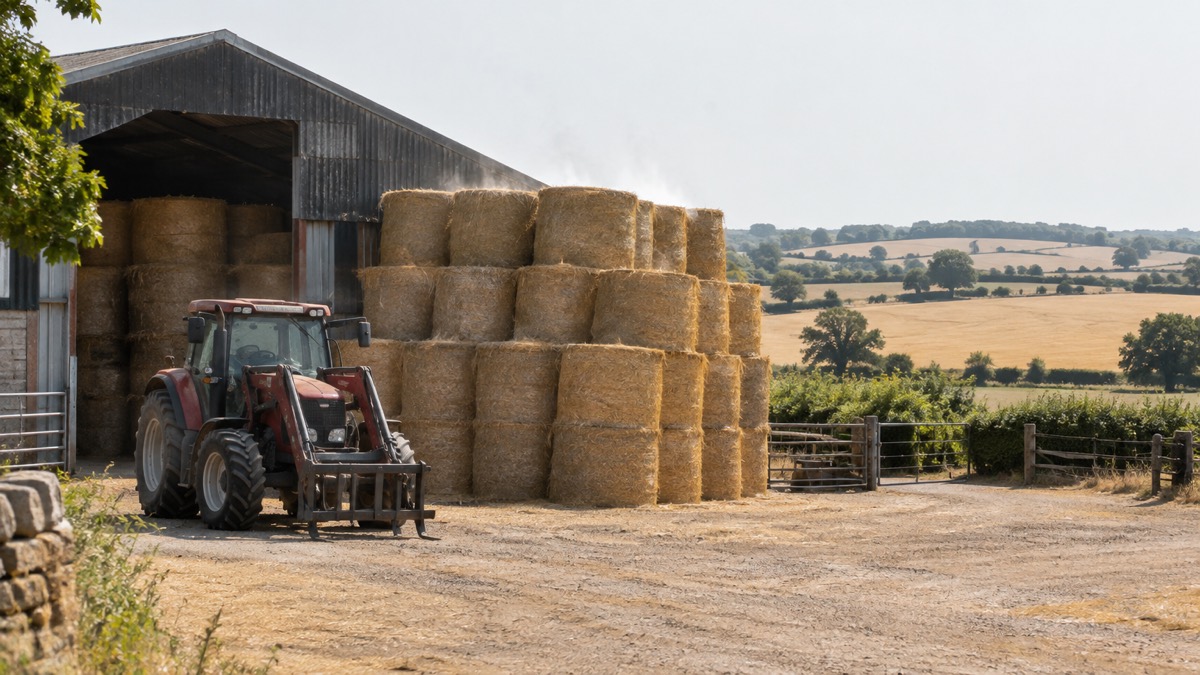
If hay bales are smouldering or on fire, call 999. That is the instruction from Mid and West Wales Fire and Rescue Service, and it applies whether you can see flames or only smell smoke and feel heat deep in the stack1. Do not try to move or break open hot bales yourself, and do not wait to see whether the problem settles.
The bigger risk with hay is often the one you cannot see. Damp bales stacked together can heat up from the inside, and the fire service runs a free service to check bale temperature and moisture content before that happens. A Farm Liaison Officer visit covers this testing, fire prevention advice and a fire plan for your farm, and can include a Safe and Well check at the same time because most farms are also homes1.
This page sets out what to do when bales are already hot or burning, how the free testing works and how to book it, what a Farm Liaison Officer visit covers, and the checks that reduce the risk around storms, fireworks and the rest of the farm.
Smouldering or burning bales: call 999
The first action is the simplest. Mid and West Wales Fire and Rescue Service states plainly: "If the bales are smouldering or on fire, call 999"1. The Welsh-language version of the same guidance carries the same instruction2. Smouldering is not a lesser emergency than flame. A stack that is hot inside can flare up without warning, and the fire service needs to know before that happens.
When you call, be ready to say what is on fire and where. Fire and rescue guidance on emergency calls suggests telling the operator what is on fire, for example "a two-storey house"4. For a bale fire, that means saying how many bales are involved, whether they are in a barn or in the open, and whether any building, vehicle or animal is close by.
The same 999 principle covers the wider farm. If a controlled burn spreads and is no longer controlled, or is at risk of affecting nearby property, call 9996. If a bonfire gets out of hand, call 999 and ask for the fire service immediately7. If you see a fire on moorland, call 999 and ask for the fire service8. And if you see a person in trouble in water, stay on the bank and phone 999, asking for the fire service if inland or the coastguard if by the sea9.
After any fire, the caution does not end when the flames are out. Guidance on wildfires warns that hot spots in the ground may continue to smoulder and can flare up without warning, so use caution when entering or allowing animals on burned areas10. Keep stock off burned ground until you are sure it is cold.
Free bale temperature and moisture testing
The free bale temperature testing service is the practical answer to the hidden risk in a hay stack. The fire service describes it as a check of the temperature and moisture content of the bales, using specialist equipment, followed by a plan to manage the risk of spontaneous combustion: "Depending on the readings we receive, we will then work with you to formulate a plan to manage the risk of spontaneous combustion"1.
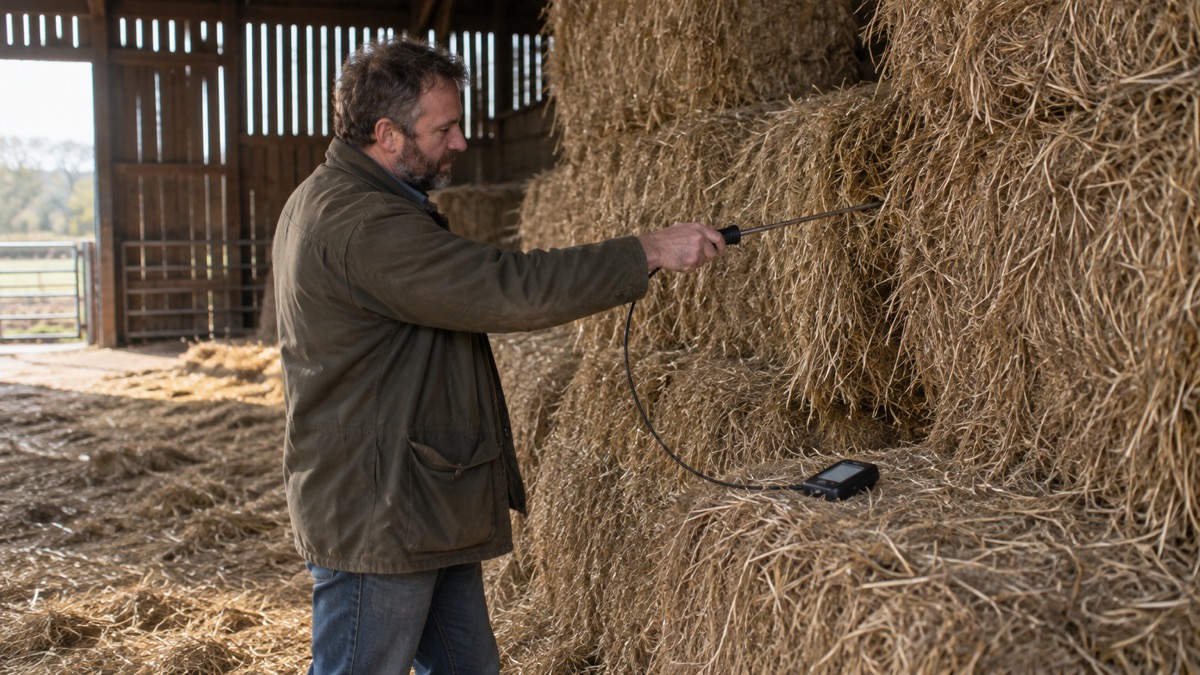
To book, contact the Farm Liaison Officer on 0800 169 12341. The service is described as free, and the visit is carried out with specialist equipment rather than a guess from the outside of the stack.
Why does moisture matter so much? Damp hay packed into a bale cannot shed heat. The fire service's interest is in catching that early, while the readings still give you options: separating bales, improving ventilation, or using them before they heat further. The plan you agree after the readings is the point of the visit, not the number on the meter alone.
| What the service does | What it gives you |
|---|---|
| Checks bale temperature and moisture content with specialist equipment1 | A reading of how hot and how damp the bales are |
| Works with you on a plan to manage the risk of spontaneous combustion1 | Practical steps for your stack, agreed with the officer |
| Booked through the Farm Liaison Officer on 0800 169 12341 | A free visit at a time you arrange |
If bales are already smouldering, testing is not the next step: 999 is1. Testing is for bales that are hot or suspect but not yet alight, and for checking a new stack before problems develop.
What a Farm Liaison Officer visit covers
A Farm Liaison Officer visit is broader than a bale check. The fire service says a visit includes free fire prevention advice, a discussion of fire plans should a fire occur, and a Safe and Well check, since most farms are also homes1. In other words, one appointment can cover the yard, the buildings and the house.
The Safe and Well element is a home fire safety visit under another name. Fire services describe these visits as including fire safety advice, a check that smoke alarms are working, and replacement or installation of new alarms if needed11. Some services go further and offer free interventions such as smoke detectors, smokers' bed packs, fire extinguishing misting systems and smart equipment such as cooker isolators12. Visits can be arranged at any time, day or night13.
For a farmhouse, that combination is useful. The same visit that looks at bale storage and fire plans can check the alarms in the rooms where the family sleeps, because the Farm Liaison Officer can carry out a Safe and Well check at the same time, since most farms are also homes14.
Fire plans and safety checks for farms
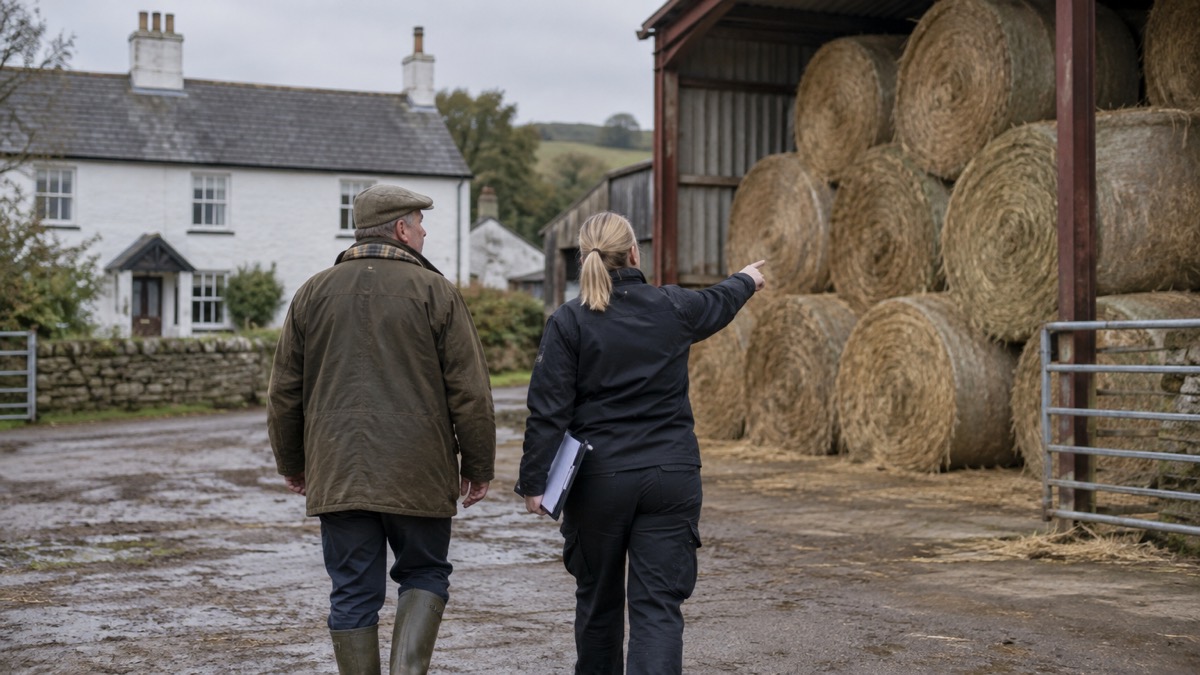
A fire plan is the part of the visit you keep using after the officer has gone. It sets out what happens if a fire starts: who calls 999, where animals go, which buildings and fuel stores are priorities, and how everyone gets out. The fire service discusses fire plans as part of the Farm Liaison Officer visit1.
Around the plan sit routine checks that reduce the chance of a fire starting in the first place.
- Boiler: get the boiler serviced, as the Met Office winter checklist advises15.
- Wood pellet systems: if the system is not heating correctly, or flue gas is flowing into the boiler room, turn the unit off and seek assistance immediately16.
- Loose objects: during storm conditions, secure all loose objects that may be blown around the farmyard17.
- Burned ground: keep animals off burned areas until hot spots are cold, because they can flare up without warning10.
- Fuel spills: deal with any fuel spillage by allowing it to evaporate, soaking into the ground, or covering it with an absorbent material18.
The plan should also say what to do about smoke alarms in the farmhouse. Fire services are clear that smoke alarms save lives, and a working alarm on each level is the baseline that a Safe and Well visit will check5. If the visit finds a gap, the officer can often fit an alarm there and then11.
Fireworks, storms and the risks around the yard
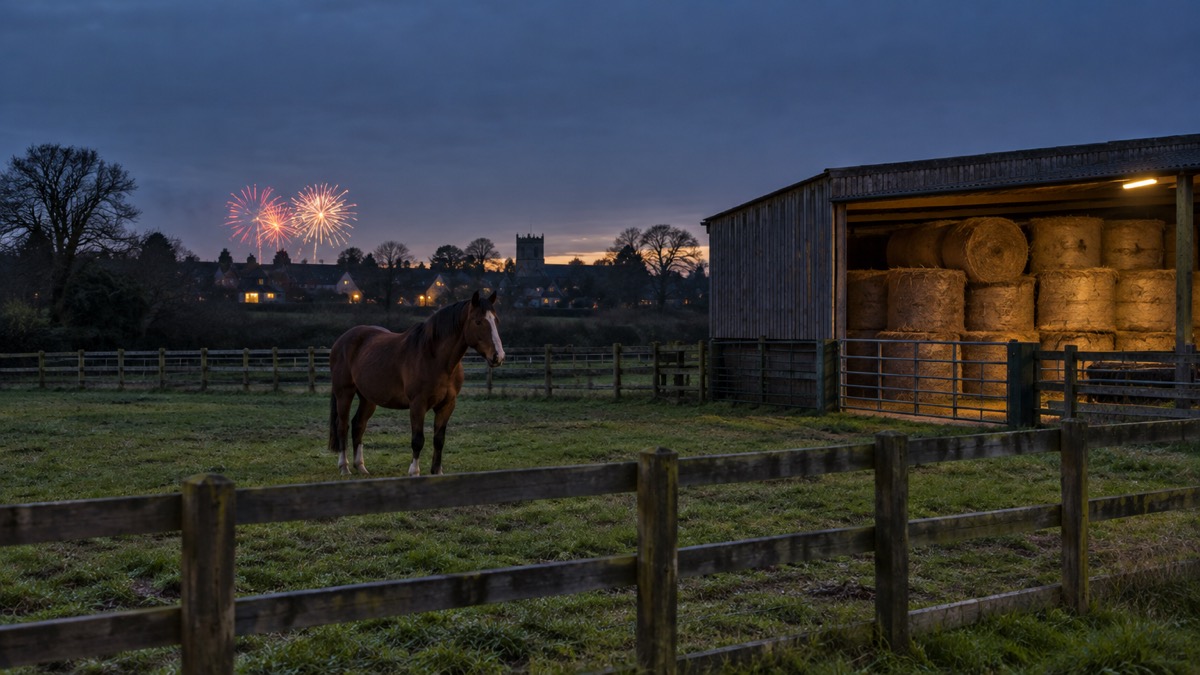
Firework season brings a specific set of risks to a farm with hay, straw and livestock. Fire services advise: "Don't use fireworks near thatched properties or crops, especially during periods of dry weather"3. The same guidance says to stand well back, and warns against launching sky lanterns near built-up areas or roads, crops, thatched buildings, hay bales, trees and power lines3. A lantern landing on a bale stack is exactly the kind of avoidable fire a fire plan should prevent.
For horses, the Scottish SPCA advises securing the perimeter of your field and yard, and making sure there are no hazards that may injure a horse that becomes spooked and tries to bolt during the fireworks19. It also warns: "Think before you act, and don't enter the horse stable if you think they're distressed in case you are harmed"19. Plan where horses will be, check the fencing, and remove anything sharp or loose before the first displays.
Storms bring their own checks. The Northern Ireland Executive's advice for farmers and livestock owners during storm conditions is to secure all loose objects that may be blown around the farmyard17. A sheet of roofing or a feed bin lifted by wind can injure stock or damage a building, and loose metal near power lines is a hazard in itself.
Where to get help
The main route to help for a farm household is the Farm Liaison Service: 0800 169 1234 or farmsliaisonofficer@mawwfire.gov.uk1. Use it to book free bale temperature testing, to arrange a Farm Liaison Officer visit, or to ask about a Safe and Well check1.
For anything already burning or smouldering, the number is 9991. The same applies to a fire that has spread beyond a controlled burn, a bonfire out of hand, or a moorland fire6. If someone is seriously injured, call 999: severe burns and scalds are among the conditions listed as needing an emergency call in Northern Ireland and Scotland20.
If your animals are affected by flooding, storms or heat rather than fire, the household guides on horses and livestock in floods and snow and keeping pets safe before, during and after a flood set out what to do. For firework season specifically, how to keep horses safe during fireworks goes further on stabling and routine. And if you are building a wider household plan, including your pets in a household emergency plan shows where animals fit alongside the rest of the household.
Sources (20)
- Farm fire safety, Mid and West Wales Fire and Rescue Service, 2026-10-29
- Diogelwch tân fferm, Mid and West Wales Fire and Rescue Service, 2026-10-29
- Fireworks, Devon and Somerset Fire and Rescue Service, 2026
- If you are trapped by fire, Essex Prepared, 2026-10-29
- Smoke alarms, Cheshire Fire and Rescue Service, 2026-07-27
- Bonfires and burning waste, Cheshire Fire and Rescue Service, 2026-10-14
- Fireworks and bonfire night, North Yorkshire Fire and Rescue Service, 2026-10-02
- Be Moor Aware, Greater Manchester Fire and Rescue Service, 2026-10-29
- Frozen water safety, Greater Manchester Fire and Rescue Service, 2026-10-29
- Wildfires, Lancashire Prepared, 2026-10-29
- Apply for a Safe and Well visit, Warwickshire County Council, 2026-10-29
- Support for vulnerable people, North Wales Fire and Rescue Service, 2026-10-29
- Alarms, London Fire Brigade, 2026-10-25
- Check if you're eligible for a safer home visit, Suffolk County Council, 2026-10-29
- WeatherReady winter checklist, Met Office, 2026-10-28
- Wood pellet fuels, Health and Safety Executive, 2026
- Strong winds weather warning information and advice, nidirect, 2026-10-24
- Fireworks, Scottish SPCA, 2025-11-04
- When to call 999, Northern Ireland Ambulance Service, 2026-10-29
- When should you call 999, Scottish Ambulance Service, 2026-10-29
 Beekeeping Starter Equipment
 Pet Hens Starter Kit
 Bringing Home Rescue Hens
 Livestock in a Heatwave
 Livestock Water Outage
 Sky Lanterns
 BeeBase Registration
 Broody Hen Hatching
 Cleaning a Chicken Coop
 Coop and Run Space for Hens
 Care for Ex-Battery Hens
 Reporting Foulbrood
 Fox-Proofing a Chicken Coop
 Daily Hen Feed Amounts
 Introducing New Hens