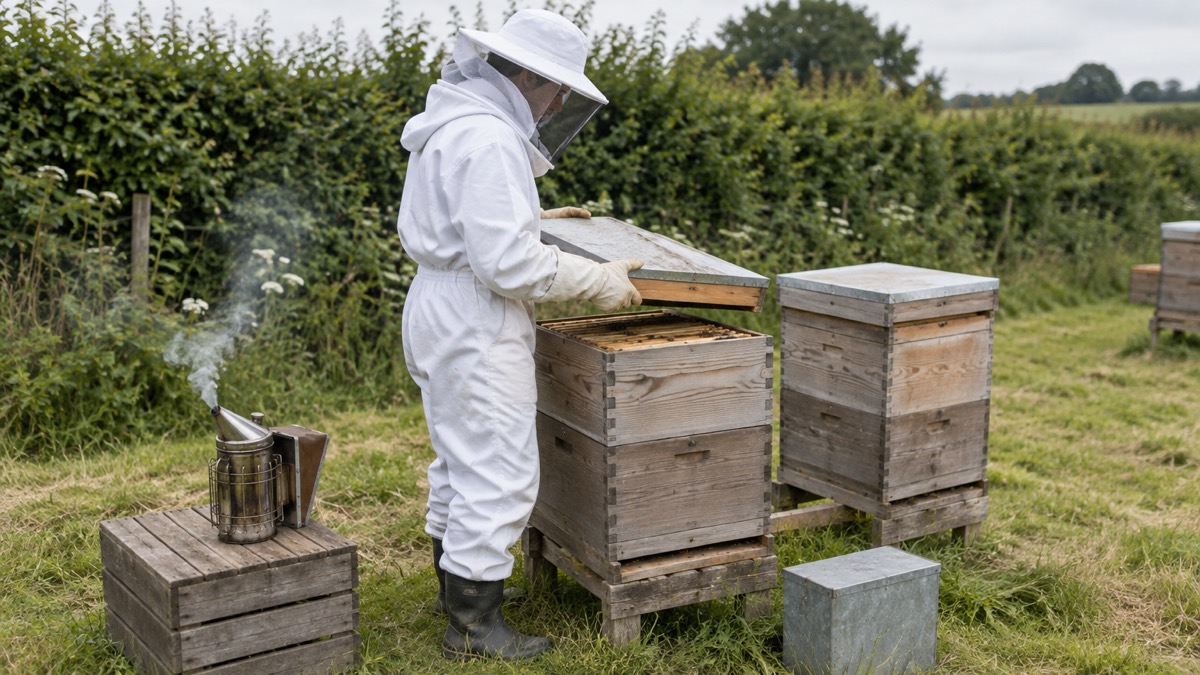
Registering with BeeBase is not a legal requirement1. If you keep honey bees in the UK, no law obliges you to add your apiary to the National Bee Unit's register, and no penalty follows if you do not. What the law does require is narrower and more specific: you must notify the National Bee Unit if you know or suspect your colonies have a notifiable disease or pest1. That duty applies whether or not you are on BeeBase.
The register is still worth joining. It is how the National Bee Unit knows where hives are, so that disease controls and pest warnings reach the right people. But it sits alongside other duties that catch new beekeepers out: bees are classed as food-producing animals, which brings record-keeping obligations for any veterinary medicines you use2, and imported honey bees must come from an approved country and be registered on the Import of Products, Animals, Food and Feed System (IPAFFS)1.
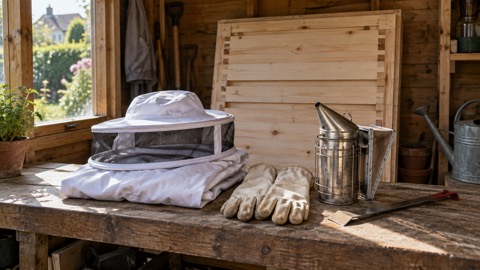
Before any of that, the practical advice from beekeeping bodies is to learn the craft first. The Ulster Beekeepers Association says anyone who wishes to take up beekeeping is strongly advised to do an introduction course, because there is more to it than buying bees and a hive and hoping they will be alright3. The British Beekeepers Association sets out the minimum kit: a suitable hive, a beekeeper suit with disposable gloves covering the wrists, a smoker and fuel, a hive tool and a feeder4.
What the law actually asks of a beekeeper
The legal responsibilities are fewer than new beekeepers often assume, but they are real. The National Bee Unit's own guidance is the place to start: registering with BeeBase is not a legal requirement, but notifying the Unit of a notifiable disease or pest is1. If you suspect foulbrood or another notifiable problem, the obligation is to report it, not to wait and see.
The second duty follows from how bees are classified. As bees are classed as food-producing animals, beekeepers must maintain documentation containing details of veterinary medicines administered to their colonies7. That record must be kept for at least five years, and it applies whether or not the colony is still in your possession or has died7. If you treat for varroa or any other condition, write it down and keep it.
There is an enforcement edge to this. You may be subject to enforcement action if unauthorised veterinary medicines, or high concentrations of authorised ones, are detected in honey sampled from your hives1. That is not a reason to avoid keeping bees; it is a reason to use only what is authorised and to record it properly.
Imports carry their own rules. Imported honey bees must come from an approved country, and the import must be registered on IPAFFS1. If you are buying bees from abroad rather than from a UK supplier or a local swarm, check both points before they arrive.
| Duty | Legal requirement? | Who says |
|---|---|---|
| Joining BeeBase | No | National Bee Unit1 |
| Notifying a notifiable disease or pest | Yes | National Bee Unit1 |
| Recording veterinary medicines for five years | Yes, bees are food-producing animals | National Bee Unit2 |
| Registering imported bees on IPAFFS | Yes, from an approved country | National Bee Unit1 |
Why joining BeeBase is still worth doing
Voluntary does not mean pointless. BeeBase is the National Bee Unit's register of beekeepers and apiaries, and being on it is how you are counted when disease controls, inspections or pest warnings are organised. The same principle applies to other registers: poultry keepers face a legal requirement to register their birds, and registered keepers are notified of bird flu or disease outbreaks in their area and given information on protecting their flock8. The benefit is information reaching you quickly.
For bees, the clearest current example is the yellow-legged hornet. A beekeeper who is known to the authorities, and who knows how to report a suspected sighting, is part of that early warning system.
Joining is also a route into local support. The British Beekeepers Association advises that swarms are usually free but you will need guidance from your local association, and that if the origin is not known the bees can be diseased or bad tempered4. That guidance comes through the same networks that BeeBase connects to.
Setting up a first hive: learn first, then buy
The most common mistake is buying a hive before learning how to use it. The Ulster Beekeepers Association's advice is blunt: to keep bees you must have some background knowledge, as there is more to it than just buying some bees and a hive and setting them in your garden3. Most associations have teaching apiaries, and beginners are advised to learn their skills with experienced beekeepers there before acquiring their own bees3.
A course is the standard route in. The Ulster Beekeepers Association runs an Introduction to Beekeeping course, an Open College Network Northern Ireland Level 1 endorsed course developed by its Education and Assessment Team with CAFRE and OCN NI, aimed at giving those interested in taking up beekeeping the basic knowledge and skills to care for their honey bees9. To register, visit the CAFRE website and enter Beekeeping in the search; an expression of interest can be given there9. By special arrangement with course tutors, 13 to 15 year olds can attend if accompanied by a parent or guardian at all times9.
When you do buy, the minimum equipment list is short and specific4:
- A suitable hive
- A beekeeper suit and disposable Marigold-type gloves that cover the wrists
- A smoker and fuel
- A hive tool
- A feeder
- Bees
A small colony on 3 to 5 frames is the best start2. A full hive later holds around 50,000 bees10, which gives a sense of the scale you are building towards. For a fuller list, see the beekeeping starter equipment checklist and the main guide to beekeeping for beginners.
Reporting a yellow-legged hornet sighting
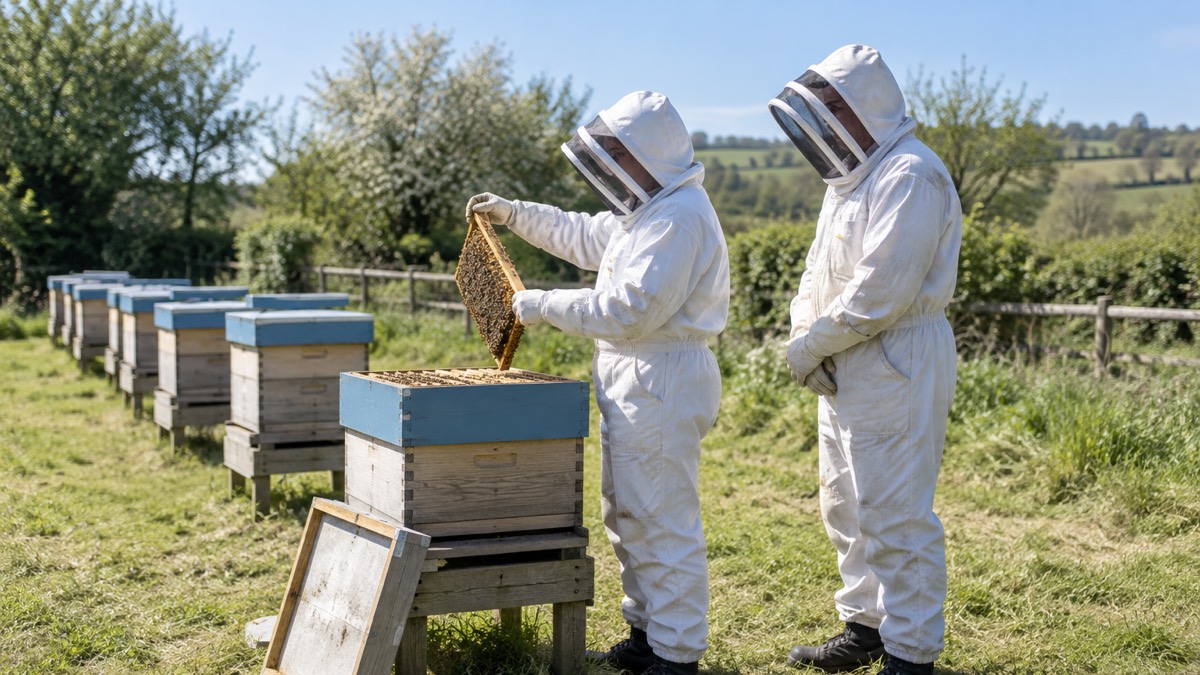
Yellow-legged hornet reporting is one of the few things a beekeeper may be asked to do at short notice, and it is worth knowing the route before you need it. Find out in advance how suspected sightings are reported in your part of the UK, so that you can act quickly when you see one.
Read up on identification before the season starts, so that you can tell a yellow-legged hornet from the insects you see every day. A sighting reported early and accurately is more useful than one reported late, so note where and when you saw it and, if you can, take a photograph.
Swarms are a separate reporting job, and one that non-beekeepers often need. If a swarm lands on your property, the British Beekeepers Association asks for a description or ideally a picture, the size of the cluster, the location and access, the height, how long they have been there, whether anyone else has been called, the address with directions and parking including postcode, and a contact number11. The Ulster Beekeepers Association asks for much the same12. Our guide to what to do if a bee swarm lands on your property covers this in full.
Removing a bee sting with one quick scrape
A bee usually leaves a stinger attached to a venom sac, and the advice is to remove it quickly using a scraping motion with a hard-edged card such as a debit card13. The Anaphylaxis Campaign is specific: the sac should be flicked upwards with one quick scrape of the fingernail or a credit card, which will reduce but not eliminate the risk of a serious reaction5. St John Ambulance says to brush or scrape the sting off sideways with something firm such as a fingernail, credit card or plastic ruler as soon as possible14.
Do not pinch or squeeze the sac. Scraping is the method all three sources describe, and it is the one to teach everyone in the household.
After removal, treat at home: wash the area with soap and water, apply a cold compress or ice pack for at least 10 minutes, raise the affected area if possible, and avoid scratching15. Stings are potentially very dangerous in the head or neck areas, so protective clothing must be worn at all times when working with bees, and watch for signs of anaphylaxis16.
Anaphylaxis risk: get medical advice before you keep bees
Bee venom allergy is the one health issue that should shape a decision about keeping bees, not just a reaction to manage afterwards. The Anaphylaxis Campaign's position is clear: any beekeeper who is at risk of anaphylaxis to bee venom should seek medical advice on how to safely continue beekeeping5. That conversation belongs before the hive arrives, not after a first bad sting.
The same source sets out how to reduce the chance of being stung in the first place: minimise the risk by avoiding things that attract bees and wasps, such as sweet food, bright clothing, and certain fragrances present in hairsprays and cosmetics5. For anyone working at a hive, the protective clothing rule is absolute: stings are potentially very dangerous in the head or neck areas and protective clothing must be worn at all times16.
If someone in the household has a known venom allergy, plan the response before the season. The Anaphylaxis Campaign publishes what to do in an emergency17, and our first aid at home guide covers the wider household picture. Keep the conversation with a GP or allergy clinic going rather than treating a past reaction as a one-off.
Planting for bees, and what a colony produces
You do not need to keep bees to help them, and the planting advice is simple. Choose plants with single, open flowers for easy access to the pollen and nectar, and plant several plants together in a group to attract the bees18. The British Beekeepers Association repeats the same two rules on its gardening page19. Bees also like white and red clover18.
Honey bees do not hibernate, and they are reliant on both nectar and pollen throughout their life cycle, needing food in order to make and store what the colony lives on18. That is why a garden with something in flower across the year beats a single spectacular border.
If you have land and no wish to keep bees yourself, the British Beekeepers Association runs an Offer Land to Bees scheme. To register a site on the map, send your postcode, email address, a short description and a photo of the land, and say whether you are a business or a personal address, to bees@bbka.org.uk10. You can also contact the BBKA office by email to express an interest in offering land for a hive or two19.
On what a colony makes, the Scottish Beekeepers Association gives a working figure: 50,000 bees should be able to produce about 230 g of wax in a day16. Treat that as an indication of what a strong colony can do at its peak, not a number to plan around.
Where to get help and training
The routes into beekeeping are local, and the national bodies point the same way. The British Beekeepers Association's becoming a beekeeper page sets out the minimum kit and the swarm guidance4. The Ulster Beekeepers Association's how to become a beekeeper page carries the teaching apiary advice and the course recommendation3. The Scottish Beekeepers Association publishes guidance on setting up a hive and installing a first colony16.
For disease and pest questions, the National Bee Unit is the authority to turn to. Our guide to honey bee health covers varroa, foulbrood and swarms in more depth, and reporting suspected foulbrood in your hives walks through the notification duty.
If you are starting from scratch and want the wider picture, begin with Beekeeping for Beginners: Hives, Training and Registration, then come back here for the registration question. The self-reliance section sets beekeeping alongside the rest of a household's practical preparations.
Sources (19)
- Legal responsibility of beekeepers, National Bee Unit, 2026-11-04
- Fighting the yellow-legged hornet, British Beekeepers Association, 2026-11-04
- How to become a beekeeper, Ulster Beekeepers Association, 2026-11-04
- Becoming a beekeeper, British Beekeepers Association, 2026-11-04
- Bee and wasp sting allergies, Anaphylaxis Campaign, 2026-10-07
- Honey bee health and advice, Ulster Beekeepers Association, 2026-11-04
- How do I manage Varroa? » APHA - National Bee Unit - BeeBase, APHA - National Bee Unit
- Bird Flu in Chickens: Symptoms, Restrictions & Protection | Woodgreen Pets Charity, Woodgreen Pets Charity
- Introduction to Beekeeping course, Ulster Beekeepers Association, 2026-11-04
- Offer land to bees, British Beekeepers Association, 2026-11-04
- Honey bee swarms information, British Beekeepers Association, 2026-11-04
- Honey bee swarms, Ulster Beekeepers Association, 2026-11-04
- Staying safe over the summer, Healthier Together, 2026-10-29
- Insect bites and stings, St John Ambulance, 2026-10-28
- Enjoy a safe and healthy bank holiday in Devon, Cornwall and the Isles of Scilly, NHS Cornwall and Isles of Scilly, 2026-08-24
- Honey, Scottish Beekeepers Association, 2023-12-18
- What to do in an emergency, Anaphylaxis Campaign, 2026
- Planting for pollinators, British Beekeepers Association, 2026-11-04
- Gardening for bees, British Beekeepers Association, 2026-11-04
 Beekeeping Starter Equipment
 Pet Hens Starter Kit
 Bringing Home Rescue Hens
 Hay Bale Fires
 Livestock in a Heatwave
 Livestock Water Outage
 Sky Lanterns
 Broody Hen Hatching
 Cleaning a Chicken Coop
 Coop and Run Space for Hens
 Care for Ex-Battery Hens
 Reporting Foulbrood
 Fox-Proofing a Chicken Coop
 Daily Hen Feed Amounts
 Introducing New Hens