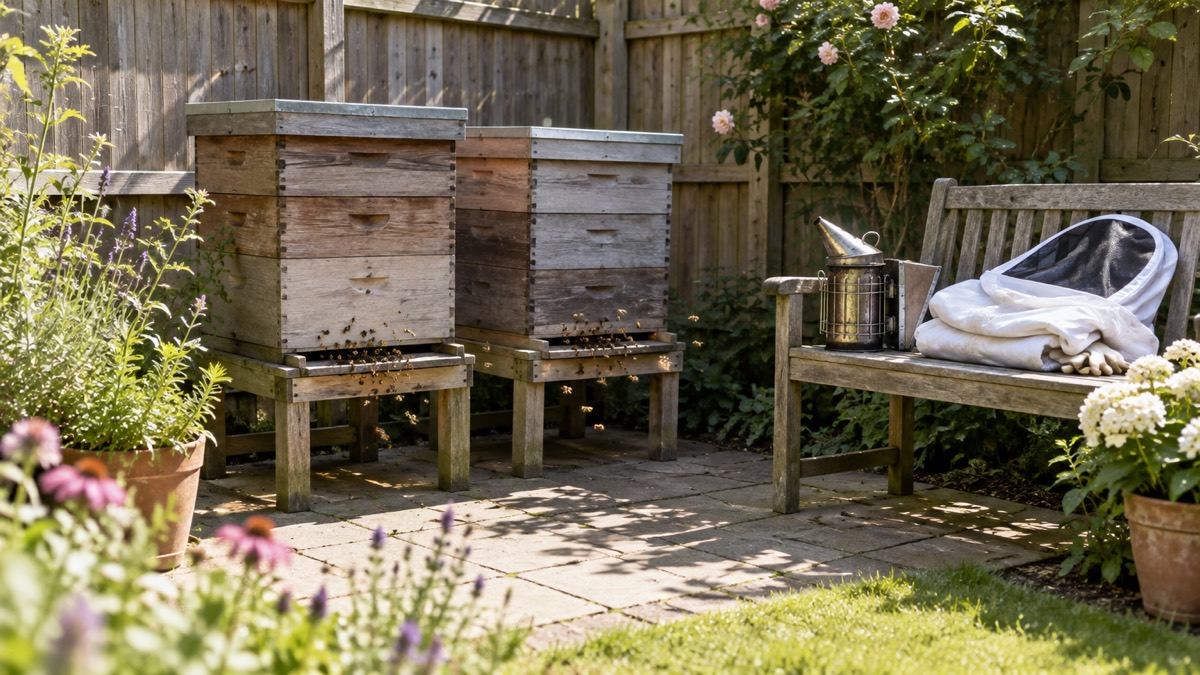
Keeping bees is a craft best learned from people who already do it well. Before you buy a hive or a colony, the single most useful step is to join a local beekeeping association and learn with experienced beekeepers, both in a classroom and at an association apiary where you can handle bees under supervision. The National Bee Unit, which is the government body responsible for honey bee health in England and Wales, is blunt about this: if you are new to beekeeping, get advice from an experienced beekeeper before attempting methods such as taking and hiving a swarm yourself1.
A structured course gives you the foundation. The Introduction to Beekeeping course, an Open College Network Northern Ireland (OCN NI) Level 1 endorsed course developed by the Ulster Beekeepers' Association (UBKA) Education and Assessment Team in conjunction with CAFRE and OCN NI, is delivered in 7 sessions of 2 hours each, held in a classroom or on Zoom, followed by 3 sessions in the local association apiary2. It has 6 units, covering equipment, the natural history of the honeybee, the year's work in the apiary, keeping honeybees healthy, harvesting honey, and practical work with the bees2.
Registration comes next, and it is simpler than many beginners fear. Registering with BeeBase, the Animal and Plant Health Agency's National Bee Unit website, is not a legal requirement, but beekeepers in England, Scotland and Wales who register and provide details of their apiaries receive email alerts about disease and pest outbreaks in their area3. What is a legal requirement is reporting: you must notify the National Bee Unit if you know or suspect your colonies have a notifiable disease or pest4.
Learn with experienced beekeepers before you get your own bees
The most common mistake new beekeepers make is buying equipment and bees before they have any hands-on experience. Bees are livestock, and handling them safely, both for you and for the colony, depends on technique that is much easier to pick up watching someone experienced than from a book. The National Bee Unit's own guidance on taking and hiving a swarm makes the point directly:
"If you are new to beekeeping, it is a great idea to get some advice from an experienced beekeeper about these methods before attempting them yourself."
National Bee Unit guidance1
That advice applies well beyond swarms. Swarm collection is one of the more demanding jobs in beekeeping, and it is also one of the most common ways new beekeepers acquire their first colony, since a swarm taken from someone else's property costs nothing but demands competence. If a swarm arrives on your property, or you are offered one, our page on what to do if a bee swarm lands on your property explains the immediate steps, and when bee swarming season falls helps you anticipate it.
Practical learning also tells you whether beekeeping suits you at all. Some people find they react badly to stings, or that they cannot commit the time through the busy part of the season. Finding that out at an association apiary, in someone else's bees, is far cheaper than finding it out with your own. If you do get stung, our first aid guide covers what to do about bee and wasp stings, including when a reaction needs medical help.
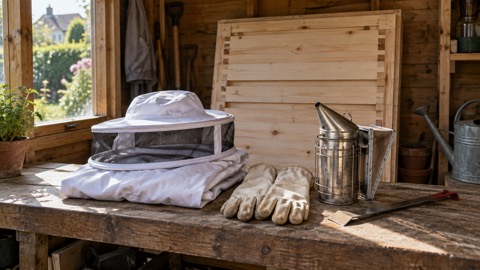
Before you spend anything on kit, work through what a beginner actually needs on our beekeeping starter equipment checklist. And before buying bees or a hive, get to know about handling bees first: the advice to prospective beekeepers is to make an attempt to get to know about handling bees before purchasing their first colony2.
Beekeeping associations: where to find local help
Local beekeeping associations are the backbone of beginner beekeeping in the UK. They run teaching apiaries, pair newcomers with experienced members, and act as the first point of call when something goes wrong in a hive. The best way to find a local beekeeper is to contact the secretary of your Area Beekeeping Association. Structured learning sits alongside this: the Introduction to Beekeeping course runs through 6 units2.
Alongside associations, every beekeeper in England, Scotland and Wales has access to a second layer of free, expert help: the official inspection service. The National Bee Unit publishes general contact details for the NBU and for local bee inspectors covering England, Scotland and Wales, and describes your local bee inspector as a further source of free, expert advice5. Contact your local bee inspector when you want help identifying disease, when you are unsure whether something you have seen in a hive is a problem, or when you need to fulfil your reporting duties and are not sure how.
This two-layer support matters because the problems you will face are rarely unique. Varroa, foulbrood and swarming are the everyday challenges of UK beekeeping, and both associations and inspectors deal with them constantly. Our page on honey bee health goes into varroa, foulbrood and swarms in more depth once you have the basics.
The Introduction to Beekeeping course: six units, classroom and apiary
The Introduction to Beekeeping course is the model of what a beginner course should look like, and it is worth understanding in detail even if you eventually take a different association's course, because most follow a similar shape. Its stated aim is to give those interested in taking up beekeeping the basic knowledge and skills to enable them to care for their honeybees2.
The course is delivered by suitably qualified tutors in 7 sessions of 2 hours each, which may be held in a classroom or on Zoom, followed by 3 sessions in the local association apiary2. That split between theory and practice is the point: the classroom sessions build the understanding, and the apiary sessions turn it into handling skills. The six units are:
| Unit | Title | What it covers |
|---|---|---|
| 1 | Beekeeping Equipment | The kit a beekeeper needs and how it is used |
| 2 | Natural History of the Honeybee | How a colony works: queen, workers, drones and the yearly cycle |
| 3 | Beekeeping: The Year's Work in the Apiary | The seasonal jobs, from spring build-up to preparing for winter |
| 4 | Keeping Honeybees Healthy | Disease and pest recognition, including notifiable diseases |
| 5 | Harvesting Honey | Taking, extracting and storing the crop |
| 6 | Practical Work in the Apiary | Hands-on hive handling under supervision |
Unit 3, the year's work, is the one that answers the question every beginner should ask before starting: what does keeping bees actually involve month by month? A colony needs attention through the active season, with inspections, swarm prevention and disease checks, and preparation for winter in the second half of the year. Unit 4 is where the legal duties around notifiable disease, covered below, are grounded in recognition skills, and Unit 6 is where you find out whether you are comfortable with bees on your hands. Winter losses are a real part of the craft; our page on why bee colonies die over winter explains the main causes.
How the course is assessed and how to register
The course leads to a real qualification, not just a certificate of attendance. It is an Open College Network Northern Ireland (OCN NI) Level 1 endorsed course, developed by the UBKA Education and Assessment Team in conjunction with CAFRE and OCN NI2.
Assessment is split by unit. Units 2 to 5, the classroom units, are assessed by the completion of student workbooks. Units 1 and 6, the equipment and practical units, are assessed by observation of practical tasks. All units must be completed to a satisfactory standard to obtain the Level 1 award2. In practice this means you cannot pass on theory alone: the award depends on demonstrating practical competence in the apiary, which is exactly what you want from a beginner qualification.
To register, visit the CAFRE website and enter "Beekeeping" in the search; an expression of interest can be given on the CAFRE website2. The minimum age for candidates is 16 years. By special arrangement with course tutors, 13 to 15 year olds can attend if accompanied by a parent or guardian at all times2, so families who want to keep bees together can start the training early.
If you are not in Northern Ireland, the same pattern of classroom plus apiary training is offered by associations across England, Scotland and Wales, and your local association is the place to ask. Whichever course you take, check that it includes supervised apiary sessions, because that practical element is what separates genuine training from a lecture series.
Registering on BeeBase: not a legal requirement, but you get local disease alerts
Once you have bees, register on BeeBase. BeeBase is the Animal and Plant Health Agency's (APHA) National Bee Unit website, and beekeepers in England, Scotland and Wales can use the online portal to register as a beekeeper and provide details of their apiaries3.
Registering with BeeBase is not a legal requirement4. But the practical case for it is strong: registered beekeepers who provide details of their apiaries receive email alerts about disease and pest outbreaks in their area3. Those alerts tell you when foulbrood has been found nearby, when an exotic pest such as the small hive beetle is a live concern in your region, and when husbandry advice relevant to your area is issued. An unregistered beekeeper hears about outbreaks late, or not at all.
The contrast with the legal duties is worth being clear about, because beginners often mix them up:
| Requirement | Legal status | What you get or must do |
|---|---|---|
| Register on BeeBase | Not a legal requirement4 | Email alerts about disease and pest outbreaks in your area3 |
| Report notifiable disease or pests | Legal requirement4 | Notify the National Bee Unit if you know or suspect them |
| Report Varroa | Requested by the National Bee Unit5 | Report through the Report Varroa page |
Our page on whether you have to register with BeeBase covers the detail, including how registration works in each nation.
Keep your apiary details current for accurate alerts
Registration is only useful if the details behind it stay accurate. The National Bee Unit asks beekeepers to ensure that the details of their current apiary sites are current and accurate, because this ensures you get the most up to date disease and husbandry alerts3.
This matters more than it might seem. Disease and pest alerts are tied to location: registered beekeepers who provide details of their apiaries receive email alerts about disease and pest outbreaks in their area, so the alert system needs to know an apiary exists to warn you about it. A beekeeper who moves hives to a new site, takes on an out-apiary, or gives one up, and does not update BeeBase, is invisible to the alerts that concern them most. The National Bee Unit's own advice is to ensure that the details of your current apiary sites are current and accurate, as this will ensure you get the most up to date disease and husbandry alerts4.
So treat BeeBase as a living record rather than a one-off form:
- Register when you get your first colony3
- Add each apiary site, not just your home address3
- Update the record when you move hives or change sites3
- Remove sites you no longer use, so alerts stay relevant3
Suspected notifiable disease must be reported to the National Bee Unit
This is the duty that carries legal weight. It is a legal requirement to notify the National Bee Unit (NBU) if you know or suspect your colonies of honey bees to have a notifiable disease or pest4. In England, this duty sits in Article 3 of The Bee Diseases and Pests Control (England) Order 20064.
The notifiable diseases are American foulbrood and European foulbrood. The notifiable pests include the small hive beetle4. Foulbrood is the one you are most likely to meet: both forms are notifiable diseases, and it is a legal requirement to notify the National Bee Unit if you know or suspect your colonies have a notifiable disease or pest, so recognising the signs and acting on them is part of being a responsible beekeeper4. The Introduction to Beekeeping course, across its 6 units, is one way to build that background knowledge before you need it2. If you suspect foulbrood, our page on reporting suspected foulbrood in your hives walks through the steps.
Varroa sits slightly apart. It is not in the same category as foulbrood, but the National Bee Unit asks you to report the presence of Varroa in your hives by going to its Report Varroa page5. The Unit's media gallery contains images of Varroa mites and Varroa damage that may be helpful in identifying the signs of infestation5. Managing varroa is an ongoing part of beekeeping rather than an emergency, and the National Bee Unit's varroa guidance is the place to start5.
One further rule protects your bees and your medicine choices: you must only use veterinary medicines that are authorised for use with honey bees in the UK, and you must use these medicines according to the instructions on the label4. Treatments bought abroad or dosed by guesswork are both against this requirement.
What the National Bee Unit does for beekeepers
The National Bee Unit exists to protect honey bee health, and knowing what it does tells you when to call on it. Its role is to control pests and diseases of honey bees through delivery of a statutory disease inspection programme, apiary surveillance for exotic pests, and education3. For England and Wales, it is the Agriculture Department to which varroa presence is reported6.
The statutory inspection side means bee inspectors can visit apiaries, diagnose disease and require action when notifiable disease is confirmed. The education side is the guidance, courses of reading and images, such as the varroa media gallery, that help beekeepers spot problems early5. The surveillance side is what stands behind the alerts registered beekeepers receive3.
The Unit also holds specific powers that bear directly on what you may do with infected colonies. In exceptional circumstances licences can be issued by the NBU to remove honey from European foulbrood infected colonies or to move infected colonies4. The key word is licences: you may not make those decisions yourself. If European foulbrood is suspected or confirmed in your apiary, the sequence is notify, wait for inspection, and act only on the Unit's instructions or under a licence it issues.
The legal framework the Unit works within is worth a sentence of background, because it explains where its authority comes from. The Bees Act 1980 is an Act of Parliament which empowers Ministers to draw up new Orders for the purpose of preventing the introduction into, or spreading within, Great Britain of pests or diseases which affect bees6. Under it sit the Bee Diseases and Pests Control Orders 2006 for England and Wales, with similar legislation in Scotland and Northern Ireland, and every beekeeper should be familiar with their provisions6.
Choose local bees, not imported bees and queens
When the time comes to get bees, source them locally. Imported bees carry imported risk, and the rules on import exist precisely because of that risk. The bees must come from an approved country4. Unless exported from New Zealand, only queen bees may be imported; packages and colonies are not permitted4. Under present policy, only queen bees and attendant worker bees may be imported from Third Countries, apart from New Zealand, from where queens and package bees are permitted6.
For a beginner, the practical reading of those rules is simple: the legal import routes are narrow, and the bees that travel them are queens and a few attendants, not full colonies. A local beekeeper selling a nucleus, or a swarm collected through your association, gives you bees already adapted to your area, with a known history and someone to ask when you have questions.
If you do handle imported queens, follow the official requirements exactly. Transfer the imported queen bees into new cages prior to putting them into the intended hives, and send the cages in which the queen bees were transported, and the attendant bees, to the NBU laboratory: RM 02G06 Fera Science Ltd, York Biotech Campus, Sand Hutton, York YO41 1LZ4. That laboratory submission is part of the surveillance that protects everyone's bees, including yours.
Where to site your hives
Siting is a practical question with a few firm points. Many beginners keep their first hives at an association apiary, which solves siting, security and supervision at once. At home, a sheltered spot with easy access for working the hive, away from footpaths and neighbours' seating areas, is the aim. An allotment is a common route to land, but check the tenancy agreement first, since rules on keeping animals vary between sites; our guide to allotment tenancy rules explains what to look for.
If your site is on the edge of heathland, moorland or woodland, add one health check to your routine. Ticks are small spider-like creatures found throughout the UK, most common in heathland, moorland and woodlands, though they can also be found in parks and gardens7. Check yourself after a session at the hives, and know how to remove a tick safely if you find one.
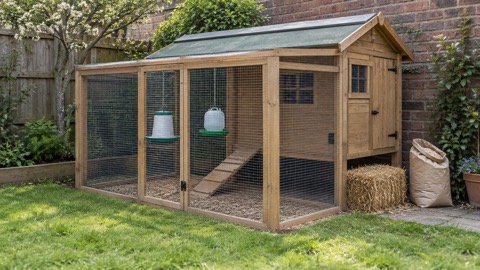
Beekeeping sits naturally alongside other kinds of household self-reliance, from growing your own vegetables to keeping chickens, and bees will work your fruit and vegetable plot hard as pollinators. Our self-reliance section brings the whole picture together.
Sources (7)
- Taking and Hiving a Swarm, National Bee Unit (BBKA News), May 2012, National Bee Unit, 2012-05
- Introduction to Beekeeping Course, Ulster Beekeepers' Association, Ulster Beekeepers' Association, 2026-11-04
- BeeBase, the National Bee Unit website, National Bee Unit, 2026-11-02
- Legal Responsibilities of Beekeepers, National Bee Unit, National Bee Unit, 2026-11-04
- How Do I Manage Varroa, National Bee Unit, National Bee Unit, 2026-11-04
- Bees and the Law, National Bee Unit, National Bee Unit, 2026-11-04
- Checking for Ticks, Forestry and Land Scotland, Forestry and Land Scotland, 2026-10-29
 Beekeeping Starter Equipment
 Pet Hens Starter Kit
 Bringing Home Rescue Hens
 Animal Disease Outbreaks
 Horses and Livestock
 Honey Bee Health
 Chicken Health