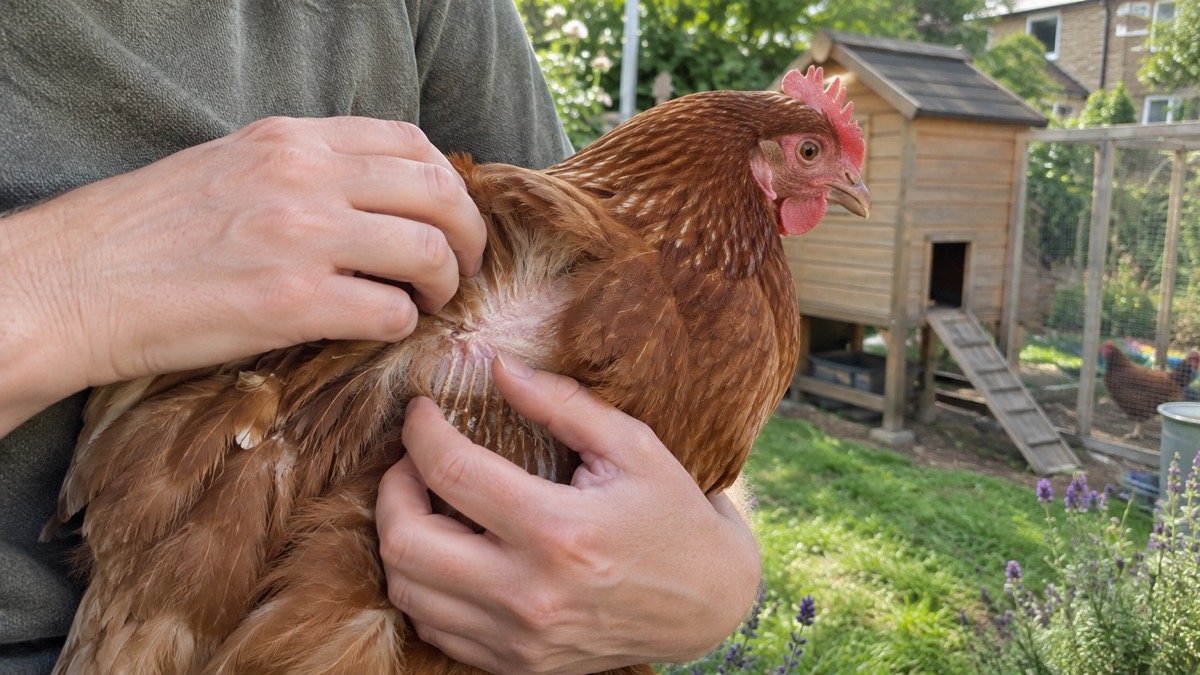
Most chicken health problems in a backyard flock come down to a handful of things: parasites that live on the bird or in the housing, worms in the gut, and crop problems that stop food moving properly. All of them are easier to deal with when you catch them early, and the way to catch them early is a short routine check rather than waiting for a hen to look obviously ill.
A healthy hen should be busy and active, scratching the ground, feeding and drinking well, and preening1. The signs of poor health are consistent across most problems: a hunched posture, erect feathers, head tucked under the wing, hiding in corners, dirty feathers, lameness, runny faeces stuck to the rear feathers, or discharge from the eyes or nostrils2. If you see any of these, contact a vet2. This page walks through the common conditions in the order you are likely to meet them, what to do about each, and when a hen needs professional help. For the day-to-day side of housing and feeding, see Keeping Chickens: Housing, Feeding and the Law.
Red mite: check under the perches at night
Red mite are the parasite most likely to cause serious harm in a backyard flock, because they do not live on the hen. They live in the housing, particularly under perches and in cracks or crevices, and feed on the blood of the bird at night4. Left unattended they are a potential killer4. Because the hens look clean and normal during the day, the only reliable way to find them is to look where they live.
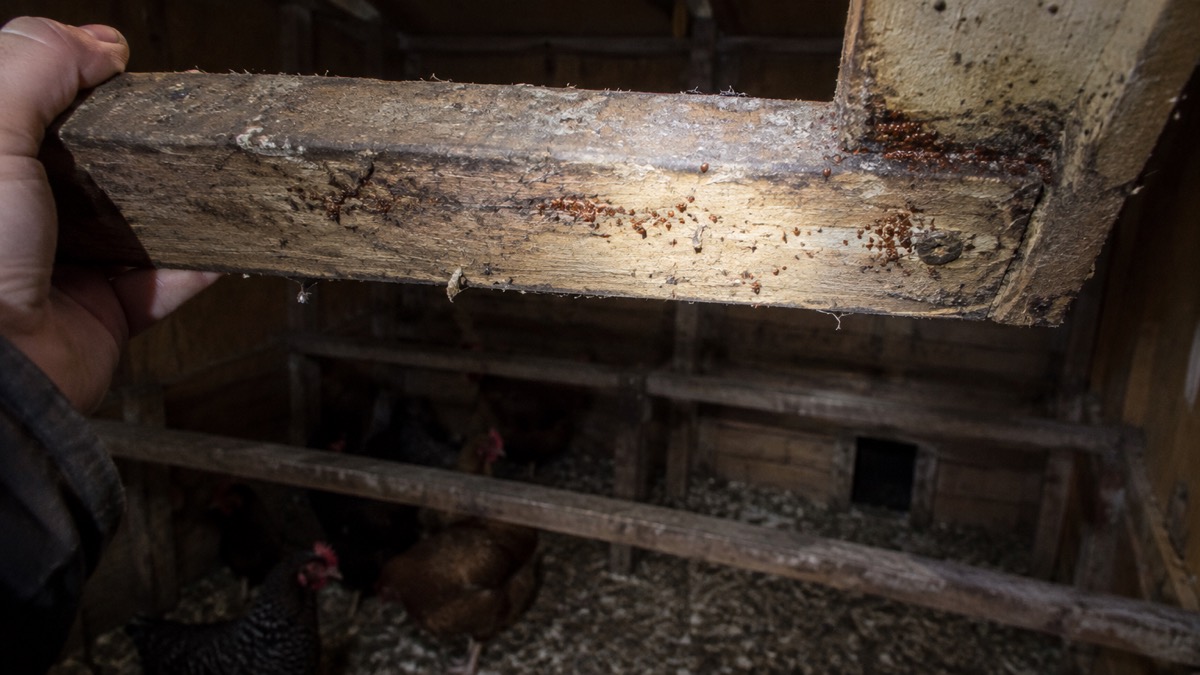
Mites live in cracks, crevices and perches during the day and feed on hens at night3, so the check is simple: go out after dark, or lift the perches in the evening, and look at the underside of the perches and along the joints. Red mites that have had a blood meal will show up as tiny red specks or a cluster of red specks; unfed mites are grey, almost dust-like and harder to spot3. The mites themselves are 0.6 to 1mm, almost invisible to the naked eye3. They are yellow or brown in colour and become red after feeding on blood from hens3.
The signs on the birds come later and are worth knowing. A large mite infestation will cause irritation and, in severe cases, anaemia, and hens will avoid entering the coop or may roost in a different area7. Pale combs and wattles are a symptom of the anaemia red mite cause3. If your hens suddenly start refusing to go in at bedtime, treat that as a red mite warning and check the housing the same evening. Red mite are spread by wild birds3, so a flock that has been healthy all winter can pick them up in spring without anything changing in your own set-up.
Red mite and lice are more commonly seen in summer8, and the British Hen Welfare Trust advises worming and treating all hens against parasites, especially red mite, in the summer months9. With a ten day life cycle, vigilance against this mite is time well spent4: a few mites in June can be an infestation by July, so repeat the perch check through the season rather than doing it once.
Red mite treatment starts with clearing out the coop
Because red mite live in the housing rather than on the bird, treatment starts with the coop, not the hen. Chicken coops need to be cleaned and disinfected regularly to remove parasites8, and the RSPCA advises that to reduce the risk of red mites, or to remove any infestations, you should clean the coop regularly and consider a plastic coop, as red mites struggle to settle in plastic8. Wooden coops, with their joints, screw holes and end grain, give mite far more places to hide by day8.
A full clear-out means removing all bedding and disposing of it in a plastic bag in a bin, as red mites will happily find somewhere else to live10. Brush out the cracks and crevices where mites shelter, and disinfect before replacing the bedding with dry material such as wood shavings or straw, topping up or replacing it when needed8. If the coop has a felt roof, remove it and have the coop re-felted, as mites can harbour beneath the felt11. Our page on How Often to Clean a Chicken Coop and How covers the routine in detail.
Diatomaceous earth products can be liberally sprinkled in nest boxes, around dust bath areas, and on the underside of perches3. The British Hen Welfare Trust describes them as easy, cheap, and safe to use for hens and people alike3. They are a support measure alongside cleaning, not a replacement for it: the mite hiding in a crack you have not brushed out are still there after the powder settles.
Two rules from the British Hen Welfare Trust finish the picture. Treat any newly purchased second-hand equipment before introducing birds3: a cheap second-hand coop can bring a whole colony of mite with it. And when merging flocks, worm and treat all hens against parasites, especially red mite in the summer months9, so that neither group passes anything to the other. See How to Introduce New Hens to an Existing Flock for the merging process itself.
Lice live their whole lives on the hen
Where red mite commute between the housing and the bird, poultry lice do not: they live their entire lives on the body of the host chicken12. That difference decides how you check for them and how you treat them. Lice can usually be easily spotted running on the skin under the wings and around the base of the tail, where they also lay their eggs in clusters12. Adult lice are visible to the naked eye at 3mm12; the RSPCA describes them as 2 to 3mm in size, found all over the body in the skin beneath the feathers, with eggs laid around the shafts of feathers8.
The symptoms to look for are feather loss, frequent scratching, redness, live adult lice seen when feathers are parted, and clusters of nits attached to the base of the feather shaft12. Those nit clusters are very hard and difficult to remove without actually plucking out the feather12. Lice live for one month12, and a female louse will lay between 50 and 300 eggs over her lifetime12, so a small problem does not stay small.
The good news is that healthy chickens will keep their bodies free from lice by daily preening and dust bathing12. Lice are usually spread by bird to bird direct contact and are more normal in sick or injured birds12, because a hen that feels ill preens less. If a hen is unable to dust bathe or has a beak deformity preventing preening, it is advisable to check the feathering frequently for signs of lice eggs or adult lice12. In small quantities lice are not much of an issue, and chickens often suffocate lice by dustbathing; for large infestations a chicken-safe louse powder can be added to the dustbath2.
One reassurance worth stating plainly: poultry lice cannot spread to humans or other species12. You can handle and treat a lousy hen without any risk to your family.
Depluming mite: feather loss that is hard to treat
The depluming mite (knemidocoptes gallinae) can infect most backyard fowl including chickens, ducks and geese13. It burrows into the feather shafts and the skin surrounding the feathers, feeding on fluid that oozes from the damage13, and the pain can be enough to cause the bird to pull out its own feathers13. The Poultry Club of Great Britain notes it is hard to see as it is very small and is usually found in the head and neck region4.
The symptom list is: feather loss, broken or damaged feathers, scratching, increased preening, restlessness, and moulting out of season13. If a hen is losing feathers on the head and neck outside her normal moult, depluming mite is one explanation to raise with a vet.
Two things make this mite harder to manage than lice. First, many birds often carry low numbers of mites without symptoms, but when they are stressed mite numbers grow rapidly13. Second, there is no way to prevent this condition13. The mite spends its entire life on the bird and cannot survive in the environment without birds13, so coop cleaning does not touch it. It reaches adulthood in as little as 17 days and prefers to reproduce in the spring and summer months13, and it gives birth to live young rather than laying eggs13. The British Hen Welfare Trust advises providing a dust bath area with diatomaceous earth powder13, but treatment of an established infestation needs veterinary advice.
Scaly leg mite: raised, crusted scales on the legs
Scaly leg is caused by a mite called Knemidocoptes mutans, which burrows under the skin on a bird's legs to feed on the keratin14. The mite is invisible to the naked eye14, so you diagnose the condition from what it does to the legs, not from seeing the parasite. Raised and encrusted scales on the legs are the indication4.
The tunnelling causes irritation, with leg scales becoming thickened as keratin seeps from the leg tissue, and eventually becoming encrusted and lifting away from the leg. The legs appear lumpy, with large gaps visible between the individual scales, and the skin is thickened and rough14. It lives and burrows under the scales and causes intense irritation4.
The mite is spread by direct contact between birds, and is initially introduced by wild birds, rodents or new flock members14. That makes it one more reason to check new birds before they join the flock, and one more reason to keep rodents away from the run.
For treatment, the Poultry Club of Great Britain advises treating with surgical spirit in a wide-mouthed jar, dunking the legs once a week for three weeks; this is not toxic to the birds4. The British Hen Welfare Trust describes the traditional method of applying a thick coating of Vaseline or Swarfega to the legs daily for one week, which will suffocate the mites and soften the scales; Swarfega will also loosen the scales, which may then shed, revealing pink healthy tissue underneath14. Be patient about appearances: new scales may take some time to grow back, but no lasting damage should be done, and the legs will look abnormal long after the mites have been killed4. The legs may take maybe a year to look normal, as scales grow very slowly and are replaced annually4. As with all the home measures on this page, these are not intended to offer a cure or replace veterinary treatment; seek veterinary advice for further treatment options14.
Worms: roundworms, gapeworms and tapeworms
There are three types of worm parasites in chickens: gapeworms, which live inside the trachea; tapeworms, which attach to the intestinal linings; and roundworms, which are found in the digestive system8. A serious worm infection can be fatal2, so this is not something to leave to chance.
The general signs of worms are reduced egg production, diarrhoea, lethargy, increased appetite, and weight loss in severe cases2. Each type has its own signature. Roundworms cause listlessness, weight loss and lack of thriftiness, and worms may be seen in droppings resembling spaghetti15. Gapeworms cause gasping or gaping, coughing, head shaking and difficulty breathing15, which is easy to mistake for a respiratory problem if you do not know it can be worms. Tapeworm requires an intermediate host, slugs and snails, so chickens can only be infected by eating infected hosts15.
The life cycle explains the prevention. Worm eggs passed by affected chickens thrive in soil and litter, and can either be eaten by earthworms which the chicken then eats, or be ingested directly via soil, faeces or bedding15. Female gapeworms lay their eggs in the trachea, which hatch and are either coughed up or swallowed by the bird before being passed out in droppings; the larvae are eaten by earthworms and slugs, which are then eaten by other hens15. So the ground itself stays infected long after the hen is treated.
That is why the RSPCA advises that chickens need regular worming, particularly if kept in the same outdoor area for more than a month, and that you should move chickens with worms to a new grazing area to prevent reinfection from infested droppings8. The British Hen Welfare Trust's husbandry advice is to carry out routine worming three or four times a year using a licensed product, and to regularly check hens and the coop for external parasites such as red mite5. Beyond worming, establish a routine hen health plan with regular preventative worming, use a ground sanitizer, pick up droppings regularly, change bedding as and when soiled, and prevent chickens from accessing intermediate hosts15.
Sour crop: a crop that stays full and smells
The crop is the pouch at the base of a hen's neck where food is stored before digestion. First thing in the morning the crop should be empty, and it will gradually increase in size as the hen eats6. That daily rhythm is your best early-warning system: a crop that is still full in the morning is telling you something is wrong, whatever the cause turns out to be.
Sour crop, sometimes called thrush, is caused by a yeast infection which makes the crop lining sore and inflamed16. The crop feels like a balloon which has filled with water, and gentle pressure applied to the crop when picking the hen up may cause fluid to spill out from her beak16. If the fluid is thick, smelly or brown it could be sour crop7. The condition can be successfully treated16, but it often recurs if the underlying cause is not discovered16.
Two related crop conditions produce a similar morning check. If the crop feels hard, rather like a wild-bird fat ball, it is impacted6. With an impacted crop, isolate your hen from food sources6; the next morning, if the crop has not reduced in size, the hen should see a vet6. It may be necessary for surgical removal of material from the crop, an often-simple procedure which can be carried out by a vet whilst the hen is conscious, though depending on exactly what is going on it may also warrant general anaesthesia6. Pendulous crop, where the crop becomes massively enlarged and hangs low, shows as reduced feed intake, weight loss and delayed crop emptying17; hens usually cope with this condition fairly well, but it can in some cases lead to sour crop17.
The British Hen Welfare Trust's guidance for sour crop, for use where professional support is not easily available, is: withhold food and water for 24 hours to allow the crop to naturally empty as much as possible; on an empty crop, dose apple cider vinegar diluted to the manufacturer's recommendations, syringed into the side of the beak; 12 hours after the apple cider vinegar administration, offer a few sips of tepid water together with a small amount, a teaspoon, of soft solid food; then monitor to check the sour crop does not return and gradually build up to normal rations of feed and water16. Store feed in weather-proof, rodent-proof containers16 as part of prevention.
Home remedies are not a substitute for a vet
The British Hen Welfare Trust publishes home measures for several conditions, and it attaches the same warning to every one of them, whether for sour crop16, impacted crop6, worms15, lice12, depluming mite13, scaly leg14, bumblefoot18, soft shell eggs19 or prolapse20. The home remedy is not intended to offer a cure or replace veterinary treatment, but may alleviate symptoms where no professional support is easily available, and the suggestions are based on experience gained with the Trust's own hens21.
That is the right way to use them: as first aid or a stopgap, with your vet still in the picture. A hen who looks dull for a day may be fine; a hen who is hunched, hiding, lame, or has a crop that will not empty needs professional attention, and delaying to try remedies first can cost the bird. The Trust's own examination guidance makes the point from the other direction: if you need to talk to a vet, having some information to hand can be useful and may help with diagnosis and treatment1. Note down when you first noticed the problem, what the droppings look like, whether she is eating and drinking, and what the crop feels like.
When a hen needs a vet, including out of hours
Some situations are emergencies. Prolapse, where tissue protrudes from the vent, is one: the British Hen Welfare Trust's advice is "This is an emergency, immediately separate your hen!"20. Suspected heatstroke is another: the signs are open mouth breathing, wings and legs outstretched, reduced appetite and egg production, and staggering or falling over22, and if you suspect your chicken has heatstroke, call a poultry-friendly vet immediately for advice22. These signs can also indicate other health issues, so do not assume heat and self-diagnose22.
For everything else, use the general signs of poor health as your trigger: hunched posture, erect feathers, head tucked under the wing, hiding in corners, dirty feathers, lame, runny faeces stuck to the rear feathers, or discharge from eyes or nostrils. Contact a vet if concerned2. Wood Green's hot weather advice for pets applies the same principle: contact a vet immediately if you have any concerns about your pet's health22. For heat, plan any necessary handling or moving of birds for cooler times of the day, morning or evening23.
Where to get help:
- Your own vet, for any hen that is unwell. Having your observations written down helps with diagnosis and treatment1.
- The British Hen Welfare Trust office, open 10am to 4pm Monday to Friday, for prolapse and other hen health advice20. The Trust also runs a Hen Helpline: if your hen passes a yolk with no shell, contact it19.
- Adoption support: if you experience issues with your hens within the first two weeks of adoption from the British Hen Welfare Trust, contact the Trust and it will do its best to help24.
- Out of hours: your vet's out-of-hours arrangements cover hens as they do other pets. For the wider question of emergency care for animals, see Pets and Animals in an Emergency: A Household Guide.
A few specific conditions and their routes: bumblefoot, a bacterial infection of the foot pad, does not seem to be painful but this varies from hen to hen, with some hens going lame; some hens can improve with antibiotic therapy and soaking the foot in Epsom salts, and exercise will also help18, which means a vet for the antibiotics. An impacted crop that has not reduced in size by the morning after isolating the hen from food needs a vet6. A soft shell egg, a yolk passed with no shell, is a call to the Hen Helpline19.
Vaccination and buying healthy birds
If you are buying ex-commercial hens, you are buying vaccinated birds. All commercial farmers vaccinate, worm and salmonella test their birds, as their eggs form part of the human food chain, but these vaccinations do not always offer lifelong protection24. The British Hen Welfare Trust lists what commercial hens are vaccinated against: Mareks, Gumboro disease, infectious bronchitis of various strains, coccidiosis, salmonella, Newcastle disease, mycoplasma, infectious laryngotracheitis, egg drop syndrome, avian rhinotracheitis, and sometimes pasteurella and E. coli5.
For chicks you breed yourself, vaccination against Marek's disease is feasible: the Poultry Club of Great Britain describes a vaccine administered twice, once in the water as a live vaccine and once by injection when chicks are slightly older4. It also cautions that in other breeds the vaccine can hide the virus, making stock progressively more susceptible, and that diagnosis rests on clinical signs of paralysis and post-mortem lesions4. Discuss the pros and cons with a poultry-friendly vet before deciding.
Buying well matters as much as vaccinating. The Poultry Club's guidance on mycoplasma, a respiratory disease that spreads through flocks, is a good general rule for any purchase: keep stressors to a minimum, use a suitable disinfectant, keep dust and ammonia levels low, feed high quality commercial food, attend to youngest stock first with clean clothes, quarantine new stock for 2 to 3 weeks, and do not buy from auctions4. Quarantine is the single most useful habit: two to three weeks apart lets a problem show itself before it reaches your existing flock. When you do merge, worm and treat all hens against parasites first9.
Dust newly purchased birds with diatomaceous earth, working the powder through the feathers before merging them into your flock3. On an ongoing basis, keep the feed bin secure inside the hen house or a shed or garage to prevent access by wild birds and vermin, and control rodents, as they can be a threat to hens5. Do not overfeed with treats or scatter food on the ground, as this will attract mice and rats and may adversely impact egg production24; a small amount of mixed corn in the afternoon is fine24. For what a hen should eat day to day, see How Much Food Does a Hen Need Each Day?.
One last point on eggs, since a drop in laying is often the first thing a keeper notices and it is usually not illness: egg laying is higher in spring and summer, and production slows in autumn unless the hens are selectively bred laying hens kept indoors with artificial lighting25. A autumn slowdown in a healthy, active flock is the calendar, not a chicken health problem.
Sources (25)
- Hen examination guidelines, British Hen Welfare Trust, 2025-10-30
- Chicken health advice, RSPCA, 2026-10-29
- Red mite in hens, British Hen Welfare Trust, 2026-11-04
- Poultry health and diseases, The Poultry Club of Great Britain, 2026-11-04
- Hen husbandry advice, British Hen Welfare Trust, 2026-06-01
- Impacted crop in hens, British Hen Welfare Trust, 2026-11-04
- Hen health FAQs, British Hen Welfare Trust, 2025-03-31
- Chickens: health and environment, RSPCA, 2026-10-29
- Merging your flocks, British Hen Welfare Trust, 2022-08-17
- Do Your Chickens Have Red Mite? | Chicken Health | Chickens | Guide, Omlet (omlet.co.uk)
- Chicken Parasites | Chicken Health | Chickens | Guide | Omlet UK, Omlet UK
- Lice on hens, British Hen Welfare Trust, 2026-11-04
- Depluming mite in hens, British Hen Welfare Trust, 2026-11-04
- Scaly leg in hens, British Hen Welfare Trust, 2026-11-04
- Worms in hens, British Hen Welfare Trust, 2026-11-04
- Sour crop in hens, British Hen Welfare Trust, 2026-11-04
- Pendulous crop in hens, British Hen Welfare Trust, 2026-11-04
- Bumblefoot in hens, British Hen Welfare Trust, 2026-11-04
- Soft shell eggs, British Hen Welfare Trust, 2026-11-04
- Prolapse in hens, British Hen Welfare Trust, 2026-11-04
- Lash eggs and salpingitis, British Hen Welfare Trust, 2026-11-04
- Caring for small pets in hot weather, Wood Green, 2026-09-02
- Heatstroke and heat illness, NHS inform Scotland, 2026-07-15
- Hen adoption FAQs, British Hen Welfare Trust, 2026-02-05
- Chickens: seasonal advice, RSPCA, 2026-11-04
 Beekeeping Starter Equipment
 Pet Hens Starter Kit
 Bringing Home Rescue Hens
 Animal Disease Outbreaks
 Horses and Livestock
 Honey Bee Health
 Beekeeping for Beginners