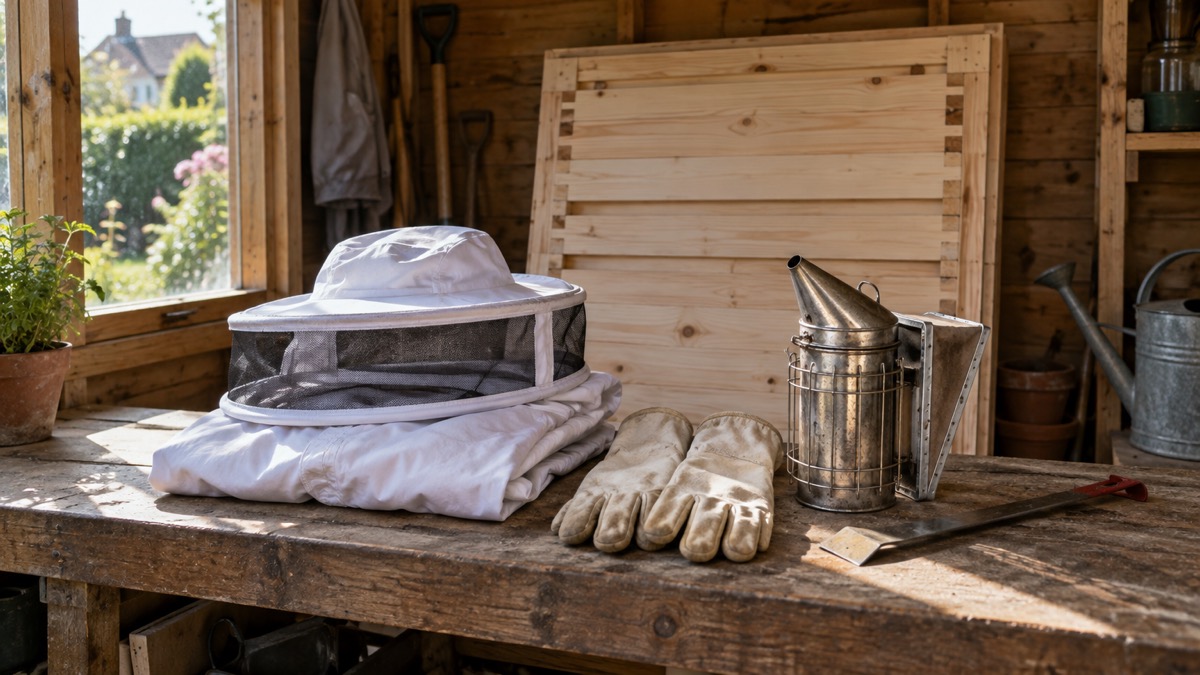
Starting beekeeping is mostly a shopping list and a course, in that order. The kit a beginner needs is a hive with frames and foundation, a bee suit, gloves that cover the wrist, a hive tool, a smoker, a feeder and a water source, and a notebook for the records the National Bee Unit expects you to keep because bees are classed as food-producing animals1. Before any of that, book some training: the Introduction to Beekeeping course is an OCN NI Level 1 endorsed course developed by the UBKA Education and Assessment Team with CAFRE and OCN NI, and it aims to give those interested in taking up beekeeping the basic knowledge and skills to care for their honeybees2.
The safety side matters as much as the shopping. A bee usually leaves a stinger attached to a venom sac, and NHS guidance is to remove it quickly using a scraping motion with a hard-edged card such as a debit card, then wash the skin with soap and water to lower the chance of infection3. If anyone in the household has had a severe reaction to a sting, get medical advice before you take delivery of a colony, because a hive in the garden puts them within reach of bees every week of the season.
This page is the checklist itself, followed by the reasoning: what each item does, how to keep it ready, and where the hard limits lie.
The starter equipment checklist
Work through this list before your bees arrive. Each line says what the item is for, so you can see which pieces you can borrow, which you can buy secondhand, and which you should have new and to hand on day one.
Protective clothing and gloves that cover the wrists
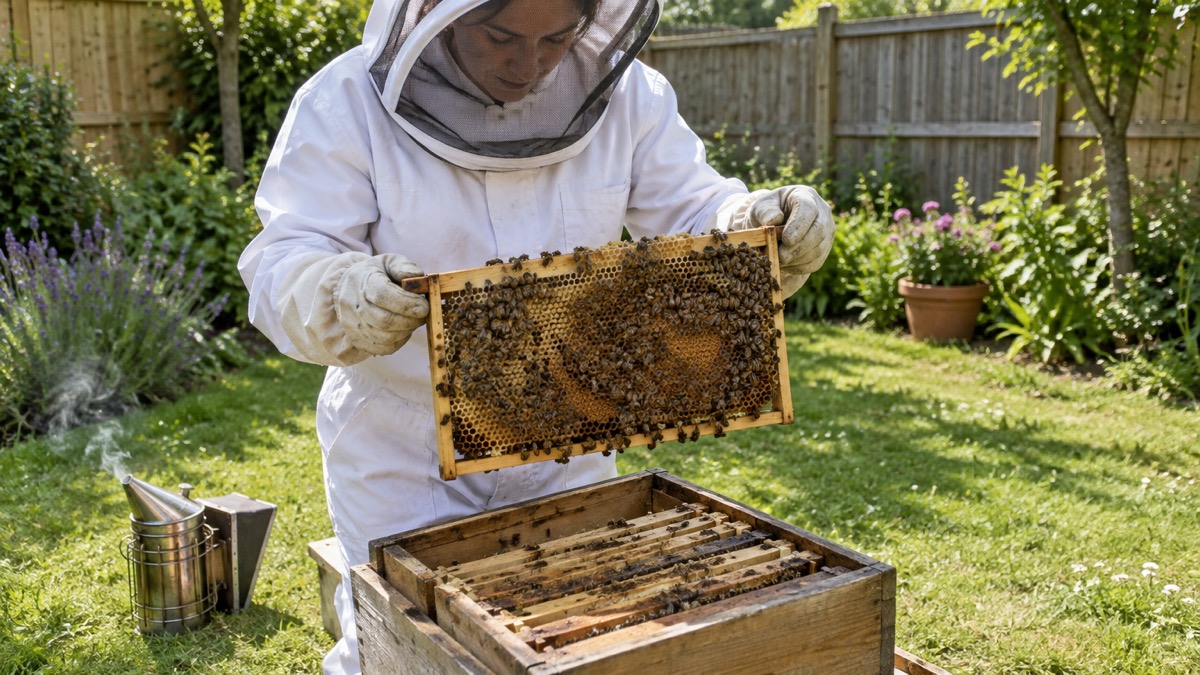
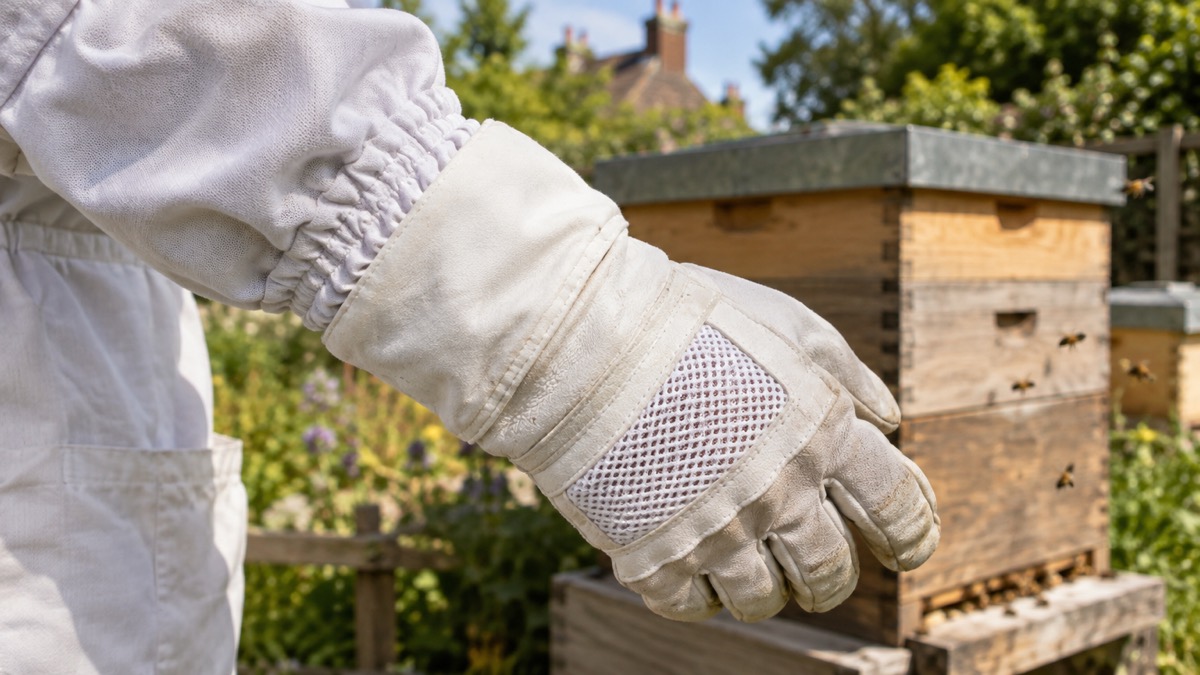
The suit is the piece of kit that decides whether beekeeping is pleasant or miserable. Buy one that fits properly across the shoulders and has a veil that holds clear of your face, and check the cuffs close over the top of your gloves. A gap at the wrist is where bees get in.
Official guidance on protective gloves, written for flood clean-up rather than beekeeping, is a useful standard: wear rubber boots, waterproof gloves and an apron, and if cleaning causes splashing, add a standard face mask and goggles, which can be reused after thorough washing7. The same principle applies at the hive. Gloves should be waterproof enough to keep venom off your skin and long enough to overlap your sleeve. Disposable gloves are cheap and hygienic but tear; leather gloves last but need cleaning and can carry alarm pheromone from a previous inspection. Whichever you choose, follow the maker's own instructions for that product.
A first aid kit belongs in the apiary bag, not just the house. The Be Ready checklist expects waterproof plasters, bandages, a thermometer, antiseptic, eyewash solution, sterile dressings and gloves, medical tape and tweezers10.
Bee stings: flick the sac out with one quick scrape
A bee usually leaves behind a stinger attached to a venom sac. NHS guidance for children is to remove it quickly using a scraping motion with a hard-edged card such as a debit card3. Do it in one movement, then wash the affected area with soap and water4. If there is nothing left in the skin, or the sting has already been removed, wash the skin with soap and water to lower the chance of infection, and ask a pharmacist about antihistamines, steroid creams and painkillers4.
Most stings settle with that. The reason to learn the routine before you keep bees is that a colony inspection can produce several stings in a minute if something has gone wrong, and fumbling then is what turns a small incident into a bad afternoon.
If someone with a known allergy is stung and then becomes unwell, do not wait to see how it develops. Sepsis guidance from NHS Wales is blunt about the general principle: clean and care for any wounds, and seek help when someone is seriously unwell11.
Where beekeeping must stop: anaphylaxis risk needs medical advice first
Beekeeping is not a hobby you can start safely in a household where someone has a diagnosed allergy to bee or wasp venom without medical advice first. The kit list above assumes a household that can be stung and recover. If that is not your household, the conversation with a GP or allergy clinic comes before the order for a hive, not after.
The same applies to neighbours. A hive in a small garden puts bees into the airspace of everyone around you, and you cannot know who two doors down carries an auto-injector. Site the hive so the flight path goes up and over a fence or hedge rather than across a path, and talk to the people next door before the colony arrives.
There is a second, quieter limit: competence. A colony that is not managed swarms, and a swarm on a neighbour's property is a problem you have to solve. The advice is that you must have some background knowledge before you start, because there is more to beekeeping than buying bees and a hive and hoping they will be alright2.
Bees as food-producing animals, and the records that follow
The National Bee Unit classes bees as food-producing animals, and beekeepers must maintain documentation containing details of veterinary medicines used1. That single sentence changes what belongs in your starter kit: a notebook and a pen are not optional extras, they are part of the equipment.
In practice, keep a simple hive record. Note the date, the colony, what you did and any treatment given. Keep it with the hive tool so it is there when you need it. If you later sell honey or move bees, that record is the thing you will be asked for.
Varroa is the reason a beginner needs a monitoring routine from the first season, not the third. Read the National Bee Unit's guidance before your bees arrive so you know what you are looking at.
Beginner courses and guides
The Introduction to Beekeeping course is an OCN NI Level 1 endorsed course developed by the UBKA Education and Assessment Team in conjunction with CAFRE and OCN NI2. It aims to give those interested in taking up beekeeping the basic knowledge and skills to enable them to care for their honeybees2.
The syllabus is a good proxy for what you need to know before you buy anything:
| Unit | What it covers |
|---|---|
| Unit 1 | Beekeeping equipment2 |
| Unit 2 | Natural history of the honeybee2 |
| Unit 3 | Beekeeping: the year's work in the apiary2 |
| Unit 4 | Keeping honeybees healthy2 |
| Unit 5 | Harvesting honey2 |
| Unit 6 | Practical work in the apiary2 |
To register, visit the CAFRE website and enter "Beekeeping" in the search; an expression of interest can be given on the CAFRE website2. The course is Northern Ireland based, so if you are in England, Scotland or Wales, ask your local beekeeping association for their beginner course and use this syllabus as the checklist of what it should cover.
Keeping the kit clean and ready between inspections
Kit that is dirty or damp is kit that fails when you need it. The general household emergency guidance is a reasonable model: keep supplies together, stored high up in a box, and check them12. Do the same with your bee bag.
- Clean the suit and gloves after every inspection. Wash according to the maker's instructions and dry fully before storing.
- Keep the first aid kit stocked. The standard list includes plasters, bandages, a thermometer, antiseptic, eyewash, sterile dressings and gloves, medical tape and tweezers13.
- Store the smoker empty and cool. Never put it away warm.
- Check the hive tool and feeder for damage before the season starts.
- Keep the notebook with the kit, so records are made at the hive rather than from memory.
A tick removal tool is worth adding if you keep bees near rough ground or walk to the apiary through long grass. Forestry and Land Scotland guidance is to engage the tick from the side, lift the hook very lightly and turn until the tick detaches, following the manufacturer's instructions for the specific tool14.
Where to get help
If you are stung and it is not settling, a pharmacist can advise about antihistamines, steroid creams and painkillers4. For a severe reaction, call 999 and follow the anaphylaxis guidance above5.
For beekeeping itself, the National Bee Unit is the official source on colony health and records1, and the UBKA course is the route into structured training in Northern Ireland2. Your local association is the place to ask about a mentor, a swarm collector and what actually works in your area.
If you are building the wider household kit alongside the bee kit, the emergency kit section covers what a UK household should keep ready, and the first aid at home guide covers the household side of stings and wounds. For the beekeeping side, start with Beekeeping for Beginners and Honey Bee Health, and if a swarm arrives before you are ready for it, what to do if a bee swarm lands on your property sets out the steps.
Sources (14)
- How do I manage varroa, National Bee Unit, 2026
- Introduction to Beekeeping Course, Ulster Beekeepers Association, 2026
- Staying safe over the summer, Healthier Together, 2026
- Summer safety, Cheshire and Wirral Partnership NHS Foundation Trust, 2026
- Anaphylaxis first aid, NHS inform, 2026
- Adrenaline auto-injectors, GOV.UK, 2023
- Flooding and health, Public Health Wales, 2026
- After a flood, Surrey County Council, 2026
- What to keep in your medicine cabinet, Healthier Together, 2026
- Be ready for emergencies - Be Ready, prepare.campaign.gov.uk (Be Ready campaign)
- Sepsis, NHS 111 Wales, 2026
- Flooding checklist for residents - Perth & Kinross Council, Perth & Kinross Council
- Be ready for emergencies - Be Ready, UK government (Be Ready campaign, beready.campaign.gov.uk)
- Checking for ticks, Forestry and Land Scotland, 2026
 Pet Hens Starter Kit
 Bringing Home Rescue Hens
 Hydroponic System Parts List