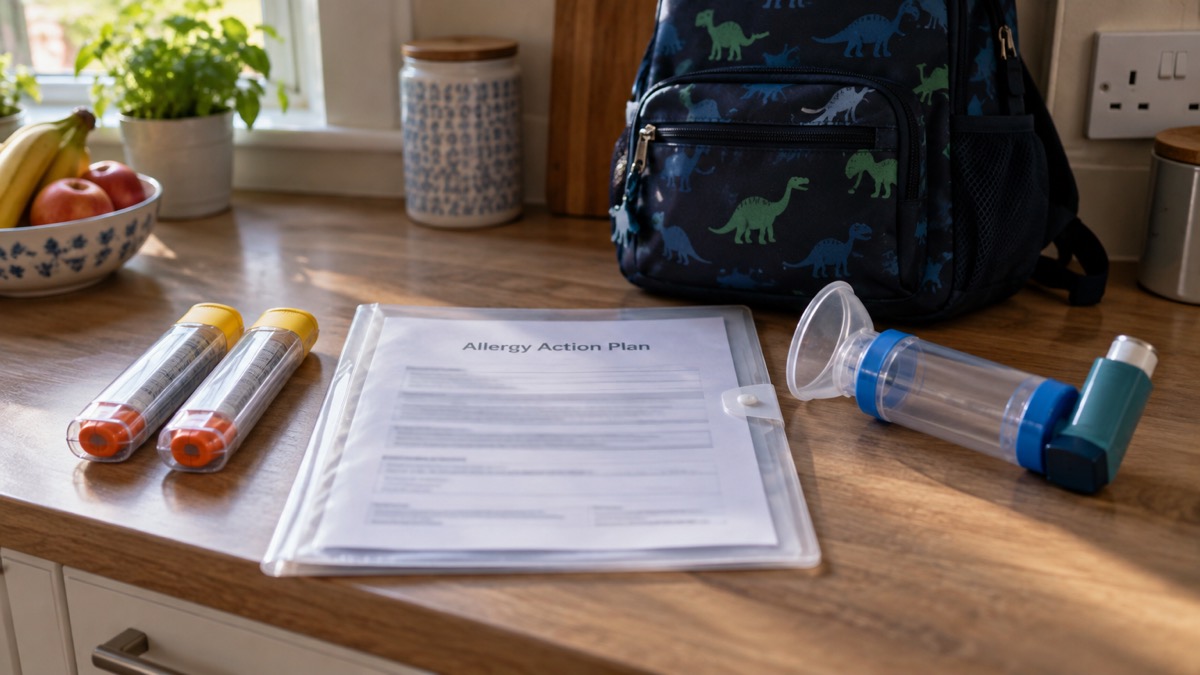
An allergy action plan is a written set of instructions and information specific to one person's allergy and treatment. NHS guidance on adrenaline auto-injectors is direct about it: "Having an Allergy Action Plan is advisable"1. The plan records what the person is allergic to, what a reaction looks like for them, which medicines to give and when, and who to contact. A paediatric (child) version exists for the different types of adrenaline auto-injector devices and can be downloaded from bsaci.org, the website of the British Society for Allergy and Clinical Immunology1.
The point of writing it down is that in a real reaction you may not be the person holding the pen. A teacher, a grandparent, a childminder or a passer-by may be the one who has to act, and a plan means they do not have to guess. The same logic sits behind every kind of household emergency plan: official guidance across the UK encourages families to write down in advance what needs to happen and who should be contacted, so the plan works even when the person who normally manages the situation cannot2.
This page explains what goes on an allergy or asthma action plan, who should have one, how to get one from your GP or allergy clinic, and how to keep it ready at home, at school and in an emergency. For what to do in the moment, see What to Do if You Suspect Anaphylaxis and Adrenaline Auto-Injectors: Carrying, Using and Storing Them.
What an allergy action plan is for
An allergy action plan is a short written document that answers, in advance, the questions anyone would ask in a reaction: what is this person allergic to, what does a reaction look like for them, what medicine do they carry, when should it be given, and who do you call? NHS guidance describes it as "a written set of instructions and information specific to the individuals allergy and tre[atment]"1. That word, specific, is the whole idea. A generic leaflet about allergies tells a helper what anaphylaxis is in general; your plan tells them that this child reacts to milk, carries two auto-injectors in the left pocket of their school bag, and that the first dose should be given at the first sign of a reaction.
The plan removes two failures that emergency planning guidance warns about everywhere else. The first is delay: someone hesitating because they are not sure the situation is serious enough. NHS patient safety guidance on adrenaline auto-injectors settles that in one line: "use your AAI if you think you may have anaphylaxis, even if your symptoms are mild"4. If that sentence is on the plan, a helper does not have to weigh it up themselves. The second failure is missing information: the right medicine being in a different room, or nobody knowing which brand of device the person carries. The plan should travel with the medicines, and the medicines should be where the plan says they are.
This is the same structure official guidance recommends for any household or carer emergency plan. Suffolk County Council's guidance on family carer emergency plans says a plan "sets out in advance what needs to happen to the person you care for in an emergency if you are unable to continue providing care, and identifies someone to be contacted"2. An allergy action plan does exactly this for one specific medical risk, and it slots into the wider household plan: the household plan says who collects the child and where the family meets; the allergy plan says what to do for the child's allergy on the way.
Who gets an allergy action plan
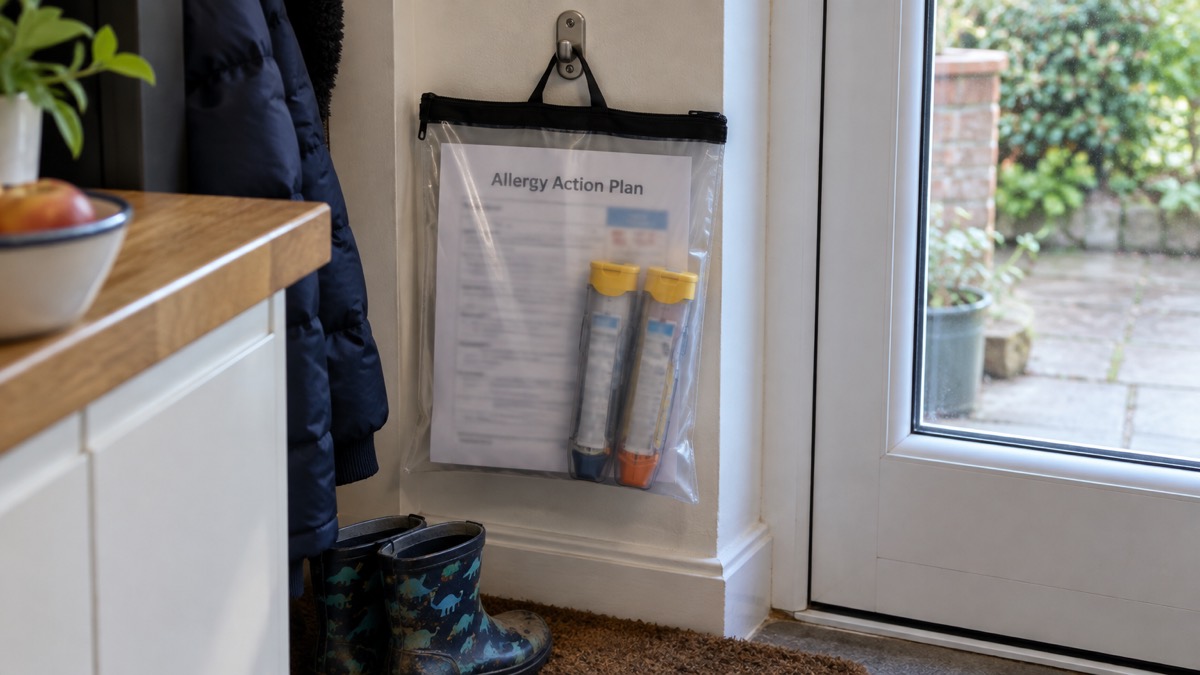
The people who need one most are those at risk of anaphylaxis, a severe allergic reaction, particularly anyone prescribed adrenaline auto-injectors. NHS guidance on auto-injectors states plainly that having an Allergy Action Plan is advisable, and that a paediatric version for the different types of AAI devices can be downloaded from bsaci.org1. If you or your child carries adrenaline, you should have a plan, and the plan should name the exact device, because brands differ in how they are used.
Beyond that, the wider principle from carer and emergency planning guidance is that a written plan is for anyone whose care depends on a particular person knowing what to do. Norfolk's carer emergency plan guidance puts the responsibility on you: "You are responsible for keeping your emergency plan up-to-date"6. Suffolk's guidance frames eligibility around dependence: "The plan is for carers who are depended on as the main source of support for a person"2. In practice that means a plan matters whenever someone other than the person with the allergy may have to act: children at school or nursery, adults cared for by family members, and anyone whose reaction could leave them unable to explain themselves.
For adults with allergies, Torbay and South Devon NHS carer guidance recommends keeping an "up-to-date list of medication/ repeat prescription with allergies" in a hospital grab bag7. That list and an allergy action plan do the same job from opposite ends: the plan tells a helper what to do before hospital; the medication list tells hospital staff what they need to know about you. The British Society for Allergy and Clinical Immunology currently provides separate plans for adults and children at risk of anaphylaxis, so adults with severe allergies can hold a plan of their own rather than relying on a paediatric version1.
Recognising an allergic reaction and anaphylaxis
A plan only works if the people around the person with the allergy can recognise what they are seeing. Anaphylaxis is a severe allergic reaction, and the NHS anaphylaxis safety campaign lists its main causes: exposure to an allergic substance, which may include foods such as nuts, cows' milk, eggs, fish, shellfish or sesame seeds; insect stings such as wasp and bee stings; medicines such as antibiotics or NSAIDs; anaesthetics; latex; aerobic exercise; and sometimes unknown causes4. NHS child health guidance gives a similar everyday list: "Pollen, stings and bites, latex and some food items, such as nuts, shellfish, eggs or dairy products, are all common cau[ses]"8.
| Common trigger | Examples from official guidance |
|---|---|
| Foods | Nuts, cows' milk, eggs, fish, shellfish, sesame seeds, dairy products4 |
| Stings and bites | Wasp and bee stings4 |
| Medicines | Antibiotics, NSAIDs, anaesthetics4 |
| Other | Latex, pollen, aerobic exercise; sometimes the cause is unknown4 |
The plan should list the person's own triggers from this list, because a helper who knows a child reacts to sesame will read a food label differently. It should also describe what a reaction actually looks like for that person, since reactions vary between individuals and between episodes.
The critical instruction, and the one most worth writing in large letters on any plan, comes from the NHS anaphylaxis safety campaign: "use your AAI if you think you may have anaphylaxis, even if your symptoms are mild"4. Hesitation is the danger here. People wait to see whether symptoms worsen, and official guidance is designed to remove that wait. If in doubt, use the device and call 999. For the full sequence of what to do, see What to Do if You Suspect Anaphylaxis, and for the devices themselves, Adrenaline Auto-Injectors: Carrying, Using and Storing Them.
"use your AAI if you think you may have anaphylaxis, even if your symptoms are mild."
Separate plans for adults and children at risk of anaphylaxis
The NHS publishes a paediatric (child) action plan format, available for the different types of adrenaline auto-injector devices and downloadable from bsaci.org1. The reason children get their own format is that a child's plan has to work in the hands of adults who are not their parents: teachers, nursery staff, dinner supervisors, grandparents. It has to say where the child's auto-injectors are kept, who gives them, and who calls whom, in language a stranger can follow in a hurry.
Adults at risk of anaphylaxis need the same information in a form that works for colleagues, friends and carers. The adult plan should also connect to any wider care arrangements. Lincolnshire's person-centred fire risk assessment guidance makes a general point that applies to any care plan: "if a care plan exists, actions taken to mitigate risks should be noted in that plan"9. If you have a carer, a care plan or a carer's emergency plan, the allergy action plan's key instructions should appear there too, so that everyone helping you is working from the same page.
Where children or vulnerable adults need help from a specific person, that should be written down. Scottish Fire and Rescue Service guidance on escape planning states: "It is important to know who will be responsible for assisting children, vulnerable adults and/or those who need special assistance"10. Substitute "in an allergic reaction" for "in a fire" and the principle is identical: name the person, and name a backup. In a school, that naming is done through the school's own procedures; at home and in the community, it belongs on the plan itself.
What an asthma action plan tells you
An asthma action plan is the parallel document for asthma. It records what the person's asthma is like day to day, what medicines they take, what to do when symptoms worsen, and when to get help. The Met Office's guidance on asthma and air pollution, which addresses people with asthma directly, gives one instruction that belongs on every plan: "Keep taking your regular preventer medicines as prescribed by your doctor"5. A reliever inhaler is for attacks; a preventer is the daily medicine that reduces the chance of an attack happening, and stopping it is a common way people drift into trouble.
Asthma attacks can be "triggered by exercise, exposure to allergens and other triggers"5. That overlap with allergies is why the two plans belong together in this guide: many households have both, and the same triggers, from pollen to food, can set off either. An asthma action plan should list the person's own triggers so that on a high pollen day, or after exercise, everyone knows to watch for symptoms and to have the reliever inhaler to hand.
| What the plan records | Why it matters |
|---|---|
| Daily preventer medicine, as prescribed | Keep taking it even when well5 |
| Reliever inhaler and when to use it | Attacks can be triggered by exercise, allergens and other triggers5 |
| The person's own triggers | Allergens and exercise are common attack triggers5 |
| What to do as symptoms worsen | Tells carers, teachers and family when to step up and when to seek help |
If an attack happens, the plan is not a substitute for first aid. See What to Do in an Asthma Attack, Even Without an Inhaler for the steps to take in the moment, and First Aid at Home: A Household Guide for the wider picture.
Getting a plan from your GP or allergy clinic
Your GP or allergy clinic is where a plan is completed. The BSACI templates, including the paediatric version for the different auto-injector devices, are downloadable from bsaci.org, but the finished plan has to be filled in to match the individual: their allergies, their medicines, their device and their doses1. That is a job for the clinician who knows the person's history, not something to complete alone.
If you are prescribed adrenaline auto-injectors and have never been given a plan, ask at your next appointment, and ask sooner if a new device or dose has been issued. One reason to keep the plan matched to the actual device is that devices have been recalled. In May 2023 the MHRA issued a National Patient Safety Alert recalling Emerade 500 microgram and 300 microgram auto-injectors due to the potential for device failure, and telling clinicians to "immediately inform patients and carers to request a new prescription to replace each Emerade 500 micrograms and Emerade 300 micrograms auto-injector with an adrenaline pen in an alternative brand"11. If your plan names a device that has been recalled or replaced, it is out of date the moment the prescription changes.
Carers should also register any wider emergency plan at the same time. Norfolk County Council runs a carer's emergency plan scheme, and its guidance on updates explains the mechanism: "To update your plan, you'll need to complete the adult carer emergency plan form again with the updated details"6. If your household includes someone with a serious allergy and someone who cares for them, the allergy plan and the carer plan should be updated together.
Keeping your plan ready for an emergency
A plan that lives in a drawer at home does nothing for a reaction at school or in the park. The rule that runs through all official preparedness guidance is to keep the plan and the kit together, reachable, and protected. Argyll and Bute Council's severe weather guidance puts it in household terms: "Make a household plan and collect together an emergency kit which will help you, whether you have to stay home or leave your house. Put it in a safe place which you can reach quickly, in a sturdy waterproof bag"12. An allergy action plan and the auto-injectors it refers to belong in exactly that arrangement: together, findable, and protected from damage.
For everyday life, that means:
- Keep an up-to-date list of medication and repeat prescriptions with allergies noted, as NHS carer guidance recommends for a hospital grab bag7
- Keep the household's wider emergency kit and evacuation checklist ready, as Somerset Council guidance advises, so the allergy plan sits inside a household that is prepared generally13
North Devon Council's guidance points households to a household plan template on the Prepare.gov campaign site14, and the UK government's Prepare campaign and Northern Ireland's Be Ready campaign both advise checking that your child's school has the correct contact numbers for you and has plans for emergencies15. Those contact numbers are part of the same system: the plan tells a helper what to do, and the contact details tell them who to tell.
Plans for school and nursery
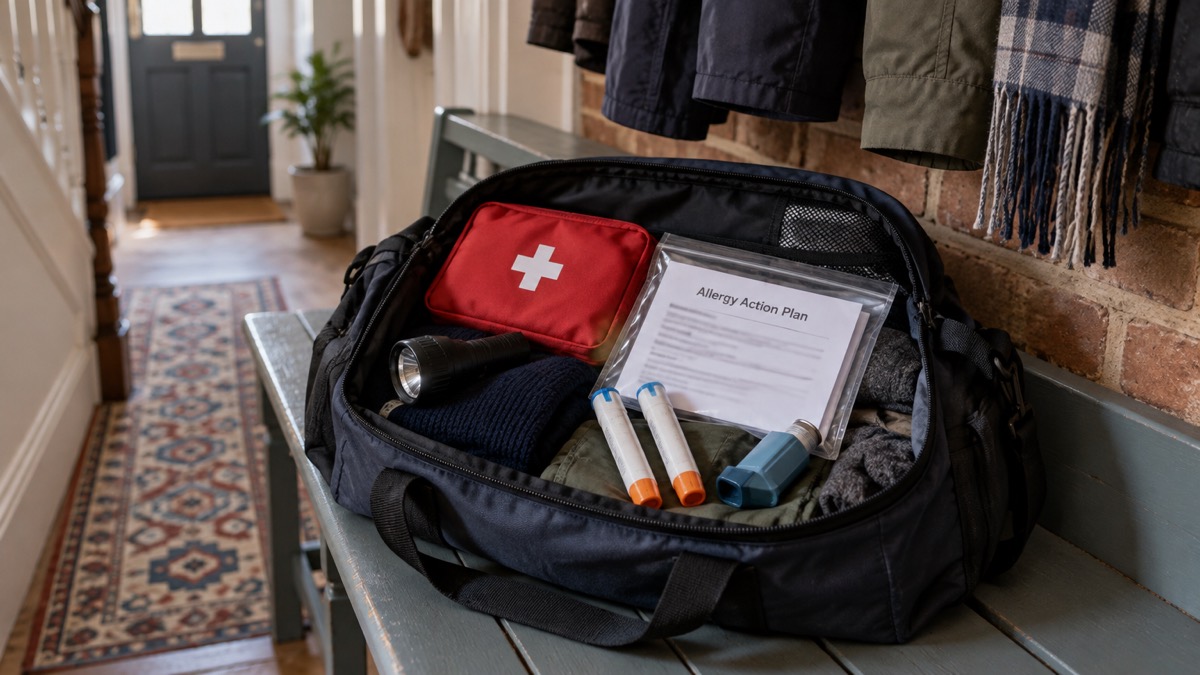
Schools are the place where an allergy action plan does its most important work, because that is where the person with the allergy spends the day away from the people who know them best. Official guidance across the UK is consistent that schools plan for emergencies. Belfast City Council states: "All schools have plans to deal with local emergencies such as fire and flooding"17. The UK government's Prepare campaign goes further on the family's role: "Your child's school should have plans and procedures in place to deal with different types of emergencies, for example f[ire]" and advises you to check the school has the correct contact numbers for you15. Northern Ireland's Be Ready campaign gives the same advice16.
Your part is to make sure the school's general emergency planning includes your child's specific allergy plan:
- Ask that your child's plan be completed by their healthcare professional, as BSACI guidance sets out, rather than by a parent or teacher1
- Remember that BSACI currently provides separate plans for adults and children at risk of anaphylaxis, so a school-age child and an allergic adult in the same household will each need their own1
The Department for Education's guidance on supporting vulnerable people before and during cold weather covers education and childcare settings and includes advice on developing emergency plans and on communicating with parents and carers18. That is an example of the wider principle: settings are expected to plan, and to plan in communication with families. Your child's allergy plan is one of the documents that communication should carry.
Updating an existing plan
A plan is only as good as its last check. Norfolk's carer emergency plan guidance sets out the triggers for an update in terms that apply directly to allergy and asthma plans: update "if support needs change, the person is prescribed new or different medication, a named contact can no longer provide support, or a contact changes their phone number or address"6. Those same triggers are the ones to watch in an allergy or asthma plan: a new prescription, a change of named contact, or a phone number that no longer reaches anyone.
A change of device brand, dose or number of pens carried is just such a change, and it can happen suddenly. Norfolk's guidance is clear that "You are responsible for keeping your emergency plan up-to-date"6, so build the habit before you need it: a fixed annual check of the plan, plus an immediate check whenever anything changes, whether that is a prescription, a device, a contact or a phone number.
A practical review list:
- Medicines and doses on the plan match what is actually prescribed today6
- Named contacts on the plan can still provide support6
- Contact numbers and addresses on the plan still work6
Staying ahead of allergy alerts
A reaction is not always caused by a mistake at home. Foods are sometimes recalled because the allergy information on their labels is missing or incorrect. Food Standards Scotland explains: "An AA is issued when the allergy information on food labels is missing or incorrect, and affected foods will therefore n[eed] to be recalled from consumers"19. The UK government's recalls and alerts service runs an allergy alerts subscription, and its guidance is simple: "Signing up to allergy alerts means you will receive information about allergy related recalls"20.
For a household managing a serious food allergy, that service is the early warning that a food in your cupboard may be unsafe. When an alert arrives for something you have bought, stop using it and follow the recall instructions. This is the quiet, everyday end of allergy preparedness: the plan tells everyone what to do in a reaction, and the alerts service reduces the chance of the reaction starting at your own table.
Where to get help
The plan itself comes from your healthcare professional: the British Society for Allergy and Clinical Immunology currently provides separate plans for adults and children at risk of anaphylaxis, and BSACI guidance is that the plan should be completed by your child's healthcare professional rather than by a parent or teacher1. In a suspected anaphylaxis, use the adrenaline auto-injector if you think it may be anaphylaxis, even if symptoms seem mild, and call 9994. For asthma attacks, follow the plan and the steps in What to Do in an Asthma Attack, Even Without an Inhaler.
For the wider household picture, see Extra Help in an Emergency: Older, Disabled and Medically Dependent Households and Health Emergencies: A Household Guide.
Sources (20)
- Your quick guide to Adrenaline Auto-Injectors, East Sussex Healthcare NHS Trust, 2022
- Family Carers Emergency Plan, Suffolk County Council, 2026
- Protect yourself and your family, Dorset Prepared, 2026
- Anaphylaxis safety campaign, NHS, 2023
- Asthma and air pollution, Met Office, 2026
- Carer's emergency plan, Norfolk County Council, 2026
- Planning ahead as a carer, Torbay and South Devon NHS, 2025
- Basic first aid for toddlers, Royal Wolverhampton NHS Healthy Child, 2026
- Person-centred fire risk assessment guidance and checklist, Lincolnshire County Council, 2022
- High-rise living and fire safety, Scottish Fire and Rescue Service, 2026
- Recall of Emerade 500 and 300 micrograms auto-injectors, NatPSA/2023/004/MHRA, Medicines and Healthcare products Regulatory Agency, 2023
- Be prepared: home and your community, Argyll and Bute Council, 2026
- Preparing for emergencies, Somerset Council, 2026
- Be prepared for emergencies, North Devon Council, 2026
- Get prepared for emergencies, Prepare campaign, 2026
- Be ready for emergencies, Be Ready campaign, 2026
- Emergency planning, Belfast City Council, 2026
- Supporting vulnerable people before and during cold weather for teachers and educational professionals, Department for Education, 2025
- Why food is recalled, Food Standards Scotland, 2026
- Recalls and alerts, UK Government, 2026
 Message in a Bottle