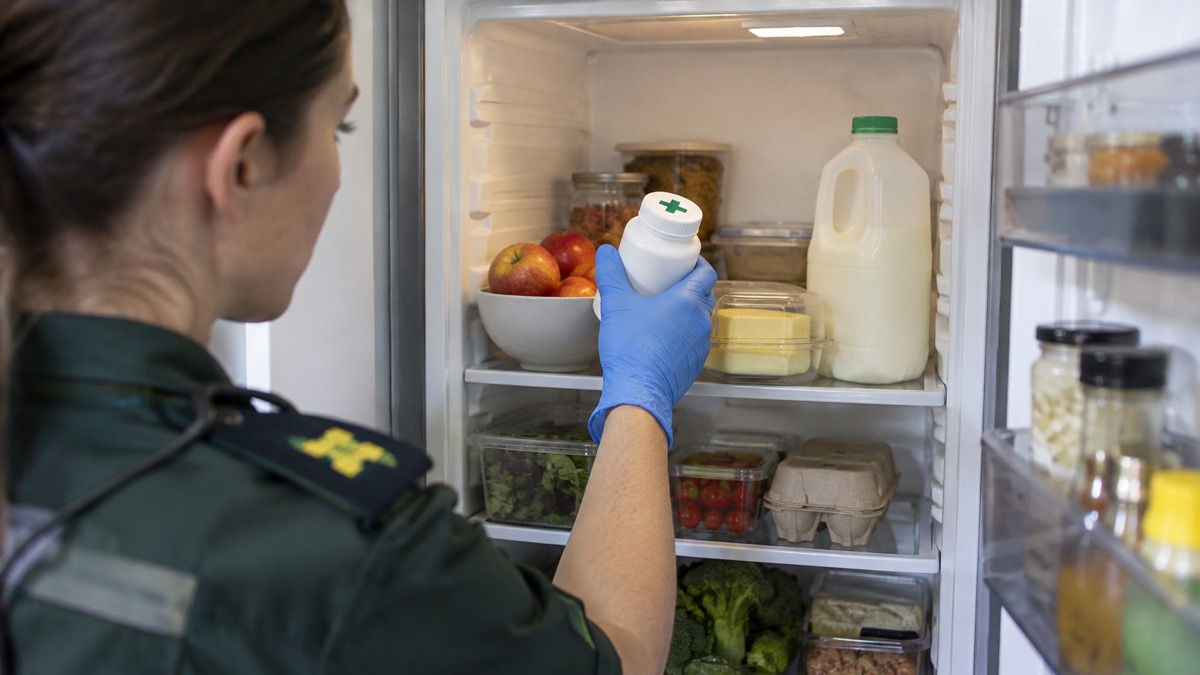
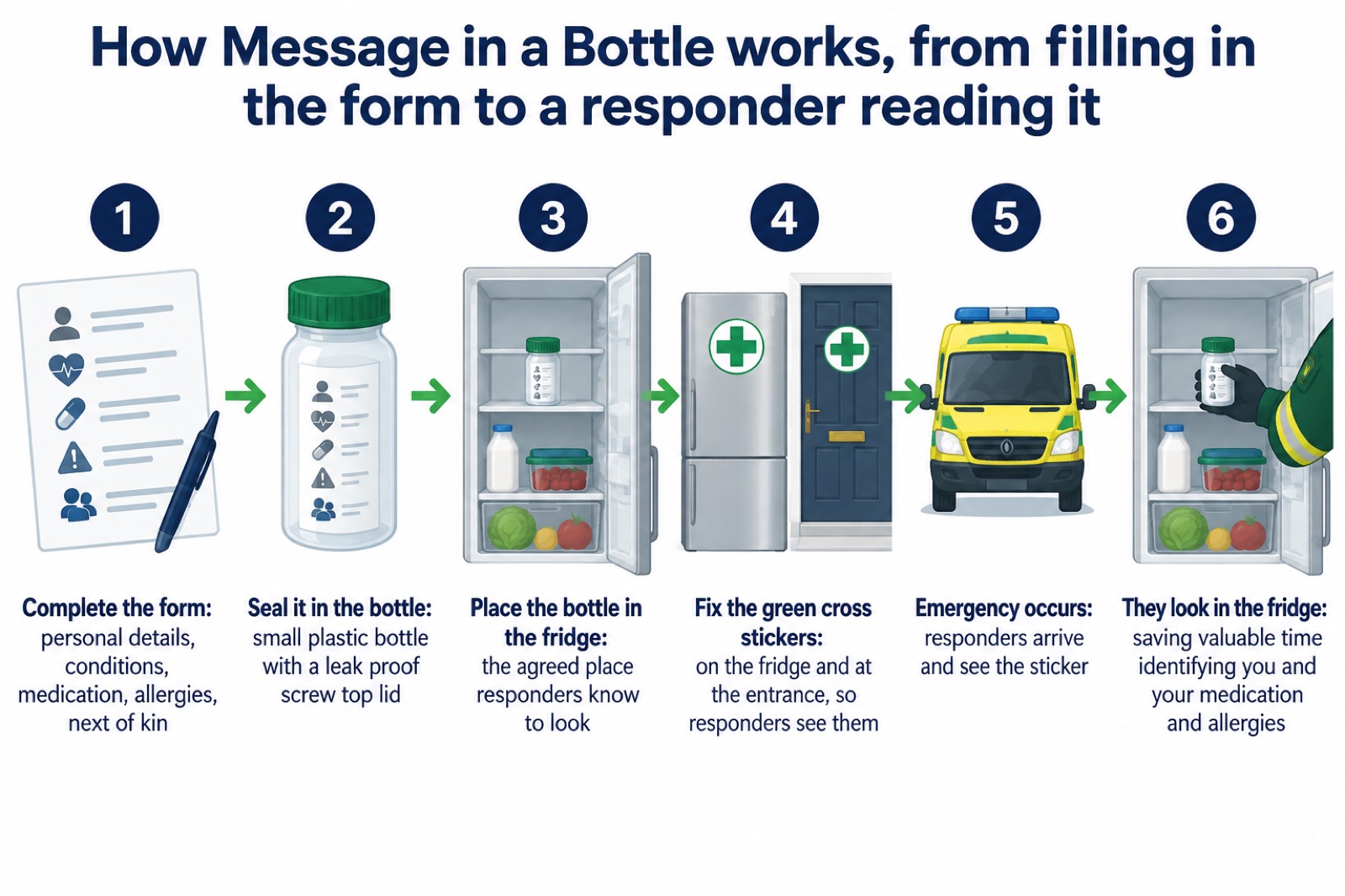
If paramedics were called to your home tomorrow and found you unable to speak, how would they know what medication you take, what allergies you have, or who to call? Message in a Bottle answers that question in the simplest possible way. You write your details on a form, seal it in a plastic bottle, and keep the bottle in your fridge. Paramedics, police, fire-fighters and social services support this Lions life-saving initiative and know to look in the fridge when they see the Message in a Bottle sticker1.
The scheme is described by the NHS and by councils across England as "an easy and free way to store vital essential information in your home where the Emergency Services can immediately find it"2. It works by saving valuable time in an emergency: identifying an individual and finding out if they have any allergies or take special medication is exactly what a crew needs to do in the first minutes, and a completed form in a known place does it for them1. Cornwall Council puts the mechanism plainly: the form "is then stored in the bottle, in the fridge, so that emergency responders can easily find information about someone, if they need to come to their house"3.
This page explains who should get a bottle, what to write on the form, where the bottle and its stickers go, and how the scheme fits alongside the other ways a household can make itself easier to help in an emergency.
What the scheme does, and why the fridge
The idea behind Message in a Bottle is that the most useful medical information in an emergency is often locked inside a person who cannot communicate it. If you are unconscious, confused, or simply too unwell to explain, a responder has to work out who you are, what conditions you have, and what drugs you take before they can treat you safely. The bottle hands them that information in seconds. West Midlands Ambulance Service NHS Foundation Trust, which promotes the scheme, says it "helps by saving valuable time in an emergency to identifying an individual and find out if they have any allergies or take special medication"1.
The fridge is the agreed hiding place because it is one piece of furniture almost every home has, in a predictable location, and it survives many kinds of incident. A fire, a flood or a collapse may damage a bedroom or a hallway, but responders know that the details they need are in the kitchen, in the fridge, behind a door marked with the scheme's sticker. That convention is what turns a bottle in a house into a system the emergency services can rely on, and it is why one bottle should be used per person1.
The scheme sits alongside other tools that speed up help. Surrey County Council's home safety advice lists "'Message in a bottle' information for first responders" among the measures that help its telecare users4, which shows how the bottle works even when a monitoring service has already raised the alarm. The same logic, information ready before it is needed, underpins the In Case of Emergency information leaflet Surrey promotes, which is designed to "enable everyone to access key information quickly and easily in an emergency"5.
Who should get a bottle
The ambulance service's advice is direct: "If you have an underlying health condition, a severe allergy or take medication, consider getting a Message in a Bottle"1. That covers a wide range of ordinary households: people on repeat prescriptions, people with heart conditions, diabetes, epilepsy or asthma, and anyone who would want a responder to know their allergies before treatment begins.
Torbay and South Devon NHS Trust widens the same advice through its related schemes, saying Message in a Bottle pots and Message in a Wallet cards "are useful for anyone with any medical condition or on medication"6. You do not need to be elderly or a carer to benefit. A fit adult with a penicillin allergy gains just as much as a frail person on ten medicines, because the allergy is precisely the detail a responder needs before giving treatment.
The scheme is also promoted to people who live alone or who may not be able to reach the door. NHS Inform's advice on creating a falls plan, aimed at people at risk of falling at home, recommends planning ahead so that help can reach you and get in, including "leaving a spare key with a friend, neighbour or relative you trust that lives nearby" or in a key safe7. A bottle in the fridge complements that plan: the key safe gets help into the house, and the bottle tells them what they need to know once inside. Welsh ambulance advice makes the same point about key safes, urging people to "make sure emergency services are aware of the code"8.
Carers and family members should think about bottles for the people they care for, and for themselves. The scheme is useful for anyone with any medical condition or on medication3, and that includes a carer whose own medication or conditions would matter if they were suddenly taken ill at home. Two bottles in one fridge, one per person, covers both1.
What to write on the form
The form is the whole point of the bottle, so what goes on it matters. Cornwall Council sets out the contents: personal information, contact details, contact details for emergencies and next of kin, and "medication and information about medical conditions"3. Torbay and South Devon's scheme leaflet describes the same thing from the responder's side: the bottle "contains basic information to help the emergency services if you have an accident or emergency"6.
In practice, that means the form should carry:
- Your allergies, including severe allergies, since identifying allergies is one of the two things the scheme exists to speed up1
- Contact details for your next of kin and for emergencies, so someone who knows you can be reached3
Write it so a stranger can act on it. Use the names medicines are dispensed under, not nicknames. If your medication changes, the form must change with it: a form that lists last year's prescription is worse than no form, because a responder may act on it. Get a fresh form, complete it, and swap it into the bottle.
The same prepare-in-advance principle appears across official advice. Surrey Police's Herbert Protocol, a form completed ahead of time for people at risk of going missing, explains why: "Filling in a form before you need it means you don't have to remember the information when you are under stress"9. Your bottle form deserves the same treatment: complete it calmly, at the kitchen table, not in the aftermath of an incident.
One bottle per person
Cornwall Council's guidance is unambiguous: "One bottle should be used per person"3. In a household where more than one person has medical needs, each person gets their own bottle, their own form and their own clearly marked place in the fridge.
The reason is simple. If two people share a bottle, a responder who grabs it in a hurry may read the wrong medication list, the wrong allergies and the wrong next of kin. Separate bottles keep each person's information unambiguous, which is the entire value of the scheme. If space in the fridge is tight, keep the bottles together but make sure each form inside carries that person's name prominently, so there is no doubt whose details the responder is holding.
Households with several bottles can go further in making themselves easy to help. Dorset and Wiltshire Fire and Rescue Service's "Do you know a CHARLIE?" campaign works through professionals who visit people at home, including domiciliary care providers, GP practices and reablement teams10, which is a reminder that the people around a vulnerable household, carers, neighbours and professionals, are part of the same system. Scottish community resilience guidance suggests neighbours can form a simple communication chain to pass on messages11, and Wiltshire and Swindon Prepared advises picking up a bottle of water for a vulnerable neighbour who cannot reach a distribution point during a water supply failure12. A household where everyone's medical details are in the fridge, and where neighbours know who lives there, is a household that help can work with quickly.
Where the bottle goes, and what kind of bottle it is
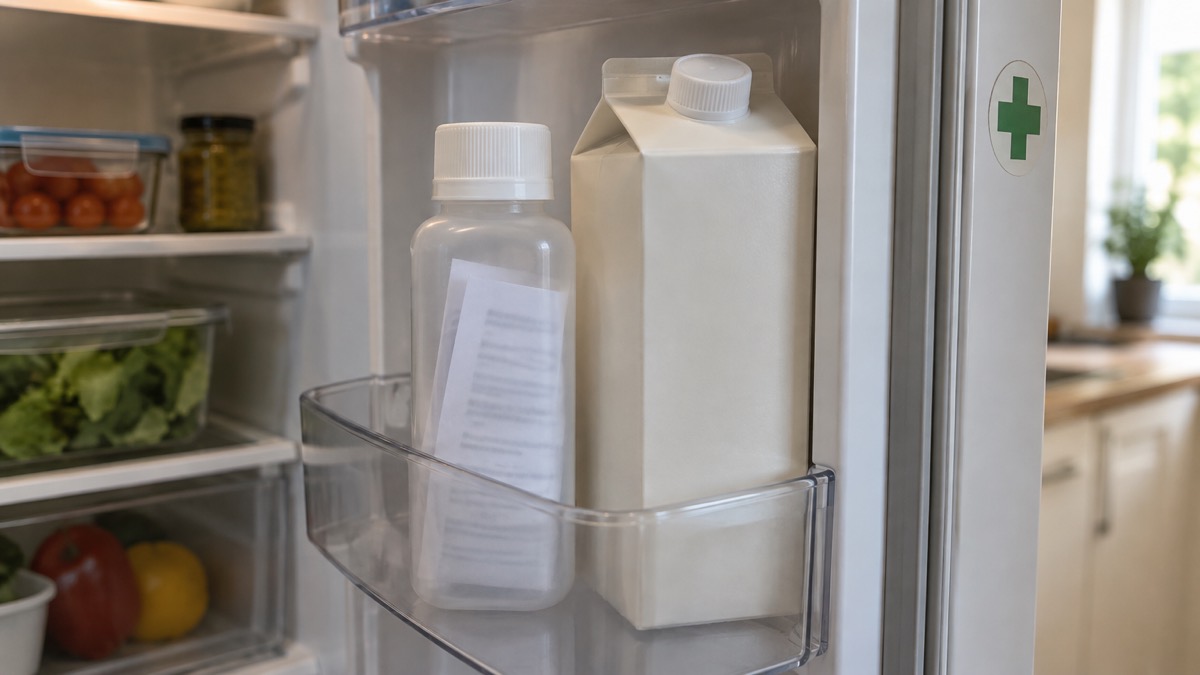
The bottle lives in the fridge. That is the convention the emergency services rely on, and it is stated in the official descriptions of the scheme: the form is stored "in the bottle, in the fridge" so responders can easily find it3, and crews know to look there when they see the sticker1.
The bottle itself is a small plastic container with a leak proof screw top lid, which keeps the paper dry and contained. One bottle of the kind used is the Sistema 475ml square bottle, and its maker's specifications show why the shape works:
| Specification | Detail (maker's figures) |
|---|---|
| Material | Plastic13 |
| Capacity | 475ml13 |
| Dimensions | L 60mm x H 184mm x W 60mm13 |
| Lid | Leak proof screw top lid13 |
| Leak proofing | Leak proof13 |
| Shape | Square, stacks on its side or fits in the refrigerator door13 |
The maker's care instructions matter here: "Remove all labels/packaging and wash before use"13. A bottle that has held drinks should be washed and dried before it holds your medical form. The maker also warns the bottle is "not intended for use with hot liquids or carbonated beverages", and that pressure build-up "could cause the lid to pop open unexpectedly, leading to injury or spills"13, which is not relevant once the bottle holds only paper, but explains why it should be used as the scheme intends. The maker also states that Sistema Hydrate and Stainless Steel bottles must not be used in the freezer13; the fridge, not the freezer, is the scheme's storage place in any case.
Two points about the fridge itself are worth knowing. Food Standards Scotland advises storing low-risk items, such as chilled beverages, in the warmer areas of the fridge14, which is a sensible spot for a bottle that holds nothing perishable. And if you also keep medicines in the fridge, the Northern Ireland direct government services advice is that medicines stored in a fridge should be "kept in a childproof medicine box" and stored safely out of reach of children15. Your Message in a Bottle form is paper rather than medicine, but the same household with children should think about where things sit on the fridge shelves.
The green cross stickers: how responders know you have one
The bottle only works if the arriving responder knows it exists. That is the job of the stickers that come with it. West Midlands Ambulance Service explains the link: paramedics, police, fire-fighters and social services "know to look in the fridge when they see the Message in a Bottle sticker"1. Cornwall Council's version of the same endorsement names the scheme's backers: "Paramedics, police, fire-fighters and social services support this life-saving initiative"3.
Place the stickers where an arriving responder will see them without searching. The two places that matter are the fridge door itself, so anyone opening the fridge is reminded what is inside, and the main entrance to your home, so a crew arriving at the door spots the symbol before they enter. The principle is the same one used elsewhere in community safety: South Western Ambulance Service NHS Foundation Trust describes defibrillator labelling stickers that carry the information a responder needs at the point of use, including the location and any access code16. A sticker is a promise that information is nearby, and it only pays off if it is visible at the moment it is needed.
Keep the stickers clean and in place. A sticker that has peeled off or been painted over breaks the chain between the symbol and the fridge, and the scheme's value goes with it.
Who runs the scheme, and how to get a bottle
Message in a Bottle is a Lions Clubs initiative. The ambulance service describes it as "this Lions life-saving initiative"1, and Staffordshire Council attributes it to the Lions Club of the same name, which "stores vital information in the person's home for emergency services"17. It is free: the Torbay and South Devon scheme leaflet calls it "an easy and free way to store vital essential information in your home where the Emergency Services can immediately find it"2.
Bottles and forms are distributed locally. The Torbay leaflet gives the practical route for its area: "MESSAGE IN A WALLET CAN BE OBTAINED FROM PAIGNTON LIONS CLUB. For more information or a further supply of cards please telephone 01803 328523 or 01803 606966"2. Elsewhere, the route is through your local Lions Club, your council's carers or adult social care pages, or your GP practice and pharmacy, many of which stock the bottles.
The related Message in a Wallet scheme works on the same principle away from home: Torbay and South Devon NHS Trust says the wallet card "contains basic information to help the emergency services if you have an accident or emergency"6. A bottle covers you at home; a wallet card covers you in the street, and the two together are stronger than either alone.
Severe allergies, and what a bottle cannot do
A bottle is information, not treatment, and it is worth being clear about the difference. If you have a severe allergy, the ambulance service's advice is to get a bottle precisely because it speeds up the moment a responder learns what they are dealing with1. Royal Wolverhampton NHS Trust's child health guidance notes that a severe allergic reaction, or anaphylaxis, is rare in children, and that common causes include "pollen, stings and bites, latex and some food items, such as nuts, shellfish, eggs or dairy products"18. Any of those belongs on your form.
But the bottle does not replace carrying your prescribed adrenaline auto-injector, knowing how to use it, and having an allergy action plan. Our pages on adrenaline auto-injectors, allergy action plans and what to do if you suspect anaphylaxis cover that side of being prepared, and the bottle works best as part of that wider readiness rather than instead of it.
The same is true of every condition on the form. The bottle tells a responder what they are dealing with; it does not treat it. Pair it with the first aid knowledge a household should have anyway, starting with our first aid at home guide and the information to have ready for the ambulance crew, which sets out the same details in the form a 999 call handler will ask for.
The bottle in the wider picture of being easy to help
Message in a Bottle belongs to a family of official schemes that all do one thing: they move information from a stressful moment to a calm one. Once you have a bottle, the other pieces are small additions.
- Location: Cornwall Council's fire and rescue service promotes what3words as "the simplest way to communicate that precise location in an emergency"19, useful when calling from an unfamiliar place or guiding a crew to a rural address.
- On the road: the eCall system, explained in National Highways driving advice, "reduces the time it takes for the police, fire service or ambulance to respond and arrive at your exact location"20 after a serious vehicle collision.
- National alerts: the UK Emergency Alerts system "enables people to be contacted via their mobile phone and tablet if their lives are at risk in an emergency"21, so keep the phone that receives them charged and with you.
- Going missing: the Herbert Protocol form, completed in advance for a person at risk of wandering, means "you don't have to remember the information when you are under stress"9.
- Falls and access: a falls plan with a key safe or a trusted key holder7, with emergency services aware of the code8, gets help through the door that the bottle then informs.
- Telecare: Surrey lists Message in a Bottle information among its measures for telecare users4, so the bottle can sit alongside a lifeline or pendant service rather than replace it.
None of this replaces the bottle, and the bottle does not replace any of it. Together they mean that whatever kind of help arrives, at your door or at your side, the facts about you are already in their hands.
Keeping it current
A Message in a Bottle is only as good as the form inside it. The scheme's purpose, saving responders time identifying you and finding out about allergies and special medication1, depends entirely on the details being right on the day someone reads them. Medicines change, diagnoses change, and next of kin details change, and each change quietly makes an old form misleading.
Build a check into your routine. Whenever a prescription changes, update the form the same week. When you review your household's wider emergency plans, perhaps when the clocks change or when you check your smoke alarms, take the bottle out, read the form, and ask whether everything on it is still true. Date the form when you complete it, so a future you can see at a glance how current it is. And if you need a fresh form or wallet cards, the Torbay scheme leaflet shows the route: contact your local Lions Club, which can supply them2.
Finally, tell the people around you that the bottle exists. Family members who might call an ambulance should know to mention it. Neighbours who might let a crew in should know where to look. The bottle is a message to responders, but like any message, it works best when the people who deliver it know it is there.
Sources (21)
- Be prepared: public safety advice, West Midlands Ambulance Service NHS Foundation Trust, 2026-06-16
- Message in a Bottle Scheme leaflet, Torbay and South Devon NHS Trust, 2019-02
- Emergency planning for carers, Cornwall Council, 2026-01-14
- Fire safety at home: tips, Surrey County Council, 2026-08-24
- Emergency information leaflet, Surrey County Council, 2026-01-08
- Carers Service: planning ahead, Torbay and South Devon NHS Trust, 2025-10-21
- Creating a falls plan, NHS Inform Scotland, 2024-06-18
- Some of the reasons people call 999, Welsh Ambulance Services NHS Trust, 2026-10-29
- The Herbert Protocol, Surrey Police, 2026-10-29
- Do you know a CHARLIE?, Dorset and Wiltshire Fire and Rescue Service, 2025-11-19
- Community emergency planning guide: respond and recover, Ready Scotland, 2026-03
- Failure of water infrastructure or loss of drinking water, Wiltshire and Swindon Prepared, 2026-10-25
- 475ml Square Bottle product page, Sistema Plastics, 2026-10-28
- Food safety in the kitchen: chilling, Food Standards Scotland, 2026-10-25
- Chemical safety in the home, nidirect (Northern Ireland government services), 2026-04-14
- Defibrillators, South Western Ambulance Service NHS Foundation Trust, 2026-10-29
- Plan emergencies and changes: support for unpaid carers, Staffordshire Council, 2026
- Basic first aid for toddlers, Royal Wolverhampton NHS Trust, 2026-10-29
- what3words: keeping safe, Cornwall Council Fire and Rescue Service, 2026-10-29
- eCall driving advice, Traffic England (National Highways), 2026-10-29
- Emergency Alerts System factsheet, UK Government Prepare campaign, 2025-08
 Allergy and Asthma Action Plans