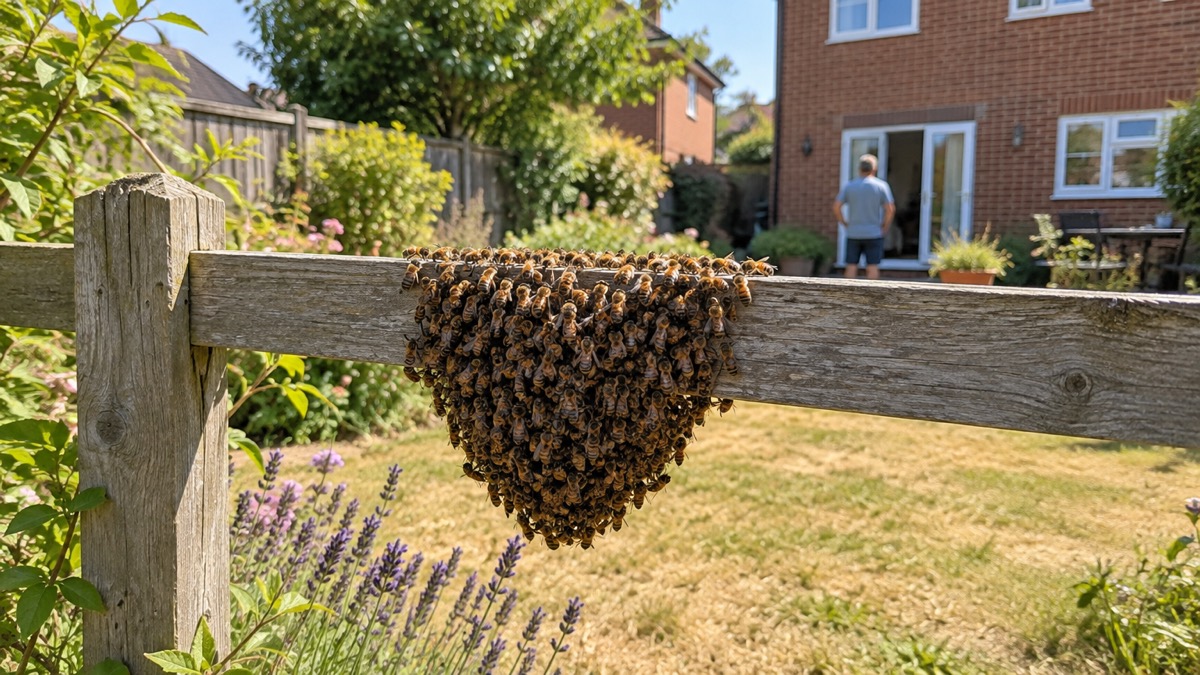
A swarm of honey bees hanging from a branch, a fence or the wall of your house looks dramatic, but it is usually a colony in transit rather than a threat. Most honey bee swarms are not aggressive, and swarming bees usually do not sting. The British Beekeepers Association's advice is simple: keep away, leave them alone, and keep children and pets indoors1.
What you do next depends on where the cluster has settled. If it is out in the open, the bees will often move on by themselves, and a volunteer beekeeper may come and collect them if you report it. If they have gone into a roof, a chimney or a cavity wall, the problem is much harder to solve, because bees that take up residence in a building can be very difficult to remove3.
The other thing to get right is the sting itself. A bee usually leaves behind a stinger attached to a venom sac, and it should be removed quickly by scraping sideways with a hard-edged card such as a debit card, or a fingernail4. Most people recover with simple first aid, but a small number have a serious allergic reaction and need urgent help.
What to do now: leave the swarm alone and report it
A honey bee swarm is a cluster of bees that has left an existing colony with a queen to find a new home. While they are clustered, they are focused on the queen and on scouting for a cavity, which is why they are so often docile. The BBKA's swarm information is blunt about the right response: most honey bee swarms are not aggressive, but please do keep away and leave them alone1. The University of Bristol Beekeepers' Association adds the practical version: it is wise to stay away from the swarm and keep children and pets indoors2.
Reporting the swarm is what turns a worry into a solution. Swarm collection is carried out by volunteer beekeepers at their own discretion, and they are not paid to provide this service2. That has two consequences for you. First, there is no guarantee anyone will come, particularly at a busy point in the season. Second, the beekeeper is doing you a favour, so make the report as useful as possible.
When you call, describe what you have seen, or ideally send a picture, and give the size of the cluster and roughly how many bees there are, the location and access, the height, and how long they have been there2. A photo lets the beekeeper check the insects really are honey bees before making the journey, because if on arrival the beekeeper finds that it is not honey bees then they are unlikely to be able to help1.
If the swarm leaves before the beekeeper arrives, or someone else collects it, call the beekeeper back to save a wasted journey1.
If the bees settle in a roof, wall or chimney
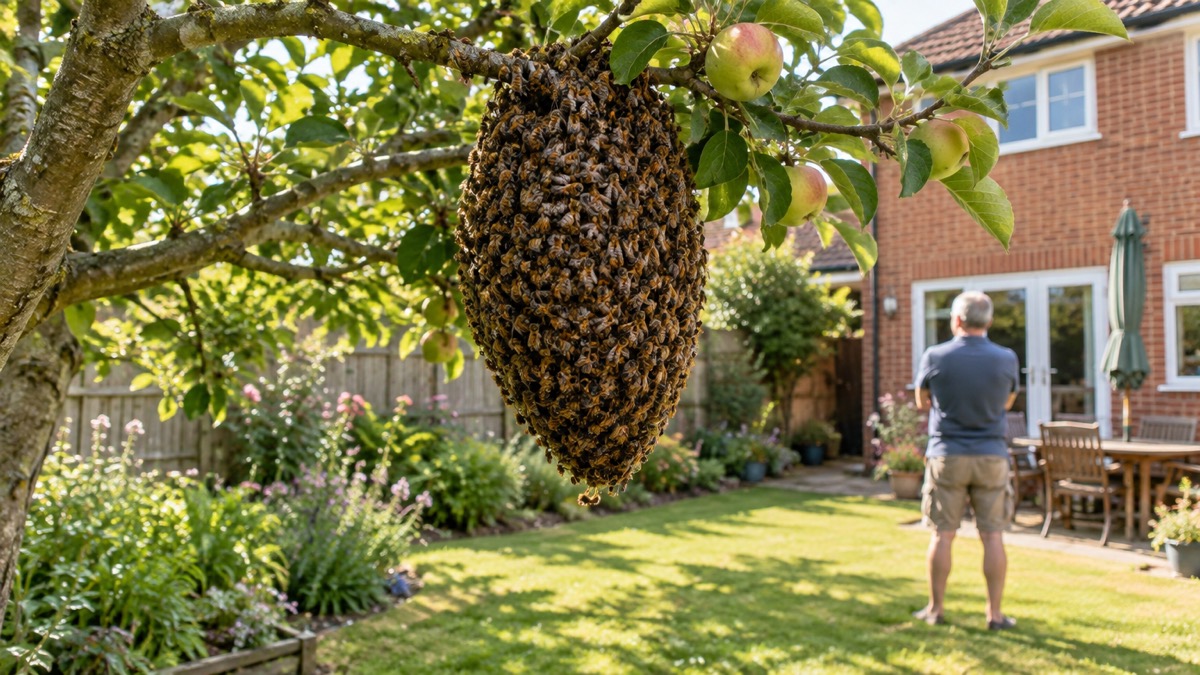
The open-air cluster is the easy case. The difficult one is when the swarm decides to move in. The BBKA warns that if a swarm subsequently decides to take up residence in a local building such as in a roof or chimney, then it can be very difficult to remove3. That is the point at which a garden curiosity becomes a property problem, and it is why reporting early, while the bees are still clustered in the open, is worth the phone call.
If you find a nest of wasps or bees in your house or garden, Allergy UK's advice is clear: do not attempt to move it yourself, and call the local authority or a beekeeping association for advice5. Do not block the entrance, do not spray it, and do not go up a ladder to investigate. A confined space with a colony inside is exactly where a sting risk becomes real.
There is a wider point about tolerance. The BBKA notes that should people become alarmed about the presence of bee hives their complaints can result in the bees being considered a nuisance whether they are or not, and that even if neighbours are stung by wasps the bees in your garden may get the blame3. If you keep bees, or are thinking about it, that is worth knowing before a neighbour's complaint lands. If you are the neighbour, it is worth checking what you are actually looking at before assuming the worst.
Removing a bee sting safely
A bee sting left in the skin keeps delivering venom, so speed matters. A bee will usually leave behind a stinger attached to a venom sac, and it should be removed quickly using a scraping motion with a hard-edged card like a debit card4. The Anaphylaxis UK guidance describes the same action: the sac should be flicked upwards with one quick scrape of the fingernail or a credit card, which will reduce but not eliminate the risk of a serious reaction5. St John Ambulance says to brush or scrape the sting off sideways with something firm like a fingernail, credit card, or plastic ruler as soon as possible6.
The key word is scrape, not pinch. Squeezing the sac can push more venom into the skin, which is why every first aid source describes a sideways motion rather than fingers.
Once the sting is out, the aftercare is ordinary household first aid:
- Scrape the sting out sideways with a fingernail, card or plastic ruler6.
- Wash the area with soap and water to help lower the chance of infection8.
- Apply a cold compress or ice pack for at least 10 minutes to reduce pain and swelling7.
- Raise the affected area if possible, and avoid scratching7.
- Ask a pharmacist about antihistamines, steroid creams and painkillers if it is uncomfortable8.
Most people will experience some degree of swelling or itching for a short time and then will gradually become more immune to the occasional sting9. That is the normal course, and it is worth saying plainly so that a red, itchy arm is understood for what it usually is.
When a sting needs medical help
A sting is a medical emergency when the reaction is widespread rather than local. St John Ambulance advises watching for signs of an allergic reaction, which can lead to anaphylactic shock6. If you are with someone who has been stung and becomes unwell, treat it as urgent and call for help.
The NHS advises contacting your GP or calling NHS 111 if symptoms worsen or do not improve after a few days, if you are bitten or stung in the mouth, throat, or near the eyes, if a large area (around 10cm or more) becomes red, swollen or pus-filled, or if you develop signs of a widespread infection such as fever, swollen glands, or flu-like symptoms7. A sting in the mouth or throat is treated seriously because swelling there can affect breathing.
For people with a diagnosed venom allergy, the longer-term route is a referral. Anaphylaxis UK says that after any serious reaction you should be referred to an allergy specialist irrespective of whether you have seen a consultant in the past10. Allergy UK states that if your allergy is serious or potentially life-threatening you should receive an urgent referral to a healthcare professional with the appropriate expertise11. Anaphylaxis UK also notes that you are more at risk of serious allergic reactions to insect stings if you have frequent or multiple stings, and that while most individuals may not require a referral to an allergy clinic, those at an increased risk of future stings, such as beekeepers, may benefit from a referral to an allergy specialist5.
If you are a beekeeper and you react badly, do not push on. Anaphylaxis UK's advice is that any beekeeper who is at risk of anaphylaxis to bee venom should seek medical advice on how to safely continue beekeeping5.
If an ambulance is coming, the South Western Ambulance Service advises putting pets somewhere safe so they do not get in the way of the crew12.
Bees, the law and food-producing animals
Beekeeping is not just a hobby in law. Bees are classed as food-producing animals, which is why beekeepers must maintain documentation containing details of veterinary medicines13. If you keep bees, or are thinking about it, that paperwork is part of the job, not an optional extra.
There is also a reporting duty. It is a legal requirement to notify the National Bee Unit if you know or suspect your colonies of honey bees to have a notifiable disease or pest14. That applies whether you have one hive in a garden or an apiary. If you are considering keeping bees, the beekeeping for beginners page covers hives, training and registration, and the honey bee health page covers varroa, foulbrood and swarms in more detail.
The legal position of a swarm is different from the legal position of a managed hive. A swarm in the open is not yours to keep simply because it landed on your fence, and a volunteer beekeeper collecting it is doing so under their own association's arrangements. What matters for a household is the practical rule: report it, do not move it, and let someone with the right equipment and insurance deal with it.
Honey bees are also unusual in the insect world. The Scottish Beekeepers Association notes that honeybees are the only bee species that has evolved the ability of bringing a large population through the winter, up to 8000 bees15. That is why a colony is worth protecting rather than destroying, and why a swarm in spring is a colony's future rather than a nuisance.
What attracts bees to a garden, and what to do about it
Bees come to a garden for flowers, and a garden full of them is a good thing. The Royal Horticultural Society advises encouraging bees into the garden by planting flowers and herbs that attract pollinating insects for successful pollination of all fruit16. If you grow apples, pears, plums or soft fruit, the bees are doing you a service.
The BBKA's planting advice is practical: choose plants with single, open flowers for easy access to the pollen and nectar, and plant several plants together in a group to attract the bees17. Bees also like white and red clover17. A patch of lawn left to grow into a mini meadow is one of the best, and easiest, ways to encourage wildlife into your garden, helping not just honey bees but all pollinators17. You can do this in any size of space, from a balcony to an open green space, right throughout the year18.
| What you plant | Why it helps | What to expect |
|---|---|---|
| Single, open flowers | Easy access to pollen and nectar17 | More pollinators visiting through the season |
| Groups of the same plant | A larger target for bees to find17 | Better pollination of nearby fruit16 |
| White and red clover | A plant bees like17 | Bees working the lawn, especially in summer |
| A mini meadow patch | Encourages wildlife and all pollinators17 | Longer grass, more insects, less mowing |
The flip side is that a garden planted to bring in pollinators can attract a swarm looking for a new home. That is not a reason to plant less. It is a reason to know what to do if a cluster appears, and to keep a note of your local beekeeping association's swarm contact before you need it.
If you want to go further, the self-reliance section covers growing food, bees and other practical household skills, and the swarming season page explains when swarms are most likely.
Where to get help
The first call for a swarm is your local beekeeping association, which can put you in touch with a volunteer collector. If the bees are inside a building, or you are not sure what you are dealing with, your local authority can advise, and Allergy UK's guidance is to call the local authority or a beekeeping association rather than moving a nest yourself5.
For a sting, the NHS is the route for anything that is not an emergency: contact your GP or call NHS 111 if symptoms worsen or do not improve after a few days, or if the sting is in the mouth, throat or near the eyes7. For a suspected severe reaction, call 999.
If you have to wait in for a beekeeper, treat it like any other household disruption. Keep baby and pet supplies to hand19, include pet food and treats in your pet kit20, and if you have to leave the property, take your pets with you21. It also helps to have a list of local boarding kennels or other animal shelters that may help in an emergency22, particularly if a collection has to be rearranged.
A swarm is usually a short-lived event. Report it, keep everyone back, and let the beekeeper do the rest.
Sources (22)
- Honey bee swarms information, British Beekeepers Association, 2026
- Honey Bee Swarms, University of Bristol Beekeepers' Association, 2026
- Offer Land to Bees, British Beekeepers Association, 2026
- Staying safe over the summer, Healthier Together, 2026
- Bee and wasp sting allergies, Anaphylaxis UK, 2026
- Insect bites and stings, St John Ambulance, 2026
- Enjoy a safe and healthy bank holiday, NHS Devon, 2026
- Summer safety, Cheshire and Wirral Partnership NHS Foundation Trust, 2026
- Fighting the yellow-legged hornet, British Beekeepers Association, 2026
- Care and medication, Anaphylaxis UK, 2026
- Anaphylaxis, Allergy UK, 2026
- What to do when the ambulance is coming, South Western Ambulance Service NHS Foundation Trust, 2026
- How do I manage varroa, National Bee Unit, 2026
- Legal responsibility of beekeepers, National Bee Unit, 2026
- Bees and beekeeping overview, Scottish Beekeepers Association, 2024
- Planning a fruit garden, Royal Horticultural Society, 2026
- Planting for pollinators, British Beekeepers Association, 2026
- Gardening for bees, British Beekeepers Association, 2026
- Emergency kit checklist, Neath Port Talbot Council, 2026
- Get help and advice in an emergency, Lincolnshire County Council, 2026
- Get help and advice in an emergency, Lincolnshire County Council, 2026
- Are you ready, Birmingham City Council, 2026
 Beekeeping Starter Equipment
 Pet Hens Starter Kit
 Bringing Home Rescue Hens
 Hay Bale Fires
 Livestock in a Heatwave
 Livestock Water Outage
 Sky Lanterns
 BeeBase Registration
 Broody Hen Hatching
 Cleaning a Chicken Coop
 Coop and Run Space for Hens
 Care for Ex-Battery Hens
 Reporting Foulbrood
 Fox-Proofing a Chicken Coop
 Daily Hen Feed Amounts