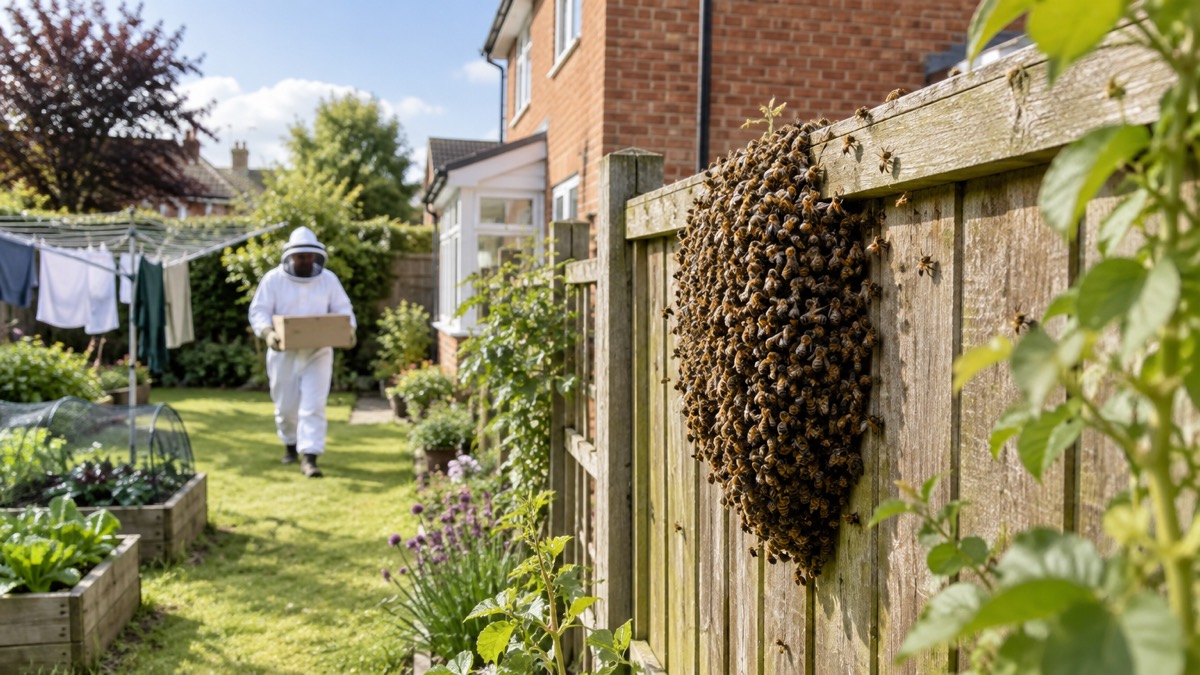
A honey bee swarm hanging from a branch, a fence post or a lamppost is one of the most alarming sights a garden can produce, and one of the least dangerous. A swarm is simply the colony reproducing: the old queen leaves the hive with some of the bees, and thousands of them settle together in a cluster while scouts look for a new home1. Swarming bees usually do not sting, and most honey bee swarms are not aggressive, though you should still keep away and leave them alone1.
Most swarms occur on warm sunny days from May to the end of July, usually between 11am and 4pm, and the bees normally settle into a cluster within 15 minutes1. A beekeeper will usually collect a swarm free of charge, but on a voluntary basis and at their own discretion, so your job is to report it clearly and keep people and pets away until they arrive1. For beekeepers, the same season brings the health checks that matter most: looking at the brood for the notifiable foulbrood diseases, managing varroa, and knowing what the law requires you to report to the National Bee Unit2.
A swarm is a colony reproducing, not an attack
The first thing to understand about a swarm is that the bees in it have no hive to defend. A swarm is the colony reproducing by the old queen leaving with some of the bees1. Half the colony leaves with her, lands somewhere nearby, and hangs in a cluster while scout bees search for a cavity to move into. That cluster is a homeless colony in transit, not a hunting party.
This is why swarming bees usually do not sting1. Stinging is a defensive act, and a swarm has nothing to defend: no comb, no stores, no brood. Most honey bee swarms are not aggressive, but the guidance is still to keep away and leave them alone1, because a cluster can be disturbed, and because a small number of people react badly to any sting. The nidirect guidance on poisoning notes that insects such as wasps and bees are not poisonous, but their stings can contain venom that can cause an allergic reaction, sometimes severe7. If you or someone nearby is stung and has a reaction involving breathing difficulty or swelling of the face, seek urgent medical help.
Size is the giveaway that you are looking at a honey bee swarm rather than a few foraging bees or a nest. Honey bee swarms are thousands, not a dozen or so1. A cluster the size of a rugby ball or larger hanging quietly from a branch is typical. If you see a handful of bees visiting flowers, that is foraging, not swarming, and needs no action at all.
Swarm season: May to the end of July, 11am to 4pm
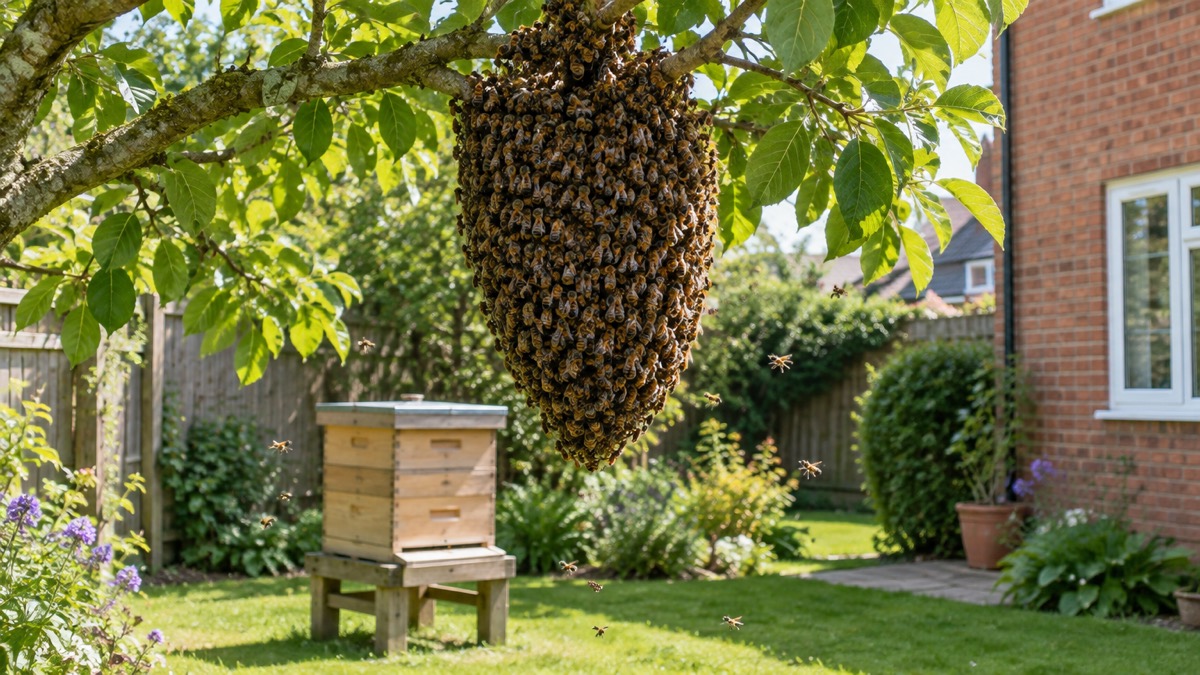
Swarms are a seasonal event, and knowing the window helps you judge what you are seeing. Most swarms occur on warm sunny days from May to the end of July, usually between 11am and 4pm1. A loud cloud of bees crossing a garden in early afternoon in June is almost certainly a swarm in flight; the same thing in February is not, and would be worth describing carefully to a beekeeper.
The flight itself is the dramatic part, and it is brief. Once the bees leave the hive they fill the air for a short while, but they normally settle into a cluster within 15 minutes1. If you arrive home to find a swirling cloud, the practical advice is to go indoors, close windows and wait a quarter of an hour before assessing anything. The cluster that forms afterwards is far easier to describe to a beekeeper than a moving cloud.
A settled cluster may stay put for hours or a few days while the scouts decide, and it may leave again on its own. That matters for what you report and when, covered below. The key seasonal point for a householder is that a swarm in the May to July window is routine beekeeping business, not an emergency, and the right response is a phone call rather than anything more drastic.
Keeping children and pets away
While the swarm is waiting to be collected, the guidance is simple: it is wise to stay away from the swarm and keep children and pets indoors1. A cluster of thousands of bees is fascinating to children and irresistible to dogs, and either can disturb it. Keep doors and windows closed on the side of the house nearest the cluster, and keep pets indoors or walked well away until the bees are gone.
Do not throw anything at the cluster, poke it with a stick, hose it down or try to sweep it into a box yourself. All of these disturb the bees for no gain, since a volunteer beekeeper will do the collection properly. Beekeepers collect swarms on a voluntary basis; they are not paid to provide this service1, so treating the cluster calmly and leaving it intact is also the courteous thing to do while someone gives up their evening for you.
If the swarm has settled somewhere children use, such as a play frame or a gate, cordon the area off informally for the hours it takes. The bees are not looking for trouble, but the safest arrangement is distance in both directions until the collector arrives.
How to report a swarm to a local beekeeper
Reporting a swarm well gets it collected faster. When you contact a beekeeper or a swarm collection service, describe what you have seen, or ideally send a picture, and cover these points1:
- What you have seen, ideally with a photo so the beekeeper can confirm they are honey bees.
- The size of the cluster, roughly how many bees or how big a shape it makes.
- The location and access, where exactly it is hanging and how reachable it is.
- The height off the ground.
- How long they have been there, which tells the beekeeper whether the cluster is settled or about to move.
Two practical warnings come with this. First, the beekeeper may not be able to come immediately; they may have jobs and commitments of their own1. Swarm collectors are volunteers fitting you in around work and family, so an evening visit is common. Second, if on arrival the beekeeper finds that it is not honey bees then they are unlikely to be able to help1, which is why the photo matters before anyone sets out.
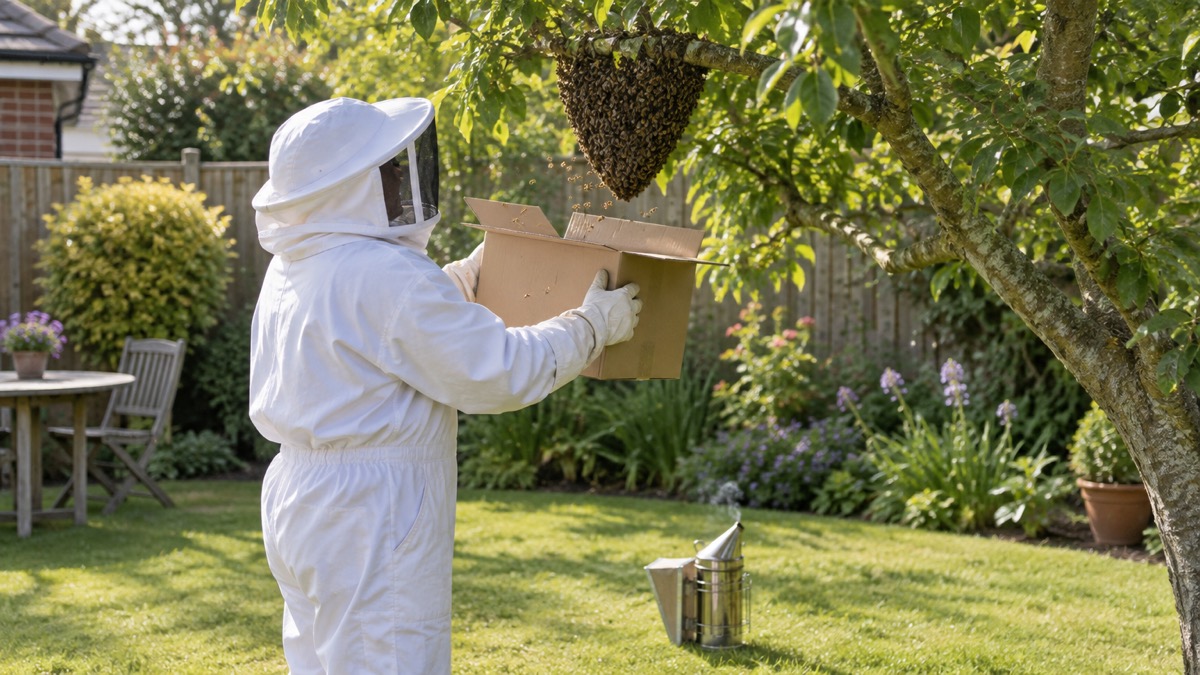
Collection itself usually happens in two parts: part one is to get the bees into a box, and part two is to return in the evening to remove the bees and the box1. Bees fly during the day, so the collector comes back at dusk when the foragers have returned to the cluster, and takes the whole lot at once. Expect the first visit to leave a box and perhaps a sheet beneath the swarm, and do not interfere with the set-up in between.
If the swarm leaves before the beekeeper arrives, or someone else collects it, tell the beekeeper to save them a wasted journey1. And be aware that it may not be possible to remove a swarm from difficult-to-reach places1: a cluster high in a chimney, deep in a wall cavity or inside drainpipe work can be beyond what a volunteer can safely do, which is why the access and height details in your report matter so much.
American foulbrood and European foulbrood: the notifiable diseases
For beekeepers, the diseases that matter legally are the two foulbroods. European foulbrood and American foulbrood are statutory diseases that are legally notifiable in the UK4, and the Bee Diseases and Pests Control Orders 2006 empower the Agricultural Departments of Great Britain to take measures to control them, as serious bacterial infections of brood8. The Orders cover England and Wales, with similar legislation in Scotland and Northern Ireland8.
The two diseases have different causes and different courses. American foulbrood is caused by a spore forming bacterium called Paenibacillus larvae2. Infected larvae normally die after the cell is sealed, and millions of infective spores form in the larval remains2. The spores are the infective stage of the disease, and infection begins when food contaminated with spores is fed to larvae2. European foulbrood is caused by the bacterium Melissococcus plutonius, and larvae infected with it normally die shortly before the cells are capped2.
| Disease | Cause | When infected larvae die | Notifiable |
|---|---|---|---|
| American foulbrood | Spore forming bacterium Paenibacillus larvae2 | After the cell is sealed2 | Yes, throughout the UK4 |
| European foulbrood | Bacterium Melissococcus plutonius2 | Shortly before the cells are capped2 | Yes, throughout the UK4 |
The course of American foulbrood is slow and deceptive. The disease may develop for months before the colony succumbs, and death may occur at any time of the year6. A colony can look reasonably strong through the summer while the infection builds, which is exactly why the law puts the duty on suspicion rather than on confirmed loss. If you keep bees, learn what a healthy brood pattern looks like in your own hives, so that sunken, perforated cappings or ragged, patchy brood stand out as something to report rather than something to watch.
Not every oddity in the brood is foulbrood. Sacbrood is a very common viral disease affecting brood which rarely causes measurable harm, though its signs can sometimes be mistaken for those of American foulbrood6. Chalkbrood is an extremely common brood disease caused by the fungus Ascosphaera apis, which kills larvae after they have been capped over6. Neither is notifiable, but both are reasons to look closely at brood regularly, and any suspicion of foulbrood is a matter for the National Bee Unit rather than for self-diagnosis.
Why foulbrood spores are so hard to get rid of
American foulbrood earns its strict controls because of its spores. The spores are very resistant to disinfectant and to extremes of heat and cold6, and they retain their powers of germination for many years in honey, in old combs kept in store, or in derelict hives, skeps or boxes6. A hive that held an infected colony years ago can still infect a new one, and honey from an infected colony can carry the disease into the next apiary it feeds.
This is why the response to suspected American foulbrood is destruction of infected colonies and their equipment rather than treatment, and why moving bees, honey or combs from an infected apiary is controlled. It is also why second-hand hives and old combs deserve caution: a bargain hive of unknown history can carry spores that outlast the beekeeper who stored it.
The comparison with chalkbrood shows the range. Chalkbrood spores have a sticky coating enabling them to adhere to combs and adult bees, and can remain infectious for three years or more6, which is persistent enough, but American foulbrood spores measured in years in honey and old comb, and shrugging off disinfectants and temperature extremes, are in a different class6. The practical lesson for any beekeeper is the same: do not move comb, honey or equipment from a hive you have any doubt about, and report the doubt.
Varroa: the reportable pest in every apiary
Varroa is the pest most beekeepers will actually live with. Since its discovery in England in 1992, the parasitic mite Varroa destructor has spread to infest colonies of honey bees throughout the UK6. Varroa destructor is a reportable pest of honey bee colonies5, and in 2021 the Bee Diseases and Pests Control Orders were amended to require that the presence of varroa is reported to the Agriculture Department for that country, to retain a trading relationship with the European Union and Northern Ireland8. For England and Wales, that department is the National Bee Unit8.
You can report the presence of Varroa in your hives through the National Bee Unit's Report Varroa page5. The National Bee Unit's media gallery contains images of Varroa mites and Varroa damage that may be helpful in identifying the signs of infestation5, and it is worth studying those images before you find the real thing, so you know what you are looking at on a bee's body or in a brood cell.
Because varroa is managed with veterinary medicines, the law around treatment matters. You must only use veterinary medicines that are authorised for use with honey bees in the UK, and you must use these medicines according to the instructions on the label3. The use of unauthorised substances, non-UK medicines or other substances, unless prescribed by a vet, to treat or prevent disease in bees is an offence under the Veterinary Medicines Regulations3. Authorised medicines can be checked using the filter 'Honey Bees' in the 'Species' section of the Veterinary Medicines Directorate product database, or the 'Predefined Searches' function selecting "Products for use in Honey Bees"3.
Telling the National Bee Unit: your legal duty
It is a legal requirement to notify the National Bee Unit if you know or suspect your colonies of honey bees to have a notifiable disease or pest3. Article 3 of The Bee Diseases and Pests Control (England) Order 2006 requires notification of notifiable diseases and pests in England3. The notifiable diseases are American foulbrood and European foulbrood, and the notifiable pests include the small hive beetle3. This duty sits alongside the wider principle that notifiable animal diseases must be reported to the Animal and Plant Health Agency even on suspicion, a rule local resilience forums apply to animal disease generally9.
Contact your local bee inspector for a further source of free, expert advice; the National Bee Unit publishes general contact details for the NBU and local bee inspectors for England, Scotland and Wales5. The role of the NBU is to control pests and diseases of honey bees through statutory disease inspection, apiary surveillance for exotic pests and education4, so an inspection is not a punishment but the service your registration and taxes support.
The arrangements differ at the edges of these islands. American foulbrood is a notifiable disease wherever you are: if suspected, contact DAERA in Northern Ireland or the Honey Bee Health Surveillance Programme in the Republic of Ireland6. The Honey Bee Health Surveillance Programme in the Republic of Ireland provides a disease diagnostic service for beekeepers6, and in Northern Ireland the Honey Bee Health Programme includes an annual survey for notifiable diseases, follow-up inspections after disease outbreaks and checks on imports6.
Enforcement has teeth. A standstill notice can be issued if a beekeeper refuses an inspector access to inspect the colonies, or if the use of illegal veterinary medicines is suspected or proven3. Failing to keep records of veterinary medicines applied to honey bee colonies, as set out in the Veterinary Medicines Regulations 2013, is an offence3, and as bees are classed as food-producing animals, beekeepers must maintain documentation of veterinary medicines administered to colonies for at least five years, whether or not the colony is still in the keeper's possession or has died5.
Honey, movement and medicines from infected colonies
The rules on what you may take from or do with an infected colony are strict, and they follow from how the disease spreads. In exceptional circumstances, licences can be issued by the National Bee Unit to remove honey from European foulbrood infected colonies or to move infected colonies3. Without such a licence, do neither: honey and moved bees are exactly the routes by which spores travel between apiaries.
The same law protects the honey itself and the people who eat it. You may be subject to enforcement action if unauthorised veterinary medicines, or high concentrations of authorised veterinary medicines, are detected in honey sampled from your hives3. This is the practical reason for the record-keeping duty above: if you cannot show what you treated with and when, you cannot show your honey is clean.
If you import bees, the rules are tighter still. Unless exported from New Zealand, only queen bees may be imported, as packages and colonies are not permitted3. The bees must come from an approved country and be accompanied by an export health certificate confirming they have been inspected before dispatch and come from disease free areas3. You must register the import on the Import of Products, Animals, Food and Feed System (IPAFFS)3, transfer the imported queen bees into new cages before putting them into the intended hives, and send the transport cages and attendant bees to the NBU laboratory at Fera Science Ltd, York Biotech Campus, Sand Hutton, York YO41 1LZ3. Exporting carries matching obligations: failure to comply with the destination country's rules may result in your consignment of bees being destroyed3.
Registering on BeeBase for local disease alerts
Registering with BeeBase is not a legal requirement3, but it is the single most useful thing a beekeeper can do to hear about disease nearby. BeeBase is the Animal and Plant Health Agency's National Bee Unit website4. Beekeepers in England, Scotland and Wales can use the online portal to register as a beekeeper and provide details of apiaries4, and registered beekeepers who provide apiary details receive email alerts about disease and pest outbreaks in their area4.
Keep your apiary site details current and accurate to get the most up to date disease and husbandry alerts4. An out-of-date apiary record means an outbreak two miles from where your bees actually are, and no alert at all for the site you forgot to add. The register is what the National Bee Unit works from to control pests and diseases of honey bees through statutory disease inspection, apiary surveillance for exotic pests and education, so accurate details help inspectors as well as you4.
Registration is separate from the legal duties. You must notify suspected notifiable disease or pest whether or not you are on BeeBase3, and you must report varroa presence in your hives5. Registration simply means that when something is found within flying distance of your apiary, the NBU can tell you, and when an inspector is in the area, they know you are there to visit. If you are starting out, our page on beekeeping for beginners covers registration alongside hives and training, and the self-reliance section has related guides on keeping animals and growing food at home.
Frequently asked questions
What if the swarm flies off before the beekeeper arrives? Tell the beekeeper straight away, or if someone else collects it first, so they do not make a wasted journey1. Swarms sometimes move on by themselves, and a beekeeper driving to your address for a cluster that has gone is time lost for everyone. If the bees settle again nearby, contact the beekeeper once more with the new location.
How do I know if they are honey bees rather than wasps or bumblebees? Honey bee swarms are thousands, not a dozen or so1, and they hang as a solid cluster from a branch, fence or wall. Bumblebees are larger, rounder and furrier, and their colonies die out naturally in late summer or autumn1, so they usually need no action at all. Please do not use chemicals or other products on bumblebees1. Send the beekeeper a photo before they set out, because if it is not honey bees they are unlikely to be able to help1.
Can a swarm be removed from a chimney or inside a wall? Not always. It may not be possible to remove a swarm from difficult-to-reach places1, and a cluster high up a chimney or deep inside cavity work can be beyond what a volunteer can safely reach. Say exactly where the bees are and how high when you report it, so the beekeeper can judge before travelling. Do not try to smoke, spray or block them out yourself.
Who deals with foulbrood in Northern Ireland and the Republic of Ireland? In Northern Ireland, suspected American foulbrood should be reported to DAERA, and in the Republic of Ireland to the Honey Bee Health Surveillance Programme, which also provides a disease diagnostic service for beekeepers6. The Bee Diseases and Pests Control Orders 2006 cover England and Wales, with similar legislation in Scotland and Northern Ireland8. The duty to report suspected notifiable disease applies across these islands.
Can I move a colony or take honey from it if it has foulbrood? Only with a licence. In exceptional circumstances, licences can be issued by the National Bee Unit to remove honey from European foulbrood infected colonies or to move infected colonies3, but doing either without one risks spreading the disease. American foulbrood spores survive for years in honey and old comb6, which is why it is treated more strictly. Report suspicion first and wait for an inspector before touching honey or equipment.
Do I have to register on BeeBase if I keep bees? No, registering with BeeBase is not a legal requirement3, but the National Bee Unit encourages it. Beekeepers in England, Scotland and Wales can register online and provide details of apiaries to receive email alerts about disease and pest outbreaks in their area4. Keep your apiary details current and accurate so the alerts you get are the right ones4. Separately, notifying suspected notifiable disease or varroa is a legal duty whether or not you are registered3.
How long does a colony with American foulbrood survive? The disease may develop for months before the colony succumbs, and death may occur at any time of the year6. Infected larvae normally die after the cell is sealed, and millions of infective spores form in the larval remains2, which is why the colony keeps recontaminating its own brood food. Report suspicion early rather than waiting to see.
Sources (9)
- Honey Bee Swarms, Ulster Beekeepers' Association
- Foulbroods: Notifiable Diseases, National Bee Unit
- Legal Responsibilities of Beekeepers, National Bee Unit
- BeeBase, National Bee Unit
- How Do I Manage Varroa, National Bee Unit
- Honey Bee Health and Advice, Ulster Beekeepers' Association
- Poisoning, nidirect, 2021-06-27
- Bees and the Law, National Bee Unit
- Animal Disease, Wiltshire and Swindon Prepared, 2024-05-31
 Beekeeping Starter Equipment
 Pet Hens Starter Kit
 Bringing Home Rescue Hens
 Animal Disease Outbreaks
 Horses and Livestock
 Beekeeping for Beginners
 Chicken Health