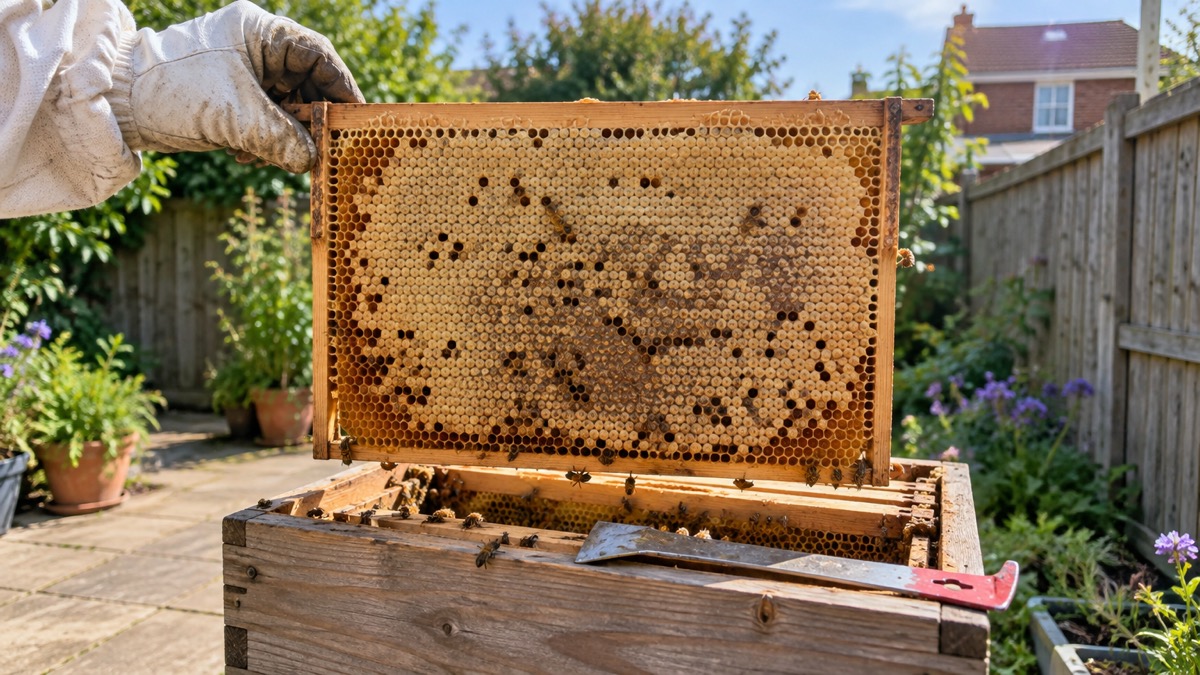
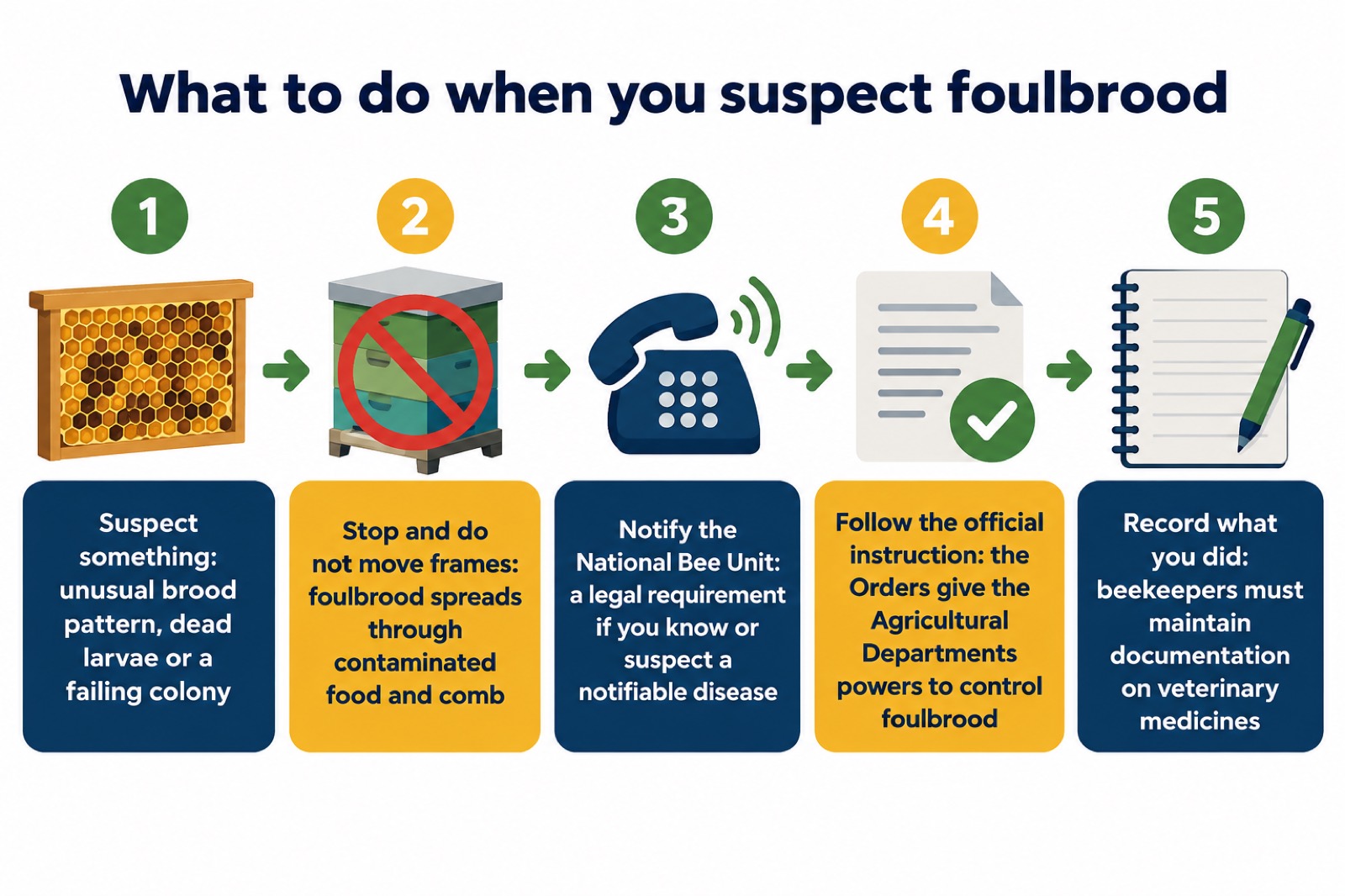
If you keep honey bees in the UK, foulbrood is one of a small number of diseases you are legally obliged to act on. American foulbrood and European foulbrood are both notifiable, and it is a legal requirement to notify the National Bee Unit if you know or suspect your colonies have a notifiable disease or pest1. The same duty covers varroa: it is a legal requirement to report the presence of Varroa destructor in your hives1.
So the first thing to do, if you suspect foulbrood, is not to treat it yourself or to move frames between hives. It is to stop, keep the hive where it is, and notify. The Bee Diseases and Pests Control Orders 2006 give the Agricultural Departments of Great Britain powers to take measures to control American foulbrood and European foulbrood, which are serious bacterial infections of brood2. That is why the response is official rather than a matter of choice.
This page sets out what the law requires, how the two foulbroods differ, how to inspect brood without putting yourself at risk, and how to set up and site a hive so that disease checks are easier from the start. If you are new to bees, start with Beekeeping for Beginners: Hives, Training and Registration and come back here when you are ready to inspect.
Why bee diseases are under official control
Bees are classed as food-producing animals, and because of that beekeepers must maintain documentation containing details of veterinary medicines6. That classification is the reason bee disease sits alongside cattle and poultry disease in law rather than being a private matter between a beekeeper and their hives.
The practical consequence is that the same principle applies to bees as to any other livestock: it is important anyone looking after livestock is familiar with the symptoms of animal diseases they are legally obliged to report7. You are expected to know what you are looking at, and to act on it.
The Bee Diseases and Pests Control Orders 2006 empower the Agricultural Departments of Great Britain to take measures to control American foulbrood and European foulbrood2. Both are serious bacterial infections of brood. The Orders were amended in 2021 so that beekeepers in England, Wales and Scotland must report the presence of varroa to their Agriculture Department2.
| Nation | Who you notify | Basis |
|---|---|---|
| England | National Bee Unit | Article 3 of The Bee Diseases and Pests Control (England) Order 2006 requires notification of notifiable diseases and pests1 |
| Wales | Your Agriculture Department | Orders amended in 2021 to require varroa reporting2 |
| Scotland | Your Agriculture Department | Orders amended in 2021 to require varroa reporting2 |
| Northern Ireland | Daera | Notifiable disease: contact Daera in NI if suspected8 |
| Republic of Ireland | Health Surveillance Programme | Contact the Health Surveillance Programme if suspected8 |
For Northern Ireland the advice is specific: American foulbrood is a notifiable disease, and if you suspect it you should contact Daera in NI, or the Health Surveillance Programme in ROI8. If you keep bees in more than one nation, check which body applies to each apiary rather than assuming.
Notifiable pests and diseases: what you must report
The list is short and worth knowing by heart. Notifiable diseases include American foulbrood and European foulbrood1. Varroa destructor is a reportable pest of honey bee colonies6, and it is a legal requirement to report its presence in your hives1.
That varroa duty is newer than many beekeepers realise. The Orders were amended in 2021 so that beekeepers in England, Wales and Scotland must report the presence of varroa to their Agriculture Department2. If you learned beekeeping before that date, the rule you were taught may be out of date.
The wider principle is that a suspicion is enough. The requirement is triggered when you know or suspect a notifiable disease or pest, not when you have had it confirmed by a laboratory1. Reporting early costs you nothing and may protect neighbouring apiaries.
American and European foulbrood: what you are looking at
American foulbrood is caused by a spore forming bacterium called Paenibacillus larvae3. Those spores are the infective stage of the disease, and infection begins when food contaminated with spores is fed to larvae3. That is why the disease spreads so readily through contaminated comb and stores, and why moving frames between colonies is such a risk.
European foulbrood behaves differently. Its timing of death is distinctive: the larva normally dies shortly before the cells are capped3. American foulbrood is slower and more insidious. The disease may develop for months before the colony succumbs, and death may occur at any time of the year8.
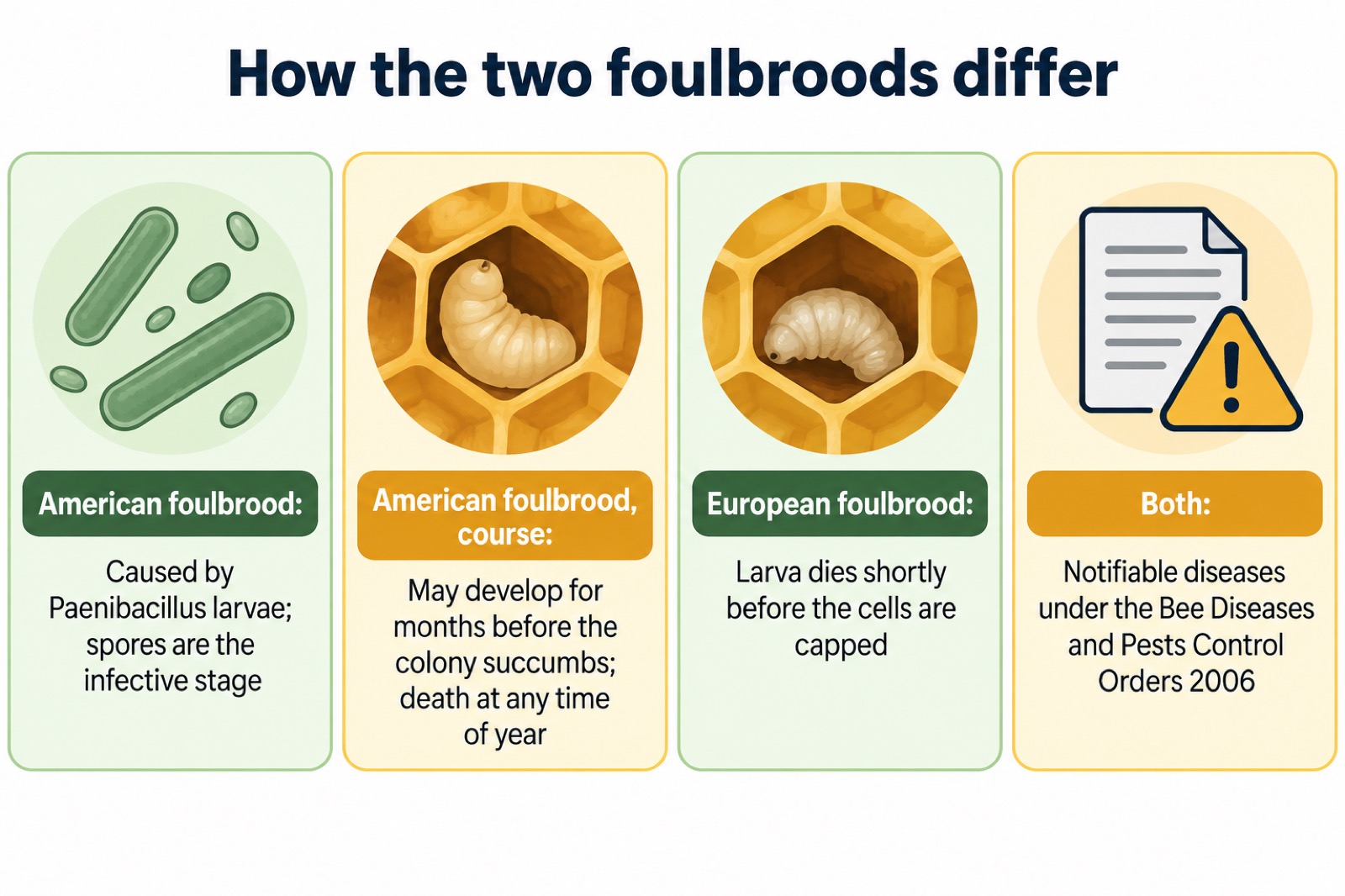
What this means for you as an inspector is that a colony which looks merely weak in autumn may have been carrying American foulbrood for months. Do not wait for the colony to die before you report a suspicion.
Inspecting brood safely: stings and anaphylaxis
Opening a hive means being stung, and for a small number of people that is a medical emergency. Watch for signs of an allergic reaction, which can lead to anaphylactic shock9. The Anaphylaxis UK charity is direct about the risk for beekeepers: any beekeeper who is at risk of anaphylaxis to bee venom should seek medical advice on how to safely continue beekeeping4.
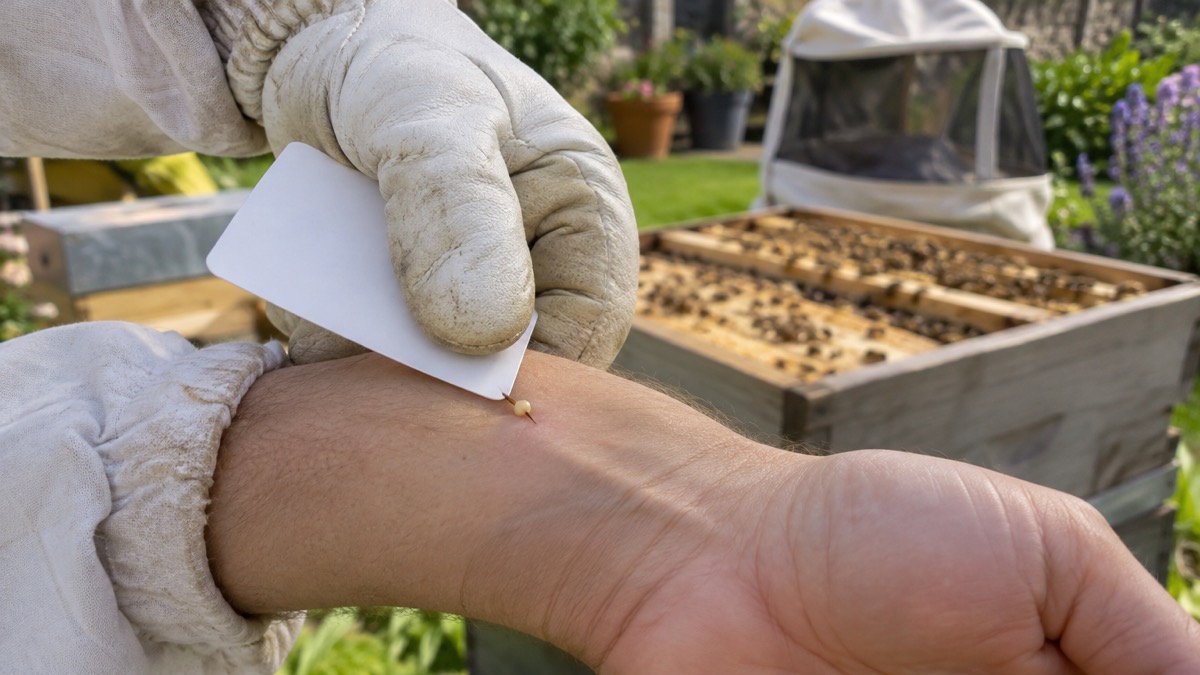
If a stinger is left in the skin, remove it quickly. A bee will usually leave behind a stinger attached to a venom sac, and it should be removed quickly using a scraping motion with a hard-edged card such as a debit card10. The sac should be flicked upwards with one quick scrape of the fingernail or a credit card, which will reduce but not eliminate the risk of a serious reaction4. The St John Ambulance advice is to brush or scrape the sting off sideways with something firm like a fingernail, credit card, or plastic ruler as soon as possible9.
The same principle applies to any severe reaction, including to a nettle sting: in very rare cases an individual may have a severe allergic reaction, and if this happens, treat for anaphylaxis and seek urgent medical help12. Keep a first aid kit and any prescribed medication with you at the apiary, and make sure anyone who works the hives with you knows what to do. Our First Aid at Home guide covers the household side.
Setting up and siting a hive with disease checks in mind
Where you put a hive decides how easy it is to inspect, and inspection is how disease gets caught early. Avoid placing hives facing onto a neighbour's property or near a public footpath; facing a hedge or fence will usually encourage the bees to fly above head height and avoid being a nuisance5.
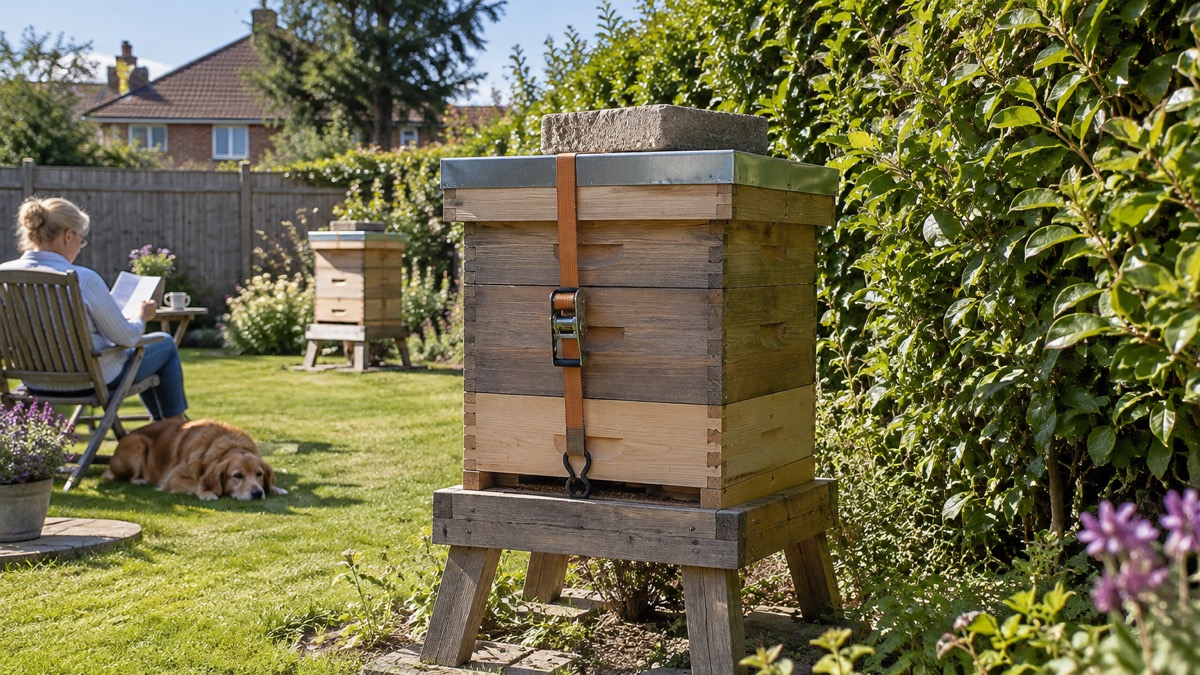
On an exposed site, secure the hive against wind. If the hives are on a windy or exposed site, weigh down the roof with something heavy like some bricks and for extra security strap the whole hive together5. A hive that has blown over is a colony under stress and an inspection you cannot do safely.
Plan for the time commitment before you take on a colony. The busiest time is during late spring and into summer, when hives need to be checked weekly, and it is essential that hives are checked weekly, taking up to an hour once a week5. That weekly hour is also your disease surveillance.
In winter, the discipline changes. The British Beekeepers Association's January advice is to leave the bees alone, think about equipment needed for the new season and check prices and lead times with suppliers, monitor for varroa and treat if necessary, use mesh cages on hives to prevent woodpecker damage, clear dead bees from hive entrances to avoid blockages, check hives by hefting to estimate remaining stores, give fondant if necessary, carry out apiary repairs, and always check hives after bad weather5.
Hive health signs: wax and brood
Wax is one of the clearest signs that a colony is working as it should. A strong colony of 50,000 bees should be able to produce about 230 g of wax in a day1, and that fresh wax is what the bees build comb from, so steady drawing of new comb tells you the colony has the numbers and the conditions to keep expanding.
There is no single normal figure for wax production, because it depends on the season, the colony and the forage. What you can do is learn the signs that something is wrong and act on them.
Chronic bee paralysis virus is one to know. Symptoms, when present, may include bees crawling on the ground outside the hive entrance, vigorous trembling of bees, and hairless or bloated abdomens caused by distension of the honey sac with liquid8. Bees on the ground outside the entrance in numbers are worth investigating rather than ignoring.
Stores are the other half of the picture. Hefting the hive to estimate remaining stores is part of the winter routine2, and it tells you more about the colony's condition than any single plant in the garden. Where bees have a choice, they also like white and red clover3, so a garden with clover in it gives them something to work when they are out and about.
Where to get help and advice
The National Bee Unit is the body to notify in England, and its guidance on the law and on foulbrood is the place to check the current position2. For varroa management, its own guidance sets out how to manage the mite6. In Northern Ireland, contact Daera; in the Republic of Ireland, the Health Surveillance Programme8.
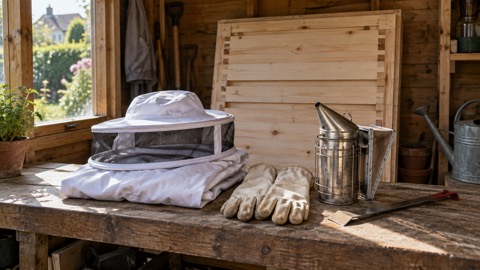
Beekeeping associations are the other source of practical help. The British Beekeepers Association publishes guidance for people becoming beekeepers and a month by month account of the beekeeping year5. If you have not yet registered your apiary, our guide to BeeBase registration explains what it involves, and Beekeeping Starter Equipment Checklist lists what to have before your first inspection.
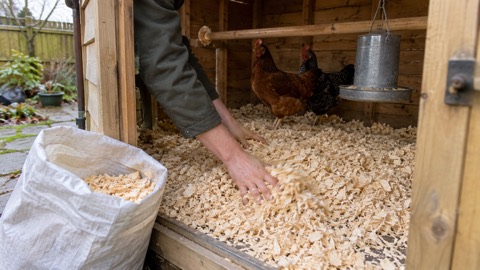
If a swarm arrives rather than a disease, that is a different call: see What to Do If a Bee Swarm Lands on Your Property. And if you keep other livestock alongside your bees, the same principle of knowing reportable symptoms applies across species, as our guides to Keeping Chickens and Chicken Health set out.
Sources (12)
- Legal responsibility of beekeepers, National Bee Unit
- Bees and the law, National Bee Unit
- Foulbroods (notifiable), National Bee Unit
- Bee and wasp sting allergies, Anaphylaxis UK
- Becoming a beekeeper, British Beekeepers Association
- How do I manage varroa, National Bee Unit
- Prepare for emergencies: risks, Surrey County Council
- Honey bee health and advice, UBKA
- Insect bites and stings, St John Ambulance
- Staying safe over the summer, Healthier Together (NHS)
- Allergic reaction, British Red Cross
- The beekeeping year, British Beekeepers Association
 Beekeeping Starter Equipment
 Pet Hens Starter Kit
 Bringing Home Rescue Hens
 Hay Bale Fires
 Livestock in a Heatwave
 Livestock Water Outage
 Sky Lanterns
 BeeBase Registration
 Broody Hen Hatching
 Cleaning a Chicken Coop
 Coop and Run Space for Hens
 Care for Ex-Battery Hens
 Fox-Proofing a Chicken Coop
 Daily Hen Feed Amounts
 Introducing New Hens