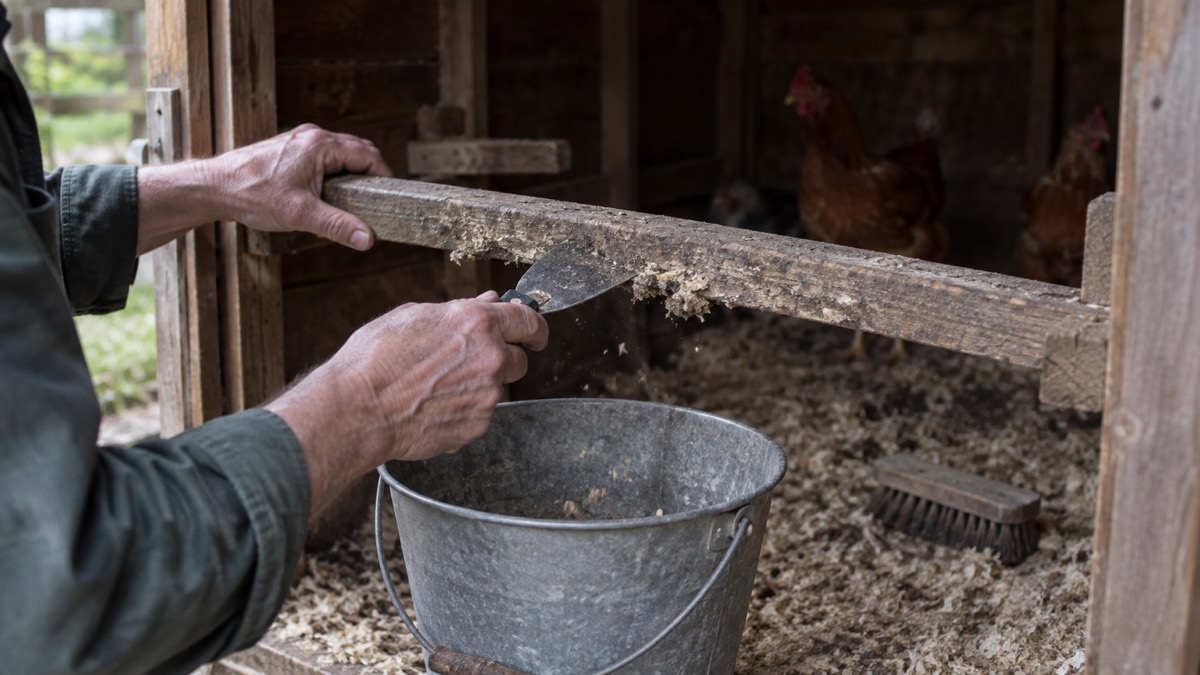
A hen house needs cleaning and disinfecting regularly to remove parasites, and the routine that matters most is a weekly clear-out of bedding with a monthly disinfection using a government approved product1. The single biggest reason is red mite, which lives in the coop by day and feeds on the birds at night, hiding in cracks, crevices and under perches3.
If you do only one thing, make it the weekly clean in the warmer months. Red mite is most common from May to October, and all types of coop can get it, though wooden coops tend to suffer infestations the most5. A ten day life cycle means a missed clean is quickly a population4.
This page sets out a routine you can keep to, how to check for mites without disturbing the flock, what to do if you find them, and where to get help when a bird is sick or dies.
Red mite hides in the coop by day and feeds at night
Red mites live in the chicken coop in the daytime and feed off the blood of chickens at night5. They sit in cracks, crevices and perches during the day and come out to feed on the hens after dark3. The Poultry Club describes them as living in the housing, particularly under perches and in cracks or crevices, and feeding on the blood of the bird at night, and calls them a potential killer if left unattended4.
That behaviour is what decides your cleaning routine. You are not mainly cleaning the floor for tidiness; you are denying a parasite the dark, undisturbed places it lives in. Perch ends, the joints of a wooden house, the underside of the roof and the nest box corners are where the mites are, which is why a quick sweep of the floor is not enough on its own.
Red mites are yellow or brown in colour, becoming red after feeding on blood from hens, and are almost invisible to the naked eye at 0.6 to 1mm3. Once fed they show up as tiny red specks or clusters of red specks; unfed they are grey and almost dust-like, and much harder to spot3.
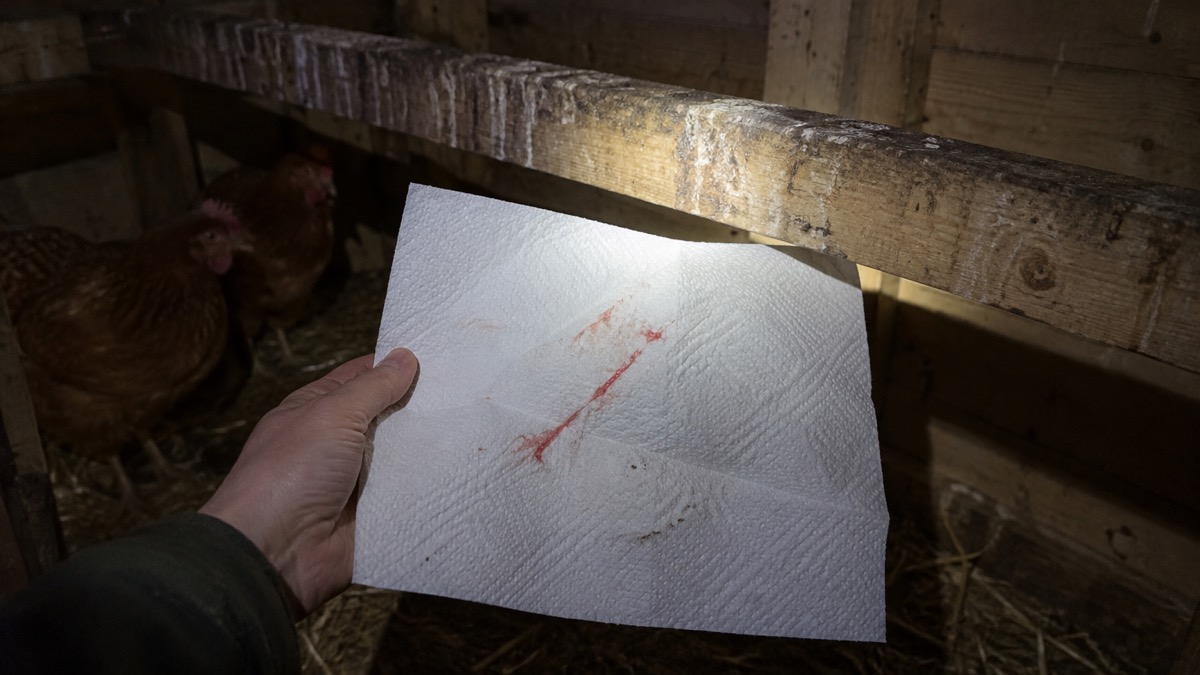
The easiest check is a night-time one. Run a white paper towel underneath the perches at night; if there are red mites you will see red streaks on the paper towel5. Do this as part of your routine rather than waiting for a bird to look unwell.
A cleaning routine you can keep to
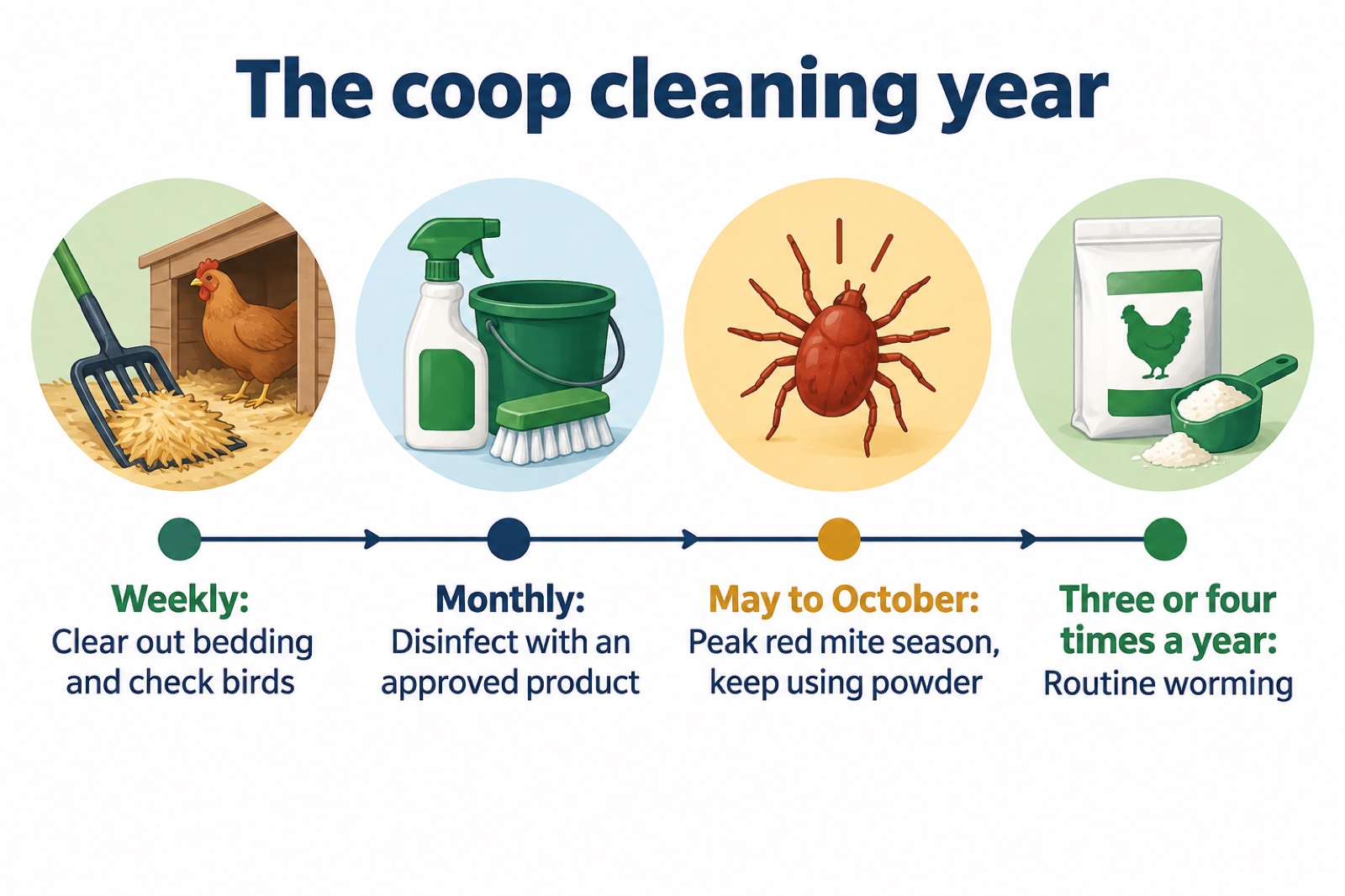
The core routine is simple and does not need specialist kit. Clean and disinfect the coop regularly with a government approved disinfectant, which can be used monthly2. Alongside that, carry out routine worming three or four times a year using a licensed product, and regularly check your hens and the coop for external parasites such as red mite2.
| When | What to do | Why it matters |
|---|---|---|
| Weekly | Clear out and replace bedding; check birds and housing for parasites2 | Breaks the mite life cycle and removes damp, dirty litter |
| Monthly | Clean and disinfect with a government approved disinfectant2 | Reaches the surfaces a sweep misses |
| Three or four times a year | Routine worming with a licensed product2 | Worms are a separate problem from mites |
| May to October | Continue mite powder and check more often5 | The months when red mite is most common |
| After illness | Leave the coop empty for two weeks following disinfection7 | Helps contain an outbreak |
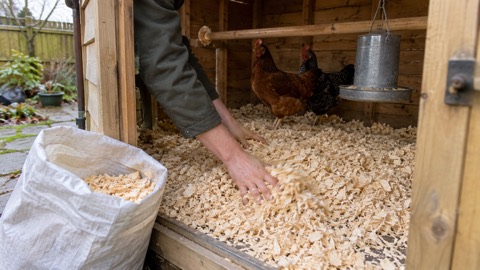
Cover the flooring with dry material such as wood shavings or straw, which gives the birds comfortable resting and dustbathing, and top up or replace the substrate when needed1. Coops need regular cleaning and disinfection to remove parasites1. Treat any newly purchased second-hand equipment before introducing birds3. The practical test is simple: if the litter is damp or compacted, replace it rather than adding more on top.
For the wider picture on housing, feeding and the law, see keeping chickens, and for a full kit list see what you need to keep pet hens.
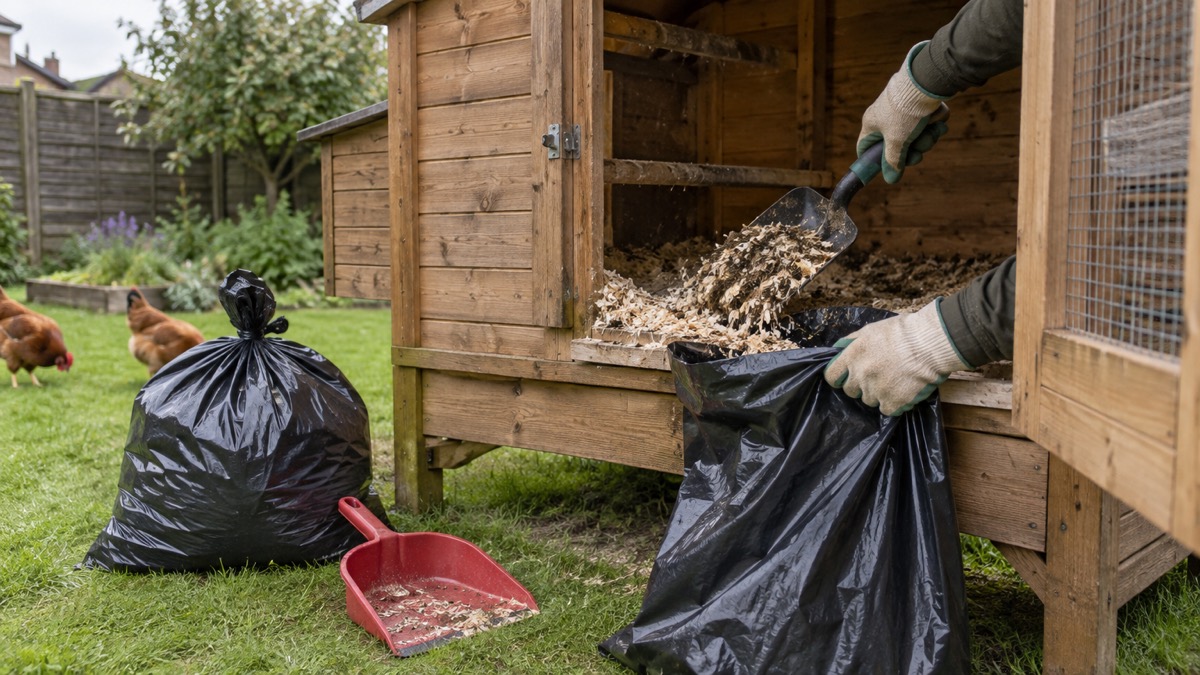
Clearing out after red mite: bag and bin all the bedding
If you confirm red mite, the clean-out is different from a routine one. Get rid of any bedding and dispose of it in a plastic bag in a bin, because the red mites will happily find somewhere else to live5. Do not put it on the compost heap or leave the bag beside the coop.
Then work through the housing itself. Mites live in cracks, crevices and perches during the day, so those are the places to reach3. A keeper writing about their own plastic coop said that although they still had red mite, the coop was so much easier to clean out than a wooden shed that they could get into the nooks and crannies, wiping it with vinegar and neem oil and putting mite powder and lavender in the brooding area and around the egg hatch where red mite congregate5.
Treat any newly purchased second-hand equipment before introducing birds3. This matters if you have bought a used house, nest box or feeder: the mites can arrive with it.
Wooden and felt-roofed coops need the most attention
All types of chicken coop can get red mite, but wooden coops tend to suffer infestations the most5. The RSPCA's advice is to clean the coop regularly and consider a plastic coop, as red mites struggle to settle in plastic1. If you keep a wooden house, plan on the more frequent end of the routine and inspect the joints and perch fixings each time.
Whatever the coop is made of, the birds need somewhere to dustbathe. Red mites and lice are more commonly seen in summer, so promote dustbathing and consider switching to a plastic coop8. A dry dustbathing area is part of the prevention, not a luxury.
Perches deserve a look too. They should be around 3 to 5cm wide with rounded edges, allow 15cm of roosting space per chicken, and sit at a height of 40cm so chickens feel safe8. Perches that are easy to lift out are easier to clean under, which is where mites sit.
For more on identifying and treating the problem, see chicken health: mites, lice, worms and common illnesses, and for housing and space see how much coop and run space do hens need.
May to October: when red mite is most common
Throughout May to October it is sensible to continue using powder, as these hot summer months are when red mite is most common5. Red mites and lice are more commonly seen in summer8. Red mite is spread by wild birds, so wild visitors to the run are part of the picture3.
The warmer months are also when other biting parasites are about. Ticks are most active between March and October9. That is a reason to check birds over when you handle them, not a reason to treat preventively with anything not intended for poultry.
Biosecurity and cleaning overlap here. Keep the living area clean and free from debris or waste that could harbour pathogens, which means regularly cleaning the coop and providing clean water and feed10. For the day-to-day version, see daily biosecurity for backyard poultry keepers.
Signs a hen is unwell, and what to check
Get to know your birds. Regularly check your flock and become familiar with handling your hens so you know when one is feeling poorly11. Signs of poor health in chickens include a hunched posture, erect feathers, a head tucked under the wing, hiding in corners, dirty feathers, lameness, runny faeces stuck to the rear feathers, and discharge from the eyes or nostrils; contact a vet if you are concerned8.
Red mite has its own signs: a drop in egg production, pale combs and wattles (anaemia), and the presence of red or grey mites in the coop or on the bird around the vent area5. Pale combs and wattles are the visible sign of anaemia3.
| What you may see | What it can point to |
|---|---|
| Pale comb and wattles | Anaemia, a red mite symptom3 |
| Drop in egg production | Red mite5 |
| Mites around the vent | Red mite5 |
| Runny faeces on rear feathers | General poor health, contact a vet8 |
| Hunched posture, head tucked | General poor health, contact a vet8 |
Lice are a separate problem with a slower cycle: the life cycle of lice is three weeks, and chickens should be lice free roughly three weeks from starting treatment6. Scaly leg mite spends its entire 10 to 14 day life cycle on the affected bird12.
Where to get help with sick or dead birds
An Avian Influenza Prevention Zone is currently in place across the UK, and the advice is not to touch or handle sick or dead birds; if you have to, thoroughly wash your hands immediately afterwards, keeping them away from your face or food8. Maintain good personal hygiene with regular hand washing with soap and use of alcohol-based hand rubs13.
If you have any concerns about the health of your birds and think they could have bird flu, contact the Animal and Plant Health Agency on 03000 600 70414. In Northern Ireland, dead wild birds including swans, geese, ducks and gulls can be reported using the DAERA Dead Wild Bird online reporting tool15.
Good biosecurity reduces the risk in the first place: place food and water under cover to prevent contamination from wild birds, change or disinfect footwear when entering the enclosure, wash hands before and after tending to birds, regularly clean and disinfect equipment and hard surfaces, keep up rodent and vermin control, use scarecrows, foils or streamers to deter wild birds, prevent access to neighbouring poultry, and reduce the movement of people, vehicles or equipment16.
For more on the disease and the rules, see keeping chickens and chicken health.
Sources (16)
- Chicken environment and housing, RSPCA, 2026-10-29
- Hen husbandry, British Hen Welfare Trust, 2026-06-01
- Red mite, British Hen Welfare Trust, 2026-11-04
- Health and diseases, Poultry Club of Great Britain, 2026-11-04
- Red mite in chickens, Omlet, 2026-11-04
- Chicken parasites, Omlet, 2026-11-04
- Mycoplasma, British Hen Welfare Trust, 2026-11-04
- Chicken health and welfare, RSPCA, 2026-10-29
- Checking for ticks, Forestry and Land Scotland, 2026-10-29
- Biosecurity for Free Range Poultry ‐ The Poultry Club, The Poultry Club of Great Britain
- Hen examination guidelines, British Hen Welfare Trust, 2025-10-30
- Scaly leg, British Hen Welfare Trust, 2026-11-04
- Avian influenza, Public Health Agency (Northern Ireland), 2026-10-06
- Avian influenza, Scottish Borders Council, 2026-10-29
- Avian flu, Belfast City Council, 2026-10-29
- Bird flu: all you need to know, Woodgreen Pets Charity, 2026-05-15
 Beekeeping Starter Equipment
 Pet Hens Starter Kit
 Bringing Home Rescue Hens
 Hay Bale Fires
 Livestock in a Heatwave
 Livestock Water Outage
 Sky Lanterns
 BeeBase Registration
 Broody Hen Hatching
 Coop and Run Space for Hens
 Care for Ex-Battery Hens
 Reporting Foulbrood
 Fox-Proofing a Chicken Coop
 Daily Hen Feed Amounts
 Introducing New Hens