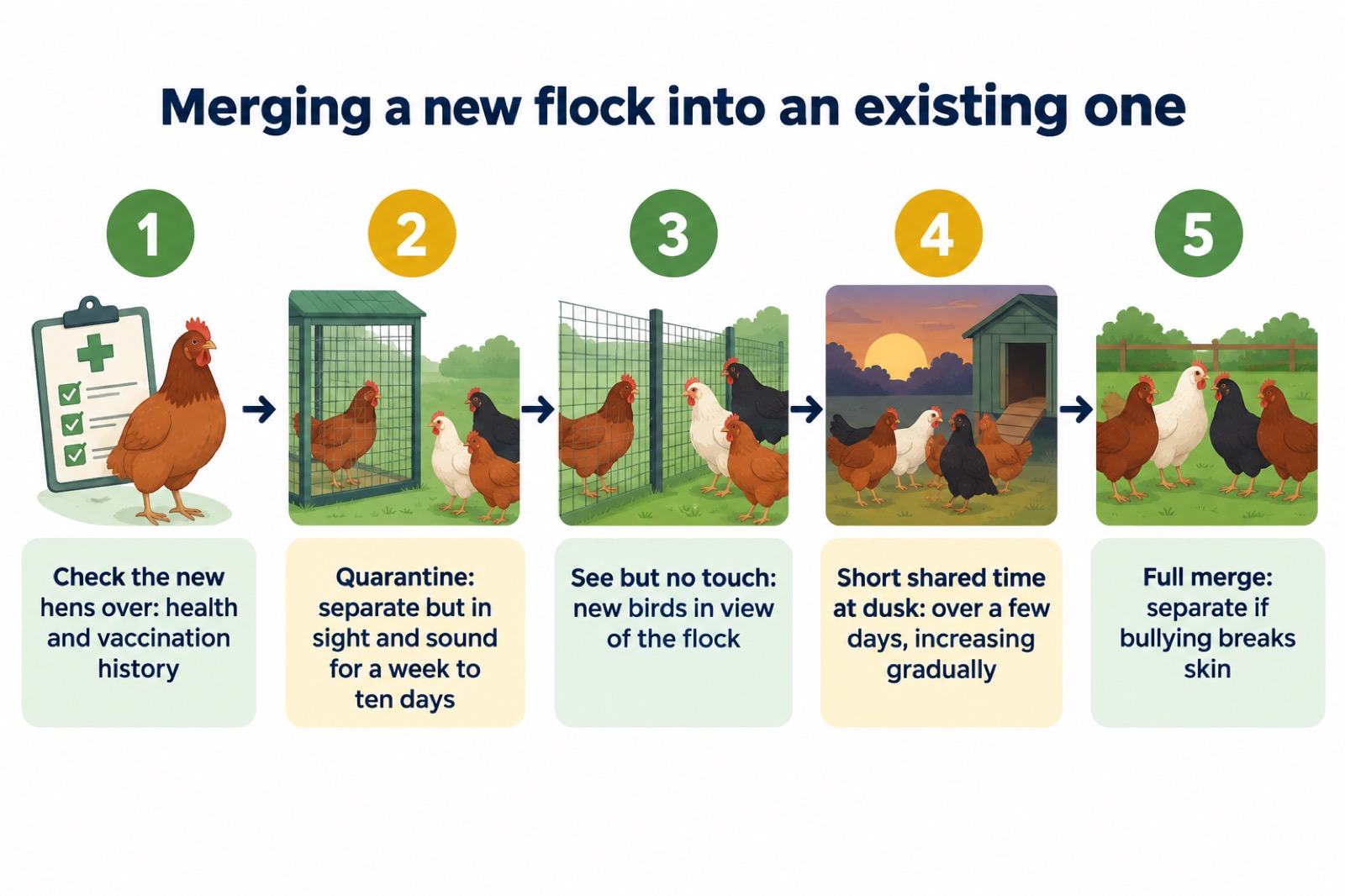
Bringing new hens into an existing flock is one of the riskiest moments in backyard hen keeping. Hens have a pecking order, and newcomers are strangers. The safe approach is to slow the whole thing down: check the new birds over before they come home, keep them separate but in sight and sound of your flock for a week to ten days, then merge them gradually at dusk when birds are more interested in roosting than fighting1.
Two rules matter more than any other. First, keep new hens separate from your existing birds for at least a few weeks if they are rehomed commercial hens, because they may be unfit and easily bullied at first3. Second, never feed kitchen scraps to chickens, which is illegal because of the risk of disease4.
This page covers what to check before you bring hens home, how to set up space and quarantine, how to merge the flocks, how to feed a mixed flock, and what to watch for in the weeks afterwards.
Check new hens are healthy before you bring them home
Before any hen crosses your threshold, look her over. The advice for all hen keepers is to check your flock regularly and handle your birds often enough that you know when one is feeling poorly8. A healthy hen should be busy and active, scratching the ground, feeding and drinking well (though not excessively) and preening8. A bird that sits hunched, ignores food or stands apart is telling you something.
If you are rehoming ex-commercial hens, expect them to be in poor condition at first. They may have never perched, never seen grass, and never had to find shelter. Very often they will sleep on the floor of the house initially, though colony hens who have had access to low perches adapt quickly, and free-range and barn hens will have no problem perching9.
Ask where the birds came from. Hens from auctions, markets and hobby breeders are unlikely to have been vaccinated, which makes the separation period an important quarantine time1. Caged hens, by contrast, are unlikely to have worms at the point of adoption as they have had no contact with solid ground10.
If you keep a cockerel, supervise introductions between him and new hens closely to make sure the hens do not suffer injuries3. The same applies to dogs: do not leave hens unsupervised with a dog until you are satisfied the dog is hen friendly3.
Keeping at least two chickens, and making space in the coop and run
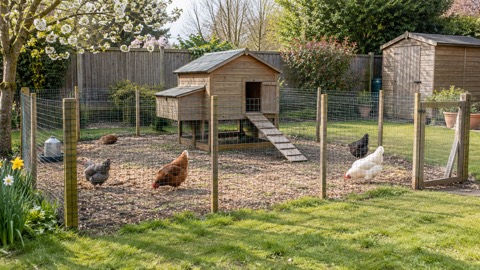
Space is the quiet factor that decides whether a merge goes smoothly or turns into persistent bullying. Chickens are social creatures, and a minimum of three hens in a flock is recommended6. If you are adding to an existing group, the British Hen Welfare Trust advises adopting a greater number of hens than you currently keep: if you already have three hens, adopt at least four new ones so the incoming birds have the advantage in numbers5.
Coop sizing is often overstated by manufacturers. For a coop sold as housing three to five hens, the Trust would recommend it is suitable for three ex-commercial hens11. Plan for the lower end of any range.
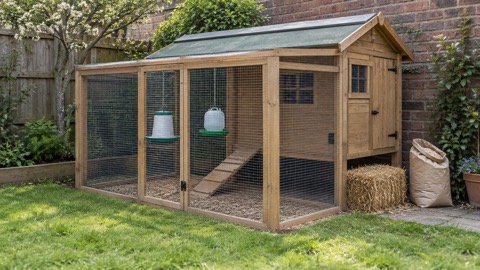
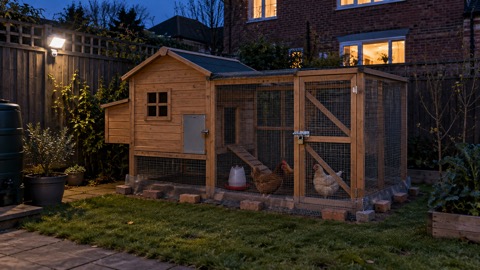
When hens first arrive, there should be some kind of enclosure around the coop so they become "homed" and learn where to eat, drink and go to bed, meeting minimum spacing requirements to reduce stress or bullying11. Put them in the hen house initially so they get accustomed to where home is, but allow them outside access straight away provided you have a fenced area5. If you have a small enclosed run, leave the door or pop-hole open; if there is no enclosure, make sure the hens are secure and cannot wander off9.
You may need to help them understand their new daily routine by encouraging them out in the morning and ensuring they are tucked up ready for bed in the evenings9. For more on housing, feeding and the law, see Keeping Chickens, and for space figures in detail, How Much Coop and Run Space Do Hens Need?.
| What to sort out | Why it matters | Source |
|---|---|---|
| At least three hens in the flock | Chickens are social and do badly alone | 6 |
| Adopt more new hens than you keep | Incoming birds need the advantage in numbers | 5 |
| Coop rated 3 to 5 hens suits 3 ex-commercial hens | Sizing claims are generous | 11 |
| Enclosure around the coop at first | Helps hens become homed and reduces bullying | 11 |
| Quarantine up to two weeks | New birds may carry illness | 5 |
Merge the flocks slowly, and at dusk
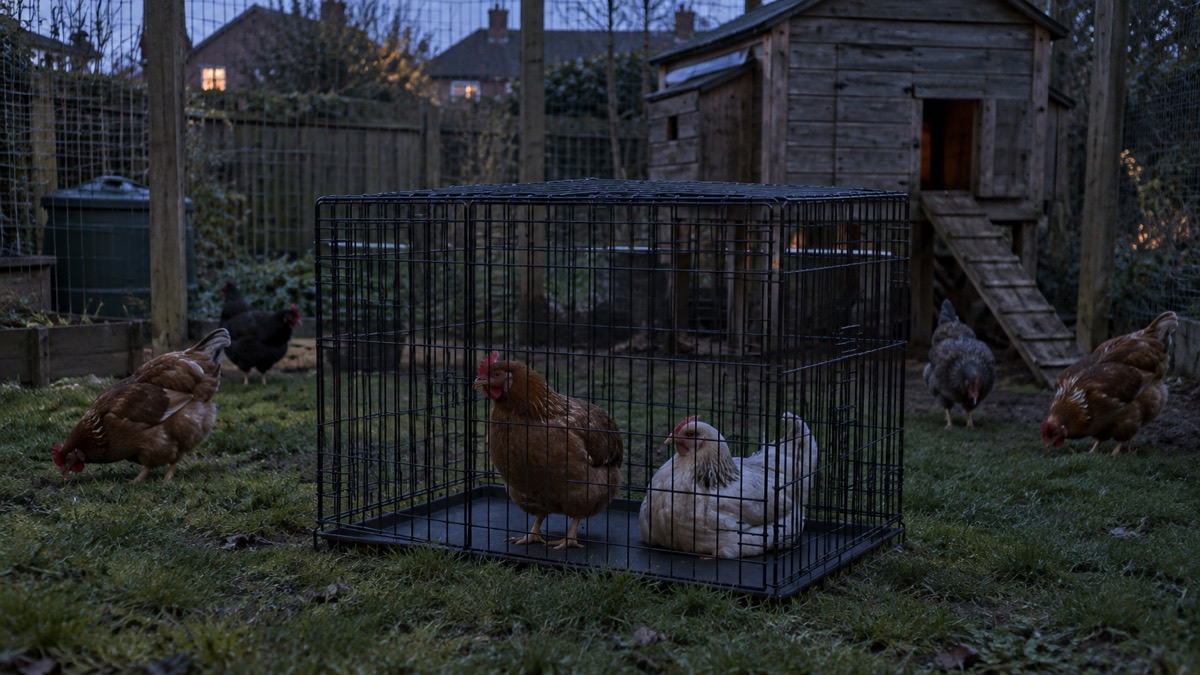
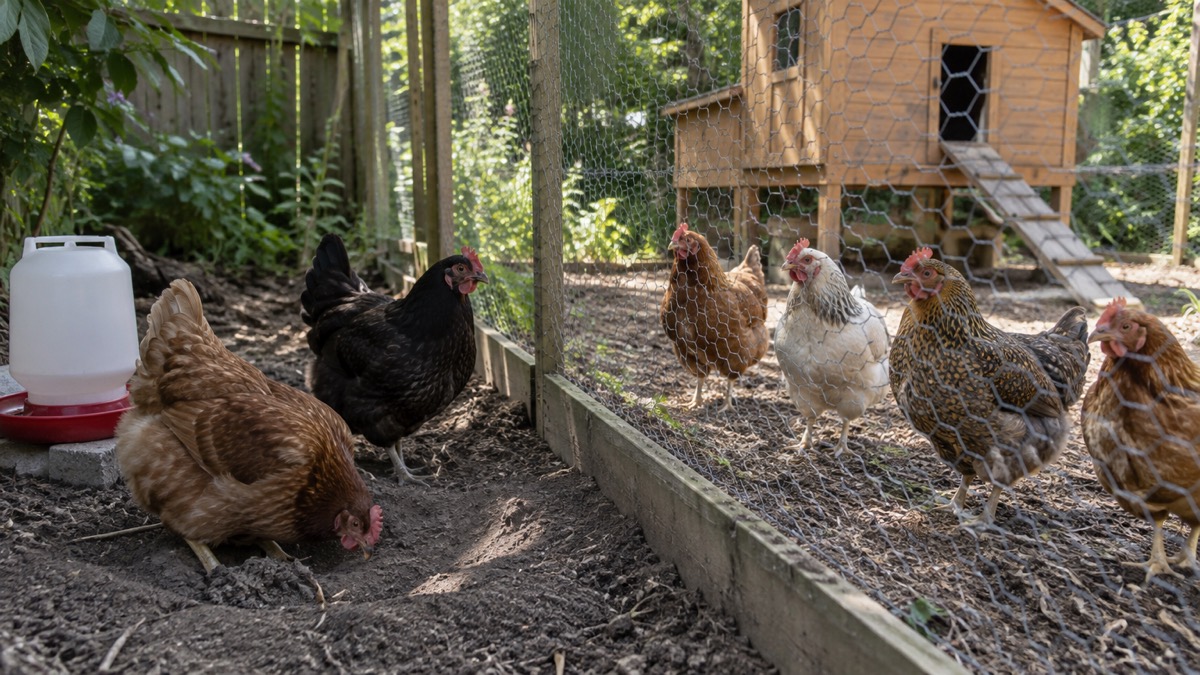
The merge itself should be a staged process, not a single release. Start with a "see but no touch" introduction: bring the new chickens into view of your existing flock, which also acts as a quarantine period4. Then let the chickens share the same space for short times over a few days, doing so at dusk when they are more focused on roosting than fighting, and increase the time gradually5.
Some dominance behaviour is normal while the pecking order is being established. What is not normal is bullying that breaks skin: separate the birds if this happens12. In summer, black out the coop windows with a black plastic bag so bullying does not start before you are up12.
If you are introducing birds at night, place the new chickens in the house with the flock when they have gone in to roost, then let them all out in the morning and keep an eye on them13.
Practical remedies for a bullied hen include smearing Vaseline on the combs of the bullied birds, so bullies cannot get a grip; putting several sources of food and water in the pen; hanging distractions such as shiny CDs, half cabbages or corn on the cobs just above head height; and giving enough space that the lowest ranking hen can stay out of trouble5.
Feeding a mixed flock: grit, oyster shell and no kitchen scraps
A mixed flock of old and new hens needs one ration that suits all of them. Chickens do not have teeth, so they need insoluble grit, such as hard flint grit, to grind and digest food. They also need oyster shell as a soluble grit providing extra calcium, particularly important for laying hens for stronger eggshells4.
It is illegal to feed kitchen scraps to your chickens because of the risk of disease4. A small amount of mixed corn in the afternoon is fine, but do not overfeed with treats or scatter food on the ground, as this will attract mice and rats and may adversely affect egg production5.
In winter, a little cod liver oil can be added to the ration, and wheat and maize can be offered as a scratch feed to keep the birds active14. Hens will eat more in colder months to generate body heat, and they sleep more in winter to conserve energy, so they are generally less active during the day6. For daily quantities, see How Much Food Does a Hen Need Each Day?.
Watch new and existing hens for signs of illness or heat stress
Spend a bit of time watching your hens each day and you will quickly learn their normal behaviour, so you can spot when one is out of sorts2. Stress, for example from moving to a new environment, can disturb a hen's immune system so worms breed wildly and affect health, so monitor the worm burden: any bird off its food or moping is suspect10. For more on common problems, see Chicken Health.
Heat is a real risk in summer, particularly for a new bird that does not know where the shade is. Watch for early signs of heatstroke, such as heavy panting, restlessness and lack of coordination16. A fast heartbeat is another symptom17. If you have any concerns about an animal's health, contact a vet immediately18.
Red mite is another hazard worth checking for when birds are stressed or crowded. Diatomaceous earth products are described as safe to use for hens and people alike; dust newly purchased birds directly onto their bodies, working the powder through the feathers before merging them into your flock19.
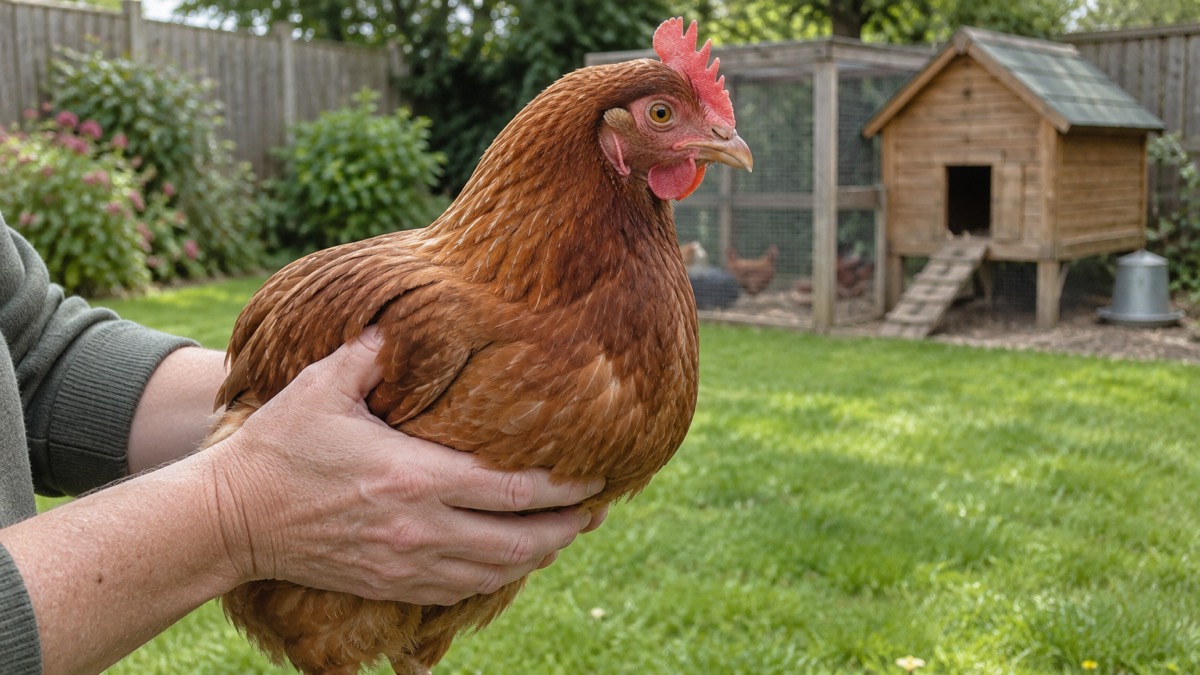
If a hen goes broody, lift her out, take her to food and water, and try to keep her out of the box for increasingly longer periods20. For handling at night, practise in the dark with a very dim torch when the hens should be on their perch, move quietly and slowly, talk to them all the time, then pick one hen off the perch with both hands around her wings and body, facing towards you21.
Avian Influenza Prevention Zone: don't handle sick or dead birds
An Avian Influenza Prevention Zone is currently in place across the UK, and it changes what you should do around sick or dead birds6. Do not touch or handle sick or dead birds. If you have to, thoroughly wash your hands immediately afterwards, keeping them away from your face or food22.
The same warning applies to anyone keeping ducks or geese23. Official guidance is blunt: do not touch or pick up a dead or visibly sick wild bird24.
Biosecurity precautions under the zone include cleansing and disinfecting equipment, vehicles and footwear; storing feed, water and bedding undercover; effective vermin control; keeping birds in a fenced-off area so they cannot access standing water; regularly disinfecting the coop and run; and discouraging wild birds from entering the area7. If a Protection Zone is declared, hens must be housed, increased biosecurity measures must be taken, anything that may be contaminated must be disinfected immediately after transportation, and you must keep a record of anyone who visits your home and has contact with your poultry7.
In all disease control zones you must follow biosecurity rules, keep a record of anyone who transports or markets poultry or poultry eggs (with exemptions for table eggs), follow rules for fresh meat, comply with biosecurity rules imposed by a veterinary inspector, not organise or attend bird gatherings, and not release game birds25.
To report dead wild birds in Northern Ireland, use the DAERA Dead Wild Bird online reporting tool26. In Great Britain, report to Defra if you find one or more dead birds of prey, three or more dead gulls or wild waterfowl (swans, geese and ducks), or five or more dead birds of any species25. For day-to-day routines, see Daily Biosecurity for Backyard Poultry Keepers.
When a poultry-friendly vet should see your hens
Most settling-in problems resolve with time, space and good feed. Some need a vet. Any bird that is off its food, moping, or showing the heat stress signs above should be assessed, and if you have any concerns about an animal's health, contact a vet immediately18.
Worms are worth understanding because stress and moving make them more likely. Monitor the worm burden, and treat any bird off its food or moping as suspect15. If you are unsure whether a hen is broody, ill or simply low in the pecking order, a poultry-friendly vet can tell the difference.
For newly adopted ex-commercial hens, the first days are the vulnerable ones. Ex-commercial hens may need physically picking up and put under shelter for the first day or two if the weather is bad, and lifted into their hen house at bedtime28. Initially hens will not know how to shelter and may stand outside when it is wet and windy, so you may need to physically put them in the coop if the weather is inclement5.
If you are bringing home rescue birds, the Checklist for Bringing Home Rescue Hens and Looking After Newly Adopted Ex-Battery Hens walk through the first days in order. For the wider picture of keeping hens at home, start with Self-Reliance at Home.
Sources (28)
- Merging your flocks, British Hen Welfare Trust, 2022-08-17
- Hen husbandry, British Hen Welfare Trust, 2026-06-01
- Cockerels and other pets, British Hen Welfare Trust, 2026-10-22
- Chickens: environment, RSPCA, 2026-10-29
- Hen adoption FAQs, British Hen Welfare Trust, 2026-02-05
- Chickens, RSPCA, 2026-11-04
- Avian influenza (bird flu), British Hen Welfare Trust, 2026-11-04
- Hen examination guidelines, British Hen Welfare Trust, 2025-10-30
- Newly adopted hens, British Hen Welfare Trust, 2025-10-16
- Worms, British Hen Welfare Trust, 2026-11-04
- Hen setup, British Hen Welfare Trust, 2025-10-30
- Keeping chickens as pets: how to care for backyard hens - RSPCA - rspca.org.uk, RSPCA (rspca.org.uk)
- Adding a new chicken to your flock, Omlet, 2026-11-04
- Hatching, rearing and care of young poultry, Poultry Club of Great Britain, 2026-11-04
- Health and diseases, Poultry Club of Great Britain, 2026-11-04
- Hot weather and its impacts, Met Office, 2026-11-03
- Staying well in hot weather, Berkshire Healthcare NHS Foundation Trust, 2026-10-29
- Summer advice for dogs, RSPCA, 2026-10-29
- Red mite, British Hen Welfare Trust, 2026-11-04
- Hen health FAQs, British Hen Welfare Trust, 2025-03-31
- Handling and welfare guidelines, Poultry Club of Great Britain, 2026-11-04
- Caring For Pet Birds In Winter - RSPCA - rspca.org.uk, RSPCA
- Ducks and geese, RSPCA, 2026-11-04
- Health protection, Devon County Council, 2026-10-29
- Avian influenza (bird flu), Suffolk County Council, 2026-10-29
- Avian flu, Belfast City Council, 2026-10-29
- Avian influenza, Public Health HSCNI, 2026-10-06
- Cold weather tips, British Hen Welfare Trust, 2022-08-11
 Beekeeping Starter Equipment
 Pet Hens Starter Kit
 Bringing Home Rescue Hens
 Hay Bale Fires
 Livestock in a Heatwave
 Livestock Water Outage
 Sky Lanterns
 BeeBase Registration
 Broody Hen Hatching
 Cleaning a Chicken Coop
 Coop and Run Space for Hens
 Care for Ex-Battery Hens
 Reporting Foulbrood
 Fox-Proofing a Chicken Coop
 Daily Hen Feed Amounts