Animal disease outbreaks are rare in the UK, but when one happens it can move with extraordinary speed. The 2001 foot and mouth outbreak saw around 2,000 officially reported cases and, by the last case in September 2001, more than 6 million sheep, cattle and pigs slaughtered1. It cost the UK around £8 billion2. A major avian influenza outbreak is planned for on the basis of a 6 to 8 month duration and up to 8 million poultry and captive birds killed by the virus or culled for disease control3.
If you keep animals, whether a commercial flock, a few backyard hens, pet pigs or a pony, the law expects certain things of you. Some diseases are "notifiable", which means you are legally obliged to report them to the Animal and Plant Health Agency (APHA) even if you only suspect an animal may be affected1. For everyone else, an outbreak mostly arrives as closed footpaths, movement restrictions, higher food prices and news of culls. This page explains what happens, what you must do, and where to get help.
Rare, but rated: how the UK judges the risk
Animal diseases in the UK are, thankfully, rare7. But rarity is not the same as low impact, and local risk registers across the country treat animal disease as a live risk precisely because the consequences are large. The diseases of most concern are those which are highly contagious and cause high fatality rates amongst livestock, or which may infect people7.
Different areas rate the risk differently, and it is worth knowing how your own area is judged. Wiltshire, a predominantly rural county where agriculture and farming are a major local industry, rates animal disease as "High" on its Community Risk Register1. Dorset rates animal diseases as "Medium Risk"8. Essex rates animal diseases a moderate to high risk, because of its geography, its economic reliance on agriculture and its significant farming sector of cattle, sheep, pigs and poultry9. The London Risk Register, reflecting a largely urban area, rates the major animal disease scenarios differently again3.
The London Risk Register (2025) sets out the main animal disease scenarios it plans for, with likelihood and impact on 1 to 5 scales3:
| Scenario | Risk rating | Likelihood (1 to 5) | Impact (1 to 5) |
|---|---|---|---|
| Major outbreak of foot and mouth disease | HIGH | 2 | 4 |
| Major outbreak of avian influenza | HIGH | 3 | 2 |
| Major outbreak of African swine fever | LOW | 1 | 1 |
| Major outbreak of African horse sickness | LOW | 1 | 1 |
Read that table as: foot and mouth is judged unlikely but severe if it happens; avian influenza is judged the most likely of the four and moderately damaging; the swine fever and horse sickness scenarios are rated low overall for London. A rural county's register will weight these differently, which is why Wiltshire's overall animal disease rating is High1.
The diseases to know
The most notable recent examples of animal disease outbreaks in the UK are foot and mouth disease, bluetongue, anthrax and avian influenza (bird flu)11. Local risk registers also flag African swine fever4. Each behaves differently, and the difference that matters most to a keeper is whether the disease can pass to people.
Zoonotic diseases are infectious diseases that can spread from animals to humans, either directly or indirectly12. Examples listed on local risk registers include anthrax, bird flu, bovine TB, rabies, West Nile fever and Zika virus. Non-zoonotic diseases, which affect animals only, include bluetongue, foot and mouth, lumpy skin disease and warble fly1.
| Disease | Main animals affected | Can it pass to people? | What an outbreak looks like |
|---|---|---|---|
| Foot and mouth | Cloven-hoofed animals: cattle, sheep, pigs | No (non-zoonotic)1 | Large-scale culling and movement restrictions9 |
| Avian influenza (bird flu) | Poultry and wild birds | Yes, potential spillover to humans9 | Up to 8 million birds killed or culled, 6 to 8 months, export restrictions3 |
| African swine fever | Pigs | No (non-zoonotic scenario) | Around 60 large commercial pig farms infected in the planned scenario3 |
| Bluetongue | Livestock | No (non-zoonotic)1 | Movement controls and trade disruption |
| Anthrax | Livestock | Yes (zoonotic)1 | Sporadic cases, carcass controls |
| Bovine TB | Cattle, and wildlife such as badgers | Yes (zoonotic)1 | Testing, movement restrictions and culling, economic losses9 |
Two of these deserve a keeper's particular attention. Foot and mouth is a highly contagious viral disease affecting cloven-hoofed animals such as cattle, sheep and pigs; an outbreak could require large-scale culling and movement restrictions9. In cattle it causes blisters under the hooves and inside the mouth, alongside possible lameness and problems feeding1. African horse sickness, though rated a low risk, is worth knowing about if you keep horses: the planned scenario carries a 99% animal fatality rate, with fatality occurring within a couple of days3.
Avian influenza is an infectious disease that primarily affects birds, caused by the influenza A virus13. Domestic poultry are especially vulnerable and the virus can rapidly cause epidemics in flocks14. It is a notifiable animal disease6.
What keepers must do: know the symptoms and report
The single most important duty for anyone who keeps livestock is this: be familiar with the symptoms of the animal diseases you are legally obliged to report15. Notifiable diseases are those you must officially report to the Animal and Plant Health Agency (APHA), even if you only suspect an animal may be affected1. If you suspect a notifiable disease, report it immediately to APHA2; the Rural Services helpline number is 03000 200 3011, and the same number, 03000 200 301, is given for reporting suspected sick or dead animals in Sussex resilience guidance4.
Reporting quickly matters beyond your own animals. Disease notifications can help identify sources of infection such as contaminated food, water or land, and identify and protect those at risk of catching the disease16. Farmers and the public being educated on recognising symptoms and reporting outbreaks quickly is itself part of how the UK limits an outbreak's spread9.
For poultry and other captive bird keepers, there are standing expectations:
- Register your birds. Registration covers chickens, ducks, turkeys, geese, pigeons bred for meat, partridge, quail, guinea fowl and pheasants, and any pet bird or bird kept outside for shows, races, exhibitions, competitions, breeding or for sale6. Registration is how the authorities reach you when rules change.
- Follow biosecurity guidance. The main causes of bird flu in poultry and other captive birds are contact with wild birds (in particular waterfowl such as geese, ducks and swans, and gulls), faeces from infected birds, and dirty footwear, clothing, vehicles and equipment6.
- Monitor and report signs of infection. Guidance for poultry keepers sets out biosecurity measures, monitoring and reporting of any signs of infection in birds, and restrictions on the movement of poultry14.
If an outbreak is declared, follow any guidance from the government at the time to protect your livestock and limit spread, vaccinate livestock where possible, follow the Countryside Code, and follow advice from the relevant authorities11. The Countryside Code itself has information about rights, responsibilities and liabilities, and how we all have a duty to protect the countryside17.
If you cannot move your livestock or outdoor pets during an outbreak or other emergency, ensure they are as far from danger as possible, and arrange shelter and food to last them several days18. Carry a photo of your pet with you in case there is a need to identify them19, and pay attention to public information about current emergency situations on local news bulletins or local multi-agency partners' social media accounts20. Our pages on including your pets in a household emergency plan and how much pet food and water to store cover the preparation side in detail.
Who to contact about a sick or dead wild animal
You do not need to keep animals to have a reporting duty of sorts: the public is asked to report certain dead wild birds, because wild bird deaths are one of the main ways avian influenza is detected. Who you contact depends on what you have found and where you are.
| What you have found | Who to contact | Number or route |
|---|---|---|
| Suspected notifiable disease in kept animals | Animal and Plant Health Agency | 03000 200 3011 |
| One or more dead birds of prey, 3 or more dead gulls or wild waterfowl, or 5 or more dead birds of any species (GB) | Defra | 03459 33 55 775 |
| Dead wild birds in Northern Ireland, including swans, geese, ducks and gulls | DAERA | Dead Wild Bird online reporting tool21 |
| Sick or injured wild birds | RSPCA | 0300 1234 9996 |
| Injured wildlife in Belfast parks or other locations | USPCA | Via Belfast City Council's contacts22 |
| An animal in distress generally | RSPCA in the first instance; the fire service is called by the RSPCA or another emergency service if needed | 0300 1234 99923 |
| Concern about a wild animal or livestock in your area (Surrey example) | Surrey County Council or the government Animal and Plant Health Agency | Via the council15 |
Do not touch or move dead wild birds you are reporting. If you are concerned about a wild animal or livestock in your area, your county council or APHA are the right starting points15.
Quarantine zones and movement restrictions
In an animal disease outbreak, controls are placed over the movement of certain livestock to reduce the spread of disease and to make sure the root of the outbreak can be traced18. Control measures such as quarantine zones and transport restrictions limit the spread of infectious diseases9. For keepers, this is usually the most directly felt part of an outbreak: you may be unable to move animals, and that in turn affects feed, bedding, vet visits, sales and shows.
The scale of these zones can be very large. The African horse sickness scenario, for example, would trigger protection zones of 150km radius and surveillance zones of 50km radius around known cases, with a 150km zone of movement ban3. A zone of that size covers entire counties, which is why an outbreak in one place can close off movement over a wide region.
What movement controls mean in practice for a household:
- You may not be able to move livestock or outdoor pets. If so, ensure they are as far from danger as possible and arrange shelter and food to last them several days18.
- Footpaths and countryside access may close. In 2001, exclusion zones caused large areas of the countryside to be effectively closed off1. Respect the signs and closures.
- Events and trade are disrupted. Essex's equestrian industry, for example, is at risk from diseases like equine influenza or strangles, which can disrupt events and trade9.
- Biosecurity applies to you too. Dirty footwear, clothing, vehicles and equipment are among the main causes of bird flu spreading to kept birds6, so follow any cleansing and disinfection requirements in force.
If you keep horses or livestock, our page on horses and livestock in floods and snow covers the practical side of sheltering animals in place when movement is impossible.
How an outbreak reaches households: food supply and prices
Most households will experience an animal disease outbreak not as sick animals nearby but as changes on the supermarket shelf. Animal disease is one of the recognised acute risks to the UK's food supply chain, alongside extreme weather, cyber-attacks, energy disruptions and human disease outbreaks24. Disruption to food supply can lead to food price inflation, less consumer choice, and vulnerable people struggling to access food, worsening food poverty and the health effects of poor diet24.
The mechanisms are concrete. Disruption in livestock production can affect meat, dairy and egg supply chains9. Loss of livestock, trade restrictions and culling measures can lead to financial hardship for farmers and supply chain disruptions9. Export restrictions on trade form part of the planned avian influenza scenario3. Increased food costs to consumers are listed as a direct consequence of animal disease in local risk assessments7.
For an ordinary household, the sensible response is the same as for any supply disruption: keep a modest store of the foods you normally eat, as general emergency preparedness guidance recommends, and see our emergency food guide for how. Disruption to the food supply chain can lead to food price inflation and less consumer choice24. A 6 to 8 month avian influenza outbreak affecting up to 8 million birds3 is the kind of event that shows up as fewer eggs and higher prices for a season, not as famine.
Bird flu and other diseases that can pass to people
Some animal diseases may be highly contagious and pass from animal to animal, causing high fatality rates, and may also have the possibility of infecting humans15. These are the zoonotic diseases: infectious diseases that can spread from animals to humans, either directly or indirectly12. Zoonotic diseases, such as avian influenza, can pose health risks to humans9.
For the general public, the risk from bird flu is low but managed seriously. Official guidance for the public on staying safe around bird flu exists and should be followed13. People whose work involves regular contact with kept or wild birds or their environment should follow Health and Safety Executive (HSE) guidance on working with poultry that is suspected of having avian influenza13.
There is a defined follow-up for people who have contact with an infected animal. People who report contact with a positive dead animal are contacted by the PHA Health Protection Team for a risk assessment and relevant health advice; in some circumstances antiviral medicines may be offered14. This is why reporting dead wild birds matters: your report can trigger health protection for you and others.
A few points of reassurance and caution:
- Rabies is present at very low levels in some UK bat populations, but the risk to humans is very low2.
- Whenever you spend time outdoors there is a small risk of catching infection from animals or the environment, and guidance is available to help you avoid becoming unwell12.
- Flu among people is a separate matter: flu is a virus that spreads easily from person to person, and communicable diseases such as measles, flu and whooping cough have vaccines to help prevent them or reduce the risk of serious illness16. Outbreaks among people are covered in our health emergencies guide.
Culls and carcass disposal: what happens and why
The response to a notifiable disease outbreak can include a mass cull and disposal of animal carcasses to stop the disease spreading7. Measures used in past outbreaks have included monitoring disease outbreaks, placing import controls on livestock, pets, zoo animals and animal products, banning feeding animals swill and kitchen waste, imposing strict biosecurity protocols, and humanely culling susceptible animals on infected premises10.
The numbers from past and planned outbreaks show the scale. The foot and mouth scenario in the London Risk Register is based on the culling and disposal of approximately 1.9 million animals on over 2,900 premises3. The 2001 outbreak itself saw over 6 million sheep, cattle and pigs slaughtered by the last case in September 20011. The avian influenza scenario contemplates up to 8 million poultry and captive birds either killed by the virus or culled for disease control3.
Carcass disposal is an environmental matter as well as an animal health one. Improper disposal of culled animals can lead to environmental pollution9. This is one reason disposal is handled by the authorities under strict protocols rather than left to individual keepers, and why you should never attempt to bury or burn an animal suspected of dying from a notifiable disease: report it and follow the instructions you are given1.
The wider impacts run through the whole rural economy. Animal diseases can affect animal health, food production, public health and the economy10. In Dorset, the recognised impacts include damage to the agricultural and tourist economy7. In Essex, loss of livestock, trade restrictions and culling measures can lead to financial hardship for farmers and supply chain disruptions9.
What 2001 tells us about a future outbreak
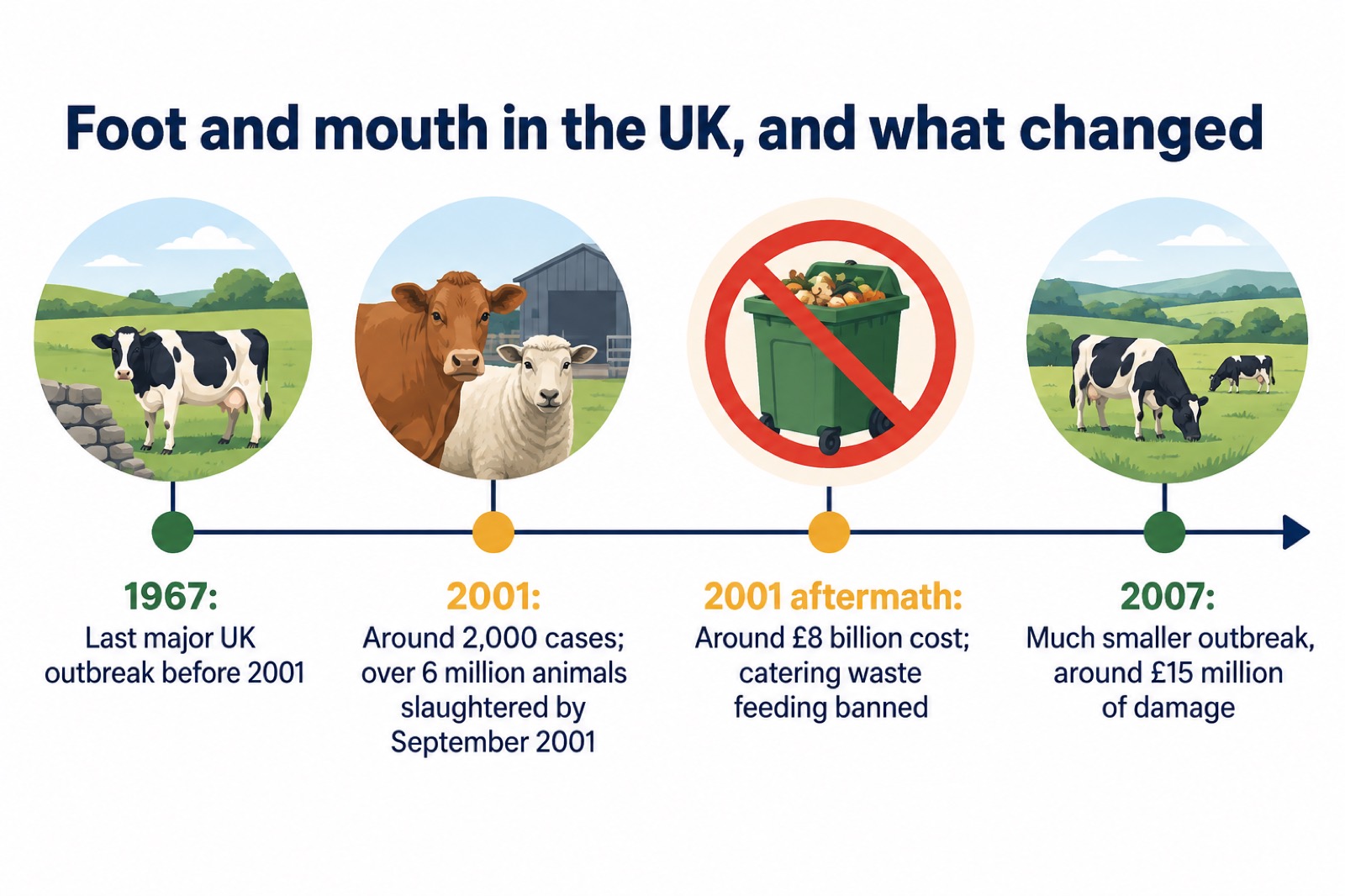
The 2001 foot and mouth outbreak is the reference case for everything on this page, and it is worth understanding what happened and what changed. Before 2001, the last major outbreak in the UK was in 19671. The 2001 outbreak was severe: officially 2,000 cases were reported, and by the last case in September 2001 over 6 million sheep, cattle and pigs had been slaughtered1. It is still unknown exactly how the disease entered the UK1. The outbreak cost the UK around £8 billion2.
The countryside effects were profound. Exclusion zones caused large areas of the countryside to be effectively closed off, which had a huge detrimental effect on tourism and many livelihoods1. If you lived through it, you will remember the closed footpaths, the disinfectant mats and the pyres. That is what a HIGH-rated, high-impact foot and mouth scenario3 would look like again, though the response arrangements have changed.
Reforms have been made to reduce the likelihood of foot and mouth returning, such as banning animal feeding on catering waste and increased monitoring of disease outbreaks across the world1. The 2001 outbreak led to significant changes both in Government legislation and in the way the UK handles food for animals7. The measures now in place, including import controls and biosecurity protocols10, are the direct legacy of that experience. The proof that the improved arrangements work is in the record: a subsequent 2007 outbreak caused much less damage, at around £15 million2.
Where the risk is highest
Animal disease risk is not spread evenly across the UK. It concentrates where livestock farming is dense and where animals and animal products enter the country. Animal diseases pose a significant risk to Essex due to the county's agricultural activities, proximity to ports, and the presence of livestock farming10. Essex has a significant farming sector with cattle, sheep, pigs and poultry, making it susceptible to outbreaks9.
Avian influenza has its own geography. Essex's proximity to coastal areas and wetlands increases the risk due to migratory birds9. Any county with coastal wetlands, estuaries or major wild waterfowl sites carries a similar pattern of risk for poultry keepers.
Rural counties rate the risk higher across the board. Wiltshire is predominantly a rural county, meaning there is a higher concern around animal disease than perhaps in some other areas of the UK, with agriculture and farming being a major local industry1. Dorset, another livestock county, rates animal diseases as Medium Risk8. If you keep animals, your local community risk register, published by your local resilience forum, is the place to see how your own area is judged.
Getting help and staying informed
The practical contacts, gathered in one place:
- Suspected notifiable disease in kept animals: APHA, 03000 200 301, immediately, even on suspicion1
- Dead wild birds (Great Britain): Defra, 03459 33 55 77, for one or more dead birds of prey, 3 or more dead gulls or wild waterfowl, or 5 or more dead birds of any species5
- Dead wild birds (Northern Ireland): DAERA Dead Wild Bird online reporting tool21
- Sick or injured wild birds or animals in distress: RSPCA, 0300 1234 9996
- Injured wildlife in Belfast: USPCA, via Belfast City Council22
- Your county council: for concern about wild animals or livestock in your area15
During an outbreak, follow the government guidance in force at the time to protect your livestock and limit spread11, and pay attention to public information on local news bulletins or local multi-agency partners' social media accounts20. Keep an eye on your animals' behaviour in case they show signs of distress, and let them stay where they feel safe25. For the broader household side of getting ready, see our pets and animals in an emergency guide and the getting started guide.
Sources (25)
- Animal Disease, Wiltshire and Swindon Prepared, Wiltshire and Swindon Local Resilience Forum, 2024-05-31
- UK National Risk Register 2017, UK Government, 2017-09
- London Risk Register v14, Greater London Authority, 2025-01
- Be ready, stay safe, act now, Sussex Resilience Forum, 2025-10
- Health protection, Devon County Council, Devon County Council, 2026-10-29
- Avian influenza (bird flu), Suffolk Trading Standards, Suffolk County Council, 2026-10-29
- Animal Disease, Dorset Prepared, Dorset Local Resilience Forum, 2024-03-05
- Health-related risks, Dorset Prepared, Dorset Local Resilience Forum, 2026-10-28
- Animal disease, Essex Prepared, Essex Resilience Forum, 2026-10-29
- National Risk Register: preparing for national emergencies, House of Lords Library, 2022-12-15
- Preparing for an emergency: what you need to know, Isle of Anglesey County Council, 2020
- Health: infectious disease outbreaks, Prepare campaign, UK Government, 2026-10-12
- Avian influenza (bird flu): advice for the public on staying safe, UK Government, 2024-03-19
- Avian influenza, Public Health Agency Northern Ireland, Public Health Agency, 2026-10-06
- Prepare for emergencies: risks, Surrey County Council, 2026-10-28
- Disease control, Derbyshire County Council, Derbyshire County Council, 2026-10-29
- Countryside safety, Cheshire Fire and Rescue Service, Cheshire Fire and Rescue Service, 2026-07-14
- Are You Ready booklet, Culham Parish Council, 2025-09
- How you prepare for emergency, Slough Borough Council, Slough Borough Council, 2026-10-29
- Your pets, Wiltshire and Swindon Prepared, Wiltshire and Swindon Local Resilience Forum, 2026-10-25
- Avian flu, Belfast City Council, Belfast City Council, 2026-10-29
- Emergency contact numbers, Belfast City Council, Belfast City Council, 2026-10-29
- Top causes of rescues and how to avoid them, Devon and Somerset Fire and Rescue Service, 2026
- Resilience of the food supply chain to disruptions, National Audit Office, 2026-09-04
- Strong winds and heavy rain warning - information and advice | nidirect, nidirect (Northern Ireland government)
 Beekeeping Starter Equipment
 Pet Hens Starter Kit
 Bringing Home Rescue Hens
 Horses and Livestock
 Honey Bee Health
 Beekeeping for Beginners
 Chicken Health