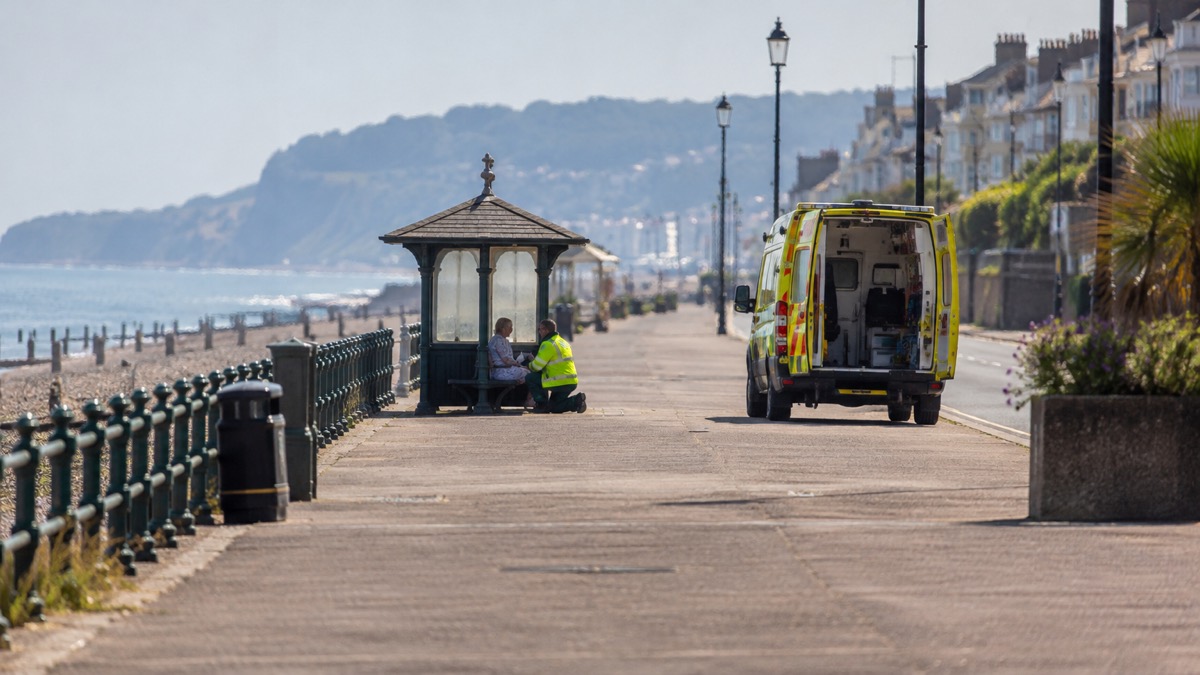
Heatstroke is a medical emergency. If you suspect someone has it, call 999 immediately1. The defining sign is a body temperature above 40°C, alongside confusion, hot skin, fast breathing or a seizure2. Do not wait to see whether they improve: while the ambulance is on its way, move them somewhere cooler, loosen their clothes, open windows or use a fan, and cool them with cold water or a damp sheet4.
The difference between heat exhaustion and heatstroke is the difference between a bad afternoon and a life-threatening event. Heat exhaustion can lead to heatstroke if untreated, and heatstroke needs to be treated as an emergency5. Without urgent medical attention, heatstroke can cause lasting damage to the brain, heart, kidneys and muscles3. That is why the advice is not to watch and wait, but to ring 999 and start cooling at once.
This page sets out the signs to act on, what to do in the minutes before help arrives, what to do if the person loses consciousness, and who is most at risk. It is first aid, not treatment: hospital staff will cool the body down and may give fluids through a vein, and recovery can take a few days7.
Heatstroke is a medical emergency: call 999
Every official source on this subject gives the same first instruction. If you suspect someone has heatstroke, call 9999. The North East Ambulance Service puts it plainly: "Call 999 immediately"1. The London Ambulance Service adds that you should dial 999 and then try to cool them down11. The order matters: the call comes first, the cooling starts while you are on the phone or immediately after.
If you are not sure whether it is heatstroke, the Red Cross advises that you help them to rest in a cool place and call 999 for emergency advice2. You are not expected to diagnose. A confused, very hot person in hot weather is a 999 call, and the call handler can talk you through what to do next. The ambulance service's own guidance is to listen carefully to the call handler and follow the instructions given to you12.
For heat-related problems that are not an emergency, contact NHS 11113. The distinction is simple: heat exhaustion with symptoms that concern you or are worsening goes to 111; a suspected heatstroke goes to 99914. In Wales, the NHS 111 Wales service carries the same message, and its heat exhaustion and heatstroke page was last updated on 22 June 202615.
Body temperature above 40°C and the other signs
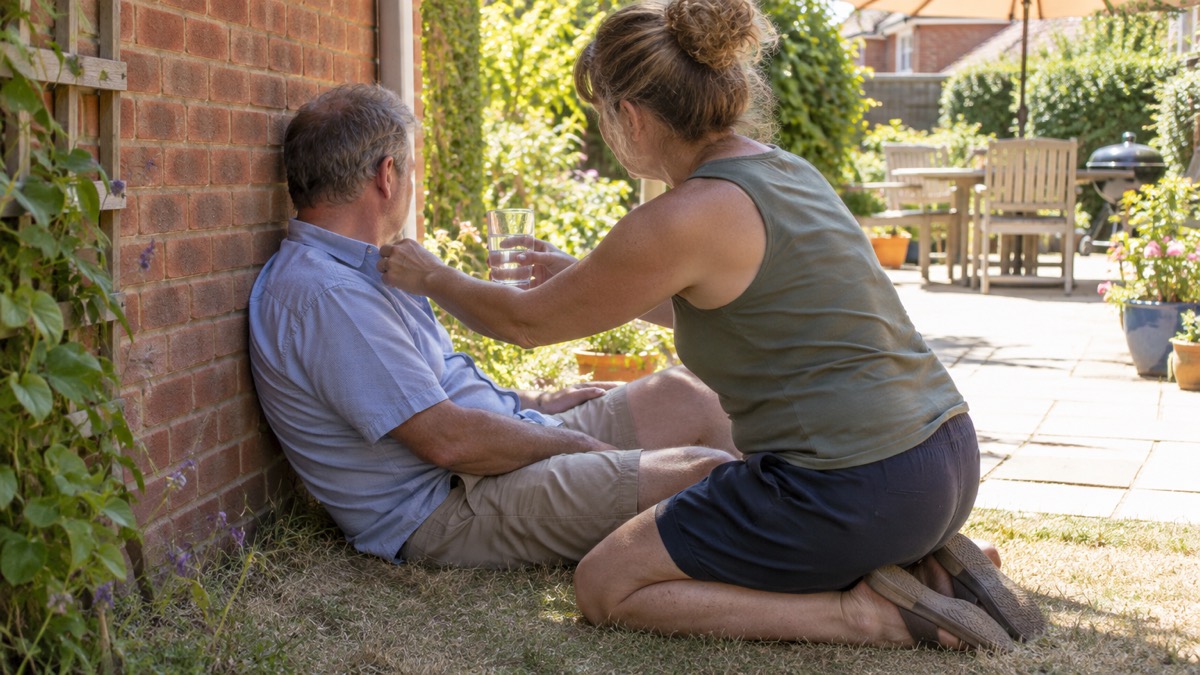
The headline figure is a body temperature above 40°C. NHS Scotland describes heatstroke as a high body temperature or fever, usually more than 40 degrees Celsius7. The Red Cross gives the same threshold: a body temperature over 40°C2, and in its comparison of the two conditions, heatstroke is above 40°C (104°F)3.
Temperature alone is not the whole picture. Official guidance lists the common symptoms of heatstroke as confusion, clumsiness, fast heartbeat, fast breathing or shortness of breath, hot skin and seizures16. The Red Cross describes the skin as hot and dry, and the person as confused, unconscious, or having seizures3. For children, symptoms may include confusion or lack of co-ordination, seizures (fits), loss of consciousness, high body temperature, red hot skin, fast heartbeat, fast shallow breathing and diarrhoea17.
Compare that with heat exhaustion, which is the milder condition on the same spectrum. Its symptoms include headache, dizziness and confusion, loss of appetite and feeling sick, excessive sweating and pale, clammy skin, cramps in the arms, legs and stomach, fast breathing or pulse, a temperature of 38°C or above, and being very thirsty18. The presence of a temperature of 38°C or above is a warning sign, not a diagnosis, and it sits two degrees below the heatstroke threshold.
| Sign | Heat exhaustion | Heatstroke |
|---|---|---|
| Body temperature | 38°C or above18 | Above 40°C3 |
| Skin | Pale, clammy, sweating18 | Hot and dry3 |
| Awareness | Dizzy, confused18 | Confused, clumsy, unconscious or seizures3 |
| Breathing and pulse | Fast breathing or pulse18 | Fast heartbeat, fast or short breathing16 |
| What to do | Rest, cool, drink water, watch19 | Call 999 and cool immediately9 |
One further warning: heatstroke can also occur suddenly and without any warning19. Someone can seem to be managing the heat and then deteriorate quickly. Treat a sudden change in awareness in hot weather as an emergency.
First aid while you wait for the ambulance
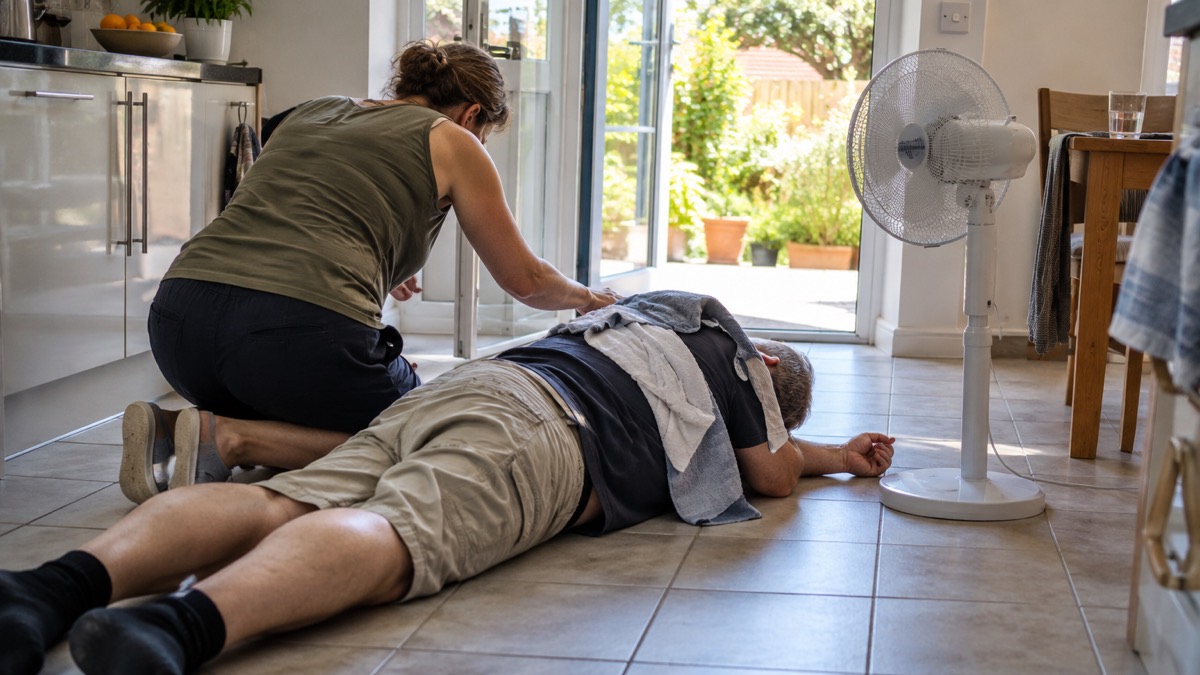
Once 999 is called, your job is to bring the body temperature down and keep the person safe until help arrives. Official guidance sets out the steps: if possible, move them somewhere cooler, increase ventilation by opening windows or using a fan, cool them down as quickly as possible by loosening clothes, sprinkling them with cold water or wrapping them in a damp sheet, and if they are conscious, encourage them to drink fluids4.
Work through it in this order:
- Call 999 and stay on the line1.
- Move them to the coolest place you can, ideally somewhere shaded or air-conditioned4.
- Open windows or set a fan running to increase ventilation4.
- Loosen or remove outer clothing4.
- Sprinkle with cold water or wrap them in a damp sheet4.
- If they are conscious, encourage them to drink fluids4.
- Stay with them and keep cooling until the ambulance arrives20.
Do not give aspirin or paracetamol. Northern Ireland's official guidance is explicit: "do not give them aspirin or paracetamol (it will not help the raised temperature and may be harmful)"10. Painkillers have their place for minor ailments and everyday fevers21, but heatstroke is a different problem: the body is too hot and needs physical cooling, not a medicine that works on a fever.
If they lose consciousness: recovery position and CPR
If the person loses consciousness while you are waiting for help, put them in the recovery position and tell the ambulance service23. NHS Scotland gives the same instruction: put the person in the recovery position if they lose consciousness while you are waiting for help15. For a child, the advice is the same: put the child in the recovery position if they lose consciousness while waiting for help24.
The recovery position keeps the airway open and lowers the risk of choking if they vomit. Guidance on the recovery position says that if the person is unconscious but breathing, put them in the recovery position with their head lower than their body25. Our page on the recovery position sets out how to do it step by step.
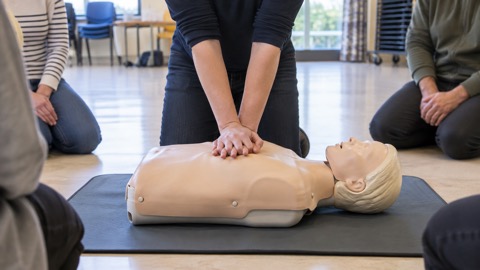
Then check breathing and pulse, and carry out CPR if they show no sign of life23. If they lose consciousness and are not breathing, begin cardiopulmonary resuscitation (CPR) with chest compressions26. Our guide to hands-only CPR for adults covers the rate and depth, and how to check if someone is breathing covers the assessment. If you are unsure at any point, the call handler can guide you.
Heat exhaustion or heatstroke: when it becomes an emergency
Heat exhaustion and heatstroke are the same problem at different severities. Heat exhaustion, if untreated, can lead to heatstroke, a life-threatening emergency12. Official guidance is blunt: if it turns into heatstroke, it needs to be treated as an emergency5. The Met Office lists heat exhaustion and heatstroke among the potentially serious conditions that can occur if you get too hot27.
The risk is highest during hot weather or exercise15. That covers more than a heatwave afternoon: a long walk, a football match, gardening or a physically demanding job in the heat all raise the risk. Heat exhaustion usually responds to rest and cooling. Guidance says that after cooling and resting, they should start to cool down and feel better within 30 minutes15. If they do not, or if any of the heatstroke signs appear, escalate.
The practical test is awareness. A person with heat exhaustion may be dizzy, sick and very thirsty, but they know who they are and where they are. A person with heatstroke is confused, clumsy, may not respond properly, or may have a seizure3. If you are unsure, help them to rest in a cool place and call 999 for emergency advice2.
Who is most at risk and what causes it
Anyone can be affected, but some people are at higher risk. NHS guidance says children, older people and people with long-term health conditions such as diabetes or heart problems are more at risk of heat exhaustion or heatstroke15. The Red Cross adds that high risk groups include young people, older people, people with certain chronic illnesses such as heart or lung disease or diabetes, and people working or exercising in the heat2. Local authority guidance names young children, older adults and people with underlying health conditions as at increased risk28.
Older people and people with heart, respiratory and other serious health problems are most vulnerable when the temperature starts to rise29. Children, older people and people with long-term health conditions such as diabetes or heart problems are more at risk of heat exhaustion or heatstroke30. People who live alone, or who may struggle to care for themselves, need a neighbour or relative to check on them in hot weather, because the early signs of heat exhaustion can be easy to dismiss.
The causes are straightforward: heat, exertion and dehydration. Being physically active in the heat, working outdoors or doing manual work raises the risk2. So does being unable to cool down at home, which is why the wider advice on hot weather matters: keep rooms shaded, drink regularly and avoid the hottest part of the day. Our guide to heatwaves and drought covers household preparation, and extra help in an emergency covers support for older, disabled and medically dependent households.
What happens in hospital, and how long recovery takes
If someone has heatstroke, they will be treated in hospital, and it can take a few days to recover7. Hospital treatment focuses on cooling: healthcare professionals will try to cool your body down, and they may also give you fluids through a vein7. That is the same principle as the first aid, carried out with more control and monitoring.
The reason for hospital treatment is the risk to organs. Without urgent medical attention, heatstroke can cause lasting damage to the brain, heart, kidneys and muscles3. It can put a strain on the brain, heart, lungs, liver and kidneys, and can be life-threatening10. Hospital staff can watch for those complications while bringing the temperature down.
Afterwards, recovery takes time. Guidance for heatwaves says that if you have suffered heat exhaustion or heatstroke, you should take time to rest and recover for as long as your GP advises, avoiding hot weather and exercise31. Do not treat a discharge from hospital as a return to normal: the person needs rest, a cool environment and a gradual return to activity.
Sources (31)
- Summer safety advice, North East Ambulance Service, 2026-10-29
- Heatstroke first aid, British Red Cross, 2026-06-10
- The difference between heatstroke and heat exhaustion, British Red Cross, 2026-10-25
- Be prepared: heat health, Lancaster City Council, 2026-10-26
- Hot weather, UK Government Prepare campaign, 2026-10-12
- Sun and heat safety, Welsh Ambulance Service, 2026-10-29
- Heatstroke and heat illness, NHS inform, 2026-07-15
- Stay cool and safe in hot weather, Somerset Council, 2026-07-08
- Staying well in hot weather, Berkshire Healthcare NHS Foundation Trust, 2026-10-29
- Heat exhaustion and heatstroke, nidirect, 2025-12-02
- Coping with hot weather in London, Greater London Authority, 2026-10-26
- Heatwave: how to cope in hot weather, South Western Ambulance Service, 2026-10-29
- Heatwave advice, Guy's and St Thomas' NHS Foundation Trust, 2026-06
- Coping with hot weather in London, Greater London Authority, 2026-10-25
- Heat exhaustion and heatstroke, NHS 111 Wales, 2026-06-22
- Keeping warm or cool in extreme weather, UK Health Security Agency, 2025-12-16
- Looking after children and those in early years settings before and during hot weather, UK Health Security Agency, 2024-12-19
- Advice for vulnerable people, NHS Norfolk and Suffolk ICB, 2026-05-29
- Hot weather advice, nidirect, 2026-10-05
- Hypothermia, NHS 111 Wales, 2025-05-14
- What to do if you have flu symptoms, London Ambulance Service, 2026-08-10
- Which NHS service, NHS Somerset, 2026-01-13
- Heat exhaustion and heatstroke, NHS, 2026-05-28
- Staying safe over the summer, Healthier Together, 2026-10-29
- Water safety, Devon and Somerset Fire and Rescue Service, 2026
- Choking first aid, East Sussex Healthcare NHS Trust, 2025-11
- Tips for keeping older people cool, Met Office, 2026-10-29
- Stay safe this summer, Cornwall Council, 2026-08-07
- Severe weather planning, Derbyshire County Council, 2026-10-29
- Keeping warm and well: sickle cell disease, University Hospitals Liverpool, 2026-10-28
- Heatwave | Lancashire Resilience Forum, Lancashire Resilience Forum
 Baby and Child Kit Checklist
 Bleeding Control Kit Checklist
 Car Kit Checklist
 CPR on a Baby
 CPR on a Child
 Chest Compression Rate and Depth
 Rescue Breaths or Hands-Only CPR
 Checking Breathing
 Agonal Breathing and CPR
 Breathing During CPR
 Recovery Position and Spine
 Cardiac Arrest vs Heart Attack
 Heart Attack First Aid
 Defibrillator Pad Placement
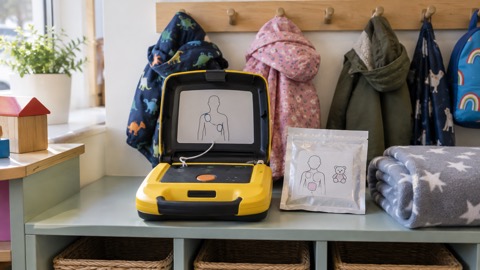 Defibrillator on a Child