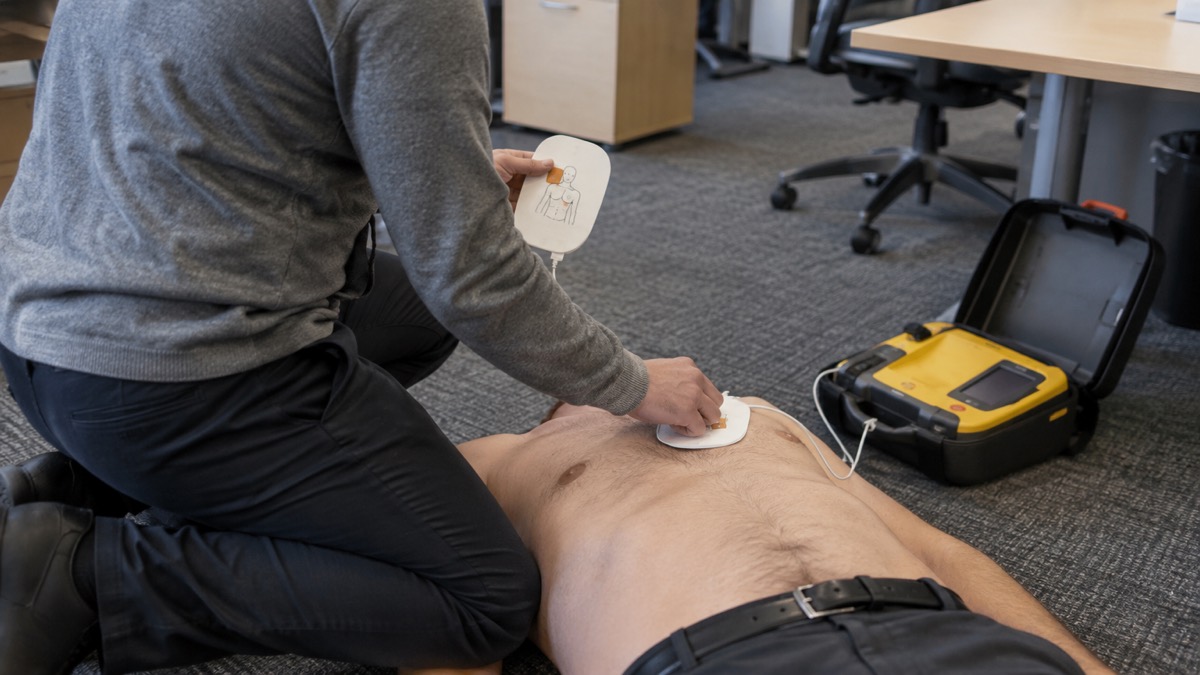
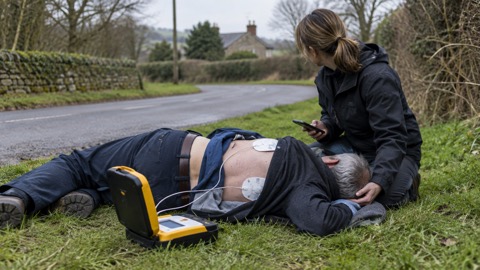
If someone has collapsed and is not breathing normally, and a defibrillator arrives, the pads go on bare skin: one on the upper right of the chest, just below the collarbone, and the other on the lower left side, below the armpit1. That is the standard adult position, and it is the same for a man or a woman. For a baby under one, or a small child, the pads go on the front and the back instead2.
You do not need training to do this. Public access defibrillators are designed for use by anyone, with clear voice prompts and visual instructions to support you during an emergency4. Open the case, switch the machine on, and it will talk you through every step, from where to put the pads to when to stand clear and when to start CPR5.
The rest of this page covers the exact placement for adults and for children, how to prepare the chest so the pads stick, and what to do about the things that worry people most: chest hair, a pacemaker, a bra, rain, and pads that touch each other.
Follow the voice prompts and the pictures on the pads
The single most useful instruction is to stop worrying about getting it perfect and let the machine lead. When the AED arrives, open it and follow the voice prompts5. The Scottish Ambulance Service says AEDs are equipped with clear voice prompts and visual instructions to support users during an emergency4, and the Resuscitation Council's paediatric guidance is equally direct: as soon as the AED arrives, switch it on and follow the instructions1.
The pads themselves carry diagrams. The LIFEPAK CR2 manual tells the rescuer to apply the pads to the patient's bare chest exactly as shown in the pictures on the pads, avoiding broken skin if possible, and to press firmly so the pads completely adhere7. So if you are unsure which way round they go, look at the pad in your hand: the picture shows you where it belongs.
Modern machines adapt to what you are doing. The Philips HeartStart HS1, for example, guides the responder from pad placement through to performing CPR with step-by-step voice prompts, and its SMART Pads feed back to the machine so it adapts its voice instructions to the user's actions and pace, and will not announce the next step until the user is ready6. That pacing matters: it means you are not being rushed while you cut clothing or position a pad.
A few practical points help the prompts work:
- Switch the machine on as soon as it is open, so it can start guiding you while you prepare the chest.
- Take the pads out and peel them as instructed, rather than waiting until you have finished cutting clothing.
- Keep doing chest compressions while a helper sets the machine up. The Resuscitation Council says to ask a helper to switch the defibrillator on and take the pads out while you continue with CPR10.
- Do not stop to read a manual. The device is the manual.
If you have never used one before, the machine will not let you deliver a shock that is not needed. It analyses the heart's rhythm itself and tells you what to do next2. That is why no prior training is required4.
Pad placement for an adult: upper right chest and lower left side
For an adult, place one pad on the upper right side of the chest, just beneath the collarbone, and the other on the lower left side, below the armpit2. The North West Ambulance Service gives the same position: the typical placement for AED pads on an adult is on the upper right and lower left side of the patient's chest1. NHS inform says to place the first pad on the casualty's upper right side, below the collar bone11, and St John Ambulance adds that the second pad should be on the casualty's left side below the armpit12.
The reason for this diagonal is that it sends the current across the heart, from one side of the chest to the other, rather than through a small patch of muscle. It is why the two pads must not be close together or overlapping.
Women: the same position, with one adjustment
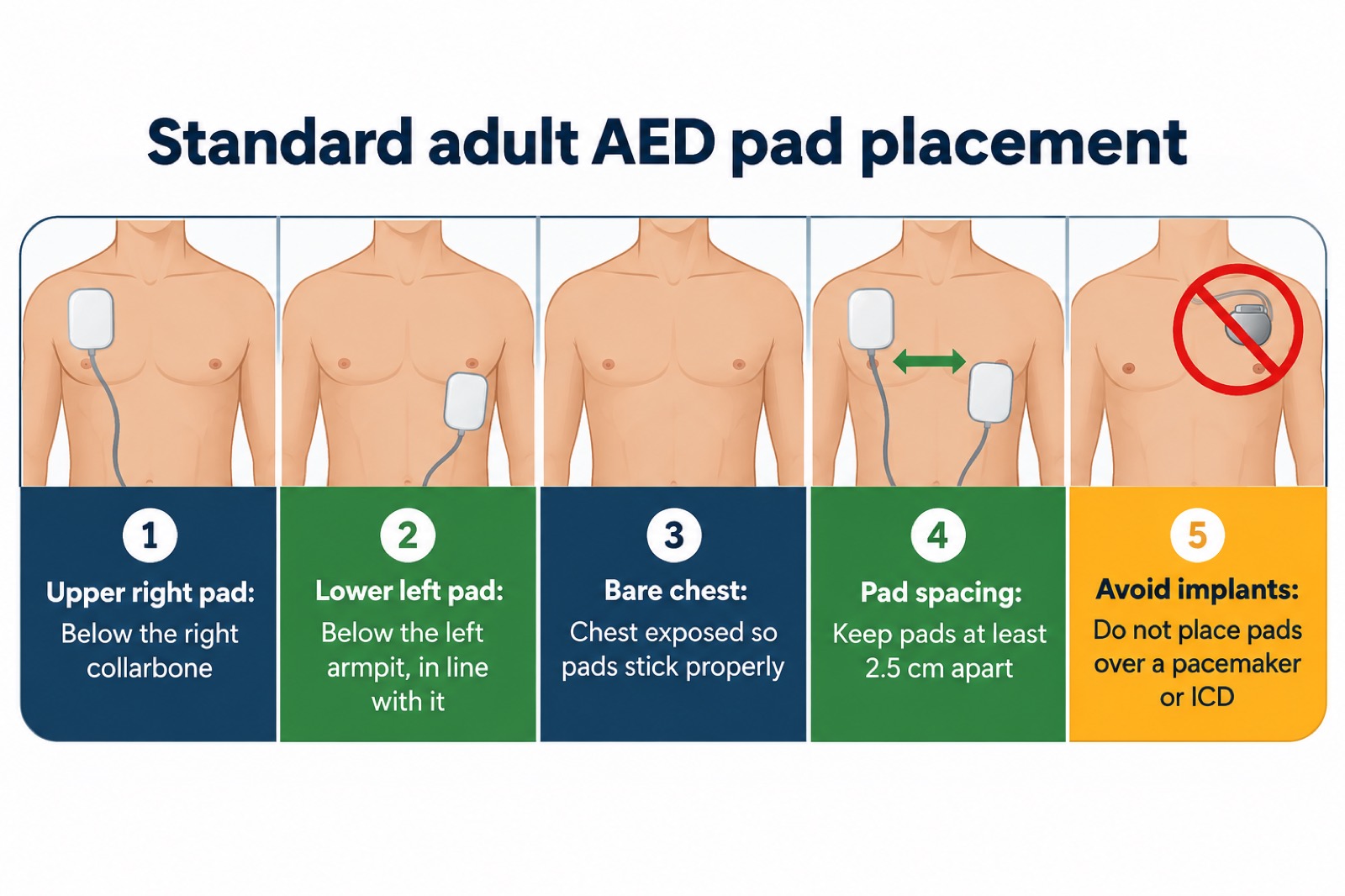
The placement does not change for a woman. St John Ambulance says that if the casualty has larger breasts, moving the left breast back towards the centre of the chest will allow correct placement of the AED pad9. In practice that means lifting or moving the breast tissue aside so the pad sits flat on the chest wall below the armpit, not on top of it.
The chest must be exposed for this to work. The South Central Ambulance Service pad information pack states that the chest should be exposed to allow pad placement, that clothes may need to be cut, torn or moved away, and that a woman's bra should be removed8. An underwire bra can sit exactly where the lower left pad needs to go, and fabric prevents the adhesive from sticking. If cutting is quicker than unhooking, cut.
If you put a pad on the wrong way round
Leave it. NHS inform advises that if you put the pads on the wrong way, you should not try to remove them, because this wastes time and they may not stick afterwards11. The machine does not care which pad is which; it only needs good contact and the right general position.
Some pads include a sensor that goes under the chest compressor's hands in the middle of the chest. With those pads you must briefly stop chest compressions to put the pad on2. That is the one time you should pause for pad placement.
Children and babies: front and back placement
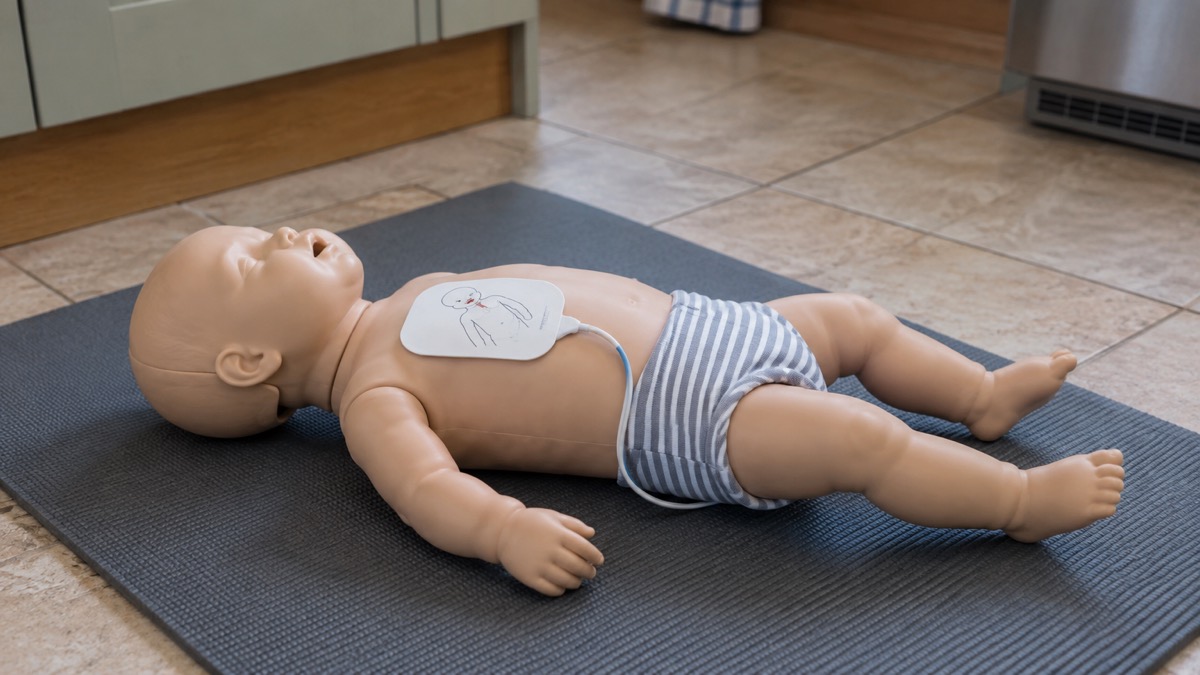
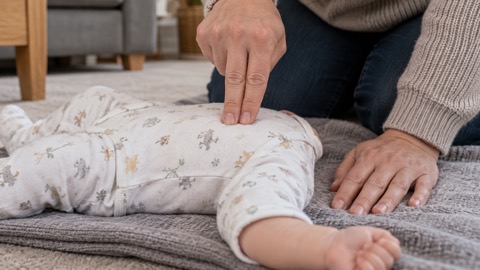
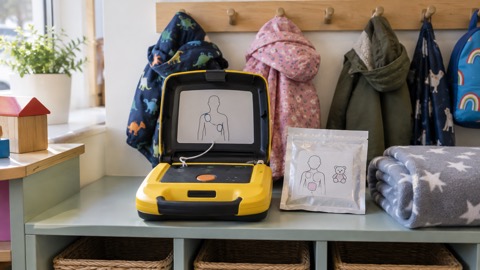
For infants and smaller children, the position changes. St John Ambulance says that in the case of infants or smaller children, you should position one pad in the middle of the chest and the second on their back, between the shoulder blades2. Its baby CPR guidance is the same: the first pad should be in the middle of the front of the chest and the second pad on the baby's back, between their shoulder blades3.
For a child aged one to eight, the British Red Cross says paediatric pads should be used, placing one pad in the centre of the child's back and the second over the centre of their chest14. If paediatric pads are not available, use standard pads with one on the centre of the chest and one on the centre of the back15.
The weight of the child matters as well as the age. St John Ambulance sets out two positions for children10:
| Child | Weight | Pad position |
|---|---|---|
| Smaller child | Less than 25kg (under about eight years of age) | First pad in the middle of the front of the chest, second pad on the child's back between the shoulder blades10 |
| Larger child | More than 25kg (about eight years of age) | First pad on the upper right side below the collarbone, second pad on the child's left side below and in line with their armpit10 |
The LIFEPAK CR2 manual gives the same logic from the maker's side: if the patient is a young child, place the electrode pads on the chest and back so they are not touching each other, with illustrations provided on the pads7. It also states the general rule that pads should be at least 2.5 cm (1 in) apart, and that if the patient's chest is too small, you should place the pads on the chest and back7.
A defibrillator can be used on adults and children over one year11. For a baby under one, follow the front and back position and let the machine analyse. If you are unsure whether the child counts as small or large, the front and back position keeps the pads apart and is the safer choice on a small chest.
Before the pads go on: bare, dry skin
The pads are self-adhesive electrodes, and they only work if they make firm contact with skin. The Resuscitation Council says that if the individual is wet, their chest should be dried so that the self-adhesive AED pads will stick properly16. The LIFEPAK CR2 manual says to press firmly so the pads completely adhere7.
So before you place them:
- Expose the chest. Clothes may need to be cut, torn or moved away, and a woman's bra should be removed8.
- Dry the skin if the casualty is wet, so the pads stick16.
- Avoid broken skin if possible, without delaying placement to hunt for a clear patch7.
- Keep the pads apart, at least 2.5 cm (1 in), or switch to the front and back position on a small chest7.
- Press each pad down firmly so it completely adheres7.
Hairy chests
Chest hair can stop a pad sticking. Official guidance is measured: shave the chest only if the hair is excessive, and even then spend as little time as possible on this, and do not delay defibrillation if a razor is not immediately available17. Many AED kits include a razor for exactly this purpose, alongside a mouth shield for protection during rescue breaths18. If a razor is in the case, use it quickly; if not, press the pad down firmly over the hair and let the machine analyse.
Pacemakers and implanted devices
Do not place a pad directly over an implanted device such as a pacemaker or ICD. The LIFEPAK CR2 manual says an indication of an implant is a protrusion in the chest skin and a scar, and that if you are in doubt, you should apply the pads as shown in the pictures7. In other words, shift the pad a little clear of the lump if you can see one, but do not spend time searching. The machine will still analyse the rhythm.
Wet weather and wet casualties
Rain is not a reason to hold back. The South Central Ambulance Service says it is usually safe to use an AED on a casualty who is lying on a metallic, wet or other conductive surface, provided the pads are applied correctly and there is no direct contact between user and casualty during the shock8. The Resuscitation Council's drowning guidance says that if an AED is available, dry the chest quickly and follow the device prompts to apply and use it19. Dry what you can, place the pads, and keep everyone clear when the machine says so.
When to stand clear: analysis and shock
Once the pads are on, the machine takes over. St John Ambulance says the defibrillator will tell you to stop CPR and analyse the heart's rhythm, and you should make sure no one is touching the casualty and follow the visual and verbal prompts2. The North West Ambulance Service explains why: the AED gives clear instructions to make sure everyone is clear of the casualty before shocking, so that we do not cause harm to other people1.
If a shock is needed, tell people to stand back. The defibrillator will tell you when to press the shock button, and after the shock it will tell you to continue CPR for two minutes before it re-analyses2. On a semi-automatic machine you press the button yourself when told; on a fully automatic machine it delivers the shock itself once it has warned everyone clear.
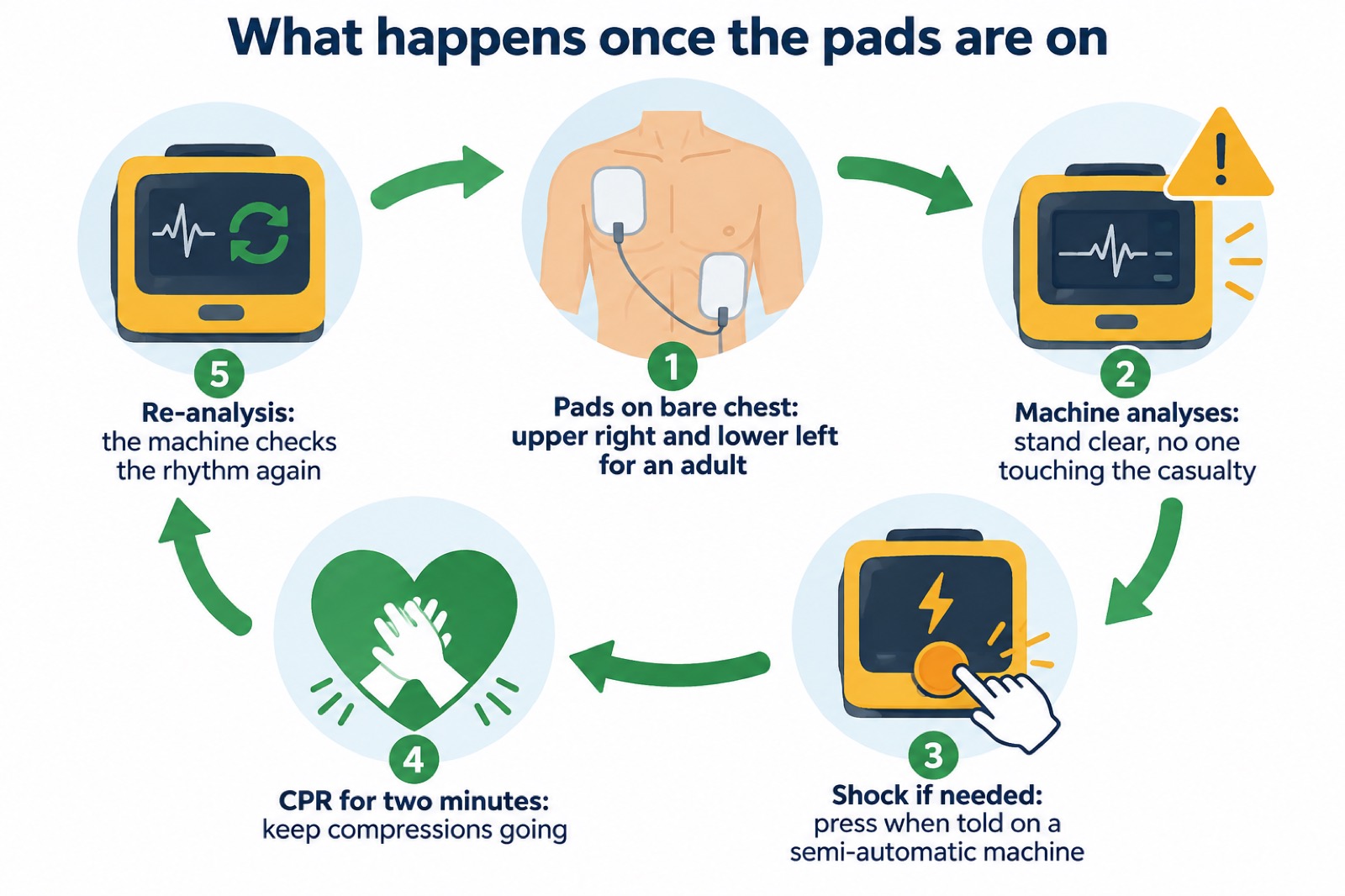
The pads stay on throughout. The South Central Ambulance Service says pads remain on the chest throughout resuscitation and until transfer to clinical staff, the AED should be left on until ambulance professionals assume responsibility, and it re-analyses after two minutes of CPR8. Do not peel them off between cycles.
Minimise interruptions to compressions. Official guidance says that when using an AED you should minimise interruptions in chest compression, and not stop to check the victim or discontinue CPR unless the victim starts to show signs of regaining consciousness, such as coughing, opening his eyes, speaking, or moving purposefully, and starts to breathe normally17. The machine's prompts are timed to protect that rhythm.
Where to find a defibrillator and get help
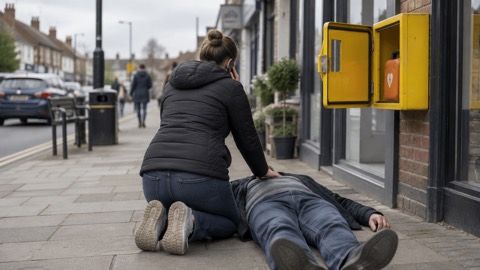
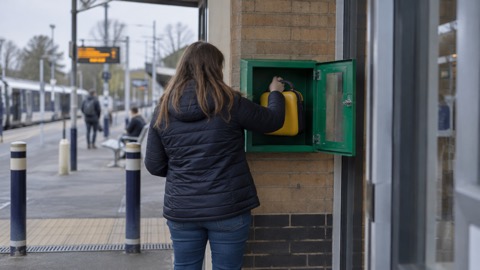
Defibrillators are found in many public places, such as train stations and shopping centres14, and NHS inform adds airports to that list11. A public access defibrillator is an AED designed for use by anyone in a cardiac emergency4, usually kept on the outside of a building in an unlocked, heated cabinet20.
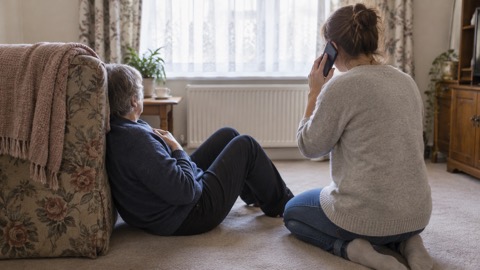
If you are the one doing CPR, you do not have to leave the casualty to find one. The Resuscitation Council says the ambulance call handler will tell you where the nearest automated external defibrillator is, and if someone is with you, ask them to fetch it and bring it back21. The East of England Ambulance Service says its emergency call handlers will help direct callers to the nearest available device and explain how to use it22.
It is worth knowing where your nearest one is before you ever need it. Essex Preparedness advises knowing where your local AED is, using the Defib finder resource, while noting that not all AEDs are listed there23. In Scotland, Save a Life Scotland provides a PADmap tool for finding public access defibrillators24.
| Nation | Where to look |
|---|---|
| England | Ambulance call handlers can direct you to the nearest device22; Defib finder lists many but not all23 |
| Scotland | Save a Life Scotland's PADmap tool24; Scottish Ambulance Service public access defibrillator information4 |
| Wales | Follow the UK-wide voice prompt guidance and ask the call handler5 |
| Northern Ireland | Ask the call handler; public access defibrillators are listed by the Northern Ireland Ambulance Service4 |
You might also hear a defibrillator called a defib, an AED (Automated External Defibrillator) or a PAD (Public Access Defibrillator)25. They are the same kind of device, and the pads go on the same way.
If you want to go further, our guides to using a defibrillator, finding your nearest public access defibrillator and doing CPR cover the steps around the pads. For a child, see can you use a defibrillator on a child or baby, and if you have never used one, can you use a defibrillator without training.
Sources (25)
- Learn to save a life, North West Ambulance Service, 2024
- How to use a defibrillator, St John Ambulance, 2026
- How to do CPR on a baby, St John Ambulance, 2026
- Public Access Defibrillators, Scottish Ambulance Service, 2026
- Unresponsive and not breathing when an AED is available, British Red Cross, 2026
- HeartStart HS1 AED, Philips, 2025
- LIFEPAK CR2 AED with cprINSIGHT operating instructions, Stryker, 2019
- PAD Information Pack, South Central Ambulance Service, 2026
- Cardiac arrest, St John Ambulance, 2026
- How to do CPR on a child, St John Ambulance, 2026
- How to use an AED, NHS inform, 2026
- How to do CPR and use a defibrillator on a person with breasts, St John Ambulance, 2026
- Cardiac arrest first aid, St John Ambulance, 2026
- Unresponsive and not breathing child, British Red Cross, 2026
- Unresponsive, not breathing with an AED available, British Red Cross
- FAQs: basic life support and CPR, Resuscitation Council UK, 2026
- Community defibrillator guidance, Whitstone Parish Council, 2010
- AED FAQs, Reliance Medical, 2023
- 2025 First Aid Guidelines, Resuscitation Council UK, 2025
- Using your HeartSine AED in an emergency, Defibshop, 2026
- How to do CPR, Resuscitation Council UK, 2026
- Cardiac arrest, East of England Ambulance Service, 2026
- Developing community resilience, Essex Preparedness, 2026
- Defibrillators, Save a Life Scotland, 2026
- Defib Dani, Resuscitation Council UK, 2026
 Baby and Child Kit Checklist
 Bleeding Control Kit Checklist
 Car Kit Checklist
 CPR on a Baby
 CPR on a Child
 Chest Compression Rate and Depth
 Rescue Breaths or Hands-Only CPR
 Checking Breathing
 Agonal Breathing and CPR
 Breathing During CPR
 Recovery Position and Spine
 Cardiac Arrest vs Heart Attack
 Heart Attack First Aid
 Defibrillator on a Child
 Defibrillator Without Training