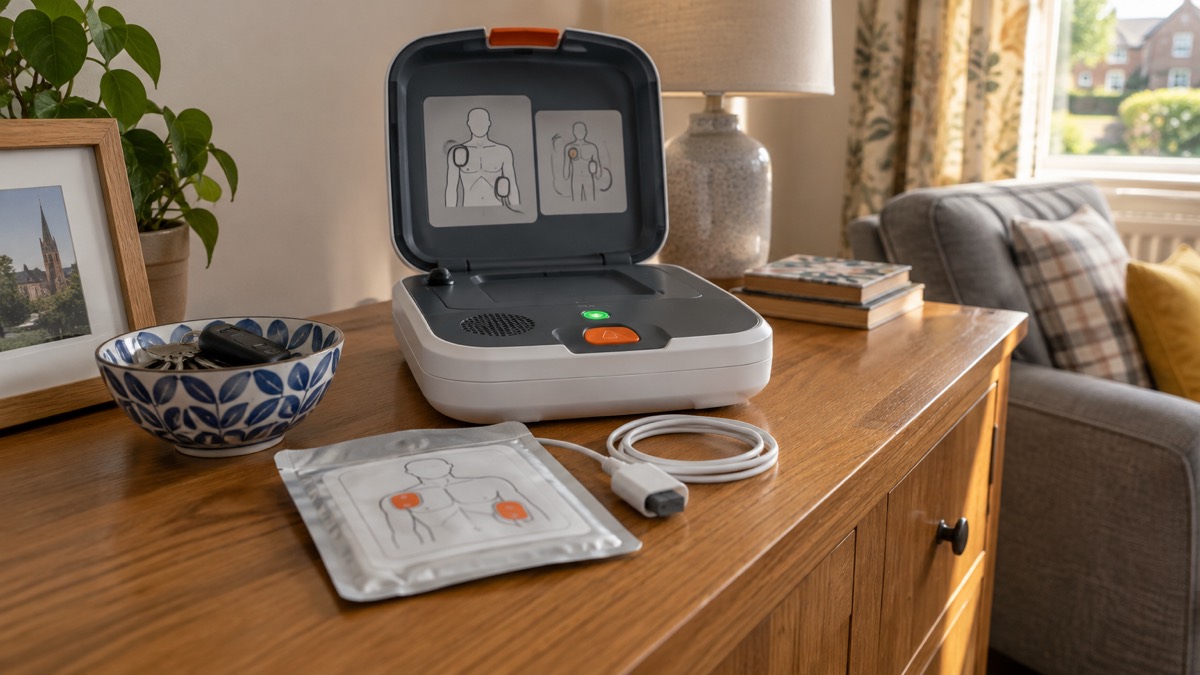
The LIFEPAK CR2 is an automated external defibrillator (AED) made by Stryker, through its Physio-Control brand: a portable device that talks a bystander through helping someone in cardiac arrest1. It is indicated for use on patients aged 1 year or older who are unresponsive, not breathing normally and showing no signs of circulation1. You open the lid, follow the voice prompts, and the device decides whether a shock is needed. It delivers up to 360 joules of electrical energy1.
If someone collapses and is not breathing normally, call 999 immediately and start CPR; ambulance call handlers can guide you through CPR and will direct you to the closest public access defibrillator2. Send someone for the CR2 if you have one, and keep doing chest compressions while it is fetched. The device is designed so that a household with no clinical training can use it: the prompts tell you where to put the pads, when to stand clear and when to resume compressions.
This page covers what the CR2 does, how to use it on an adult and a child, where the pads go, and the checks that keep it ready between emergencies. It is a named product page, so the instructions here are the maker's own, taken from the operating instructions supplied with the device1.
What the LIFEPAK CR2 is and who it suits
The CR2 is a public-access style AED built for places where ordinary people, not clinicians, will be the first to reach it: a village hall, a sports club, a workplace, or a home where someone has been told they are at risk. The maker's manual describes it as an AED and lists fully automatic and semi-automatic models1. It is not made with natural rubber latex, which matters for households where latex allergy is a concern1.
It is indicated for adults and children from 1 year old, but only for someone in cardiopulmonary arrest: unresponsive, not breathing normally, and with no signs of circulation such as a pulse, coughing or movement1. That is a narrower set of conditions than "collapsed" or "unwell". If the person is breathing, or responding to you, the defibrillator is not the next step; check what to do first with our guide to the primary survey and to cardiac arrest and heart attack, which are not the same thing.
The device has a noise sensor that monitors the surrounding area while it is in use and automatically adjusts the volume of the voice prompts so they can be clearly heard1. In a noisy hall or at the side of a road, that is the difference between hearing "DO NOT TOUCH PATIENT" and guessing.
Using it in a cardiac arrest: open the lid and follow the voice prompts
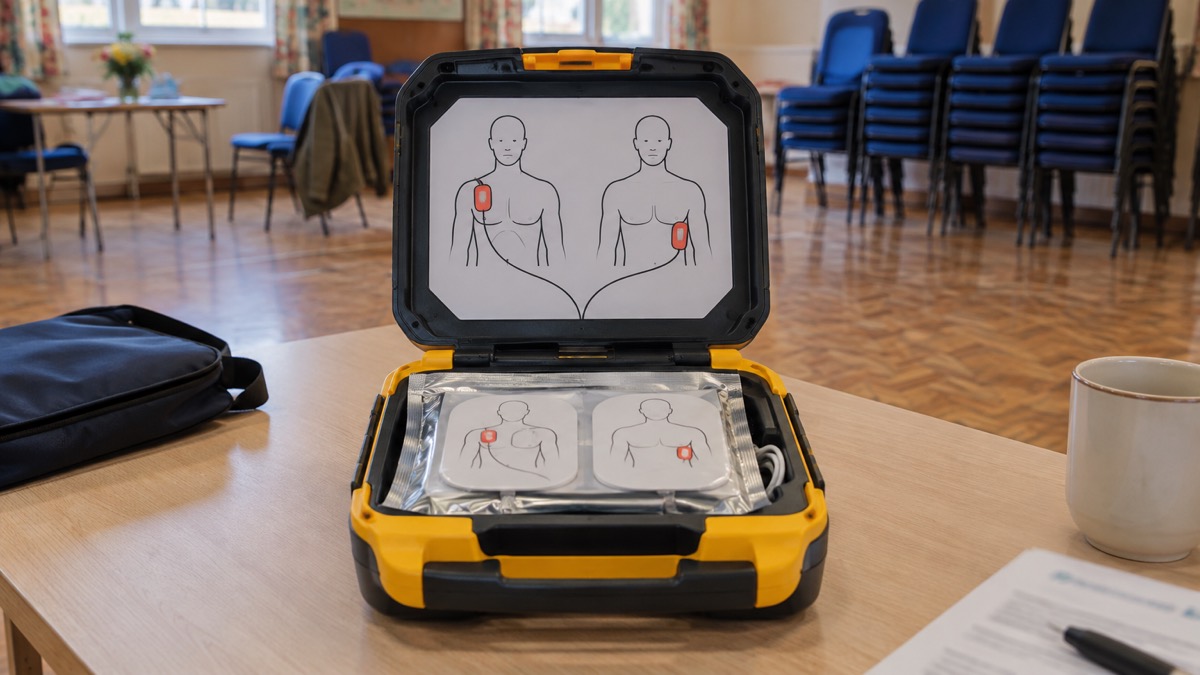
The sequence is deliberately simple. Call 999, start CPR, and get the defibrillator. The Resuscitation Council UK's first aid guidelines say that if you suspect a cardiac arrest, call 999 and follow the call handler's instructions on how to perform CPR3. The Welsh Ambulance Service makes the same point: phone 999 immediately and start CPR, and call handlers can direct you to the closest public access defibrillator2.
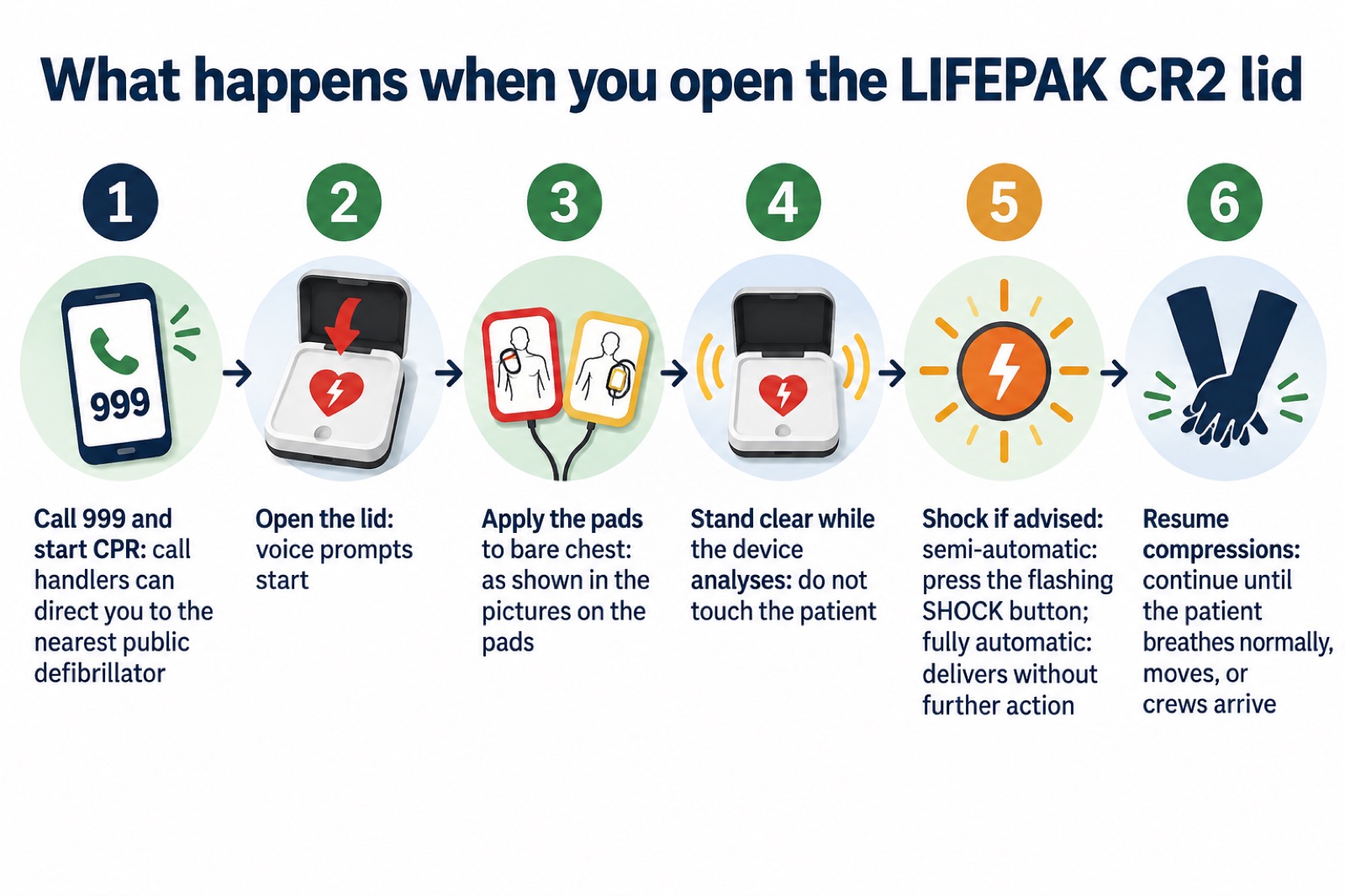
On the CR2, open the lid. The voice prompts start and talk you through the rest. Apply the pads to the patient's bare chest exactly as shown in the pictures on the pads, avoiding broken skin if possible, and press firmly so the pads completely adhere1. Then follow the prompts: do not touch the patient while the device analyses the rhythm, and resume compressions when told.
On a semi-automatic model you hear PRESS FLASHING BUTTON and press the flashing SHOCK button; on a fully automatic model the defibrillator delivers the shock without requiring further action1. On fully automatic models the SHOCK indicator flashes when the defibrillator is preparing to deliver a shock1.
Continue to follow the voice prompts and provide chest compressions when instructed until the patient begins breathing regularly or moving, or emergency medical personnel arrive and tell you to stop1. If the casualty shows signs of becoming responsive, such as coughing, opening their eyes, speaking or starting to breathe normally, put them in the recovery position, leave the defibrillator attached, monitor their level of response and prepare to give CPR again if necessary4. Our guide to what to do if someone starts breathing during CPR covers that moment in more detail.
Two habits protect the battery. After completing an initial inspection, do not open the lid unless necessary, because each time you open the lid the defibrillator turns on and battery power is reduced1. And only pull the red handle in an emergency: if it is pulled, the electrode seal will be broken and the electrodes will dry out, and if the seal is broken the electrode tray must be replaced immediately1.
Child mode for children aged 1 to under 8
The CR2 has a Child Mode, and the maker's manual defines it as the mode to use if the patient is a child 1 year of age or older and less than 8 years old1. In Child Mode the defibrillator delivers lower energy levels appropriate for young children without having to change electrodes, and it adjusts the CPR coaching to suit a young child1. That last point is easy to miss: the pads stay the same, but the instructions you hear change.
The manual gives a second description of who Child Mode is for: a child less than 8 years old or who weighs less than 25 kg (55 lb)1. The two descriptions do not quite match for a heavy child under 8 or a light child over 8, and the manual does not resolve it. If you are unsure, follow the age definition the manual gives first, and let the 999 call handler guide you.
Adult Mode is for a patient 8 years or older who weighs more than 25 kg (55 lb)1. For a young child, place the electrode pads on the chest and back so they are not touching each other, following the illustrations provided on the pads1. Ensure the pads are at least 2.5 cm (1 in) apart; if the patient's chest is too small, use the chest and back positions shown in the child pictures on the pads1.
To select Child Mode, press the CHILD MODE button within 10 seconds of the voice prompts starting when the lid is opened; if you miss that window, the AED proceeds as it would during a cardiac arrest1. The same 10 second limit applies to the LANGUAGE button1. Our page on using a defibrillator on a child or baby sets out the general principles for any AED, and how to do CPR on a child covers the compressions and rescue breaths that go alongside it.
Pad placement and what to keep the pads away from
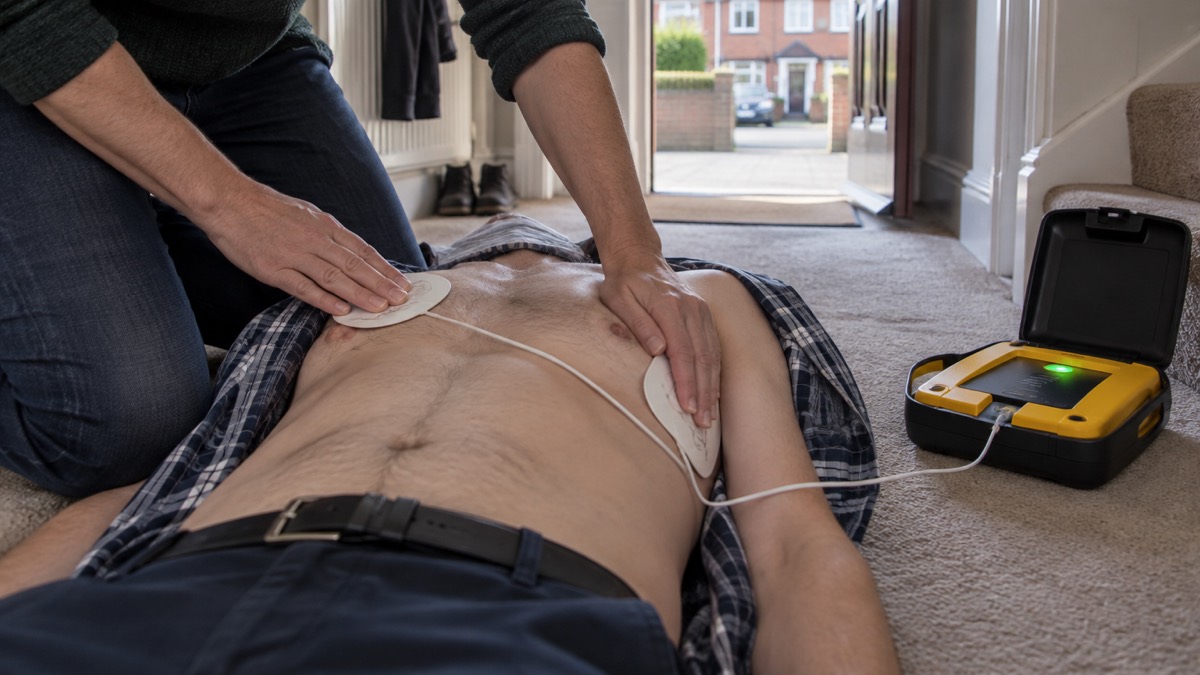
The standard adult position is well established. St John Ambulance says the first pad should be on the upper right side, below the collarbone, and the second pad on the casualty's left side just below and in line with the armpit4. The Resuscitation Council's older guidance describes the same placement in anatomical terms: one pad to the right of the sternum below the clavicle, the other in the left mid-axillary line5. The CR2's own pictures on the pads show the position, and the maker's instruction is to apply them exactly as shown1.
The pads must go on bare, dry skin. The South Central Ambulance Service's public access defibrillator pack sets out the "7Ps" to check before placing pads6:
- Patches: remove medicated patches and wipe the skin dry.
- Piercings: do not remove them; place the pad around them.
- Perspiration: dry the area.
- Pendants: move neck jewellery out of the way.
- Pacemaker site: if there is an implanted device on the right, place the pad below it.
- Playtex: cut an underwired bra through the centre and move it to one side.
- Body hair: remove excess hair with the razor provided.
On implanted devices, the maker's manual is direct: do not place the electrode pads over an implanted device such as an implanted pacemaker or ICD1. An indication of an implant is a protrusion in the chest skin and a scar; if you are in doubt, apply the pads as shown in the pictures1. If you put the pads on the wrong way, do not try to remove them, as NHS inform says this wastes time and they may not stick afterwards7.
Emergency medical personnel may disconnect the electrode pads by pulling the electrode cable straight out from the defibrillator and closing the lid to turn the defibrillator off1. Leave that to them. Our page on where defibrillator pads go covers the general rules for any device.
Readiness checks: the indicator flashes every 6 seconds when ready
An AED that has sat unused for a year is only useful if it is still working. The CR2 shows its state at a glance: the Readiness indicator flashes every 6 seconds to indicate the defibrillator is ready for use1. The maker's manual says device readiness should be verified at least once each month1.
If the defibrillator needs attention, the Readiness indicator does not flash and an alert tone sounds every 15 minutes; the alert tone option can be turned off1. If the indicator is not flashing, open the lid, and when the voice prompts start press and hold the LANGUAGE and CHILD MODE buttons simultaneously for at least 2 seconds until you hear DEVICE READY or DEVICE NOT READY1. Note that the DEVICE READY voice prompt indicates whether the AED is ready for a cardiac emergency; it does not indicate whether wireless is ready1.
| What you see or hear | What it means | What to do |
|---|---|---|
| Indicator flashes every 6 seconds | Ready for use1 | Nothing; check again next month1 |
| No flash, alert tone every 15 minutes | Needs attention1 | Open the lid and run the DEVICE READY check1 |
| DEVICE NOT READY | Not ready for a cardiac emergency1 | Follow the maker's troubleshooting and replace the battery if indicated1 |
The maker's manual also warns that if the defibrillator indicates the battery is low, replace it immediately, because of possible loss of power during patient care1. Our defibrillator guardian checklist turns these checks into a monthly routine, and how long defibrillator batteries and pads last explains the wider picture for any model.
Battery and pads: install the battery within 1 year of manufacture
The CR2 runs on a lithium manganese dioxide battery, and the maker's manual is clear that it must not be recharged1. The battery must be installed within 1 year of its date of manufacture to attain a 4-year service life1. Check the date of manufacture on the battery label, printed in YYYY-MM-DD format1.
To fit it, insert the battery into the battery compartment on the back of the defibrillator; the defibrillator will automatically begin a self-test, and you should wait until 3 audible tones sound before proceeding to the next step1. The self-test may take up to 2 minutes, and you should not open the lid until you hear the 3 tones, because doing so will prevent the self-test from completing1. If the same battery has been previously inserted, the 3 tones will not sound1.
The pads have their own dates. The maker prints a Use By date on the electrodes in YYYY-MM-DD format1. For publicly accessible defibrillators generally, the Resuscitation Council UK says the shelf life of compatible self-adhesive pads must be a minimum of two years from the date of supply8, and the South Central Ambulance Service notes that batteries and pads have a long shelf life of between 2 and 5 years depending on the AED model6. The Resuscitation Council also expects replaceable batteries to have a life expectancy of at least two years once inserted9.
Write both dates, battery and pads, on a card inside the cabinet and check them at the monthly readiness check. The maker's manual also notes that storage at extreme temperatures reduces electrode shelf life and battery life: the device and electrodes are designed to withstand fluctuations between -30° and 60°C, but storage at those extremes is limited to one week1.
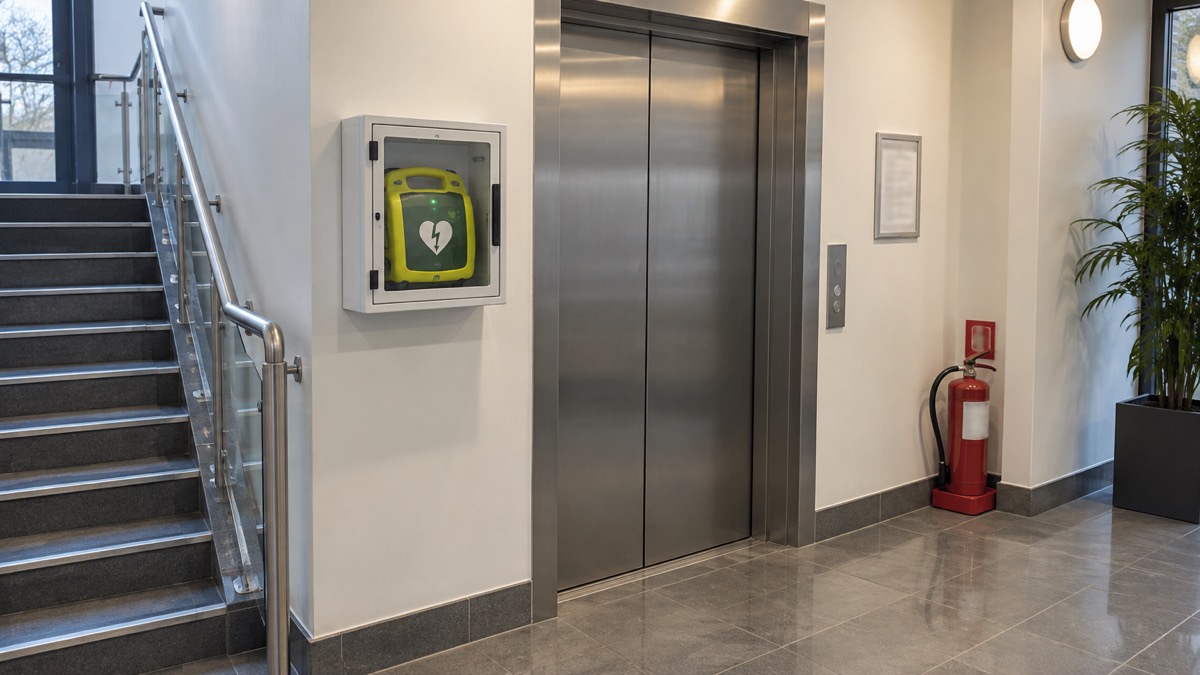
Where to keep it: stored at 15 to 25°C in a visible spot
The maker's recommended storage temperature range is 15° to 25°C1. That is close to normal room temperature, which is why a hallway, a staff room or a community hall cupboard works and a shed, loft or car boot does not. The device will operate between 0 and 50°C1, so it will work if carried outside on a cold morning, but that is an operating range, not a storage one.
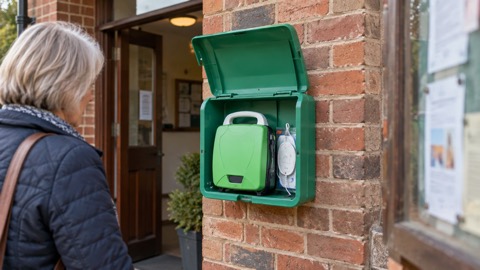
Keep it visible and reachable. The general principle for household emergency kit applies: keep it in a safe place at home where you can reach it easily10. For a defibrillator, visibility matters as much as reach: a device nobody can find quickly is no better than one that is locked away. If you are deciding between an indoor and an outdoor cabinet for a community setting, our comparison of indoor and outdoor defibrillator cabinets sets out the trade-offs.
Heat is the main enemy. NHS and government heatwave guidance for medicines is a useful benchmark for any temperature-sensitive equipment: most medicines should be kept below 25°C, somewhere cool, dry, out of direct sunlight and away from windowsills11. A defibrillator stored on a sunny windowsill or beside a radiator will spend part of the summer above its recommended range. The British Heart Foundation notes that heat affects the body and the heart, and the same caution applies to the kit you keep to protect it14.
Wi-Fi, cellular and USB connections and email alerts
All LIFEPAK CR2 defibrillators have USB capability; to find out whether yours also has Wi-Fi or cellular capability, check the serial number label in the battery compartment on the back of the device1. The device uses either Wi-Fi, cellular or USB to connect, and it can connect to LIFELINKcentral AED Program Manager or the LIFENET System over any of the three1.
Once connected, the device looks after its own paperwork. Email notifications are sent if a battery or electrode expiration date is approaching, if an expiration date has passed, or if the defibrillator has failed a self-test; a notification is also sent if a defibrillator with wireless capability has failed to check in1. The AED checks in automatically once each month1.
There are practical limits worth knowing. Cellular transmission does not occur during patient use; transmissions happen following a patient use, after device self-tests, or when transmission is manually initiated1. If a Wi-Fi connected device is used, information such as heart rhythm and shocks delivered can be transmitted to emergency responders during the cardiac arrest event1. If a cellular connected device is moved from its established location, an email notification is sent, and the defibrillator can be instructed to beep and report its approximate location1.
Setting up Wi-Fi needs a PC running Windows 7 or above with an internet connection, administrator rights and the supplied USB cable, and a typical setup takes 10 to 20 minutes1. Software updates may take up to 30 minutes, and you should not turn the AED off during this time unless it is needed for an emergency; after rebooting, the AED will be silent for 1 to 2 minutes while it performs a self-test1.
Registering the device, training and disposal
Register the device. The maker asks owners to register at www.physio-control.com, which ensures you are notified of any product updates1. Independent guidance on electrical products makes the wider case: register your device so you can be contacted easily if there is a safety recall15. The Association of Manufacturers of Domestic Appliances runs Register My Appliance at www.registermyappliance.org.uk, which makes it easy to register electrical products and is simple to follow16. Keep the serial number from the battery compartment label with your household paperwork.
Do not train on it. The maker's manual states: "Do not use the LIFEPAK CR2 defibrillator for training. Doing so will reduce available battery charge, and could damage the electrodes."1 A separate LIFEPAK CR2 trainer simulates the defibrillator but does not deliver shocks1. The maker recommends that all identified defibrillator users attend formal CPR and AED training provided by a recognised training organisation, repeated every 2 years1. Our guide to first aid courses explains what is available, and learning CPR free online covers the no-cost options.
At end of life, the maker's manual says not to dispose of the product in the unsorted municipal waste stream, but according to local regulations, with recycling instructions at www.physio-control.com/recycling1. For the battery: do not place it near an open flame, heat it above 100°C, or incinerate it, and do not crush, puncture or disassemble it1. Your council's household waste recycling centre is the usual route for electrical and battery waste in the UK.
Where to get help and how to prepare
The first call in a cardiac arrest is always 999. Ambulance call handlers can talk you through CPR and point you to the nearest public access defibrillator2. If you do not own a defibrillator, our guide to public access defibrillators explains how to find one, and how to get the code for a locked cabinet covers the common obstacle of a locked case.
For households deciding whether to buy one at all, our guide to choosing a defibrillator for a home, club or village sets out what to weigh up, and the comparison of semi-automatic and fully automatic defibrillators explains the one choice that changes what you do in the moment. If you are responsible for a device in a community setting, the defibrillator guardian checklist is the monthly routine in one place.
If someone in your household has a heart condition, tell the ambulance service. For a household managing a health condition day to day, our guide to extra help in an emergency explains what is available and how to register.
Finally, know the limits of the device. It is one link in a chain that starts with recognising cardiac arrest, calling 999 and starting compressions. The Resuscitation Council UK's 2025 first aid guidelines are the current standard for bystanders3, and our summary of the 2025 resuscitation guidelines explains what changed. The CR2 will talk you through its part; the rest is yours.
Sources (17)
- LIFEPAK CR2 Operating Instructions with cprINSIGHT, Stryker, 2019
- Some of the reasons people call 999, Welsh Ambulance Service, 2026
- First aid guidelines, Resuscitation Council UK, 2025
- Cardiac arrest, St John Ambulance, 2026
- Paediatric cardiac arrest first aid guide, North East Ambulance Service, 2024
- PAD Information Pack, South Central Ambulance Service, 2026
- How to use an AED, NHS inform, 2026
- Public access defibrillators: a guide for communities, Resuscitation Council UK, 2025
- AED Guide, Resuscitation Council UK, 2026
- Get prepared, Carmarthenshire County Council, 2026
- How to keep cool this summer, Lancashire County Council, 2026
- Staying well in hot weather, Berkshire Healthcare NHS Foundation Trust, 2026
- Beat the heat: staying safe in hot weather, UK Health Security Agency, 2026
- Weather and your heart, British Heart Foundation, 2026
- Smart homes, Electrical Safety First, 2026
- Register your appliance, Cornwall Council, 2026
- Maintain appliances and recalls, Greater Manchester Fire and Rescue Service, 2026
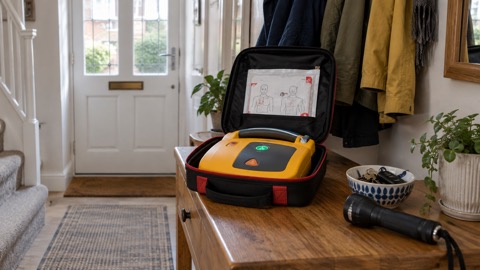 HeartSine samaritan PAD 350P
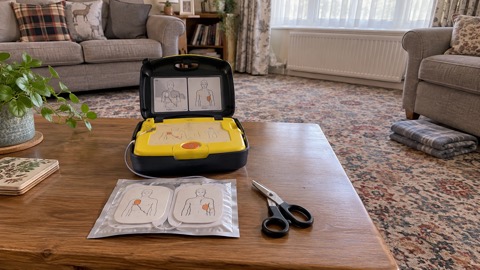 ZOLL AED 3 Defibrillator
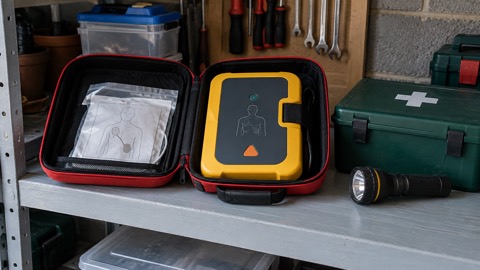 ZOLL AED Plus Defibrillator
 Cardiac Science Powerheart G5
 Philips HeartStart FRx AED