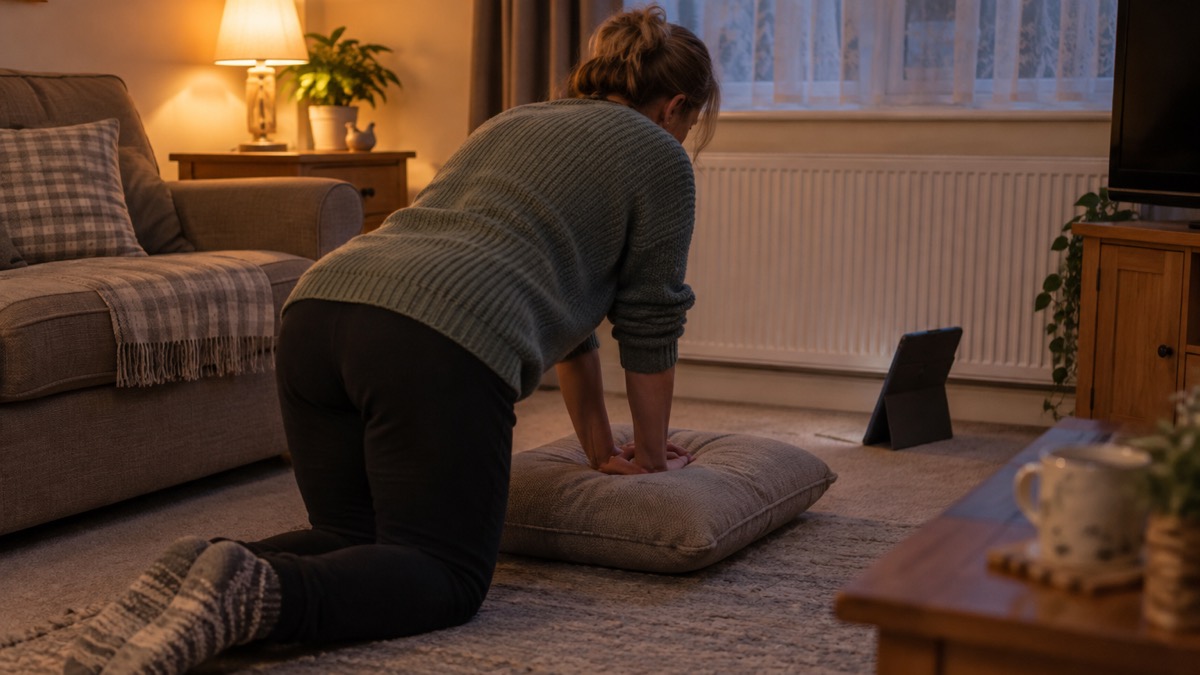
You can learn CPR today, at home, for nothing. RevivR is a free online CPR training tool provided by the British Heart Foundation which aims to build people's confidence in how to act if they witness a cardiac arrest1. The course is free to use, takes 15 minutes, and can be accessed via a smart phone or tablet1. All you need beyond that is a cushion to practise on, as Cheshire Fire and Rescue Service puts it in its own safety advice: "Learn lifesaving CPR in 15 minutes for free, with RevivR, using your mobile phone and a cushion"2.
Why it matters is blunt. CPR, or chest compressions, help to pump blood around the body when the heart can't3, and starting them early is what a person in cardiac arrest needs while an ambulance is on the way. Yet 38% of UK adults have never had CPR training4. A 15-minute session on your sofa closes that gap for your household tonight, and there are two other free routes as well: Restart a Heart events every October, and the ResusReady register for showing that you or your organisation are trained.
What RevivR is and who made it
RevivR is a free online CPR training tool provided by the British Heart Foundation which aims to build people's confidence on how to act if they witness a cardiac arrest1. It is not a formal course with an exam or a certificate: it is a short, practical tool whose whole purpose is to take someone with no training and leave them, a quarter of an hour later, able to start chest compressions.
It sits inside a wider national effort. CPR teaching in UK secondary schools was developed by Resuscitation Council UK partnering with key organisations including the British Heart Foundation, St Andrews First Aid, St John Ambulance, British Red Cross and the East London Cardiovascular Prevention group from Barts Health NHS Trust1. The same partnership sits behind the annual Restart a Heart campaign, so the free online tool and the free October events are two doors into the same room.
There is also a companion resource worth knowing about. The "CPQR code" directs people to a short 2-minute video on how to do CPR and is available in nine languages1. That makes RevivR and its related materials usable across a multilingual household or workplace, not just in English.
What you need before you start
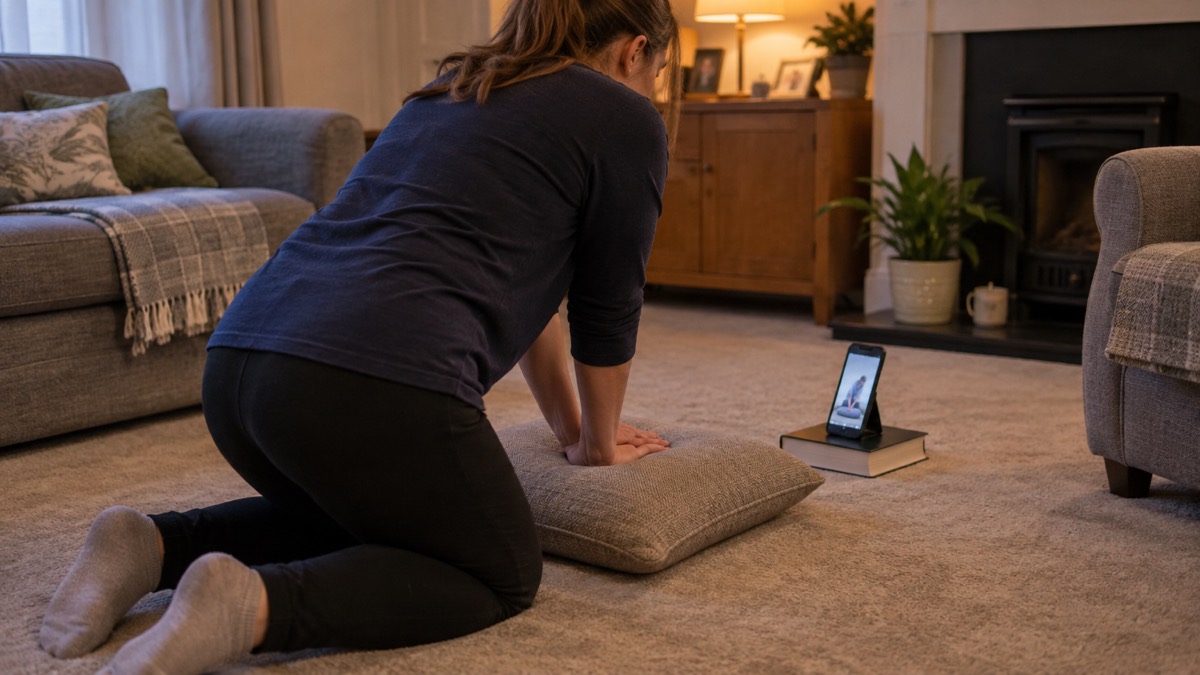
Very little, which is the point. The course can be accessed via a smart phone or tablet1, and you need a cushion to act as the practice chest2. Give yourself a patch of clear floor so you can kneel and use your body weight rather than just your arms, and put the phone where you can see the screen while your hands are on the cushion.
Beyond that, treat it like any online session: a charged device and a working internet connection. If your household keeps a first aid app as well, the free Red Cross first aid app for your smartphone is another layer of the same preparedness, available on the usual app stores9. Neither replaces hands-on practice, but together they mean the knowledge is in the house, not just on a website you once visited.
What the course teaches, step by step
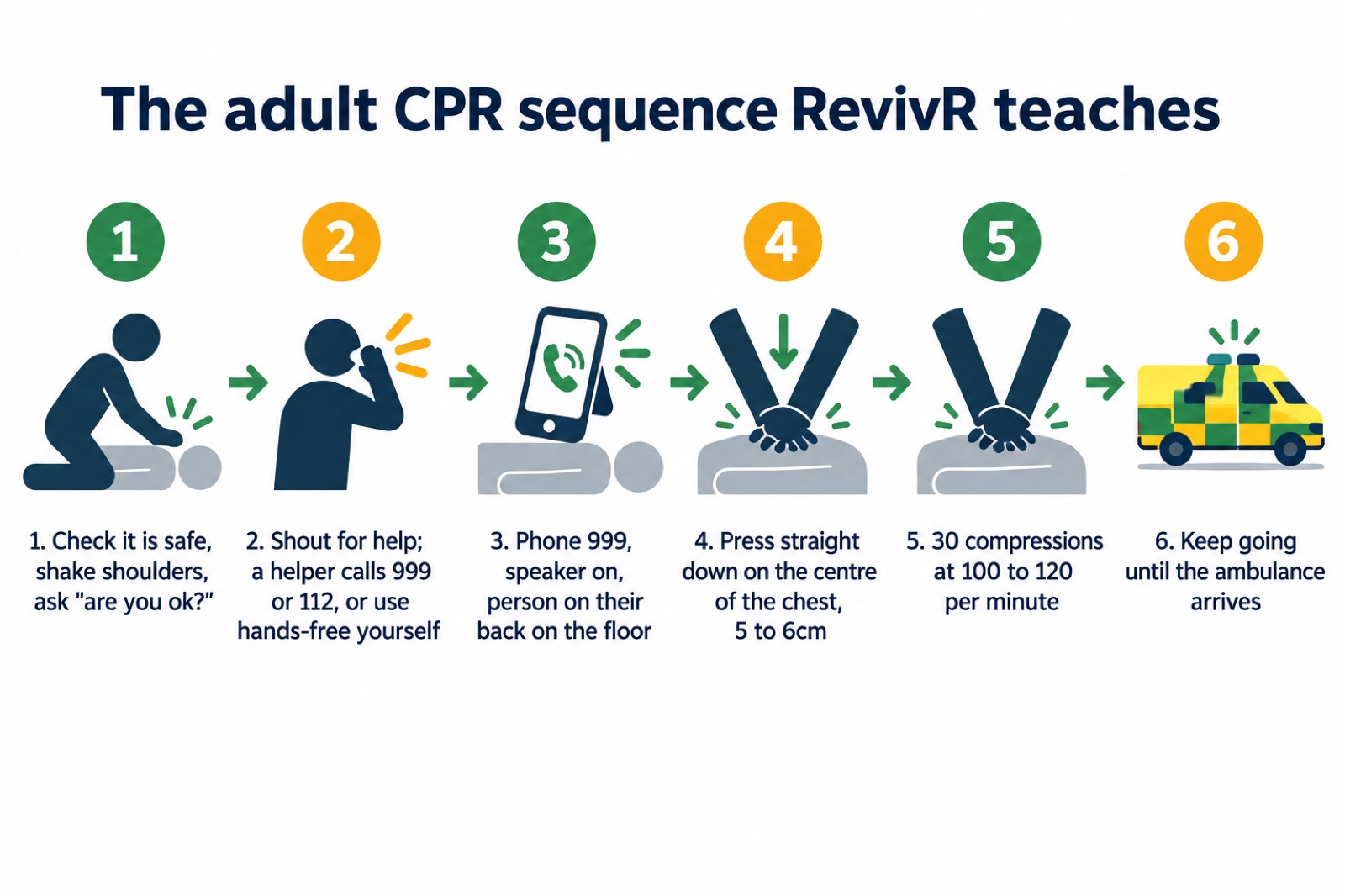
RevivR builds confidence for a cardiac arrest, and the steps it teaches are the standard adult sequence used across UK ambulance services and NHS guidance. The course works through them in order, and the cushion stands in for the person's chest so your hands learn the movement, not just your eyes.
The sequence, drawn from official UK guidance:
- Check it is safe, then check for a response. Shake the shoulders gently and ask loudly "are you ok?"5. One NHS source adds the same first moves: make sure it's safe to approach, check response by shaking shoulders and asking loudly, and shout for help5.
- Call 999. If they're not breathing, phone 999 and begin chest compressions7. Ask a helper to call 999 or 112, or put your phone on hands-free and call yourself5; another official source says to call 999, set the phone on speaker mode, lay the person on their back on the floor and remove anything under their head6. The documents phrase it differently but the action is the same: get the call going and start compressions without leaving the person.
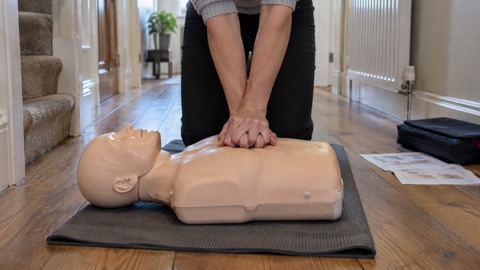
- Start chest compressions. This is often called CPR10. Lean directly over the person's chest and press down vertically on the centre of the chest6.
- Get the depth right. Using your body weight, not just your arms, press straight down by 5 to 6cm (2 to 2.5 inches)5; NHS inform gives the same figure, about 5 to 6 cm6, and North East Ambulance Service says to press down hard and fast by 5 to 6cm11.
- Get the rate right. Give 30 compressions at a rate of 100 to 120 per minute7. North West Ambulance Service puts it simply: just concentrate on compression at a rate of 100-120 per minute8.
- Keep going until help arrives. Chest compressions help to pump blood around the body when the heart can't3, so the longer you continue, the more blood keeps moving.
For the full detail on each step, including what to do at each point and why, see how to do CPR and how fast and how deep chest compressions should be. If you want to understand the checks that come before compressions, the primary survey walks through danger, response, airway and breathing in order.
RevivR is for adults, not children or babies
This is the limit to know before you start. RevivR teaches adult CPR, and the technique for children and babies is different enough that a household with young children should learn both.
The differences that matter most:
| Adult | Child over 1 | Baby under 1 | |
|---|---|---|---|
| Call 999 | Phone 999 and begin compressions7 | If alone, do CPR for 1 minute then phone 999, phone on speaker12 | If alone, do CPR for 1 minute then phone 999, phone on speaker5 |
| Opening the airway | Head back, chin lift as standard6 | Tilt the head back with a hand on the forehead and lift the chin with fingertips under the point of the chin13 | As for a child, handled far more gently |
| Compression rate | 100 to 120 per minute7 | About 100 to 120 compressions a minute13 | About 100 to 120 compressions a minute13 |
The child and baby rules share one striking feature: if you are alone with a child over 1, do CPR for 1 minute then phone 999, and put your phone on speaker to make the call12. The same applies for a baby under 1: if you're alone, do CPR for 1 minute and then phone 999, putting your phone on speaker5. That is the reverse of the adult sequence, where you call first. If possible, take the child with you if you need to go to a phone12.
For the full sequences, see how to do CPR on a child and how to do CPR on a baby under one.
Restart a Heart: free CPR learning every October
If you want to practise with real people rather than a cushion, October is the month to watch. Restart a Heart is an annual event held in October, dedicated to teaching as many people as possible the vital skill of cardiopulmonary resuscitation14. Ambulance services across the UK run free sessions as part of it.
In 2026, South Western Ambulance Service ran free CPR and AED training sessions at venues across the South West from 7 to 30 October 202614, including an event on 7 October 2026 at the Riviera International Centre in Torquay, free to enter but requiring tickets14. In the East of England, free CPR training events were scheduled throughout October as part of Restart a Heart Month, with the note that further events may be added and details are subject to change15.
What to expect at one of these sessions:
- No prior medical knowledge is needed4. These are community CPR and defibrillator familiarisation sessions aimed at ordinary people.
- They cover defibrillators as well as compressions, which RevivR's cushion practice cannot give you: holding an AED, hearing it speak and seeing where the pads go.
- They are free, as part of the campaign's purpose of teaching as many people as possible14.
Check your regional ambulance service's website each autumn for dates and venues, since events are added through the year and details change15. If you cannot wait for October, some services run community learning outside the campaign: North East Ambulance Service offers CPR learning through its community learning pages11, and South Central Ambulance Service provides public access defibrillator information alongside its community work16.
ResusReady: showing you or your organisation is CPR trained
Learning CPR is one thing; being able to show you have learned it is another. You can register as ResusReady through the Resuscitation Council UK website and add yourself to the growing network of people and organisations committed to CPR training15. For a household this is a small public commitment; for a club, a school, a village hall or a workplace it is a way of saying, visibly, that the people there are trained and ready.
Skills fade, so build in a refresh. In community first responder schemes in Northern Ireland, ongoing updates mean refresher training every 12 months held at your local scheme, plus non-clinical courses18. Applying the same interval to yourself is a sensible rule: redo RevivR or attend a Restart a Heart event once a year, and your 15-minute investment stays current rather than becoming something you did once.
For a group or workplace that wants arranged training rather than self-directed learning, North West Ambulance Service gives an email contact if you're interested in having a defib in your workplace or community, or if you'd like to arrange CPR training for a group8. That route suits an employer, a residents' association or a sports club that wants several people trained at once.
Registering a defibrillator with The Circuit
Learning CPR naturally leads to the question of defibrillators, and here there is one action that matters for any household, club or business that owns one. The Circuit is an online database that records the location of every publicly accessible defibrillator in the UK19. If you already have a defibrillator, make sure it is registered on the national database called The Circuit at www.thecircuit.uk16.
If you manage a defibrillator in your community, workplace or school, it's essential to register it on The Circuit1. The reason is practical: if your defibrillator is not registered on The Circuit, it will not be visible to the Scottish Ambulance Service and may not be deployed when it is needed most20. An unregistered defibrillator may as well be in a locked cupboard nobody knows about, because the 999 call handler cannot direct a bystander to it.
Two points to check:
- Older registrations do not carry over automatically. All older community defibrillators that were directly registered with the ambulance service will need to be registered on The Circuit too19.
- You can check whether yours is already listed by visiting www.defibfinder.uk19.
For finding a defibrillator rather than registering one, the same site serves both purposes: find out if there is a defibrillator near you at www.defibfinder.uk16. It is worth doing tonight for your own street, so that in an emergency you already know where the nearest one is. Our guides on public access defibrillators and choosing a defibrillator for a home, club or village cover the rest of that ground.
Practising safely, and what happens in a real resuscitation
Practising on a cushion, as RevivR directs, carries no risk to you or anyone else: you are pressing a household object at the depth and rate the course teaches. The fears people have about CPR concern the real thing, and the official advice addresses them plainly.
North West Ambulance Service is direct about the most common worry:
"Ribs can be broken during CPR, but these will mend if resuscitation attempts are successful. Do not stop CPR if you feel this has occurred."
North West Ambulance Service8
The clinical background is set out in NHS guidance on adult basic life support: those who are in cardiac arrest and exposed to longer durations of CPR are likely to sustain rib and sternal fractures, and damage to internal organs can occur but is rare21. In other words, the injuries people fear are real but survivable, and the alternative, stopping compressions, is far worse. Knowing this before an emergency is exactly what stops a bystander freezing at the first crack.
One further point from the same guidance concerns drowning. Modified approaches, such as 5 initial breaths and 1 minute of CPR by the lone provider before getting help, may improve outcome for victims of drowning, but this is taught only to those with a specific duty of care such as lifeguards21. A household member should not treat RevivR or any online tool as covering that situation; see our page on what to do after someone nearly drowns instead.
Where this fits in your household's first aid readiness
RevivR, Restart a Heart and ResusReady are the free layer of first aid preparedness. Around them sit the practical skills a household actually calls on more often: the primary survey for any collapsed person, checking if someone is breathing, the recovery position, and telling a cardiac arrest from a heart attack, since the two are confused constantly and call for different immediate actions.
If you want a structured qualification rather than a confidence tool, first aid courses sets out the types, lengths and where to find one. And if a cardiac arrest in the family is a live worry rather than a theoretical one, the pages on defibrillators and whether you can use one without training answer the questions that matter most in that situation.
The order that suits most households: do RevivR tonight, check defibfinder.uk for your nearest defibrillator, book a Restart a Heart session if one is coming up in your area, and register as ResusReady if you want the commitment on record. Fifteen minutes is the whole cost of the first step.
Sources (21)
- Improving outcomes in cardiac arrest: tools and resources, NHS England
- Safe and Well booklet, Cheshire Fire and Rescue Service
- How to resuscitate a child, NHS
- CPR and defibrillator training, South Western Ambulance Service NHS Foundation Trust
- How to give a baby CPR, NHS inform
- Cardiac arrest, NHS inform
- How to give an adult CPR, NHS inform
- Learn to save a life, North West Ambulance Service NHS Trust
- Useful information for you and your community, Argyll and Bute Council
- How do I perform CPR?, Restart a Heart, Yorkshire Ambulance Service NHS Trust
- Cardiac arrest, Scottish Ambulance Service
- How to give a child CPR, NHS inform
- Learning CPR, North East Ambulance Service NHS Foundation Trust
- Restart a Heart, South Western Ambulance Service NHS Foundation Trust
- Cardiac arrest, East of England Ambulance Service NHS Trust
- Public access defibrillators, South Central Ambulance Service NHS Foundation Trust
- Public access defibrillators, South Central Ambulance Service NHS Foundation Trust
- First responders, Northern Ireland Ambulance Service
- The Circuit: the new defibrillator database, North West Ambulance Service NHS Trust
- AED placement and registration, Scottish Ambulance Service
- Adult basic life support and automated external defibrillation, East London NHS Foundation Trust
 Baby and Child Kit Checklist
 Bleeding Control Kit Checklist
 Car Kit Checklist
 Danger, Response, Airway
 CPR Steps for Adults
 2025 Resuscitation Guidelines
 Defibrillators (AEDs)
 Public Access Defibrillators
 Choosing a Defibrillator
 The Recovery Position
 Choking First Aid
 Cuts, Grazes and Wounds
 Burns and Scalds
 Adrenaline Auto-Injectors
 Sepsis Signs to Act On