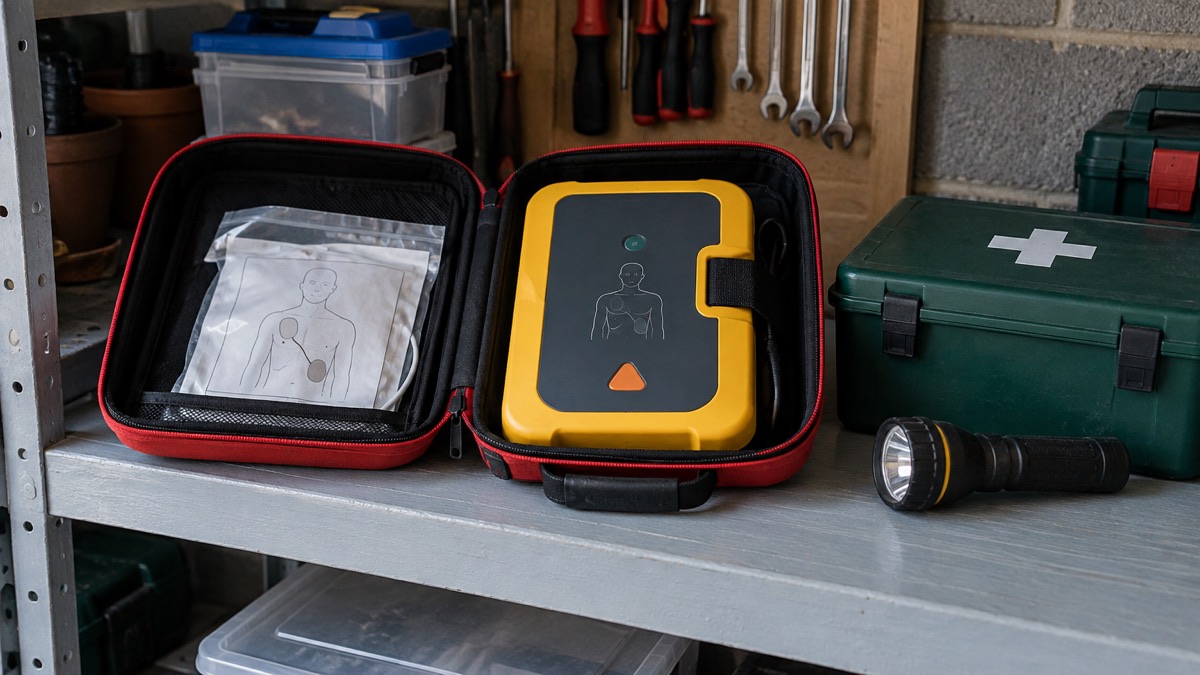
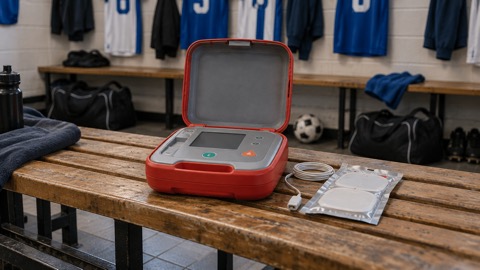
The ZOLL AED Plus is a semi-automatic defibrillator: a portable machine that analyses a heart rhythm during cardiac arrest and, if a shock is needed, tells the rescuer to press a flashing button. It is built for people with no medical training. The maker says it is designed to be user-friendly, with step-by-step instructions that guide even untrained rescuers through the process, using visual, voice and text prompts1.
What sets it apart from a basic defibrillator is its CPR feedback. Real CPR Help gives the rescuer real-time feedback on both the depth and the rate of chest compressions, so you know whether you are pushing hard enough and fast enough while you wait for the ambulance2. That matters because the figures the NHS gives are specific: press down hard and fast by 5 to 6cm on an adult's chest, at a rate of 100 to 120 compressions a minute3.
If you are thinking about one for a home, a club or a village, the practical questions are what it does, how it is powered, how long the pads and batteries last, and how to keep it ready. This page sets those out from the maker's own product information and from NHS ambulance service and Resuscitation Council UK guidance on defibrillators generally.
What the ZOLL AED Plus is and who can use it
An AED is for someone who is unresponsive and not breathing normally. The Resuscitation Council UK draws the line between the two types plainly: some AEDs, the fully automatic ones, will deliver a shock automatically, while semi-automatic AEDs require the rescuer to press the shock button6. The ZOLL AED Plus is the second kind. The Scottish Ambulance Service describes semi-automatic devices as prompting the user to press the shock button, and fully automatic ones as using a countdown or voice commands and delivering the shock without the user pressing anything5.
That distinction is the main thing to understand before you buy. With this device you are part of the loop: it analyses, it decides, it tells you, and you press. The maker's own step list puts it as: stand clear while the device analyses the heart, then, if a shock is advised, press the flashing Shock button1. The St John Ambulance advice for semi-automatic machines is the same: if a shock is needed, tell people to stand back, and the defibrillator will tell you when to press the shock button7.
Who is it for? The maker positions it for settings where a defibrillator needs to be found and fetched quickly, saying it should be placed in easily accessible, well-marked and visible locations that allow for immediate retrieval and use during a cardiac emergency1. In a household that means somewhere everyone knows about, not the back of a cupboard. For a club, a village hall or a workplace, it means a marked spot by the entrance.
You do not need training to use it, though training helps. The machine's prompts carry you through, and the feedback system is there precisely because compression quality varies. If you have never done CPR, read our guide to using a defibrillator without training and the steps in how to do CPR before you need them.
Semi-automatic: you press the shock button when told
The sequence on a semi-automatic AED is fixed, and the machine narrates it. The ZOLL AED Plus gives visual, voice and text prompts throughout1. The maker's step list runs: stand clear while the device analyses the heart, and if a shock is advised, press the flashing Shock button1. The St John Ambulance adds what happens next: after the shock has been given, the defibrillator will tell you to continue CPR for two minutes before it re-analyses7.
Two safety points sit inside that sequence. The first is hands off during analysis. The NHS advises: do not touch the casualty while the AED is analysing the heart's rhythm, because this interferes with readings and there is a risk of electric shock8. The second is the pause while the machine charges. The maker lists a pre-shock pause of 13 seconds for this model1, and a charge time of less than 10 seconds with new batteries1. Keep your hands off the casualty and let the machine do its work.
"Do not touch the casualty while the AED is analysing the heart's rhythm. This will interfere with readings and there's a risk of electric shock."
If you have a fully automatic defibrillator instead, there is no button: the St John Ambulance notes that some defibrillators are fully automated and have no shock button, and they warn you when they are going to shock, when they have delivered a shock, and when to continue chest compressions7. Our comparison of semi-automatic and fully automatic defibrillators sets the two side by side for a home or community setting.
Real CPR Help: live feedback on depth and rate
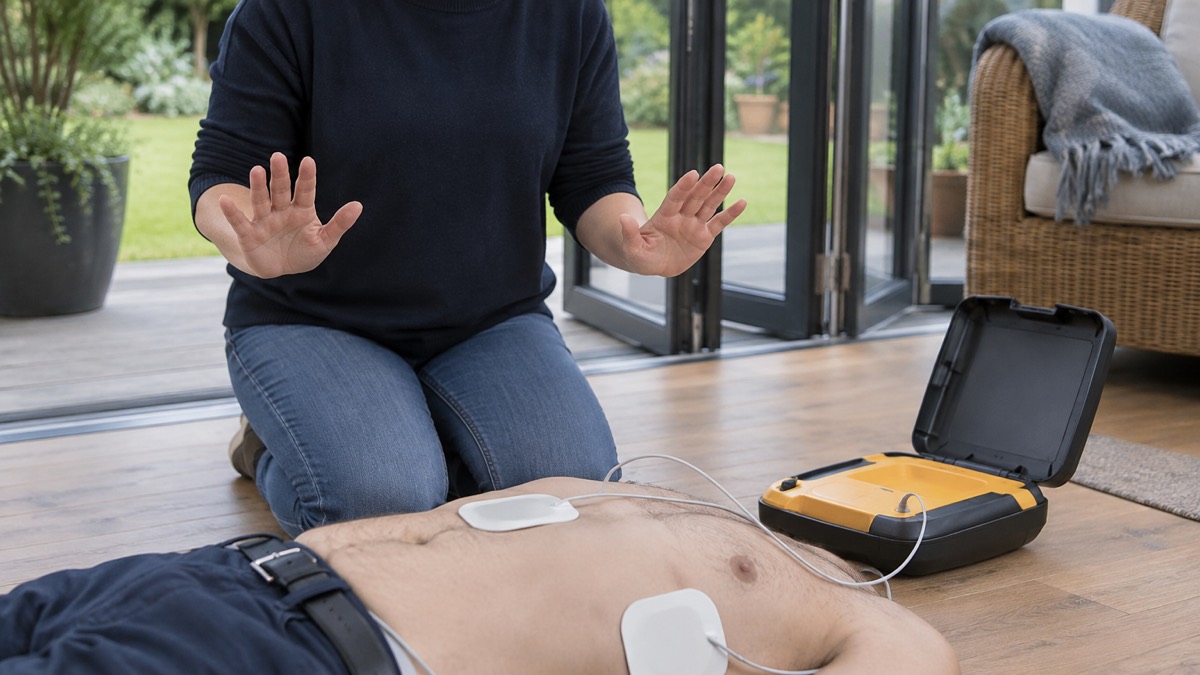
Most of what goes wrong in bystander CPR is depth and speed. Push too shallow and the heart is not squeezed enough; push too fast or too slow and the circulation suffers. The ZOLL AED Plus addresses this directly: the maker states it provides the responder with real-time feedback for both depth and rate of chest compressions, helping to provide the most effective CPR2, and lists Real CPR Help as its feedback system1.
The targets it is guiding you towards are the standard ones. The NHS says to press down hard and fast by 5 to 6cm on an adult's chest3, and to push at a rate of 100 to 120 per minute4. The Resuscitation Council UK gives the same rate, 100 to 120 per minute, in cycles of 30 compressions9. The maker lists the device's compression depth sensing range as 1.9 to 8.9 cm1, which covers the target band with room either side.
The feedback is not a substitute for the rest of the drill. The North West Ambulance Service advises repeating compressions at a rate of 100 to 120 times a minute, roughly two per second, until an ambulance arrives or for as long as you can10. If you are working with a child, the numbers differ and the pauses for breaths change the effective rate: the NHS notes that the actual number of compressions delivered will be fewer than 100 to 120 a minute because of the pauses to give breaths11. Our page on how fast and how deep chest compressions should be covers the adult and child figures together.
Specifications: 3.1 kg, IP55, -30°C to +60°C
The maker's datasheet gives the numbers that decide where the device can live and how it travels. Note that the weight is 3.1 kg, not the 3.8 kg sometimes quoted: the maker's own product page lists 6.7 lbs (3.1 kg)1.
| Specification | Maker's figure |
|---|---|
| Weight | 3.1 kg (6.7 lbs)1 |
| Size | 13.3 cm x 24.1 cm x 29.2 cm1 |
| Dust and water resistance | IP551 |
| Altitude tolerance | -300 to 15,000 ft (-91 m to 4,573 m)1 |
| Shock resistance | IEC 68-2-27; 100G1 |
| Vibration compliance | MIL Std. 810F, Min. Helicopter Test1 |
| Charge time | Less than 10 seconds with new batteries1 |
| Pre-shock pause | 13 seconds1 |
| Guidance | Visual, voice and text prompts1 |
| Connectivity | Event download via IrDA1 |
The IP55 rating is the maker's stated ingress protection figure for this unit1. That gap is exactly why outdoor cabinets are heated, as the next section explains.
Batteries: 10 lithium 123A cells, about 225 shocks
The ZOLL AED Plus runs on ten Duracell 123A lithium batteries, which the maker gives a five-year shelf life1. The maker lists the standby battery life as 5 years1. That is the figure that decides your replacement schedule: the cells sit in the device doing nothing until it is needed, and the machine's self-tests draw on them.
The Scottish Ambulance Service gives the general picture for AED batteries and pads: they will have a long shelf life of between 2 and 5 years depending on the AED model5. For this model the maker's figure is at the top of that range, five years for both the standby battery life and the adult pad shelf life1.
What you should do with those figures:
- Write the dates down. Record when the batteries and pads were fitted and when they fall due, and check them against the device's own self-test indicators.
- Keep spares if the device is critical to your setting. The Scottish Ambulance Service notes that pads and items like scissors and razors are single use and must be replaced before the AED can be response ready again5.
- Do not rely on memory. The Northern Ireland Ambulance Service lists the pads expiry date as a required detail when a defibrillator is registered12, which is a useful prompt to keep it visible on the device or in your log.
Our page on how long defibrillator batteries and pads last covers the general replacement cycle across models.
Pads and batteries last up to 5 years in storage
Storage life is the quiet specification that decides whether a defibrillator is ready when someone needs it. The maker gives the adult CPR-D-Padz a 5-year shelf life and the standby battery life as 5 years1. The Scottish Ambulance Service's general guidance is that batteries and pads have a shelf life of between 2 and 5 years depending on the model5.
The Resuscitation Council UK sets a floor for publicly accessible defibrillators: the shelf life of the compatible self-adhesive pads must be a minimum of two years from the date of supply, and the pads must have the ability to be pre-connected13. The ZOLL AED Plus's five-year pad life sits comfortably above that minimum1.
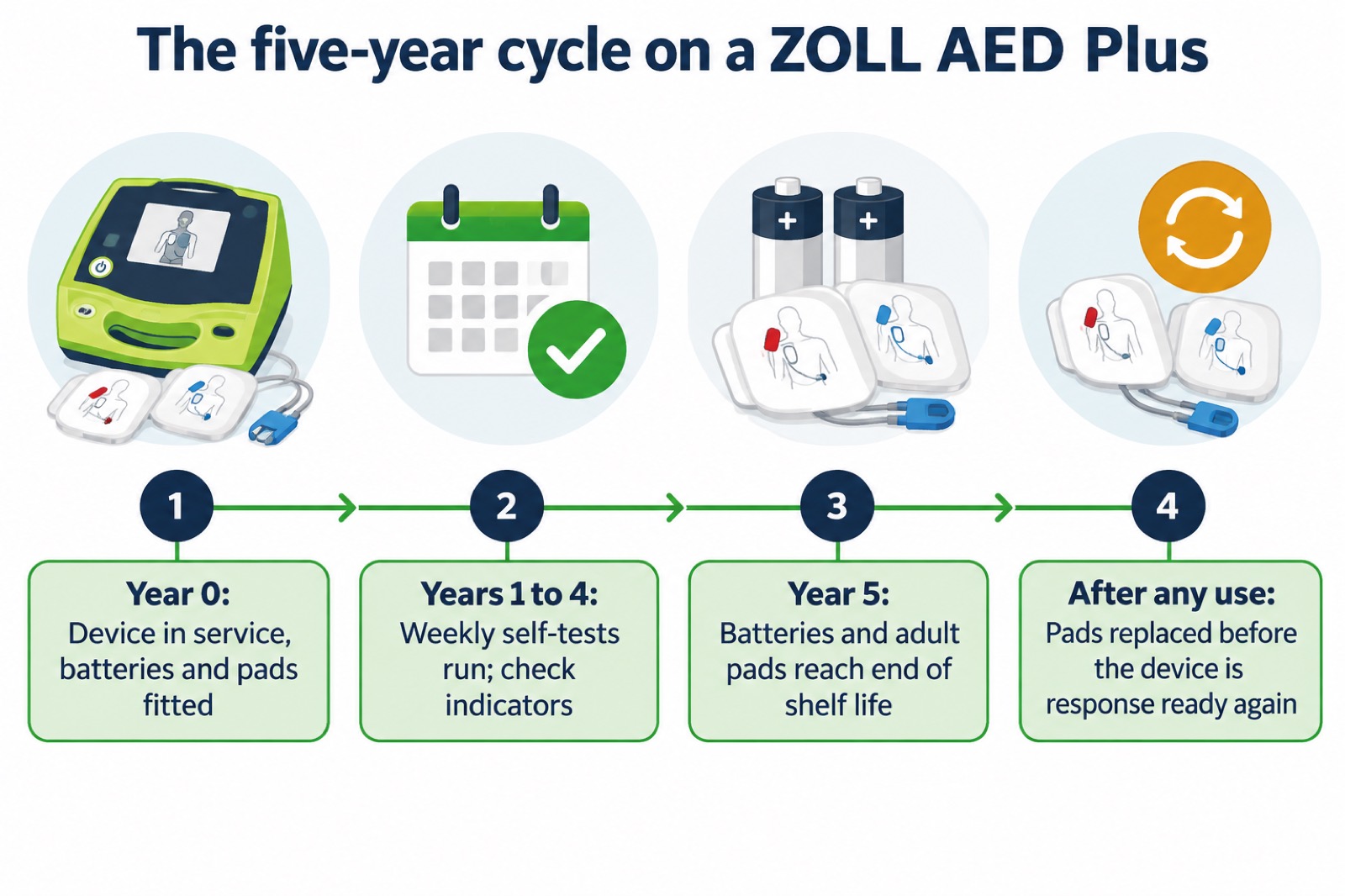
Two habits keep the cycle honest. The first is checking the device's status indicator, which reflects the weekly default self-test the maker lists1. The second is replacing single-use items after any use, because the Scottish Ambulance Service is clear that pads, scissors and razors are single use and must be replaced before the AED can be response ready again5. Our defibrillator guardian checklist turns this into a routine.
Using it on a child needs separate paediatric pads
The ZOLL AED Plus can be used on a child, but not with the adult pads alone if you have the choice. The maker lists a paediatric rescue mode with a child-specific analysis and therapy algorithm that requires paediatric pads, and states that paediatric patients under 8 years old or under 25kg use Pedi-Padz II1.
The general guidance explains why. The Scottish Ambulance Service says AEDs are safe to use on children, and that paediatric pads or programmes typically decrease the output of the machine to 50-75 joules, recommended for children between 1 and 8 years old5. The Resuscitation Council UK adds that adult pads and energy can be safely used on a child if this is the only resource available, but care should be taken to ensure the pads are not in contact with each other when delivering a shock13.
If you are using adult pads on an infant or smaller child, the St John Ambulance advises positioning one pad in the middle of the chest and the second on their back, between the shoulder blades7. The North West Ambulance Service's summary is the same: if possible, use an AED with a paediatric attenuator for children below eight years old; if this is not available, use the standard AED for all ages15.
Our page on using a defibrillator on a child or baby covers pad placement and the age limits in more detail.
Self-tests, rescue data and the 7-year warranty
The ZOLL AED Plus looks after itself between emergencies to a point. The maker lists a weekly default self-test1, which is the routine check that tells you the batteries and circuitry are sound without you doing anything. What it cannot do is tell you the pads are in date or that the cabinet is working, so those remain your job.
The device also records what happened. The maker lists 7 hours of ECG and CPR data, plus 20 minutes of audio if enabled, with event download via IrDA1. That data is useful after an incident, for the ambulance service and for your own records, and it is one reason to keep the device registered and its details up to date.
Registration matters in two ways. The British Heart Foundation runs The Circuit, the national defibrillator network, in partnership with the Association of Ambulance Chief Executives, Resuscitation Council UK, St John Ambulance and NHS England16, and the North West Ambulance Service describes it as a system managed by the British Heart Foundation17. Registering your defibrillator is how the ambulance service knows it is there. Separately, the maker states the device comes with a 7-year warranty, standard five years extended to seven when you register it with ZOLL1. The maker also offers support including tracking the expiration dates of pads and batteries, responder training and AED certification management1.
Storing it outdoors in a cabinet
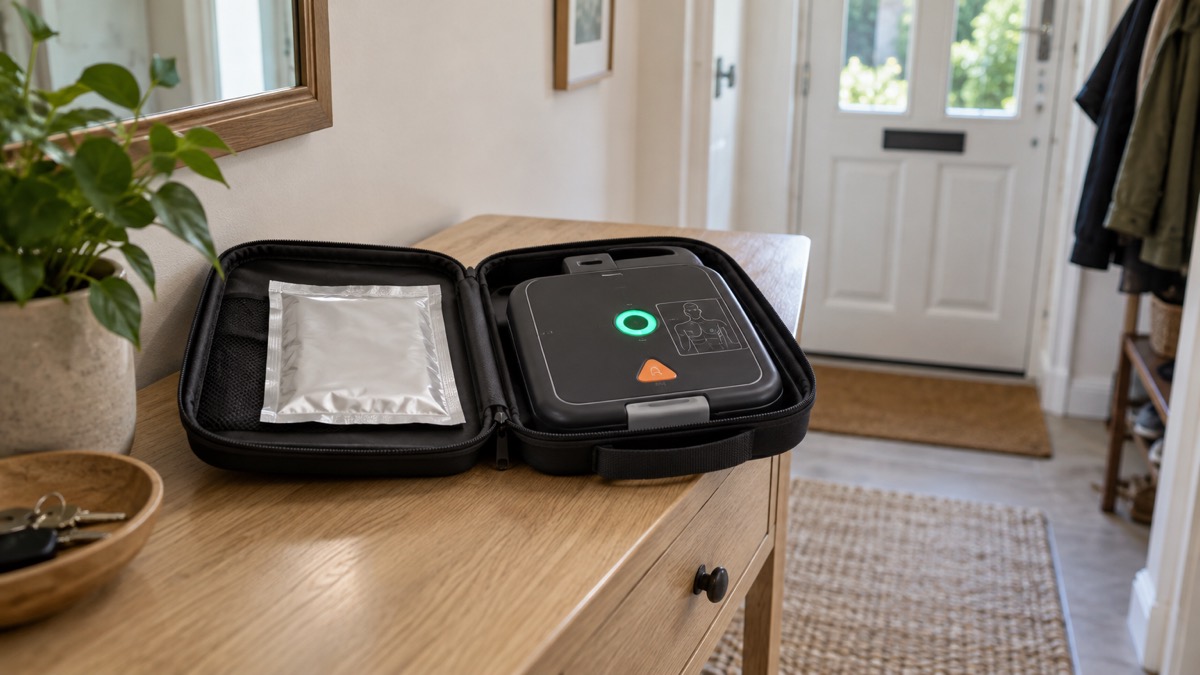
An outdoor cabinet is the difference between a defibrillator that is available at 3am and one that is locked in a hall. The Northern Ireland Ambulance Service advises that AEDs stored in visible, secure cabinets are accessible 24/7 and protected from weather and vandalism12. The Scottish Ambulance Service recommends an unlocked outdoor cabinet so that the defibrillator is easy to get in an emergency1.
Temperature is the part people miss. The Scottish Ambulance Service states that external locations need a cabinet with an integrated heating unit to prevent damage to the device and battery from cold or heat exposure5, and that outdoor AED cabinets should be temperature-controlled to keep the device within its recommended range, preserving battery life and optimal function1. The Resuscitation Council UK adds that a defibrillator kept outside needs to be inside a protective cabinet, that the cabinet requires a domestic power supply for its heating element, and that the cabinet should be weatherproof13.
A retailer package pairs this defibrillator with an unlocked outdoor cabinet in yellow, also available in green2, but check the cabinet's heating specification against the ambulance service advice before you rely on it.
Our comparison of indoor and outdoor defibrillator cabinets covers the choice in full, and public access defibrillators explains how to register and publicise one.
Where to get help and what to do next
If someone is unresponsive and not breathing normally, ring 999 and start CPR. The ambulance call handler can tell you where the nearest defibrillator is, and The Circuit is the network behind that: the British Heart Foundation runs it with the Association of Ambulance Chief Executives, Resuscitation Council UK, St John Ambulance and NHS England16, and it is managed by the British Heart Foundation17. The Northern Ireland Ambulance Service lists the pads expiry date among the details needed to register a defibrillator12, so have it to hand.
For a household thinking of buying one, the sequence is: decide where it will live and who will check it, confirm the cabinet and its power supply if it is going outside, and register it. Our guide to choosing a defibrillator for a home, club or village sets out the decision, and defibrillators (AEDs): what they do and how to use one covers the drill itself. If you want to compare this model with others by what they do rather than by brand, the HeartSine samaritan PAD 350P, the LIFEPAK CR2, the ZOLL AED 3, the Cardiac Science Powerheart G5 and the Philips HeartStart FRx each have their own page.
Sources (17)
- ZOLL AED Plus Semi Automatic Defibrillator, Steroplast, 2026-10-29
- ZOLL AED Plus Semi-Automatic Defibrillator and Unlocked Outdoor Cabinet, Defib Store, 2026-10-29
- How to Give an Adult CPR, NHS inform, 2026-09-08
- CPR, NHS, 2026-10-29
- PAD Information Pack, South Central Ambulance Service, 2026-08
- Adult Basic Life Support Guidelines, Resuscitation Council UK, 2025
- How to Use a Defibrillator, St John Ambulance, 2026-10-28
- How to Use an AED, NHS inform, 2026-09-28
- Public Access Defibrillators: A Guide for Communities, Resuscitation Council UK, 2025-10
- How to Do CPR, North West Ambulance Service, 2025-03-13
- How to Resuscitate a Child, NHS, 2026-05-21
- AED, Northern Ireland Ambulance Service, 2026-10-29
- AED Guide, Resuscitation Council UK, 2026
- Improving Outcomes in Cardiac Arrest: Tools and Resources, NHS England, 2026-10-29
- What to Do When Someone Isn't Breathing, North West Ambulance Service, 2025-03-13
- The Circuit: The New Defibrillator Database, North West Ambulance Service, 2025-07-10
- Purchasing a Public Access Defibrillator, Scottish Ambulance Service, 2026-10-29
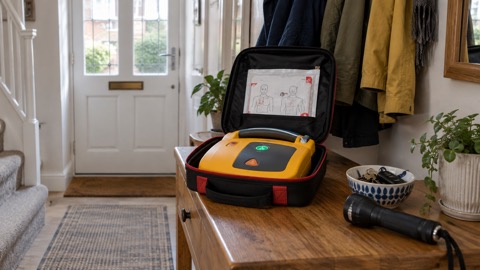 HeartSine samaritan PAD 350P
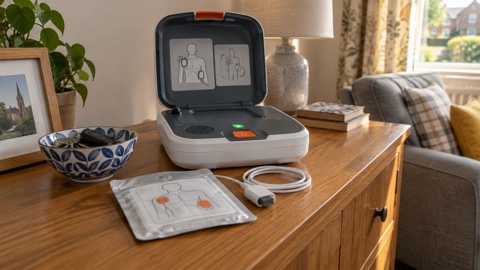 Stryker LIFEPAK CR2
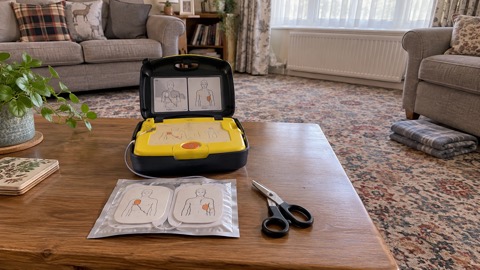 ZOLL AED 3 Defibrillator
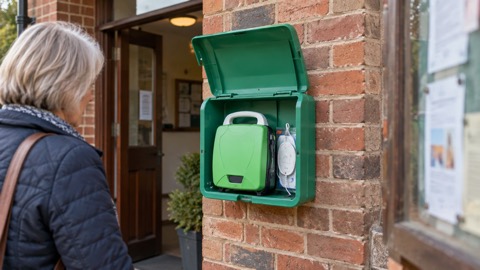 Cardiac Science Powerheart G5
 Philips HeartStart FRx AED