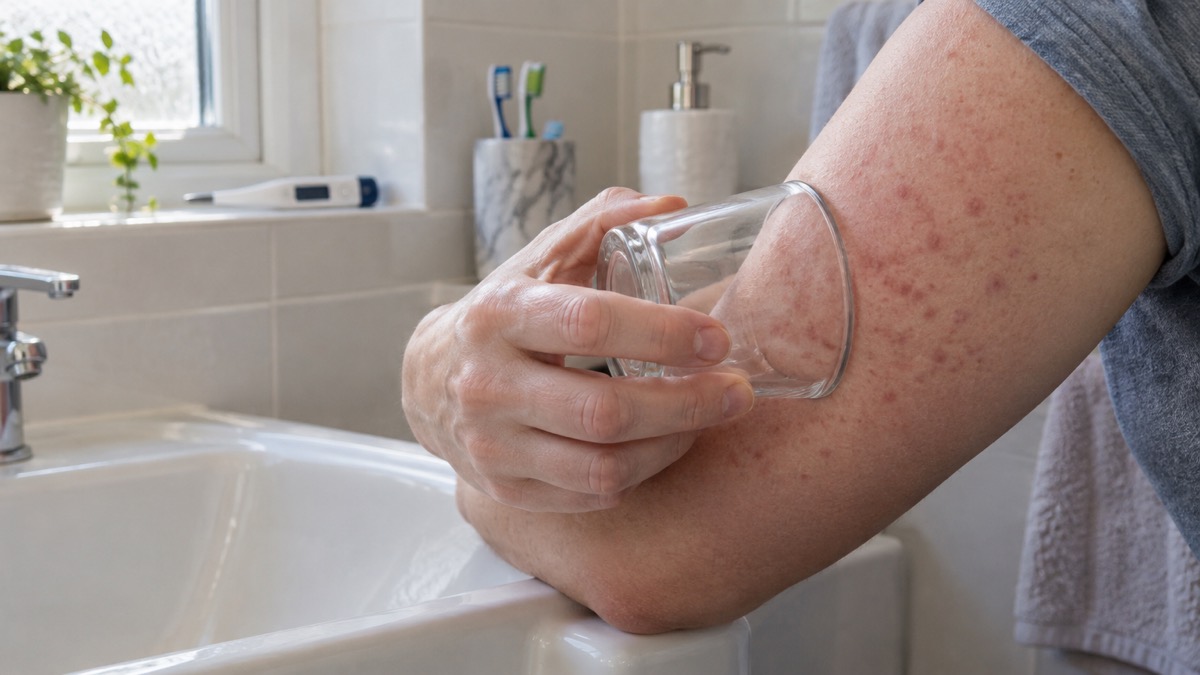
If you suspect meningitis or meningococcal disease in anyone in your household, call 999 or 112 straight away, or go to the emergency department of your nearest hospital. Meningitis and the blood poisoning that often comes with it, septicaemia, can come on suddenly, progress very quickly, and kill in hours1. Every minute matters, and the advice from every official body in the UK is the same: do not sit and watch, and do not wait to be sure.
Meningococcal disease is an infection that can lead to meningitis, which is inflammation of the lining of the brain, and sepsis, which is blood poisoning2. The onset can be sudden, which is why knowing the signs and symptoms, and acting quickly, matters so much2. This page sets out what to look for in adults, teenagers, children and babies, what to do while you wait for help, and how vaccination protects your household.
Do not wait for a rash, or for every symptom to appear
The single most important thing to understand about meningitis is that the famous rash is not a starting signal. Public Health Wales is blunt about it: "Do not wait for a rash" and "Not everyone gets this rash"1. Meningitis Now says the same: "You should never wait for a rash, it can be a late sign or may not appear at all"4. The rash usually starts as small spots but quickly becomes deep purple patches1, so by the time it is obvious, valuable time has already been lost.
The same applies to the full list of symptoms. Not everyone gets all the meningitis and sepsis symptoms, and they can appear in any order5. In babies and toddlers, symptoms can appear in any order and some may not appear at all4. Someone can have meningitis with only two or three of the signs listed on this page, and they can still be dangerously ill.
If your baby or toddler is ill and getting worse, get medical help immediately and go to the emergency department of your nearest hospital1. If you are seriously worried about someone who is ill, do not wait for a rash to appear: get medical help5. Trust your instincts, as Meningitis Now puts it, and get medical help immediately4. Parents and carers know their own family, and a child who is simply not themselves in an unusual way is a child worth having looked at.
The glass test
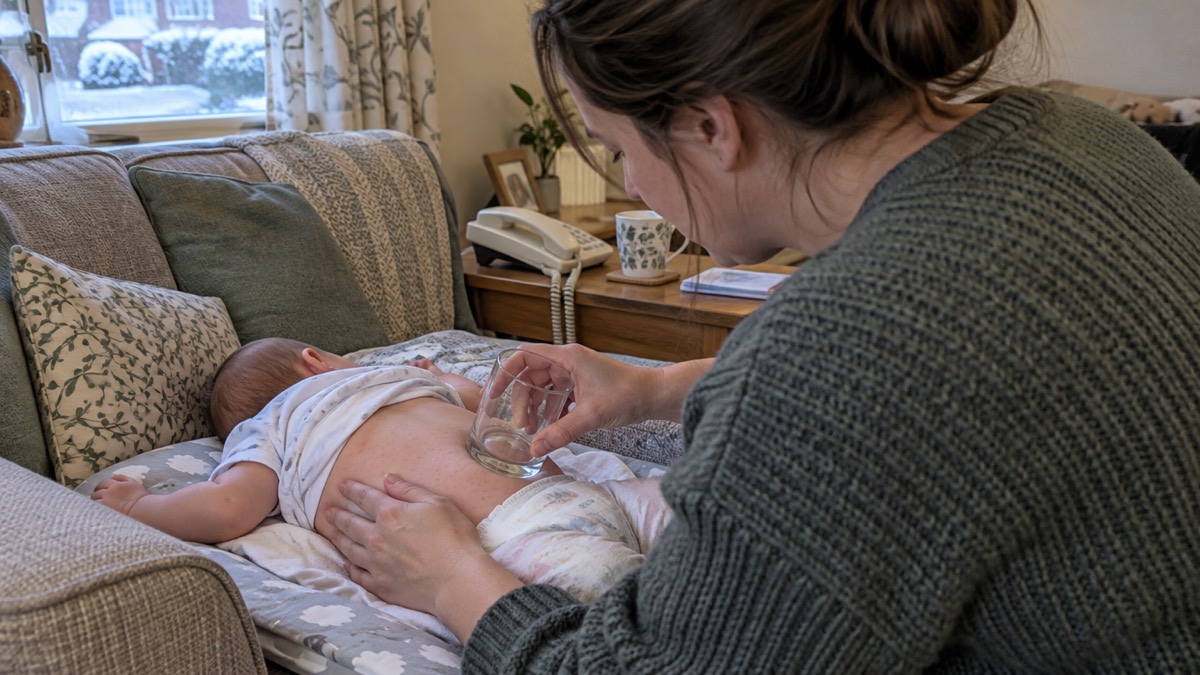
The glass test is the standard check for the meningococcal rash. Press the side of a clear glass firmly against the skin. Fever with spots or a rash that do not fade under pressure is a medical emergency1. Meningitis Now describes it as the tumbler test: "Press a clear glass tumbler firmly against the rash. If you can see the marks clearly through the glass get urgent medical help immediately"5.
Two things to keep in mind. First, on dark skin the spots or rash can be more difficult to see1, so check carefully and do not rule anything out because you cannot see a rash. Second, a rash that does fade when pressed with a clear glass is classed as a medium-risk sign rather than an emergency one, but if you are worried about a child who has it alongside other symptoms, call NHS 111 or your doctor without delay5. A rash that does not fade when you roll a glass over it is listed as a sepsis symptom in both adults and children, the same as meningitis6. Our page on how to do the glass test for a meningitis rash goes through the steps in detail.
Early signs: fever, vomiting, headache and feeling unwell
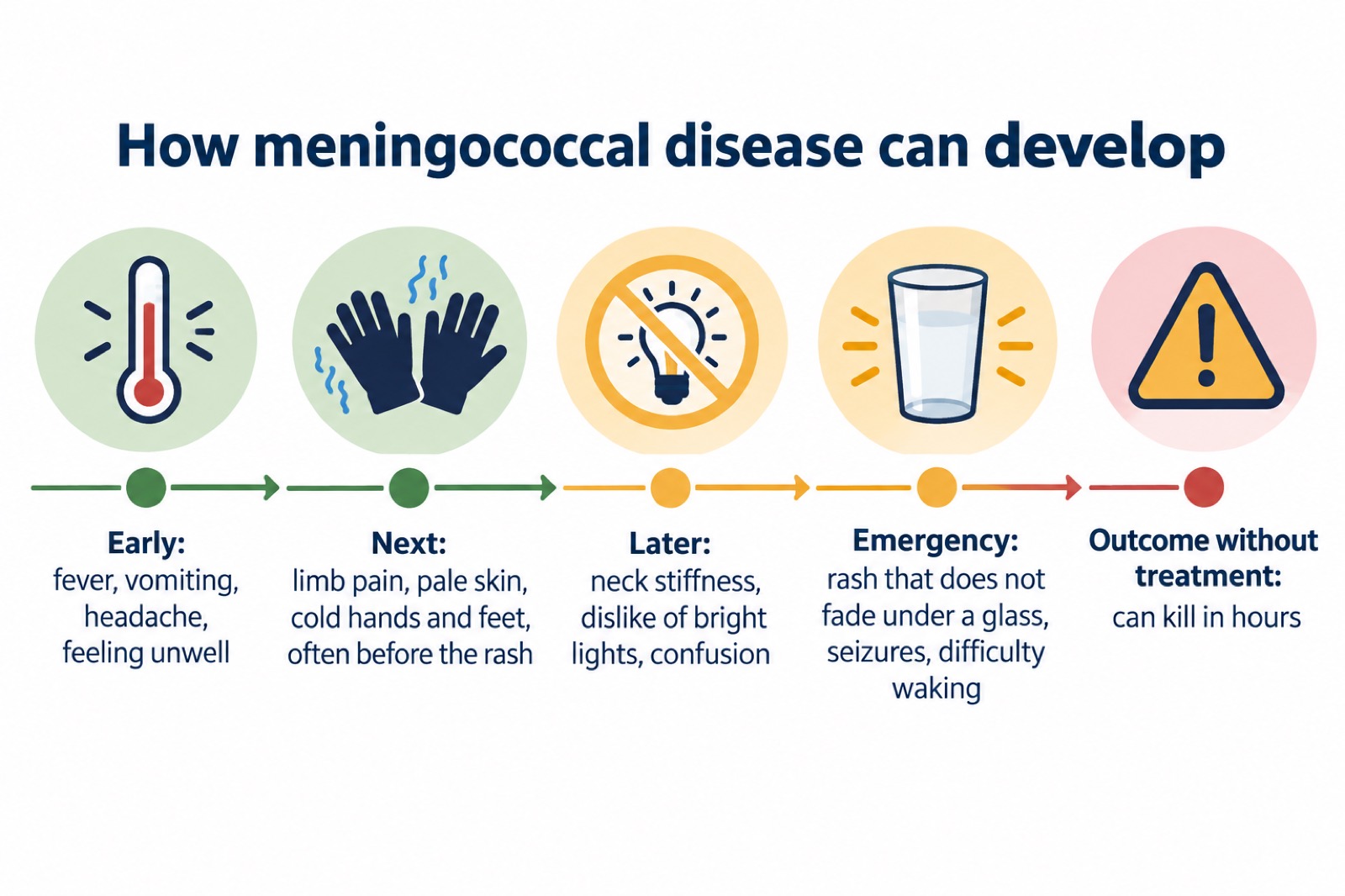
The first symptoms of meningitis and sepsis are usually fever, vomiting, headache and feeling unwell5. These are also the symptoms of a dozen ordinary winter illnesses, which is exactly why meningitis is hard to catch early. What separates it is the company these symptoms keep, and how fast they move. Limb pain, pale skin, and cold hands and feet often appear earlier than the rash, neck stiffness, dislike of bright lights and confusion5.
Because meningococcal disease often shows up first as sepsis, it helps to know the early sepsis signs too. In older children and adults, early symptoms of sepsis may include a high temperature (fever) or low body temperature, chills and shivering, a fast heartbeat, and fast breathing7. The Scottish Ambulance Service lists very high or low temperature, uncontrolled shivering, confusion, cold or blotchy hands, and not passing as much urine among its sepsis warning signs8.
In adults, sepsis symptoms that mean you should call 999 include confusion or slurred speech, uncontrollable shivering, muscle pain, difficulty breathing, blue, pale, grey or blotchy skin, lips or tongue, a high or low temperature, and not peeing all day or peeing very little in the past 18 hours9. If you or anyone else have any of these symptoms, call 999 or go to A&E and ask if it could be sepsis3.
Symptoms in adults and teenagers
In adults and older children, the meningitis symptoms to watch for are fever and vomiting, a severe headache, a stiff neck, dislike of bright lights, being very sleepy, vacant or difficult to wake, confusion or delirium, and seizures (fits)5. A stiff neck and dislike of bright lights are less common in young children5, so their absence in a child does not rule anything out.
A UK Health Security Agency outbreak notice lists the full picture of meningococcal disease in one place: a rash that does not fade when pressed with a glass, sudden onset of high fever, severe and worsening headache, stiff neck, vomiting and diarrhoea, joint and muscle pain, dislike of bright lights, very cold hands and feet, seizures, confusion or delirium, and extreme sleepiness or difficulty waking2. The key word there is "worsening": a headache that is getting worse over hours, not one that has settled, is the pattern that needs urgent attention.
Teenagers deserve particular attention in any household. There is a smaller second peak in meningococcal disease cases among teenagers aged 15 to 19 years1, and teenagers are also the group most likely to brush off feeling rough. If a teenager in your house has fever with a worsening headache, or is unusually sleepy or confused, treat it the same way you would in a toddler: get medical help immediately.
| Symptom | Adults and teenagers | Babies and toddlers |
|---|---|---|
| Fever | Common, sudden onset | Common, but very young babies may have a normal or low temperature1 |
| Headache | Severe and worsening2 | Cannot say, but may be fretful and dislike being handled4 |
| Rash | Does not fade under a glass2 | Spots or rash, harder to see on dark skin1 |
| Neck and light | Stiff neck, dislike of bright lights5 | Stiff neck, dislike of bright lights4 |
| Alertness | Very sleepy, vacant, difficult to wake, confused5 | Drowsy, floppy, unresponsive4 |
| Other | Vomiting, joint and muscle pain, cold hands and feet, seizures2 | Refusing food, unusual cry, rapid breathing or grunting, tense bulging fontanelle, convulsions4 |
Signs in babies and toddlers, including a bulging fontanelle
Babies and toddlers show meningitis differently, and the list of signs is longer because they cannot tell you what hurts. Meningitis Now lists the symptoms for this age group as: fever with cold hands and feet, refusing food and vomiting, being fretful and disliking being handled, drowsy, floppy or unresponsive, rapid breathing or grunting, pale blotchy skin with spots or a rash, an unusual cry or moaning, a tense bulging fontanelle, stiff neck and dislike of bright lights, and convulsions or seizures4.
The fontanelle is the soft spot on the top of a baby's head. A tense, bulging fontanelle is one of the baby-specific signs of meningitis4. Note that it works one way only: a sunken soft spot is listed by the NHS as a sign of dehydration in a baby, alongside few or no tears when crying, fewer wet nappies than usual, and drowsiness or irritability11. A sunken fontanelle is not a meningitis sign, but it still means a baby needs assessing, so either way you are seeking medical help.
Babies and children under five with sepsis may also not be interested in feeding, or may keep being sick9. They may not have all these symptoms6, so a baby who has only one or two of these signs and is clearly not right still needs to be seen.
Very young babies may not have a fever
This is the trap that catches families. Very young babies may not have fever: their temperature could be normal or low1. A normal thermometer reading in a young baby who is floppy, refusing feeds, or grunting does not rule out meningitis or sepsis. If you are using a thermometer at home, read our guide to thermometers for checking a fever, but treat the reading as one piece of information, never the deciding one.
Meningitis Now flags that young infants are particularly vulnerable to serious infection, and says to seek urgent medical help if a baby under eight weeks old has a combination of any of the following, with or without a fever: persistent refusal to feed, being lethargic or excessively sleepy, irritable, a stiff or floppy body, a weak, high-pitched or continuous cry, grunting, or a bulging soft spot5. For babies this young, the bar for calling for help should be low.
Someone with meningitis can get worse very quickly, so keep checking them
Meningitis and sepsis can come on suddenly, progress very quickly, kill in hours, and leave survivors with serious health problems or lifelong disabilities including brain or nerve damage, deafness, blindness or epilepsy1. That is not said to frighten anyone: it is the reason the advice is to act on suspicion rather than certainty, and to keep checking someone who is unwell rather than leaving them to sleep it off.
If symptoms worsen quickly or you feel very unwell, seek medical help promptly12. In practice this means checking a sick person regularly, including through the night, and looking for the direction of travel as much as the symptoms themselves. A child who had a fever and a headache at teatime and who is now hard to wake has changed for the worse, and that change is itself the emergency sign. Someone who seemed mildly unwell two hours ago and now has cold hands and feet, pale or blotchy skin, and is confused has moved from "keep an eye" to "call 999".
If you have already sought medical help and the person is sent home or you are waiting, keep checking them, and go back or call again if they deteriorate. You are not being a nuisance. The NHS advice on sepsis is to call 111 if you or your child have had sepsis in the past 12 months and have symptoms of an infection, such as a very high temperature, or feeling hot, cold or shivery9, because a previous episode raises the stakes.
Who is most at risk: babies under one and teenagers aged 15 to 19
Meningococcal disease is most common in babies under one year old, with a smaller second peak among teenagers aged 15 to 19 years1. Those are the two ages where a household's vigilance should be highest, but the disease can affect anyone.
The reason babies are more at risk is their immune systems. Babies and young children are particularly vulnerable to meningitis because they cannot easily fight infection, as their immune system is not yet fully developed4. Public Health Wales says the same: young children's immune systems are not yet fully developed to fight off infection10. This is also why babies are offered the MenB vaccine10.
There are multiple strains of meningococcal bacteria: MenA, MenB, MenC, MenW, MenX and MenY2. The vaccines in the UK routine programme cover the strains that most commonly cause disease here. If someone in your household falls into a higher-risk group generally, our page on people at higher risk in an outbreak has wider advice on protecting vulnerable relatives.
Vaccines that protect against meningococcal disease
Meningococcal vaccines work very well, and they are the best way to protect against meningitis and sepsis1. The two your household will meet in the routine programme are MenB and MenACWY.
The MenB vaccine is designed to protect against most meningococcal disease due to MenB bacteria1. It was introduced in 2015, and cases of meningococcal disease in young children fell by over 60 per cent by the third year of the vaccination programme1. Babies get their MenB vaccinations when they are offered10, which follows from the fact that the disease is most common in babies under one10.
Teenagers get their MenACWY vaccination in school1, timed to the second peak in cases among 15 to 19 year olds. If your child has missed a school vaccination session, contact your GP practice to catch up. Vaccinations are safe and effective at protecting people from infectious diseases, and some people are more at risk of becoming seriously ill from infectious diseases than others13. Our wider page on vaccines that protect against outbreaks covers the rest of the routine and travel programme.
| Vaccine | Who gets it | What it protects against |
|---|---|---|
| MenB | Babies, offered in infancy10 | Most meningococcal disease due to MenB bacteria1 |
| MenACWY | Teenagers, given in school1 | MenA, MenC, MenW and MenY strains |
How meningococcal bacteria spread within a household
The bacteria can pass from person to person through close contact, for example coughing or sneezing within a household1. Public Health Wales is specific: people living in the same household can spread MenB bacteria to other people through coughing or sneezing10. This is why, when a case of meningococcal disease is confirmed, health protection teams pay close attention to household members, and it is why a case in one family member means the rest of the household should follow the advice given by the health team rather than assuming everyone else is fine.
The practical steps are the ones that limit any infection spread at home: covering coughs and sneezes, washing hands, ventilating shared rooms, and not sharing cups, towels and bedding while someone is ill. Our pages on stopping infections spreading at home and staying at home when ill set these out in full.
If you have questions after a case in your family or community, you can call NHS 111 or your GP practice for advice10, and the Meningitis Now helpline is available on 0808 80 10 3881. During a local outbreak, follow the advice issued by the UK Health Security Agency and your local health protection team; our page on infectious disease outbreaks near you explains how that works.
Where to get help, and in what order
The order to remember is this. Call 999 or 112, or go straight to A&E, if you suspect meningitis or sepsis, if symptoms are progressing quickly, or if there is a rash that does not fade under pressure1. Go to the emergency department of your nearest hospital if your baby or toddler is ill and getting worse1. Call NHS 111 or your GP practice for advice if you have questions about meningitis, or if someone is unwell but does not have the emergency signs10. If you are worried about a child with medium-risk symptoms, such as a rash that does fade under a glass, call NHS 111 or your doctor without delay5.
NHS 111 is the free number to call when you need medical help fast but it is not an emergency14. If you are unsure whether it is a 999 situation, our page on when to call 111 and when to call 999 works through the decision, and NHS 111: what it can help with explains the service. For wider preparation for health emergencies in your household, start with our health emergencies guide.
Sources (14)
- Meningitis and meningococcal disease, Public Health Wales, 2026
- UKHSA meningitis B outbreak: what you need to know, Wiltshire and Swindon Prepared, 2026
- Recognising sepsis, Bradford District Care NHS Foundation Trust, 2026
- Signs and symptoms in babies and toddlers, Meningitis Now, 2026
- Meningitis symptoms, Meningitis Research Foundation, 2026
- Sepsis symptoms, NHS 111 Wales, 2026
- Sepsis, NHS inform Scotland, 2026
- Identifying sepsis, Scottish Ambulance Service, 2026
- Sepsis, NHS, 2026
- Meningitis, Public Health Wales, 2026
- Dehydration, NHS, 2026
- Take care of yourself this winter, Staffordshire County Council, 2026
- Looking after your health in winter, Cumberland Council, 2026
- Are You Ready booklet, Culham Parish Council, 2025
 Medicine Cabinet Checklist
 Sick at Home Supplies Kit
 Caring for Someone Ill at Home
 Pandemics and UK Household Plans
 Outbreaks Near You
 UK Health Security Agency
 Staying Home When Ill
 Stopping Infections at Home
 Caring for a Sick Person at Home
 Keeping Prescription Medicine
 Medicine Shortages Explained
 Storing Medicines Safely
 Urgent Care and A&E
 Vaccines Against Outbreaks
 Flu Symptoms and Getting Help